Home · The Ordane Journal · Pricing and cost · Prop Firms For Futures
Prop Firms For Futures
Prop firms for futures supply traders with simulated capital in exchange for an upfront fee. This model allows individuals to operate in a simulated environment governed by strict risk rules, without risking personal funds. Traders who follow these documented constraints qualify for performance-based payouts paid from the firm's fee revenue.
Ordane accounts operate on simulated capital. No live funds are traded and no deposits are accepted. (Ordane Rulebook v1.0, clause P-2, retrieved 2026-08-04)
Payouts depend on simulated performance under Rulebook v1.3; no level of performance is typical or assured.
What Are Prop Firms For Futures?
The core model is straightforward: a trader pays a fee to access a simulated environment. Managing the simulated capital according to documented rules qualifies the trader for payouts based on performance. The industry relies on this structure to manage exposure and filter participants.
Traders encounter two primary access models. Most firms use either challenge/evaluation accounts or instant funding with stricter risk rules (Prop Firm Rules Explained, retrieved 2026-09-29). The evaluation model requires hitting specific profit targets across phases before requesting a payout. The instant access model removes profit targets, allowing payout requests based on performance from day one, provided drawdown limits are respected.
Evaluation accounts feature lower fees but require significant time to pass testing phases. Instant access accounts carry a higher initial cost but remove the time pressure of an evaluation, accelerating the timeline to a potential withdrawal.
Ordane sells one product, the Ordane Instant Account: direct access, no evaluation phase and no challenge, on simulated capital. (Ordane Rulebook v1.0, section 1, retrieved 2026-08-04) The focus is entirely on managing risk from the start. This structure demands strict adherence but provides immediate clarity on the payout path. Understanding the specific model is critical when evaluating options.
Documented Rules for Futures Trading
Every prop firm enforces rules to protect simulated capital, typically involving drawdown limits, daily loss limits, and prohibited practices. Traders must read the rulebook carefully because a breach results in immediate account closure.
Drawdown rules dictate allowable simulated losses. Some firms use a trailing drawdown, which moves up as the balance increases, shrinking the buffer as the trader generates profit. Other firms use a static floor, providing a fixed buffer that never changes, offering a more stable risk parameter.
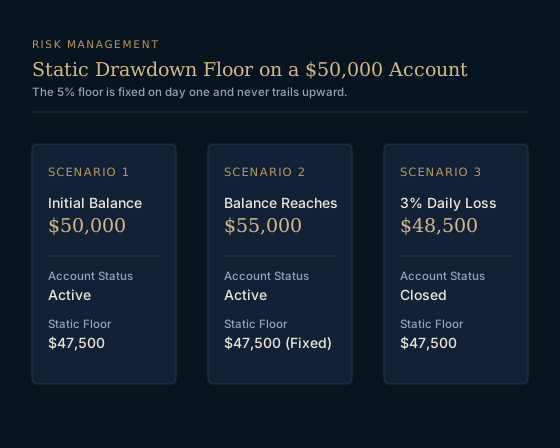
Ordane's maximum drawdown is 5 percent and static: account equity may never fall below 95 percent of the initial balance. The floor is fixed on day one, never trails upward, and a breach closes the account. (Ordane Rulebook v1.0, clause R-1, retrieved 2026-08-04) This removes the moving target common in trailing drawdown models. On a $50,000 account, that static floor sits at $47,500 from the first minute. A trader who ends a difficult first week near $48,500 still holds most of the original buffer, because the floor has not moved. Even after a strong run pushes equity to $55,000, the limit continues to measure against the initial balance rather than the peak, so profits widen the cushion instead of eroding it.
The daily loss limit is 3 percent, measured against the balance at the start of the server day. A breach closes the account. (Ordane Rulebook v1.0, clause R-2, retrieved 2026-08-04) This rule prevents a trader from suffering catastrophic losses in a single session, forcing disciplined execution.
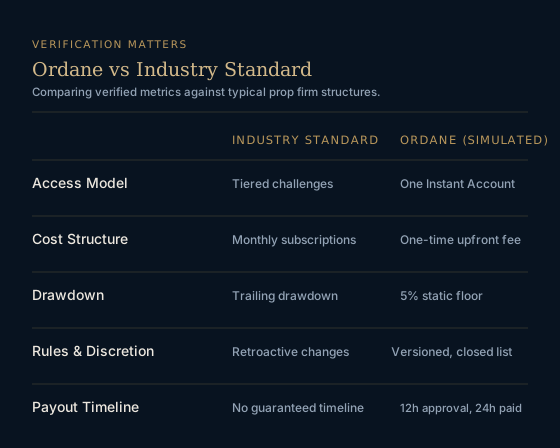
| Metric/Feature | Ordane (Simulated) | Industry Standard |
|---|---|---|
| Evaluation Phase | Direct access, no evaluation phase | Most firms use challenge/evaluation accounts |
| Typical Cost Structure | One-time fee, $59 for the $2,500 account | Monthly subscriptions like Topstep's $49/month |
| Profit Split | 80 percent base, scaling to 100 percent | Traders typically keep 70-90% of profits |
| Account Drawdown | 5 percent static floor | Trailing drawdowns are common |
Many firms ban specific trading styles, such as high-frequency trading or news straddling, to prevent exploitation. Violating a rule closes the account and cancels pending payouts. The rules must be public, numbered and versioned. The version you sign up under governs your account, and changes should never apply retroactively, ensuring the trader knows their exact boundaries.
Costs and Account Structures
Fees cover the platform, data feeds, and administrative overhead, varying by account size, access model, and pricing strategy.
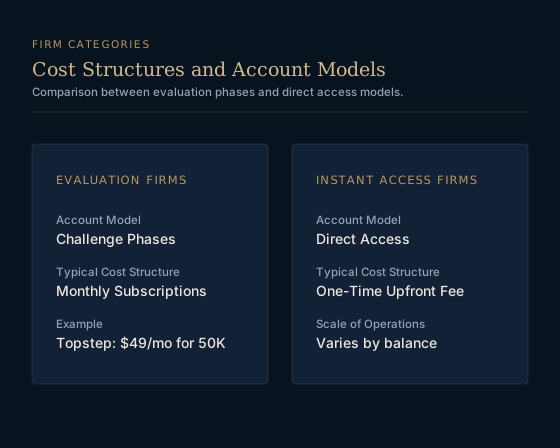
Some firms require monthly subscriptions for their evaluation accounts. This recurring fee applies until the trader passes or cancels, creating time pressure. Other firms offer a vast range of account sizes to accommodate different capital requirements. Apex Trader Funding (prop firm) offers evaluations from $25K to $300K accounts (Apex Trader Funding, retrieved 2026-09-29). Larger accounts carry higher fees and larger potential simulated profit buffers.
Instant access models typically charge a single upfront fee. The fee is one-time: $59 for the $2,500 account, $139 for the $10,000 account, $299 for the $25,000 account, $549 for the $50,000 account, $999 for the $100,000 account. There are no recurring fees, no hidden tiers and no charge to withdraw. (Ordane Rulebook v1.0, section 1, retrieved 2026-08-04) This transparency lets traders calculate their exact financial commitment upfront, avoiding unexpected charges.
Resetting an account after a breach is another cost. Subscription models often require an additional reset fee. With one-time fee models, a breach closes the account, requiring a new purchase. The absence of hidden fees simplifies the process, allowing focus on strategy execution.
To illustrate the cost difference over time, consider a trader operating a $50,000 simulated account over three months.
| Scenario: 3 Months Trading a $50K Account | Upfront Cost | Recurring Fees (3 Months) | Total Cost Incurred |
|---|---|---|---|
| Ordane Instant Account | $549 one-time fee | $0 | $549 |
| Topstep 50K Trading Combine | $49 first month | $98 (two additional months) | $147 |
The structure of the cost directly impacts the trader's runway and overall profitability.
How Do Payouts Work in the Industry?
The payout mechanism is critical. The premise relies on the firm honoring its commitment to pay the trader a share of the simulated profits. Prop firm traders typically keep 70-90% of profits, with top firms in 2026 offering 80-100% splits (2026 Guide to Prop Firms, retrieved 2026-09-29). The split determines how much generated profit the trader actually receives.
Some firms offer high splits immediately. Other firms use a scaling split that increases with completed withdrawals, incentivizing long-term consistency.
Many firms fail on payout timelines. A firm might advertise a high split but take weeks to process withdrawals. Speed and reliability separate legitimate operations from those relying on attrition.
Every withdrawal request is approved, or denied in writing citing the exact rule breached by section number, within 12 clock hours. Past that deadline the request is treated as approved and the G-1 clock starts. (Ordane Rulebook v1.3, clause G-0, retrieved 2026-09-18) This strict timeline prevents the firm from stalling or using vague excuses to delay a payout, forcing accountability.
The Ordane Guarantee enforces this timeline with a direct financial penalty on the firm itself. A payout approved and not paid within 24 clock hours, not business hours, triggers automatic compensation: a 100 percent refund of the account fee, plus the payout owed in full. G-2 excludes documented fraud or KYC review and declared force majeure, each for at most 10 business days. Beyond those deadlines, G-1 applies regardless. (Ordane Rulebook v1.3, clause G-1 and G-2, retrieved 2026-09-28) This contract binds the firm to perform, removing uncertainty and providing a clear path to liquidity.
What Should You Verify Before Paying a Firm?
Traders must verify claims and infrastructure before purchasing. The industry is full of marketing noise, requiring documented proof before committing capital. The CFTC strongly urges the public to verify a company's registration with the Commission (CFTC Customer Advisory, retrieved 2026-09-29). Regulatory checks are the first step in assessing a firm's legal standing and legitimacy.
Traders must demand proof of a payout reserve. A firm that cannot prove it has funds is a structural risk. The payout reserve address is disclosed on-chain for any purchase bound to this version of the Ordane Rulebook. (Ordane Rulebook v1.3, clause PR-1, retrieved 2026-09-28) This on-chain visibility allows any trader to inspect the reserve before they pay the fee, proving the capacity to pay without requiring blind trust.
A closed list of prohibited practices is essential. If a behavior is not listed, it should not be a violation. Firms relying on unwritten discretion to deny payouts protect their own capital at the trader's expense. Rules must be objective, verifiable, and strictly enforced.
Finally, look for a written guarantee on payout timelines. A firm without self-imposed late penalties has zero incentive to pay on time. A contractual penalty indicates operational integrity. Verification is the only defense against bad actors.
FAQ: Prop Firms For Futures
Here are the most common questions traders ask when evaluating prop firms for futures.
How do prop firms make money?
Prop firms generate revenue primarily through the fees charged for evaluations and instant accounts. Since the accounts operate on simulated capital, the firm does not risk live funds in the market. The upfront fees cover the operational costs, platform licensing, and the payouts to successful traders. Sustainable firms manage payout reserves from this revenue pool, meeting obligations without relying on trader losses. (ordanemarkets.com FAQ, retrieved 2026-08-04)
What is the difference between trailing and static drawdown?
A trailing drawdown moves up as the account balance increases, reducing the trader's buffer if the balance drops from its peak. This model punishes the trader for leaving profit in the account. A static drawdown provides a fixed floor that never changes, regardless of how much simulated profit the trader generates. The static floor provides clarity and prevents the drawdown limit from shrinking as the trader secures gains. (Ordane Rulebook v1.0, clause R-1, retrieved 2026-08-04)
Do I need a license to trade with a prop firm?
No, traders do not need a financial license to trade with a prop firm because the trading occurs entirely in a simulated environment. The trader is not managing client funds or executing live orders on a public exchange. The relationship is governed strictly by the firm's terms of service and rulebook, not by traditional brokerage regulations or licensing boards. (Ordane Rulebook v1.0, section 1, retrieved 2026-08-04)
Can a firm change the rules after I buy an account?
A reputable firm will never apply rule changes retroactively to an active account. The rules must be versioned, and the version you agree to at checkout must govern your account for its entire lifespan. If a firm changes the rules on active accounts, it demonstrates a fundamental lack of operational integrity and respect for the initial contract signed by the trader. (Ordane Rulebook v1.0, section 6 Changelog, retrieved 2026-08-04)
What happens if I breach a rule?
A breach of any risk management rule, such as the maximum drawdown or the daily loss limit, typically results in immediate account closure. The firm will terminate the simulated environment and cancel any pending payouts associated with that account. (ordanemarkets.com FAQ, retrieved 2026-08-04)
Sources
- Topstep Pricing help.topstep.com Retrieved 2026-09-29.
- Topstep Terms of Use topstep.com Retrieved 2026-09-29.
- CFTC Customer Advisory cftc.gov Retrieved 2026-09-29.