Home · The Ordane Journal · Before you pay · What is a Prop Firm? Rules, Costs and Risks
What is a Prop Firm? Rules, Costs and Risks
A retail proprietary trading firm evaluates trader discipline using simulated trading environments, charging an upfront fee for software access rather than managing live client deposits. Ordane accounts operate on simulated capital. No live funds are traded and no deposits are accepted. (Ordane Rulebook v1.0, clause P-2, retrieved 2026-09-13)
This fundamental distinction separates modern retail firms from traditional brokerages, establishing a unique framework of rules, costs, and structural risks that every participant must navigate carefully before paying an evaluation fee.
What is a Prop Firm and Do You Risk Your Own Money?
A retail prop firm provides simulated trading accounts to users who pay an upfront evaluation fee. Users do not deposit or risk their own capital in the markets. If the simulated performance meets the firm's strict risk management rules, the user becomes eligible for a simulated profit split.
Many market participants confuse retail proprietary trading with traditional investment banks or hedge funds. The terminology can be misleading without a clear structural breakdown of how capital is deployed, how risk is managed, and how payouts are actually generated. Understanding these distinctions is the first step in identifying a reliable provider and avoiding structural traps.
Traditional Proprietary Trading vs. Retail Firms
Historically, proprietary trading involved financial institutions deploying their own massive balance sheets to capture market inefficiencies. Proprietary trading involves a firm or bank trading for its own direct market gain rather than earning commission dollars by trading on behalf of clients. (CFTC Glossary, retrieved 2026-09-13) In this traditional institutional model, professional traders are highly vetted employees or contractors who execute complex strategies using the firm's actual liquidity in live financial markets. The firm absorbs the physical losses and pays the trader a portion of the generated revenue as a performance bonus. The barrier to entry is exceptionally high, usually requiring advanced degrees, institutional track records, and regulatory licenses.
The modern retail model operates on a completely different architecture. Retail firms do not provide traders with live market capital, nor do they require institutional credentials. Instead, they provide trading environments connected to simulated data feeds. The relationship is based purely on evaluating a trader's discipline, execution consistency, and risk management over a designated period. The firm acts as an evaluator, providing the software infrastructure necessary to monitor performance metrics in real time.
Simulated Capital Explained
The core product of a retail firm is the evaluation environment itself. The user pays a fee to access a platform configured with specific trading parameters, acting as a controlled testing ground. Ordane sells one product, the Ordane Instant Account: direct access, no evaluation phase and no challenge, on simulated capital. (Ordane Rulebook v1.0, section 1, retrieved 2026-09-13)
Because the environment is simulated, the user's financial exposure is strictly limited to the upfront fee paid at checkout. There are no margin calls, no negative balance liabilities, and zero exposure of personal trading capital due to sudden market volatility or structural market events. The firm's revenue is derived directly from the evaluation fees paid by all users, while payouts are distributed to the subset of users who successfully navigate the simulated constraints. This structure removes the catastrophic financial risks associated with live market execution, replacing them with a fixed, known cost of entry.
Hidden Rules: What Blocks a Prop Firm Payout?
The most critical aspect of evaluating any simulated trading provider is a thorough examination of the rulebook. The industry is known for complex evaluation phases that require users to reach specific, often aggressive profit targets while simultaneously navigating layered restrictions. Failing to understand these restrictions is the primary reason users fail to reach a payout stage. Transparency in rule enforcement is what separates a reliable firm from one designed to force statistical failures.
Daily Loss Limits and Maximum Drawdown
Risk management parameters are enforced algorithmically by the firm's platform. The two most common constraints are the daily loss limit and the maximum drawdown limit. The calculation method for these limits determines the actual difficulty of the account, and hidden clauses here frequently catch users entirely off guard.
A trailing drawdown moves upward as the account balance grows, constantly reducing the allowable margin for error and forcing the user to adopt increasingly defensive strategies. A static drawdown remains fixed at the original starting balance, providing a clear and unchanging safety net. Ordane's maximum drawdown is 5 percent and static: account equity may never fall below 95 percent of the initial balance. The floor is fixed on day one, never trails upward, and a breach closes the account. (Ordane Rulebook v1.0, clause R-1, retrieved 2026-09-13)
Similarly, the daily loss limit dictates how much equity can be lost in a single twenty-four hour period. The daily loss limit is 3 percent, measured against the balance at the start of the server day. A breach closes the account. (Ordane Rulebook v1.0, clause R-2, retrieved 2026-09-13) These hard stops are designed to enforce strict discipline, ensuring that users do not rely on excessive risk to recover from losing positions.
Consistency Rules and News Trading Restrictions
Firms often implement consistency rules to prevent users from passing an evaluation through a single lucky trade or anomalous market event. These rules require the profit to be distributed across multiple trading days, demonstrating repeatable skill. Ordane's consistency rule is 20 percent: at the moment of a withdrawal request, no single trading day may account for more than 20 percent of the cycle's total profit. If a day exceeds 20 percent, the excess profit from that day is deferred to the next cycle. It is never confiscated, and the remainder of the cycle pays out normally. (Ordane Rulebook v1.0, clause R-4, retrieved 2026-09-13)
News trading restrictions are another common mechanism used to control volatility exposure. Some firms completely prohibit holding positions during major macroeconomic announcements, failing accounts for simple timing errors. Ordane's rulebook does restrict one thing around news: clause R-6(d) prohibits straddling news releases with paired opposing orders. Because R-6 is a closed list, no other clause restricts trading during news or high-impact events. (Ordane Rulebook v1.0, clause R-6, retrieved 2026-09-13)
Furthermore, absolute transparency in prohibited practices is essential for a fair evaluation environment. Ordane's prohibited-practice list is closed. Clause R-6 names six practices: latency, reverse or hedge arbitrage; high-frequency or bulk automated exploitation; copy trading between Ordane accounts; straddling news releases with paired opposing orders; platform or data-feed exploitation; and gap abuse. If a behavior is not listed in that section, it is not a violation. Discretion is not a rule. (Ordane Rulebook v1.0, clause R-6, retrieved 2026-09-13)
Regulatory Risk: Will the Prop Firm Still Exist?
The rapid growth of the retail evaluation industry has drawn significant attention from regulatory bodies globally. Users must clearly understand the jurisdictional and regulatory boundaries that separate these software companies from traditional financial service providers. The legal classification directly impacts the longevity and stability of the firm offering the service.
Are Prop Firms Regulated by ESMA or the CFTC?
Because retail prop firms operate entirely on simulated capital and do not execute client orders in live markets, they generally do not fall under the same strict licensing requirements as retail brokerages. Traditional brokers are heavily regulated regarding how they handle client deposits, route orders, and offer leverage to retail participants. For instance, ESMA restricts the maximum leverage on Contracts for Difference (CFDs) for retail clients to 30:1 for major currency pairs. (ESMA Product Intervention Measures, retrieved 2026-09-13)
Simulated evaluation firms do not hold client deposits for investment purposes, nor do they provide leverage for live market execution. The service provided is strictly an educational or evaluation software product. However, regulatory scrutiny increases sharply when firms misrepresent their services, promise investment returns, or fail to honor their stated payout commitments to successful users.
The Difference Between a Prop Firm and a Broker
Understanding this structural difference is vital for assessing counterparty risk. A broker executes trades, connects to liquidity providers, and holds client funds in segregated accounts. An evaluation firm simply sells software access and monitors simulated metrics on a closed server.
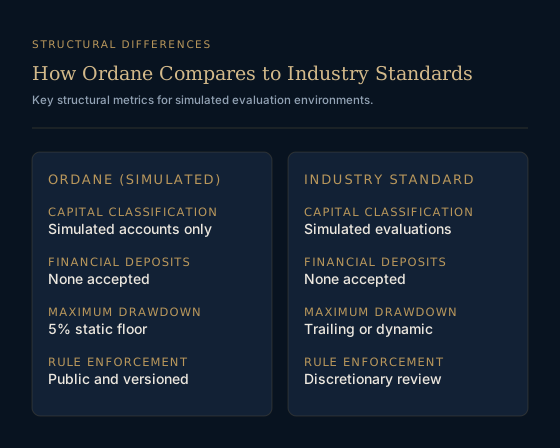
<table id="table"> <thead> <tr> <th>Metric/Feature</th> <th>Ordane (Simulated)</th> <th>Industry Standard</th> </tr> </thead> <tbody> <tr> <td>Capital Classification</td> <td>Simulated accounts only</td> <td>Simulated evaluations</td> </tr> <tr> <td>Client Financial Deposits</td> <td>None accepted</td> <td>None accepted</td> </tr> <tr> <td>Maximum Drawdown Type</td> <td>5 percent static floor</td> <td>Trailing or dynamic</td> </tr> <tr> <td>Rule Enforcement Method</td> <td>Public and versioned</td> <td>Discretionary review</td> </tr> </tbody> </table>
When a provider controls the entire simulated environment, transparency regarding payouts becomes the only verifiable metric of reliability. Users should look for explicit, written contractual agreements regarding withdrawal processing times, rather than relying on vague customer service promises or marketing materials.
Every withdrawal request is approved, or denied in writing citing the exact rule breached by section number, within 24 clock hours. Past that deadline the request is treated as approved and the G-1 clock starts. (Ordane Rulebook v1.0, clause G-0, retrieved 2026-09-13) A payout approved and not paid within 48 clock hours, not business hours, triggers automatic compensation: a 100 percent refund of the account fee, plus the payout owed in full. (Ordane Rulebook v1.0, clause G-1, retrieved 2026-09-13) This mechanism is called The Ordane Guarantee. Both G-2 exclusions (documented fraud or KYC review, and declared force majeure) are capped at 10 business days each. Past that deadline, G-1 applies regardless. (Ordane Rulebook v1.0, clause G-2, retrieved 2026-09-13) The Ordane Guarantee establishes a clear, enforceable timeline for performance compensation, removing arbitrary delays entirely.
How Much Does a Prop Firm Account Cost?
The financial commitment required to access these simulated platforms varies widely depending on the provider, the account size, and the complexity of the evaluation phases. Understanding the total cost of entry is necessary before committing to any evaluation program, as hidden fees can quickly escalate the total expenditure.
Declared inputs for this check: a $139 evaluation fee for Ordane, a $0 recurring platform fee, and a $0 monthly data feed fee. Worked arithmetic: $139 + $0 + $0 = $139 total upfront cost.
The pricing model is entirely built on upfront payments. Users must carefully evaluate the total cost of access, especially when platforms require multiple evaluation phases that significantly increase the probability of failure and subsequent retry fees.
One-Time Evaluation Fees
Most firms charge a one-time fee to begin the evaluation process. This fee scales proportionally with the size of the simulated account provided. The FTMO (prop firm) Challenge for a $10,000 simulated account requires a fee of 155 EUR. (FTMO Objectives, retrieved 2026-09-13)
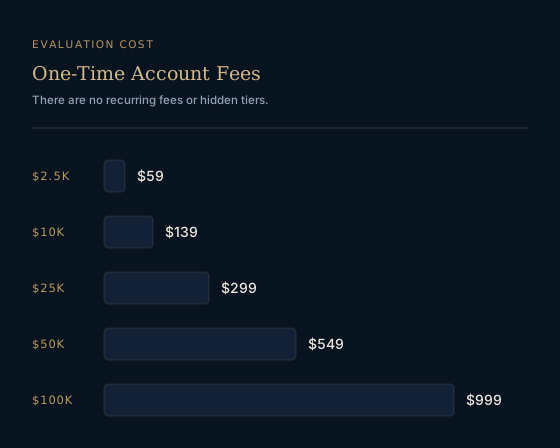
Ordane Instant Account comes in five sizes: $2,500, $10,000, $25,000, $50,000, and $100,000. The fee is one-time: $59 for the $2,500 account, $139 for the $10,000 account, $299 for the $25,000 account, $549 for the $50,000 account, $999 for the $100,000 account. There are no recurring fees, no hidden tiers and no coupon games. (Ordane Rulebook v1.0, section 1, retrieved 2026-09-13)
The absence of recurring fees ensures that users are not penalized for taking their time to execute trades carefully. A monthly subscription model inherently pressures the user to rush their process, which directly conflicts with sound, methodical risk management principles necessary for long term consistency.
Refundable Fees on First Payout
A common industry practice is to offer a refund of the initial evaluation fee when the user successfully navigates the rules and reaches their first payout. This structure theoretically aligns the incentives of the user and the firm, provided the firm actually processes the withdrawal without deploying hidden clauses or discretionary denials at the last minute.
The ability to verify payout histories is critical. When assessing any provider, look for public records, verifiable ledgers, or strict contractual guarantees that prove the company honors its financial commitments to successful users without unnecessary friction or bureaucratic delays.
Frequently Asked Questions
Is a prop firm a broker?
No, a retail proprietary trading firm is not a broker. Brokers are heavily regulated entities that execute orders in live financial markets and hold client deposits for investment purposes. (CFTC Glossary, retrieved 2026-09-13) Evaluation firms provide simulated trading environments and charge an upfront fee for access to their software, infrastructure, and performance monitoring tools.
Can you lose more than your evaluation fee?
Your financial exposure is strictly capped at the fee paid at checkout. Because the accounts operate on simulated capital, you are not liable for actual market losses, negative balances, or margin calls that occur within the simulated environment. The upfront fee is the maximum potential exposure. (Ordane Rulebook v1.0, section 1, retrieved 2026-09-13)
Do prop firms pay out real money?
Yes, successful users receive real money as a reward for their performance in the simulated environment. These payouts are funded directly by the firm's own revenue, which is primarily generated from the evaluation fees paid by all users participating in the program. (Ordane Rulebook v1.0, clause PR-1, retrieved 2026-09-13)
How do profit splits work?
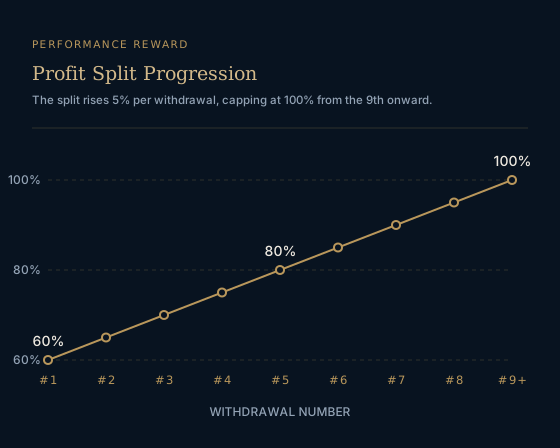
When a user generates simulated profit while adhering strictly to all risk management rules, they become eligible to request a withdrawal. The firm then pays the user a percentage of that simulated profit. Ordane's profit split starts at 60 percent and rises 5 percentage points with every completed withdrawal, reaching 100 percent from the ninth withdrawal onward. (Ordane Rulebook v1.0, clause PA-2, retrieved 2026-09-13)
Are prop firm accounts demo accounts?
Technically, the underlying infrastructure is identical to a standard demo account, as it uses simulated data feeds and virtual balances without live market routing. However, the commercial application is entirely different. An evaluation account is connected to strict monitoring software that enforces rules, tracks performance metrics, and determines eligibility for financial compensation based on the verifiable results. (Ordane Rulebook v1.0, section 1, retrieved 2026-09-13)
To see exactly how these rules are enforced in practice, read the Ordane Rulebook or explore our Instant Account models.
Sources
- CFTC Glossary cftc.gov Retrieved 2026-09-13T11:29:30-03:00.
- ESMA Product Intervention Measures esma.europa.eu Retrieved 2026-09-13T11:29:30-03:00.
- FTMO Objectives ftmo.com Retrieved 2026-09-13T11:29:30-03:00.