Home · The Ordane Journal · Before you pay · Prop Firm Age and Eligibility Rules
Prop Firm Age and Eligibility Rules
The age and eligibility rules of a proprietary trading firm define the strict legal requirements an applicant must meet to enter a binding commercial agreement and receive payouts. Ordane accounts operate on simulated capital. No live funds are traded and no deposits are accepted.
Before evaluating any eligibility clause, traders face three primary concerns about the industry. The first is whether the company actually pays out. The second is whether a hidden rule will be invoked to deny a withdrawal. The third is whether the company will still exist in twelve months. Everyone promises. Ordane published the contract, the reserve, and the penalty. Every withdrawal request is approved, or denied in writing citing the exact rule breached by section number, within 24 clock hours. A payout approved and not paid within 48 clock hours, not business hours, triggers automatic compensation: a 100 percent refund of the account fee, plus the payout owed in full. The mechanism is The Ordane Guarantee. The Ordane Guarantee has two objective exclusions: documented fraud or KYC review, and declared force majeure. Both carry a hard deadline, and beyond it G-1 applies regardless. Ordane's payout reserve is published at a public TRON address on ordanemarkets.com and in Rulebook v1.0 clause PR-1. The page carries a dated observed balance and states that the reserve is not a promise, it is an address.
Ordane's prohibited-practice list is closed. Clause R-6 names six practices: latency, reverse or hedge arbitrage; high-frequency or bulk automated exploitation; copy trading between Ordane accounts; straddling news releases with paired opposing orders; platform or data-feed exploitation; and gap abuse. If a behavior is not listed in that section, it is not a violation. Discretion is not a rule. The governing document is Ordane Rulebook v1.0, published 2026-07-23. The Ordane rulebook is public, numbered and versioned, and no rule is ever applied retroactively to an open account. Changes produce a new version with a dated changelog entry, and the version you sign up under is the version that governs your account. Ordane is new. Its live homepage says it will not fake a history; the rulebook says payout performance metrics begin with the first month in which a payout is requested.
Ordane sells one product, the Ordane Instant Account: direct access, no evaluation phase and no challenge, on simulated capital. Ordane Instant Account comes in five sizes: $2,500, $10,000, $25,000, $50,000 and $100,000. The fee is one-time: $59 for the $2,500 account, $139 for the $10,000 account, $299 for $25,000, $549 for $50,000 and $999 for $100,000. There are no recurring fees, no hidden tiers and no coupon games. Ordane's profit split starts at 60 percent and rises 5 percentage points with every completed withdrawal, reaching 100 percent from the ninth withdrawal onward.
How old do you have to be to use a prop firm?
The baseline requirement across the industry is absolute.
The 35-word answer
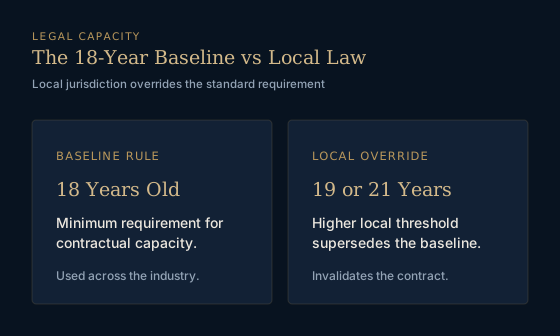
An applicant must possess the legal capacity to enter into a binding commercial contract. FTMO (prop firm) requires a natural person at least eighteen years of age who is not subject to restrictions based on nationality or residency under the rules of each Restricted Jurisdiction (FTMO Challenge Terms and Conditions, last updated 4 August 2026, clause 1.1.1, retrieved 2026-08-14). The number eighteen is not a guideline or a preference. It represents the strict legal threshold of majority in most jurisdictions. Below this age, any contract signed by the individual is generally voidable at their discretion. A firm cannot enforce its terms, collect fees securely, or bind the user to confidentiality or liability clauses if the user lacks contractual capacity. Therefore, the age limit is a structural requirement of the business model, protecting the firm from entering into unenforceable agreements.
Why a higher local minimum overrides 18
While eighteen serves as the baseline, local law dictates the actual threshold for contractual capacity. If a user resides in a jurisdiction where the age of majority is nineteen or twenty-one, the baseline of eighteen is insufficient. The contract is governed by the laws applicable to the user's domicile. Topstep (prop firm) terms of use require the customer to represent and warrant that they are at least 18 years of age, and to meet a higher minimum where the jurisdiction sets one (Terms of use | Topstep, section 4, retrieved 2026-08-14). The clause is engineered to capture whichever number is higher. If the firm states eighteen, but the local law requires twenty-one, the user who purchases an account at nineteen breaches the eligibility representation. The firm relies on the user to know their local laws, shifting the burden of compliance entirely onto the applicant. This design prevents the firm from needing to maintain a global database of majority ages, instead invalidating the contract if the user misrepresents their legal status under their own local statutes.
What does a full eligibility clause contain?
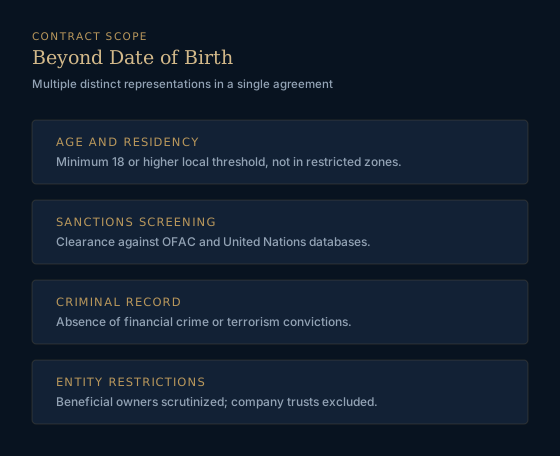
A standard eligibility clause extends far beyond a simple date of birth. It bundles multiple distinct representations into a single agreement block. FTMO's eligibility clause further requires that the customer is not on European Union, OFAC, United Nations or Czech sanctions lists, has no criminal record related to financial crime or terrorism, and meets the firm's know your customer or know your business requirements (FTMO Challenge Terms and Conditions, last updated 4 August 2026, clause 1.1, retrieved 2026-08-14).
| Requirement Category | Scope of Verification | Consequence of Failure |
|---|---|---|
| Age of Majority | Minimum requirement of 18 years, or higher local threshold ([Terms of use | Topstep, section 4](https://www.topstep.com/terms-of-use), retrieved 2026-08-14). |
| Nationality and Residency | Must not reside in designated Restricted Jurisdictions (FTMO Challenge Terms and Conditions, last updated 4 August 2026, clause 1.1.1, retrieved 2026-08-14). | Immediate termination; payouts blocked. |
| Sanctions Screening | Clearance against OFAC, UN, and regional databases (FTMO Challenge Terms and Conditions, last updated 4 August 2026, clause 1.1, retrieved 2026-08-14). | Total block; funds frozen; legal reporting triggered. |
| Criminal Record | Absence of financial crime or terrorism convictions (FTMO Challenge Terms and Conditions, last updated 4 August 2026, clause 1.1, retrieved 2026-08-14). | Account closure; failure of KYC protocol. |
| Entity Restrictions | Trusts often excluded; beneficial owners scrutinized (FTMO Challenge Terms and Conditions, last updated 4 August 2026, clause 1.1.2, retrieved 2026-08-14). | Business account application rejected. |
Each element in this table represents an independent point of failure. A user might meet the age and residency requirements perfectly, yet fail the background screening due to a matched name on a regional database. The firm bundles these requirements because regulatory compliance demands a comprehensive filter before any financial distribution can occur.
What representation do you make when you click buy?
Clicking the purchase button executes a specific legal action. The user does not merely submit an application; they make a definitive representation and warranty regarding their status. FTMO's terms state that if the eligibility criteria are not met the agreement is not concluded, and that a customer who stops meeting them after signing must notify the firm immediately (FTMO Challenge Terms and Conditions, last updated 4 August 2026, clause 1.4, retrieved 2026-08-14). A warranty is a guarantee provided by one party to another that certain facts are true. If those facts are false, the foundation of the contract collapses entirely. The firm is not obligated to verify the user's claims prior to accepting the fee. The architecture of the transaction assumes the user's declaration is accurate. If an ineligible applicant checks the box claiming to meet the criteria, the firm relies on that warranty to grant access to the simulated environment. When the falsehood is eventually discovered, the firm invokes the breach of warranty to nullify the arrangement. The user cannot argue that the firm should have checked earlier. The contractual language explicitly places the liability for accuracy on the purchaser, rendering the initial transaction fundamentally conditional upon the truth of the user's statements.
When does the firm actually verify your identity?
The timing of verification defines the risk profile for the user.
Identity verification at the first withdrawal
Firms rarely demand identification documents at the checkout stage. Adding friction to the purchase process reduces conversion rates. Instead, the verification protocol is delayed until the firm faces an outgoing financial obligation. The check occurs precisely when the user requests their first payout. At this juncture, the user must upload government-issued identification, proof of address, and sometimes undergo facial recognition matching. The gap between the purchase date and the first withdrawal request can span weeks or months. During this period, an ineligible user operates under the illusion of compliance, expending time and effort on the simulation. The firm holds zero financial exposure during this delay because no funds leave the company. The entire verification mechanism is positioned as a gatekeeper to the payout rails, ensuring that compliance costs are only incurred for users who successfully reach the withdrawal stage.
What an unverifiable identity does to a payout
Failing the identity check at the withdrawal stage carries severe consequences. If the documents submitted do not perfectly match the details provided at checkout, the verification fails. A user who registered under a pseudonym, used a relative's payment method, or lied about their age is immediately flagged. Because FTMO's terms state that if the eligibility criteria are not met the agreement is not concluded (FTMO Challenge Terms and Conditions, last updated 4 August 2026, clause 1.4, retrieved 2026-08-14), the firm treats the entire relationship as invalid from inception. The payout request is denied. Furthermore, the initial fee is rarely refunded, as the user breached the warranty clause by supplying false information. The time spent trading the simulated account yields nothing. The firm points to the terms of use, confirming that the user agreed to forfeit their position by misrepresenting their identity. This mechanism ensures that ineligible participants cannot extract capital from the system, while the firm retains the fees collected from those who deliberately bypassed the initial declarations. The payout block is absolute, automated, and legally supported by the user's own accepted terms.
Can you buy an account as a company?
Operating through a legal entity presents a different set of rules. Some firms permit corporate accounts, but the restrictions are rigorous. FTMO's eligibility clause admits a legal entity only if it is not established in a Restricted Jurisdiction, excludes company trusts in any jurisdiction, and requires the beneficial owner to be eligible in their individual capacity as well (FTMO Challenge Terms and Conditions, last updated 4 August 2026, clause 1.1.2, retrieved 2026-08-14). This dual-layer eligibility means the firm examines both the corporate structure and the human behind it. Establishing an account as a business carries a hidden cost regarding legal standing. FTMO's terms state that providing a business identification number or a tax registration number, or declaring a legal entity, removes consumer status for the whole duration of the agreement (FTMO Challenge Terms and Conditions, last updated 4 August 2026, clause 1.2, retrieved 2026-08-14). Consumer protection laws mandate specific refund windows, venue choices for disputes, and plain-language requirements. By declaring a business status, the user willingly abandons these statutory shields. The relationship shifts to a business-to-business contract, which courts interpret with strict adherence to the written text, assuming both parties possess equal commercial sophistication. The user trades regulatory safety for corporate structuring.
How do eligibility rules affect connected accounts?
Eligibility extends beyond the primary account holder. Firms actively monitor networks of connected individuals to prevent coordinated exploitation or circumvention of limits. Topstep's terms state that the account is personal to the customer, that only one account is permitted, and that it cannot be sold, transferred, assigned to or shared with any other party (Terms of use | Topstep, section 16, retrieved 2026-08-14). The restriction on sharing means a household cannot pool resources through a single login. Furthermore, corporate accounts trigger deep network analysis. FTMO reserves the right to limit the total number of orders in aggregate where other connected clients use the services, naming the ultimate beneficial owner, top management and employees or officers of that client (FTMO Challenge Terms and Conditions, last updated 4 August 2026, clause 3.14.1, retrieved 2026-08-14). This clause prevents a single entity from spawning multiple subsidiary accounts to bypass maximum allocation rules. If a director of a trading firm holds an individual account, and their firm opens a corporate account, the provider links them. Breaching the rules on one account can trigger a cascade of closures across the connected network. The firm protects its risk exposure by treating the entire web of beneficial ownership as a single operational entity.
Do you get regulatory protection under these rules?
A critical element of the eligibility agreement is the explicit waiver of financial regulation. Users often assume that because charts resemble broker terminals, the same oversight applies. The contracts state otherwise. FTMO's terms state that none of the services are subject to laws regulating the financial sector in the countries where they are provided, that the firm is not regulated by the Czech National Bank or a similar authority, and that the customer will not receive the regulatory protection associated with the financial sector (FTMO Challenge Terms and Conditions, last updated 4 August 2026, clause 2.1, retrieved 2026-08-14). This declaration removes the firm from the jurisdiction of financial ombudsmen and statutory compensation schemes. The user agrees that they are purchasing an educational or evaluation service on simulated capital, not opening a brokerage account. If a dispute arises over a denied payout or a closed account, the user cannot file a complaint with a securities regulator. The dispute resolution is bound entirely by civil contract law, often requiring arbitration in the firm's home jurisdiction. Acknowledging this lack of regulatory protection is a mandatory condition of eligibility, defining the exact legal perimeter of the service.
What are the eligibility checkpoints on a timeline?
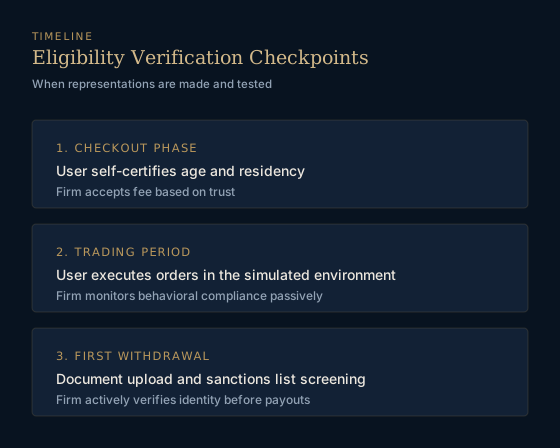
The timeline of a user's lifecycle illustrates exactly when representations are made and when they are tested.
Declared inputs for this check: an 18 year baseline age (FTMO Challenge Terms and Conditions, last updated 4 August 2026, clause 1.1.1, retrieved 2026-08-14), an 18 year representation requirement (Terms of use | Topstep, section 4, retrieved 2026-08-14), and a 36 combined total for two applicants. Worked arithmetic: 18 + 18 = 36.
| Phase | Action Taken | What is Assessed | Responsibility |
|---|---|---|---|
| Checkout | User clicks agreement box. | Self-certified age, residency, and single-account compliance ([Terms of use | Topstep, section 16](https://www.topstep.com/terms-of-use), retrieved 2026-08-14). |
| Trading Period | User executes orders. | Behavioral compliance, network matching, IP logging. | Firm monitors passively. |
| First Withdrawal | User requests payout. | Document upload, facial match, sanctions list screening (FTMO Challenge Terms and Conditions, last updated 4 August 2026, clause 1.1, retrieved 2026-08-14). | Firm actively verifies. |
| Subsequent Cycles | User requests further payouts. | Re-check of connected accounts and ongoing eligibility (FTMO Challenge Terms and Conditions, last updated 4 August 2026, clause 3.14.1, retrieved 2026-08-14). | Firm monitors changes. |
| Dispute | User challenges closure. | Verification of initial consumer status representation (FTMO Challenge Terms and Conditions, last updated 4 August 2026, clause 1.2, retrieved 2026-08-14). | Arbitration panel. |
This chronological view confirms that the firm collects the fee based on trust, but distributes payouts strictly based on hard evidence.
Which six-step check should you run before paying?
Before submitting payment, an applicant must perform a systematic self-audit against the firm's specific terms. First, read clause one of the terms and conditions, locating the exact age requirement for your specific country. Second, check the restricted jurisdiction list to confirm your country of residence is permitted. Third, verify your own documents against the name on the payment method; a mismatch here routinely triggers fraud alerts. Fourth, decide whether to register as an entity or an individual, understanding the permanent loss of consumer protection if the corporate route is chosen. Fifth, save the terms page with a visible date stamp. Firms update terms, and you need proof of the version you accepted. Finally, locate the clause defining the verification moment. Know exactly when the firm will demand your documents. Completing these six steps ensures you are actually eligible to receive a payout, rather than merely eligible to pay a fee. Ignoring this procedure guarantees that any underlying disqualification will remain hidden until the worst possible moment: the day you attempt to withdraw funds.
Where does Ordane verify your information?
Transparency regarding verification timing and corporate structure allows a user to assess counterparty risk before committing capital. Ordane positions its checks clearly in its public materials. KYC happens once at Ordane, at the first withdrawal request, not at purchase. There is no re-verification loop at every payout. This schedule removes the uncertainty of continuous identity challenges while maintaining strict compliance before any funds are disbursed. Regarding corporate identity, Ordane publishes its status plainly rather than adopting the visual language of a regulated broker. Ordane is operated by Ordane Markets Ltd (in formation). The entity makes no claims of financial sector oversight, aligning precisely with the simulated nature of the product. The user knows exactly who they are contracting with, under which versioned rulebook, and precisely when they will be required to prove their identity. This structure forces the relationship into clear, verifiable boundaries from day one, avoiding the ambiguity that often surrounds off-shore simulated environments.
Frequently Asked Questions
Can a 17-year-old open a prop firm account?
The answer is definitively no. The requirement is structural, bound to contract law rather than company preference. A minor cannot form a binding commercial agreement. FTMO requires a natural person at least eighteen years of age (FTMO Challenge Terms and Conditions, last updated 4 August 2026, clause 1.1.1, retrieved 2026-08-14). Even if the applicant possesses the skill to trade the simulated environment, their acceptance of the terms and conditions is legally voidable. The firm will accept the initial payment, but upon requesting a payout, the mandatory identity check will reveal the date of birth. The payout will be denied, the account closed, and the fee forfeited for breaching the initial warranty.
Does a parent's account solve it?
Opening the account in a parent's name while the minor trades it introduces a severe secondary violation. Topstep terms state that the account is personal to the customer, that only one account is permitted, and that it cannot be sold, transferred, assigned to or shared with any other party (Terms of use | Topstep, section 16, retrieved 2026-08-14). If a parent passes the KYC check but the firm detects disparate trading locations, hardware fingerprints, or behavioral anomalies indicating a different operator, the account is flagged for unauthorized sharing. This workaround does not solve the age issue; it merely substitutes a lack of capacity for a deliberate breach of the personal use clause, resulting in identical consequences: closure without payout.
What happens to the fee if you were never eligible?
When an ineligible user purchases an account, they breach the representation and warranty made at checkout. FTMO's terms state that if the eligibility criteria are not met the agreement is not concluded (FTMO Challenge Terms and Conditions, last updated 4 August 2026, clause 1.4, retrieved 2026-08-14). Because the user initiated the falsehood, the firm is legally positioned to retain the fee as compensation for the breach, or to cover the administrative costs of the subsequent investigation. The user cannot demand a refund on the basis that the firm should have stopped them from buying. The terms explicitly place the burden of truthful representation on the buyer. The fee is lost, serving as a direct penalty for attempting to bypass the eligibility perimeter.
Can you trade as a legal entity?
Some firms permit corporate accounts, but the restrictions are rigorous. Establishing an account as a business removes consumer protection status for the whole duration of the agreement.
Once you verify your eligibility, the next step is to choose the right account size for your trading style. If you are ready to begin, you can review the complete Ordane Rulebook for the exact rules that govern our simulated accounts.
Sources
- FTMO Challenge Terms and Conditions, last updated 4 August 2026, clause 1.1.1 cdn.ftmo.com Retrieved 2026-08-14.
- Terms of use | Topstep, section 4 topstep.com Retrieved 2026-08-14.
- ordanemarkets.com, homepage FAQ ordanemarkets.com Retrieved 2026-08-14.
- Ordane Rulebook v1.0 signature block ordanemarkets.com Retrieved 2026-08-14.