Home · The Ordane Journal · Before you pay · Is Prop Firm Trading Really Free? What Trials Cover
Is Prop Firm Trading Really Free? What Trials Cover
Ordane defines a genuinely free prop firm path as registration, simulated trading, qualification, and payout eligibility without any required payment.
Ordane accounts operate on simulated capital. No live funds are traded and no deposits are accepted.
Is prop firm trading actually free?
Prop firm trading is usually not free from registration through payout eligibility because proprietary trading evaluations require an assessment fee for a chance to access a simulated funded account.
The proprietary trading industry is built on evaluation models and access fees. When a company advertises a free trial, traders naturally want to know if they can navigate the entire system and withdraw real cash without ever paying a fee. The reality is that a free label is often used as a marketing tool to lower the initial barrier to entry, rather than a promise of completely free trading. You must inspect the entire pipeline to understand where the free experience ends and the payment requirements begin. A true free path means you can register, trade, pass the evaluation, and request a withdrawal without a single transaction. In practice, this uninterrupted chain is incredibly rare. Most firms implement a payment trigger at a specific gate to cover their operating costs and ensure they can fund successful payouts. Understanding these gates protects you from spending weeks on a simulated account that was never designed to pay you without a prior purchase.
A free label can apply to only one step
When a company advertises a free trial, the reader often assumes the entire process from signup to payout has no cost. This is rarely the case in the proprietary trading industry. A free label can apply to only one step in the pipeline. It might mean that creating an account profile costs nothing. It might mean you can download the trading platform and look at the charts without a credit card. It might mean you can place simulated trades for a limited time.
None of these isolated steps guarantee that the next step is also free. A trader who passes a free trial might discover that the reward is not a payout, but a discount code to buy a paid evaluation. The label is technically accurate for the step it describes, but it creates a misunderstanding about the final destination. You must define free as an uninterrupted no payment path from the moment you register to the moment you become eligible for a payout. A free feature is not a free business model.
Free entry, free trading access, and payout eligibility are different claims
To protect your time, you must separate the claims. Free entry simply means the registration form does not ask for billing details. Free trading access means the firm provides a simulated account with live data where you can execute orders. Payout eligibility is a completely different claim. It means the firm contractually agrees to pay you a share of the simulated profits you generate.
Many traders fear that they will pass a test and never get paid. They also worry about hidden rules taking them down right before a withdrawal. The third common fear is whether the firm will still exist the following year. Firms that give away trading access and payouts for free often lack the revenue model to survive. Sustainable operations either charge for evaluations or they charge for direct access. Ordane sells one product, the Ordane Instant Account: direct access, no evaluation phase and no challenge, on simulated capital. Understanding the difference between entry, access, and eligibility prevents you from spending weeks on a trial that was never designed to pay you.
What is the four gate free to payout test?
To determine if an offer is genuinely free, you must test it against four strict gates. If the offer fails at any gate, the path to a payout requires a purchase.
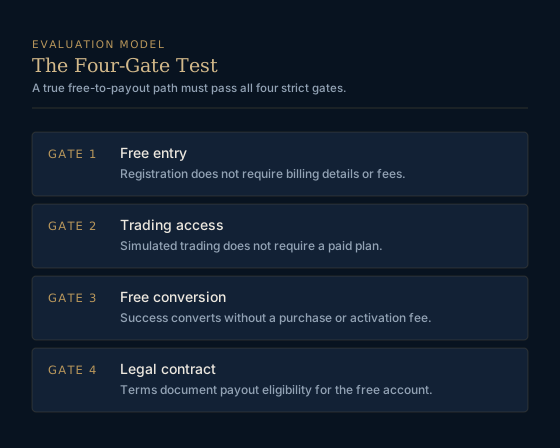
Gate 1: Can you enter without paying?
The first gate tests the registration process. If you must provide a credit card or pay a fee just to create your user profile, the offer fails gate one. The barrier to entry immediately invalidates the free label. Some firms require a subscription before they allow you to access their practice environments. In these cases, the practice environment might not have an additional cost, but the entry to the ecosystem requires a payment. A true free trial allows you to enter the system and view the dashboard without a transaction, preserving your capital until you are ready to commit.
Gate 2: Can you trade without a paid subscription or plan?
The second gate tests the trading access. Once you are inside the dashboard, can you open a simulated trading account, connect it to a platform, and execute trades? Some firms allow free registration but keep their trading servers locked behind a paywall. You might be able to read the educational materials and browse the community forums, but you cannot trade. If simulated trading access requires a paid evaluation plan, the offer fails gate two. Without the ability to place orders and manage risk in real time, the account provides no practical trading value.
Gate 3: Does success convert without a purchase or activation fee?
The third gate tests the conversion mechanism. If you receive a free trial and successfully reach the profit target without breaching any rules, what happens next? A truly free path will convert your successful trial into a payout eligible account without asking for money. Many firms fail the test at this exact point. Instead of a funded account, they offer a coupon for a paid plan. Others require a one time activation fee to upgrade your status. If you must pay to convert your success into an active account, the offer fails gate three. The trial was merely a stepping stone to a mandatory purchase.
Gate 4: Do the official terms document payout eligibility?
The fourth gate tests the legal contract. If you pass a free trial and receive an account without paying an activation fee, you must check the terms of service. Do the official rules document that this specific free account is eligible for a real cash payout? Some firms offer perpetual demo accounts that are strictly for practice. You can trade them forever, but the profits remain simulated and cannot be withdrawn. If the terms do not explicitly state that the free account qualifies for a payout, the offer fails gate four. The entire effort produces no return.
How do the four documented offers score?
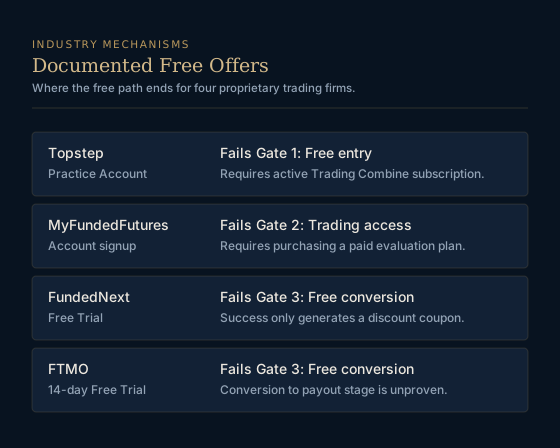
We applied the four gate test to four specific proprietary trading firms using their official documentation. The results show exactly where the free path ends for each offer.
FTMO: bounded 14 day demo, with later conversion and payout not established by the supplied claims
FTMO (prop firm) offers a practice environment, but it has a strict time limit. FTMO's Free Trial demo account runs for a fixed 14 days before it ends (FTMO Free Trial | FTMO.com, retrieved 2026-08-26). You do not have unlimited time to test your strategies or become comfortable with the trading platform. The countdown begins as soon as the account is issued. Furthermore, FTMO rations its free tier: only one Free Trial account per client is allowed at a time, citing demand (FTMO Free Trial FAQ, retrieved 2026-08-26). This means you cannot open multiple free trials simultaneously to test different approaches or trade different asset classes in isolation. While the entry and trading access pass the first two gates, the supplied documentation does not establish that this 14 day trial converts into a payout eligible account. Based on the available evidence, the free path stops at practice. If you want to move beyond the 14 days and trade for a potential payout, you must transition to a paid evaluation challenge. The trial is strictly a preliminary step, not a complete trading solution.
Topstep: a paid Combine is required before the free Practice Account
Topstep (prop firm) takes a different approach to practice accounts by tying them directly to a paid product. Topstep's only standing free account, the Practice Account, is not a standalone free product: it requires the trader to already hold an active, paid Trading Combine subscription (Practice Account | Topstep Help Center, retrieved 2026-08-26). Because you must purchase the subscription first, this offer fails gate one immediately. The practice account itself does not cost extra, but you cannot access it without a transaction. This structure is designed for existing customers who want to test new strategies or refine their execution without risking the rules of their main evaluation account. It provides value to active subscribers, but it does not serve as a free entry point for new traders exploring the platform. The payment is the prerequisite for the practice, reversing the traditional trial model.
FundedNext: trial success generates a coupon for a paid plan
FundedNext (prop firm) allows traders to enter and trade a trial without upfront payment, passing gates one and two. You can register your details and access the simulated trading environment without entering billing information. However, the offer fails at gate three. Passing FundedNext's Free Trial does not hand the trader a funded account or a payout; it automatically generates a coupon code once the trader reaches the 5 percent profit target, and that code is only a discount on a paid CFD plan (FundedNext Free Trial Rules | FundedNext Help Center, retrieved 2026-08-26). The reward for your trading success is a reduction in the price of a paid evaluation, not a free path to a payout. This mechanism uses the trial as a performance based discount system. It encourages traders to prove their skills, but it still requires a financial commitment to proceed to the payout eligible stage.
MyFundedFutures: signup is free, but simulated trading access requires a paid evaluation plan
MyFundedFutures (prop firm) offers free registration, which passes gate one. You can create a user profile and view the internal dashboard without any cost. However, the path stops immediately at gate two. Creating an MFFU account is free and needs no credit card, but that free step only opens the door: simulated trading access itself requires paying for an evaluation plan (How It Works: Futures Evaluation to Funded Payouts | MFFU, retrieved 2026-08-26). You can look around the ecosystem, read the rules, and understand the interface, but you cannot execute simulated trades without purchasing a plan. The free label applies exclusively to the account creation process, not the trading activity. If you want to place an order, test a strategy, or begin an evaluation, you must initiate a transaction. The free step is administrative, not operational.
| Firm | Free step | First gate passed | First gate failed or unproven | Payment trigger | Payout eligibility documented in this ledger |
|---|---|---|---|---|---|
| FTMO | 14 day demo account | Gate 1: Free entry | Gate 3: Conversion unproven | Not established by ledger | No |
| Topstep | Practice Account | None | Gate 1: Free entry failed | Trading Combine subscription | No |
| FundedNext | Free Trial | Gate 1: Free entry | Gate 3: Conversion failed | Purchasing the discounted plan | No |
| MyFundedFutures | Account signup | Gate 1: Free entry | Gate 2: Trading access failed | Evaluation plan purchase | No |
What replaces a fully free path?
Since a fully free path from registration to payout is exceptionally rare, proprietary trading firms use five main mechanisms to structure their offers. Understanding these mechanisms helps you identify exactly what you are getting and when you will have to pay.
Bundled access is not standalone free access
When a practice account is bundled with a paid subscription, it is a feature of the paid product, not a standalone free offer. Topstep demonstrates this model clearly. You cannot simply sign up for the Practice Account from the homepage. You must buy the Trading Combine first. This mechanism allows active customers to test new strategies without risking their main evaluation account, but it does not provide free entry for new users. Bundling adds value to the purchase, but it does not eliminate the purchase requirement. Traders must recognize that a free feature inside a paid ecosystem is not a free trial of the ecosystem itself.
A coupon lowers a later price but does not remove the purchase
The coupon mechanism is designed to turn trial users into paying customers. FundedNext uses this structure effectively. You trade the trial account to prove your skills and become familiar with their rules. When you succeed, you receive a discount code instead of a funded account. The trial serves as a lead generation tool and a skill filter. It lowers the financial barrier to entry for the paid evaluation, but it does not remove the purchase requirement entirely. You are still required to pay a fee to access the stage where payouts become possible. The free experience is strictly limited to the qualification phase for the discount.
A later fee refund does not erase the upfront payment
Some firms advertise refundable fees, which can confuse traders into thinking the account is eventually free. A refund mechanism requires you to risk your own capital upfront. On FundedNext's Stellar 2-Step plan, the registration fee a trader pays upfront only becomes refundable after the trader has already earned money: it is requested together with the first Performance Reward, meaning the account is never free before that point, only reimbursed after success (Will I get back my Registration Fee? | FundedNext Help Center, retrieved 2026-08-26). The upfront cost remains a hard barrier. If you fail the evaluation, the firm keeps the fee and you receive nothing back. This is a conditional refund, not a free entry. You must navigate the specific terms of the refund policy to recover your initial payment, which proves that the process was never free from the start. A reimbursed cost is still a cost that must be paid to enter.
Free signup can end before trading access begins
The free registration mechanism is common, but it provides the least operational value to the trader. MyFundedFutures allows you to create an account for free, but you cannot trade. You must pay to access the evaluation environment. This structure allows the firm to build an email list and market their paid products to registered users. It provides you with a login credential, but it does not provide a free trading experience. The distinction between a free user account and a free trading account is critical. Administrative access does not equal market access.
A real cash payout does not prove a free path to eligibility
Firms must fund their payouts from a reliable source. MyFundedFutures draws the free-versus-paid line at the payout, not the account: no real capital is ever deployed in its simulated funded account, but the payouts a trader withdraws are real cash, paid from the company's own operating funds (How It Works: Futures Evaluation to Funded Payouts | MFFU, retrieved 2026-08-26). Because payouts require real cash, firms charge upfront fees to cover their operating costs and build the payout reserve. The5ers (prop firm) prices its High Stakes two-step challenge starting at 39 dollars, with unlimited time allowed to pass (Unlimited Time to Pass The5ers 2-step Challenge (High Stakes) | The5ers, retrieved 2026-08-26). These costs fund the operation. If a firm does not charge an upfront fee, it cannot sustain real cash payouts over the long term. The presence of a real payout is exactly why the path leading to it requires a payment.
Evaluating trial costs and upfront fees
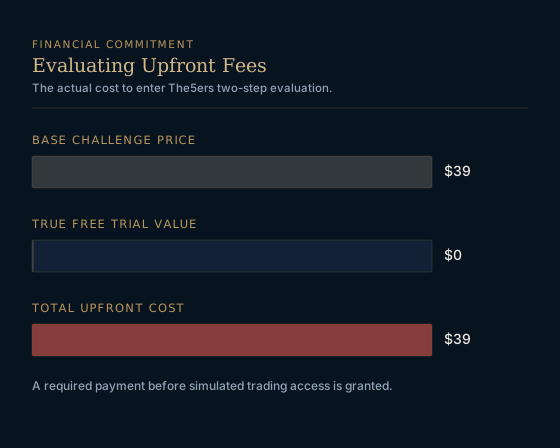
To determine the actual cost of entering an evaluation, traders must calculate the upfront fees required before simulated trading access is granted. For this check, The5ers' documented starting price is 39 dollars, so adding a 0-dollar true free-trial cost produces a 39-dollar total upfront cost (Unlimited Time to Pass The5ers 2-step Challenge (High Stakes) | The5ers, retrieved 2026-08-26).
| Mechanism | Documented example | Upfront payment required | Result of success | Payout source |
|---|---|---|---|---|
| Bounded demo | FTMO 14 day Free Trial | No | Not established by ledger | Not established by ledger |
| Paid bundle | Topstep Practice Account | Yes | Practice only | Not established by ledger |
| Coupon | FundedNext Free Trial | No | Discount on paid plan | Not established by ledger |
| Deferred reimbursement | FundedNext Stellar 2-Step | Yes | Fee refunded with first payout | Not established by ledger |
| Free registration | MyFundedFutures signup | No | Dashboard access only | Operating funds |
What are the most common questions about free prop firm trading?
The most common questions about free prop firm trading concern total cost, trial contents, payout eligibility, deposit requirements, and the difference between a prop firm trial and a broker demo.
Is prop firm trading free?
In most cases, proprietary trading is not entirely free. While many firms offer a free trial or a free demo account, these options usually fail the four gate test before payout eligibility. The business model requires revenue to sustain operations and fund payouts for successful traders, as payouts are real cash from operating funds (How It Works: Futures Evaluation to Funded Payouts | MFFU, retrieved 2026-08-26).
What does a prop firm free trial include?
A prop firm free trial typically includes access to a simulated trading environment with live market data. The duration is often bounded, such as the 14 days offered by FTMO (FTMO Free Trial | FTMO.com, retrieved 2026-08-26). Trials allow you to test platform mechanics without risking your own capital on an evaluation fee, but they do not usually include a path to a real cash withdrawal.
Can a free demo lead directly to a payout?
A free demo rarely leads directly to a payout. Firms use demos to demonstrate their technology, not to recruit traders for immediate payouts. Passing a free trial often results in a coupon code for a paid evaluation (FundedNext Free Trial Rules | FundedNext Help Center, retrieved 2026-08-26). You should expect to pay a fee before you can earn a return.
Is there a free prop firm account with no deposit?
All prop firm accounts operate without deposits because you do not deposit trading capital. You pay a fee for the service. True no payment paths to payouts are extremely rare and not established by current documentation. The lack of a deposit does not equal a lack of fees.
Is a prop firm free trial the same as a broker demo?
A prop firm free trial and a broker demo both use simulated capital, but their rules differ significantly. A broker demo lets you test the software with no restrictions, whereas a prop firm trial enforces strict risk management rules to simulate their specific evaluation environment.
Check the requirements before committing
If you want to trade without evaluation phases or hidden trial conversions, review the Ordane Instant Account to see how direct access works, or read the public Rulebook to verify the exact rules before making a decision.
Which sources support this guide?
Primary sources are linked inline above.
This article is for information only and is not investment, financial, or tax advice.
Ordane accounts operate on simulated capital. No live funds are traded and no deposits are accepted. Payouts depend on simulated performance under Rulebook v1.0; no level of performance is typical or assured.
Sources
- Practice Account | Topstep Help Center help.topstep.com Retrieved 2026-08-26.
- FTMO Free Trial | FTMO.com ftmo.com Retrieved 2026-08-26.
- FTMO Free Trial FAQ ftmo.com Retrieved 2026-08-26.
- Unlimited Time to Pass The5ers 2-step Challenge (High Stakes) | The5ers the5ers.com Retrieved 2026-08-26.
- FundedNext Free Trial Rules | FundedNext Help Center help.fundednext.com Retrieved 2026-08-26.
- Will I get back my Registration Fee? | FundedNext Help Center help.fundednext.com Retrieved 2026-08-26.
- How It Works: Futures Evaluation to Funded Payouts | MFFU myfundedfutures.com Retrieved 2026-08-26.