Home · The Ordane Journal · Risk and exposure · Forex Risk: Counterparty, Volatility, Leverage
Forex Risk: Counterparty, Volatility, Leverage
Forex risk is the exposure you accept when you open a currency position, stacked in three layers: counterparty (you trade only against your dealer), market (volatility amplified by leverage, where a 2 percent margin requirement lets $2,000 control $100,000, per the U.S. Commodity Futures Trading Commission, CFTC), and custody (deposits are unprotected if the dealer fails).
Ordane accounts operate on simulated capital. No live funds are traded and no deposits are accepted. Payouts depend on simulated performance under Rulebook v1.5; no level of performance is typical or assured.
Ordane sells one product, the Ordane Instant Account: direct access, no evaluation phase and no challenge, on simulated capital.
What is forex risk?
Forex risk is the combined exposure of three layers: a counterparty layer (who is on the other side of your trade), a market layer (volatility amplified by leverage) and a custody layer (your funds if the firm fails). Volatility is how far and how fast a price moves; margin is the deposit that secures a position, and leverage means a small margin controlling a much larger position, as when $2,000 controls $100,000. A dealer is the firm that quotes your price and takes the other side of your trade. Investopedia, an investor-education publisher, names the market layer directly in its guide: "Two of the biggest risks in forex trading are volatility and leverage" (Understanding Forex Risk Management | Investopedia, retrieved 2026-10-13). The U.S. Commodity Futures Trading Commission (CFTC), the federal regulator of futures and off-exchange forex, supplies the other two layers: its customer advisory explains that retail off-exchange forex customers trade only against their dealer, and that deposits are not protected if a dealer disappears (Customer Advisory: Eight Things You Should Know Before Trading Forex | CFTC, retrieved 2026-10-13).
Each layer needs a different control: leverage is controlled by position sizing, volatility by sizing and by accepting that losses are normal, and counterparty and custody risk by verification before you ever deposit.
Is the other side of your trade a market or a dealer?
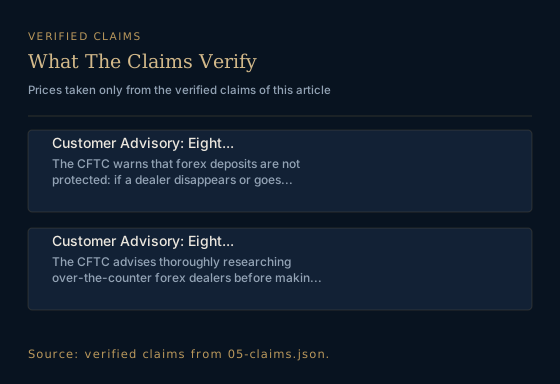
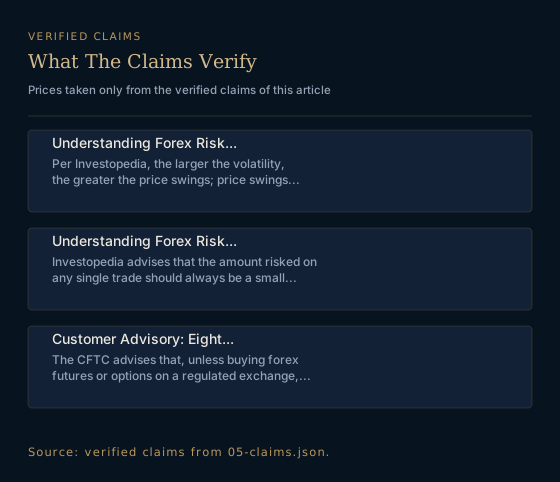
The other side of your trade is a dealer, not an open market, in most retail forex trading. Unless you trade forex futures or options on a regulated exchange, the CFTC's customer advisory is blunt about what that means: "This means you are not trading in an open market, you are trading only against your dealer. When you buy, your dealer is the seller; when you sell, your dealer is the buyer." (Customer Advisory: Eight Things You Should Know Before Trading Forex | CFTC, retrieved 2026-10-13).
That sentence reframes forex risk as a structural question: your counterparty is the firm that also quotes your prices, holds your margin and processes your withdrawals, and the ordinary safety assumptions of exchange trading do not exist here. When the counterparty is a single company, checking that company is the equivalent of checking the exchange itself. FOREX.com, a retail forex broker, lists 4 exposure categories in its own risk warning for off-exchange transactions: leverage, creditworthiness, limited regulatory protection and market volatility; two of the four, creditworthiness and limited regulatory protection, concern the dealer itself (Risk Warning - FDM Disclosures | FOREX.com US, retrieved 2026-10-13).
How do volatility and leverage multiply each other?
Volatility and leverage multiply each other: price swings move the price, and borrowed money multiplies what each swing does to your account. Investopedia states the volatility half of the pair:
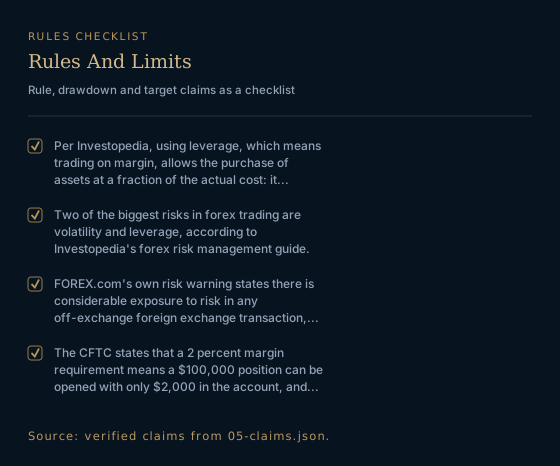
On leverage, the same guide says that "Using leverage, which means trading on margin, allows the purchase of assets at a fraction of the actual cost. This allows traders to trade with less money but it amplifies the losses" (Understanding Forex Risk Management | Investopedia, retrieved 2026-10-13). The CFTC turns the abstraction into numbers: "a 2 percent margin requirement means you could open a $100,000 position with only $2,000 in your account", and "This high degree of leverage amplifies both gains and losses" (Customer Advisory: Eight Things You Should Know Before Trading Forex | CFTC, retrieved 2026-10-13).
Original calculation: what a 2 percent margin does to a 1 percent move
- Inputs: $100,000 position and $2,000 margin, both from the CFTC example above (Customer Advisory: Eight Things You Should Know Before Trading Forex | CFTC, retrieved 2026-10-13).
- Method: leverage = 100,000 ÷ 2,000 = 50, and loss = position × price move.
- Result: a 1% adverse move costs 100,000 × 0.01 = $1,000, which is 50% of the $2,000 margin; a 2% adverse move costs $2,000, the entire margin.
A currency move that is unremarkable on its own is account-defining on a position 50 times your margin. The CFTC's conclusion, "amplifies both gains and losses," is the honest version of leverage: the amplification is symmetric, but the account that must absorb a losing streak is finite.
What happens to your deposit if a dealer disappears?
The CFTC's advisory states the exposure plainly: "If a dealer disappears or goes bankrupt, you may not be able to get your money back." (Customer Advisory: Eight Things You Should Know Before Trading Forex | CFTC, retrieved 2026-10-13). Forex deposits are not protected the way bank deposits are, so all the volatility management in the world is irrelevant if the firm holding the balance fails. Market risk can be sized, stopped and survived. Custody risk is different, because it decides whether the profit on your screen is ever money you can withdraw, and it cannot be managed with a stop order, only before depositing. FOREX.com's disclosure warns that you could sustain a total loss of initial margin funds, which in the $2,000 margin example is 100% of the amount posted (Risk Warning - FDM Disclosures | FOREX.com US, retrieved 2026-10-13).
For readers approaching this from the funded-account side, the same custody question appears in a different costume: see what happens if a prop firm shuts down and whether you can lose money with a prop firm.
How do you check a forex counterparty before you rely on it?
You check a forex counterparty by researching the dealer before depositing, verifying CFTC registration for the firm and its employees, and checking disciplinary history with the National Futures Association (NFA), the self-regulatory body of the U.S. derivatives industry. The CFTC's advisory instructs: "Research should include verifying that the dealer and its employees are registered with the CFTC and checking the dealer’s disciplinary history with the National Futures Association (NFA)." (Customer Advisory: Eight Things You Should Know Before Trading Forex | CFTC, retrieved 2026-10-13). The funded-account equivalent is auditing a prop firm before you buy. The checklist below has 4 steps, and every row traces back to that advisory (Customer Advisory: Eight Things You Should Know Before Trading Forex | CFTC, retrieved 2026-10-13):
| Step | What to do | CFTC basis |
|---|---|---|
| 1 | Research the over-the-counter (OTC) forex dealer thoroughly before making initial deposits: not after | Advisory: research dealers before initial deposits |
| 2 | Verify the dealer itself is registered with the CFTC | Advisory: verify registration with the CFTC |
| 3 | Verify the dealer's employees are also registered | Advisory: "the dealer and its employees" |
| 4 | Check the dealer's disciplinary history with the NFA | Advisory: check disciplinary history with the NFA |
What does controlling the risk cost you?
The control lever for the market layer is position sizing. Investopedia's guide states that "A good starting percentage could be 2% of your available trading capital" risked on any single trade: a starting suggestion from one guide, not a universal law (Understanding Forex Risk Management | Investopedia, retrieved 2026-10-13). Its function is simple: cap the damage any single volatility-and-leverage event can do, the same logic behind a prop firm's daily loss limit and the choice between a static or trailing drawdown.
Original calculation: five consecutive 2% losses on a $10,000 account
- Inputs: a declared hypothetical $10,000 account, 2% risked per trade (Investopedia's starting percentage), 5 consecutive losing trades.
- Method A, 2% of the starting balance each time: 5 × $200 = $1,000 lost.
- Method B, 2% of the remaining balance each time: 10,000 × 0.98^5 = $9,039.20 left, so $960.80 lost.
- Reading: the loss is $961 to $1,000, or about 9.6% to 10% of the account; own calculation from the Investopedia guideline, not a sourced statistic.
FOREX.com, a retail forex broker, states in its own risk warning that there is considerable exposure to risk in any off-exchange foreign exchange transaction, including leverage, creditworthiness, limited regulatory protection and market volatility, and that you could sustain a total loss of initial margin funds (Risk Warning - FDM Disclosures | FOREX.com US, retrieved 2026-10-13).
Verified facts at a glance
| Fact from the research ledger | Source |
|---|---|
| Two of the biggest risks in forex trading are volatility and leverage | Understanding Forex Risk Management / Investopedia |
| Using leverage means trading with less money, at the cost of amplified losses | Understanding Forex Risk Management / Investopedia |
| A 2 percent margin requirement means a $100,000 position can be opened with only $2,000 | Customer Advisory / CFTC |
| A retail forex customer trades only against the dealer, not in an open market | Customer Advisory / CFTC |
| If a dealer disappears or goes bankrupt, you may not be able to get your money back | Customer Advisory / CFTC |
| There is considerable exposure to risk in any off-exchange foreign exchange transaction, including leverage, creditworthiness, limited regulatory protection and market volatility | Risk Warning - FDM Disclosures / FOREX.com US |
Frequently Asked Questions
Direct answers on the layers of forex risk.
What is forex risk?
Forex risk is a stack of three named layers. Investopedia identifies volatility and leverage as "two of the biggest risks in forex trading"; the CFTC adds the structural layers: off-exchange customers trade only against their dealer and deposits are unprotected if the dealer fails. Source: Understanding Forex Risk Management | Investopedia.
Can you lose more than your deposit in forex?
You can lose your entire margin, and the CFTC's arithmetic shows how: a 2% margin requirement lets $2,000 control a $100,000 position, and leverage "amplifies both gains and losses". FOREX.com's disclosure goes further, warning that "you could sustain a total loss of initial margin funds and be required to deposit additional funds to maintain your position" (Risk Warning - FDM Disclosures | FOREX.com US, retrieved 2026-10).
What is counterparty risk in forex?
Counterparty risk in forex is the fact that, off-exchange, your dealer is your only counterparty. Per the CFTC: "you are not trading in an open market, you are trading only against your dealer. When you buy, your dealer is the seller; when you sell, your dealer is the buyer". Source: Customer Advisory: Eight Things You Should Know Before Trading Forex | CFTC.
How much should you risk on a single position?
Investopedia suggests "A good starting percentage could be 2% of your available trading capital": attributed to that source as a starting point, not a universal rule. Source: Understanding Forex Risk Management | Investopedia.
How do you check a forex broker?
Follow the CFTC advisory: research the dealer before depositing, verify the dealer and its employees are registered with the CFTC, and check disciplinary history with the National Futures Association. Source: Customer Advisory: Eight Things You Should Know Before Trading Forex | CFTC.
Sources
- Understanding Forex Risk Management | Investopedia investopedia.com Retrieved 2026-10-13.
- Risk Warning - FDM Disclosures | FOREX.com US forex.com Retrieved 2026-10-13.
- Customer Advisory: Eight Things You Should Know Before Trading Forex | CFTC cftc.gov Retrieved 2026-10-13.