Home · The Ordane Journal · Risk and exposure · Forex Position Size Calculator: Formula and 1% Risk
Forex Position Size Calculator: Formula and 1% Risk
A forex position size calculator converts a few simple inputs, your account balance, the percentage you are willing to risk, and your stop-loss distance in pips, into a lot size you can enter. Your planned dollar loss is set before you buy or sell.
Ordane accounts operate on simulated capital. No live funds are traded and no deposits are accepted. Payouts depend on simulated performance under Rulebook v1.5; no level of performance is typical or assured.
Ordane sells one product, the Ordane Instant Account: direct access, no evaluation phase and no challenge, on simulated capital.
What Is a Forex Position Size Calculator and What Does It Do?
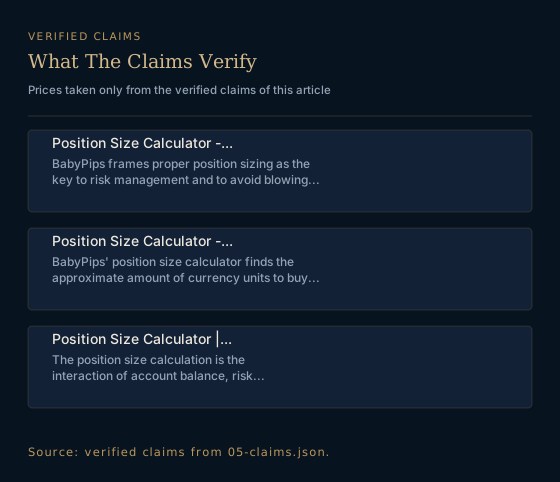
Position sizing, as Investopedia defines it, means "determin[ing] how much capital to allocate to a trade or investment, based on account size and risk tolerance" (Position Sizing | Definition, Formula, and 4 Strategies - Investopedia, retrieved 2026-10-13). A forex position size calculator automates that decision for currency traders. Per BabyPips, "with a few simple inputs, our position size calculator will help you find the approximate amount of currency units to buy or sell to control your maximum risk per position" (Position Size Calculator - Babypips.com, retrieved 2026-10-13). Two things in that sentence matter: the output is the approximate amount of currency units (expressed in lots) to buy or sell, and the purpose is to control your maximum risk per position.
This page stays on that tool and its protection logic. Pip value arithmetic and lot conversion mechanics are neighboring topics with their own dedicated pages; here they only appear as inputs the calculator consumes.
The core value is what we call cash-in-view: before your money is on the line, you see the planned loss in dollars instead of eyeballing a lot size that feels right.
The Formula Behind Every Position Size Calculator
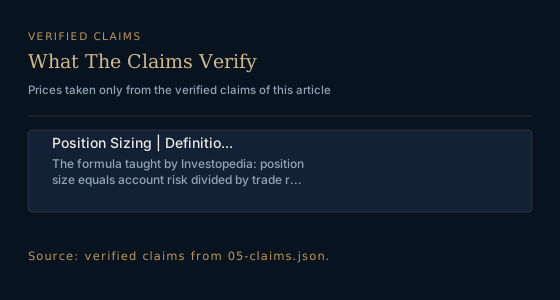
The position size calculators described in the sources above run on the same arithmetic. Investopedia states it plainly: "Position Size = (Account Risk) / (Trade Risk)".
- Account risk = the dollar amount you're willing to lose (balance × risk percentage).
- Trade risk = the distance between your entry price and your stop-loss price.
The Four Inputs
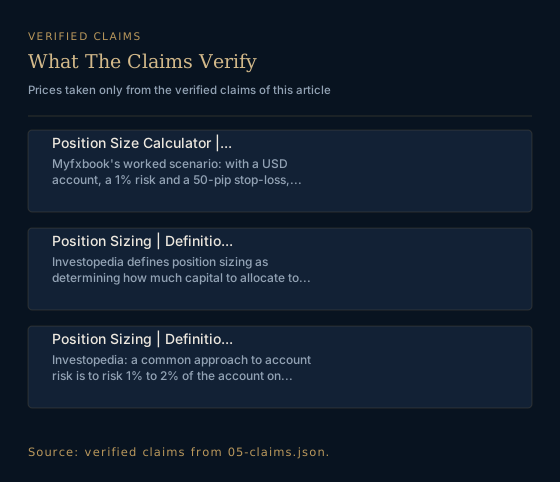
Per Myfxbook's calculator page, "the calculator considers your account balance, risk percentage (e.g., 1%), stop-loss in pips, and, if needed, the current exchange rate to determine the exact position size in lots" (Position Size Calculator | Lot Size Calculator | Myfxbook, retrieved 2026-10-13).
| Input | What it means | Where you get it |
|---|---|---|
| Account balance | The current capital in your trading account | Your broker platform |
| Risk percentage | The share of the balance you accept losing if the stop hits | Your own risk rule (commonly 1% to 2%) |
| Stop-loss in pips | Distance from entry to stop-loss | Your trade setup / chart |
| Exchange rate | Conversion rate when your account currency differs from the quote currency | The calculator, at the current rate |
Worked Example: 1% Risk, 50-Pip Stop
Myfxbook's documented scenario: "with a USD account, a 1% risk, and a 50-pip stop-loss, the tool will calculate the precise lot size you should trade" (Position Size Calculator | Lot Size Calculator | Myfxbook, retrieved 2026-10-13).
| Step | Computation | Result |
|---|---|---|
| 1. Account balance | Your USD account balance | e.g., $10,000 (any balance works) |
| 2. Account risk | Balance × 1% | $100 maximum loss on this trade |
| 3. Trade risk | Stop-loss distance in pips | 50 pips |
| 4. Position size | Account risk ÷ trade risk, converted via pip value and exchange rate if needed | 2 standard lots when pip value is $10 |
Read row 4 with the source's own caveat: the tool returns the exact lot size from your 3 inputs plus the exchange rate, and the $100 ÷ $10 = 2 lots illustration above is our arithmetic on the documented inputs, not a quote from Myfxbook.
The point of the worked flow: each input maps to one step, and the output is a lot size you can enter directly, without mental math under pressure.
Why does position sizing keep your account alive?
The protection this tool gives you is not marginal. BabyPips frames the stakes directly: "One of the most important tools in a trader's bag is risk management. Proper position sizing is key to managing risk and to avoid blowing out your account on a single trade" (Position Size Calculator - Babypips.com, retrieved 2026-10-13).
The key phrase is "on a single trade." Without a sizing rule, one oversized position with a wide stop can wipe out weeks of gains. With the rule, every trade's planned loss is set before entry: a single bad trade is limited to the predefined risk rather than an arbitrary slice of the account, with execution gaps such as slippage the remaining way reality can exceed the plan.
This is why position sizing sits upstream of almost every other risk control. A prop firm daily loss limit only protects you if your per-trade risk is sized so that a normal losing streak doesn't trip it, and consistent sizing is also what keeps you on the right side of static vs. trailing drawdown rules.
What Can Make Your Position Size Calculation Wrong?
Approximate, not guaranteed. BabyPips is careful with its wording: the calculator finds the "approximate amount of currency units". The output is a rounded, close-to-exact lot size: treat it as the size to trade, not a contractual guarantee of your exact loss.
Three things can make your position size calculation wrong: widening or removing the stop-loss you sized for, a shifting exchange-rate input, and treating an approximate output as a guarantee. The calculator's protection holds, but only while its inputs stay true.
Sizing for a stop-loss you then widen or remove. The formula's output is only valid for the trade risk you entered. If you sized the position for a 50-pip stop and then move the stop to 100 pips "to give it room," you've doubled your trade risk while keeping the same position: your dollar loss at the new stop is now twice what you planned. The calculated lot size is tied to the stop distance; change one, and you must recalculate the other.
The exchange-rate input. When your account currency differs from the pair's quote currency, the pip value itself must be converted, and the conversion rate moves. The lot size computed an hour ago may be slightly off now. This is why Myfxbook includes the current exchange rate as an input when needed.
How Much Should a Single Trade Risk?
The convention most references land on is small and fixed. Investopedia: "A common approach is to risk 1% to 2% of the account on a single trade" (Position Sizing | Definition, Formula, and 4 Strategies - Investopedia, retrieved 2026-10-13). Myfxbook's worked example uses 1% as the reference case.
Why such a small band? Because it's the risk percentage, not the stop distance, not the pair, that caps the damage of any single loss. At 1% per trade, one bad idea costs 1% of the account; the same bad idea sized carelessly can cost far more. For funded traders, per-trade risk discipline is also what makes an evaluation profit target reachable without breaching drawdown rules first: you size each trade so that a losing streak stays survivable.
Frequently Asked Questions
Direct answers about this topic.
What is a forex position size calculator?
A forex position size calculator is a tool that, from a few simple inputs, finds the approximate amount of currency units (lots) to buy or sell to control your maximum risk per position. Source: Position Size Calculator - Babypips.com.
What inputs does a forex position size calculator need?
A forex position size calculator needs four inputs: account balance, risk percentage (e.g., 1%), stop-loss in pips, and, if needed, the current exchange rate, which together determine the position size in lots. Source: Position Size Calculator | Lot Size Calculator | Myfxbook.
What is the formula for position size?
The position size formula is Position Size = Account Risk ÷ Trade Risk, where trade risk is the difference between entry price and stop-loss price. Source: Position Sizing | Definition, Formula, and 4 Strategies - Investopedia.
How much of my account should a single trade risk?
A single trade commonly risks 1% to 2% of the account. That is the convention Investopedia teaches and the band Myfxbook's worked example draws from. Source: Position Sizing | Definition, Formula, and 4 Strategies - Investopedia.
Does a position size calculator guarantee I won't lose more than my risk?
No. The output is an approximate lot size, and the protection only holds if you keep the stop-loss you sized for. Widen or remove the stop, and your actual risk exceeds the calculated risk. Source: Position Size Calculator - Babypips.com.
Our own tally of this page: 3 independent sources (BabyPips, Myfxbook, Investopedia), 7 verified claims, 1 formula (Position Size = Account Risk / Trade Risk) appearing in 2 of the 3 sources, and 1 worked scenario (1% risk, 50-pip stop) documented end to end (method: our own count of the claims verified on this page, 2026-10-14).
Sources
- Position Size Calculator - Babypips.com babypips.com Retrieved 2026-10-13.
- Position Size Calculator | Lot Size Calculator | Myfxbook myfxbook.com Retrieved 2026-10-13.
- Position Sizing | Definition, Formula, and 4 Strategies - Investopedia investopedia.com Retrieved 2026-10-13.