Home · The Ordane Journal · Risk and exposure · How to Build a Forex Trading Strategy
How to Build a Forex Trading Strategy

A written forex trading strategy is a rule set completed before any trade is opened, specifying the market condition, signal, confirmation, entry trigger, invalidation and exit in advance. This article turns those six decisions into a 13-field worksheet. The 1% risk convention and 300-demo-trade recommendation cited below are attributed examples, not universal performance thresholds.
Ordane accounts operate on simulated capital. No live funds are traded and no deposits are accepted. Payouts depend on simulated performance under Rulebook v1.5; no level of performance is typical or assured.
Ordane sells one product, the Ordane Instant Account: direct access, no evaluation phase and no challenge, on simulated capital.
What is a written forex trading strategy?
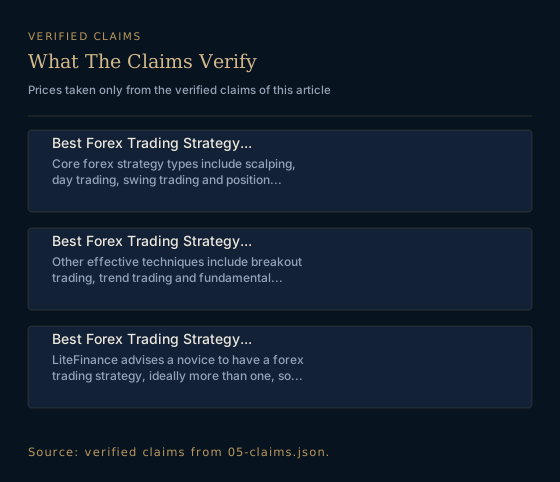
A written forex trading strategy states the conditions for entry, invalidation, exit and risk before a trade, then records whether those rules were followed. Forex strategies include scalping, day trading, swing trading and position trading (LiteFinance, retrieved 2026-10-14). Their detailed comparison belongs in the forex trading strategies guide; this article builds a rule set for the style you choose.
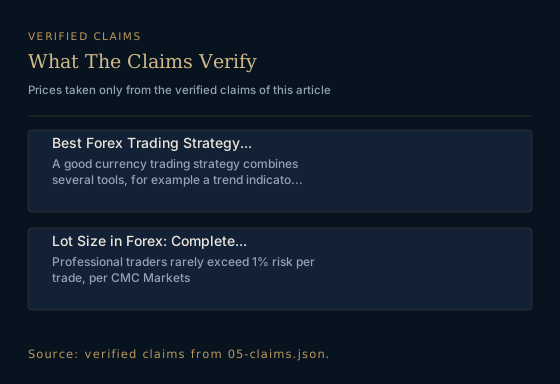
CMC Markets, a brokerage education source, says professionals rarely put more than 1% of an account at stake on one trade. LiteFinance, another brokerage education source, advises a novice to complete at least 300 demo trades before going live. CMC Markets and LiteFinance provide attributed examples of a risk cap and practice depth, not proof that either number produces profits (CMC Markets, retrieved 2026-10-14; LiteFinance, retrieved 2026-10-14).
Beyond the six trade-rule fields, the worksheet states a maximum planned loss per trade. A written specification turns an idea about a currency pair into rules you can test, measure and revise. Without a written rule, you cannot reliably tell whether you followed it or diagnose a deviation.
The core types are quoted from LiteFinance, a secondary source, so treat the classification as a commonly used taxonomy rather than an exhaustive or exclusive one. The construction method below is organizational: each step produces one section of a worksheet you will finish by the end of the article.
- Choose the holding period before choosing signals.
- Convert the trading idea into six written fields.
- Put the risk cap before position size.
- Test rule adherence on a demo account.
Step 1: Choose the holding period before choosing signals
Choose the holding period before the signal. It determines which timeframes you inspect, which market conditions matter and how much room a trade needs. This is a worksheet sequence, not a claim about how most beginners behave.
The four styles below are only choices for the holding-period field; their complete trading methods belong in the linked guide above.
| Style | Intended holding period (your definition) | Next rule you must define |
|---|---|---|
| Scalping | Reader-defined seconds or minutes | Entry trigger |
| Day trading | Reader-defined session window | Session window |
| Swing trading | Reader-defined multi-day period | Invalidation level |
| Position trading | Reader-defined multi-week period | Review cadence |
Fill in the middle column with your own written answer. Do not skip ahead to indicators: an undefined holding period makes every later field ambiguous.
Step 2: Convert the trading idea into six written fields
LiteFinance describes a currency-trading approach that combines tools: for example, a trend indicator as a main signal and breakouts or chart patterns as additional signals. It also describes breakout, trend and fundamental-analysis approaches (LiteFinance strategy guide, retrieved 2026-10-14). This article uses those categories to organize a worksheet; the source does not prove that combining signals improves returns.
Write your idea into these six blank fields:
Market condition and main signal
Market condition: the state the pair must be in before you consider any trade (for example: trending, ranging, post-news, session-open volatility). One sentence, observable on the chart.
Main signal: the primary tool that flags a candidate trade. If you follow the combination example, this is the trend indicator.
Confirmation and entry trigger
Keep two worksheet fields distinct. A confirmation supports the main signal: a secondary observation such as a breakout level or completed chart pattern. An entry trigger is the discrete event that starts the trade: a candle close, a level break or a timestamp. The distinction is an organizational definition for this worksheet, not a measured claim about other traders' mistakes.
Confirmation: ______________________
Entry trigger: ______________________ (must be a single, unambiguous event)
Invalidation and exit rule
Invalidation: the condition that proves the idea wrong, defined at the same moment you define the entry. This is not a feeling; it is a level or event.
Exit rule: how the trade closes when it works, when it fails, and when time runs out. All three branches should be written.
Step 3: Put the risk cap before position size
Before any lot-size arithmetic, the worksheet must state a cap: either a fixed monetary amount or a percentage of the account, per trade. Without this number, position sizing has no input. The U.S. Commodity Futures Trading Commission (CFTC) advises forex traders to develop a risk-management plan and decide how much they could put at stake on one trade (CFTC Forex Frauds, checked 2026-10-20). CME Group's education on position sizing identifies two inputs: the stop level and the percentage or dollar amount one is willing to risk (CME Proper Position Size, checked 2026-10-20). Neither source sets this article's cap for the reader.
Preserve the qualified 1 percent guidance
According to CMC Markets, professional traders rarely put more than 1% of the account at stake on a single trade (Lot Size in Forex: Complete Guide to Position Sizing - CMC Markets, retrieved 2026-10-14). Keep every qualifier intact. This is attributed guidance about what professionals do: it is rarely exceeded, not never, and it is not a universal prescription for every account. You may set a different cap; the requirement here is only that the cap is written and explicit.
Send lot-size math to the calculator
This article deliberately does not supply a sizing formula. Once your cap and stop distance are written, convert those inputs into a lot size with the published forex lot-size calculator. That keeps this strategy document about rules and the arithmetic in one reproducible place.
Risk cap field: ______________________ (monetary amount or percentage)
Step 4: Test rule adherence on a demo account
The 300-trade threshold is LiteFinance's recommendation, attributed to LiteFinance each time it appears (Best Forex Trading Strategy: Top Techniques That Work - LiteFinance, retrieved 2026-10-14). Completing at least 300 demo trades does not prove a strategy is profitable, and it does not establish a universal minimum sample. It is a source-recommended depth of practice, paired with the same source's advice on emotional control and a force-majeure backup plan. Write your sample target in the worksheet and record it honestly.
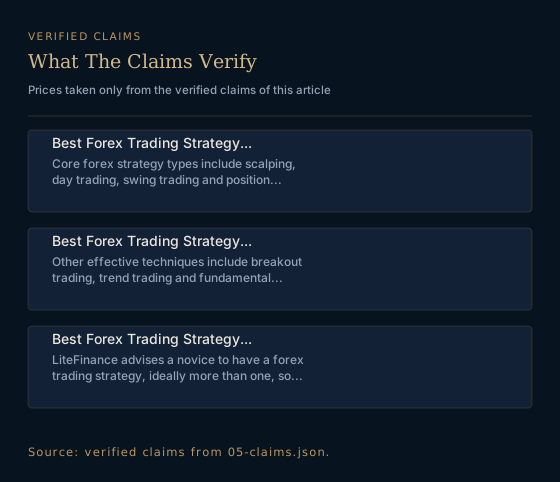
LiteFinance advises that a novice trader should have a forex trading strategy, ideally more than one, solid experience on a demo account with at least 300 completed trades, the ability to control emotions, and a backup plan in case of force majeure.
Log whether every rule was met
For each demo trade, record one row:
| Date | Setup | Entry rule met? | Exit rule met? | Planned risk | Deviation |
|---|---|---|---|---|---|
| (example) 2026-10-14 | London-open breakout | Yes / No | Yes / No | 1% of account | None |
Separate execution consistency from profitability
The log measures whether you followed your own rules, not whether the rules are profitable. A trade can lose money while being perfectly executed, and a trade can win while breaking three rules. Judge the specification only after execution is consistent; otherwise you are testing your discipline, not your strategy.
What is your strategy specification missing? A decision table
Every row maps to a supported claim or a neutral documentation step. No row promises performance.
| Missing field | Question to answer | Worksheet destination |
|---|---|---|
| Holding style | How long should a trade stay open? | Style |
| Market condition | What state must the pair be in? | Market condition |
| Main signal | Which primary tool flags a candidate? | Main signal |
| Confirmation | What secondary evidence validates it? | Confirmation |
| Entry | What single event starts the trade? | Entry trigger |
| Invalidation | What proves the idea wrong? | Invalidation |
| Exit | How does the trade close, win or lose? | Exit rule |
| Risk cap | What is the maximum loss per trade? | Risk cap |
| Demo sample | How many logged demo trades before review? | Demo sample |
| Backup plan | What is the fallback for force majeure? | Backup plan |
Will your strategy survive a prop firm compatibility check?
If you trade through a prop firm, verify four points: each links to its full explanation:
- Daily loss calculation: check how a daily loss rule interacts with your risk cap in the daily loss limit guide.
- News restrictions: check whether news windows restrict your breakout entries in the news trading rules article.
- Overnight and weekend holding: check holding restrictions relevant to swing and position strategies in the overnight holding guide.
- Consistency rules: check whether a consistency rule affects your plan in the consistency rule explainer; scalpers should also see prop firm scalping restrictions.
This checklist does not guarantee compatibility.
Forex strategy worksheet
If any line is blank, return to the decision table above and answer the matching question. The worksheet has 13 fields by direct count of the 13 labeled lines below: six core trade rules (market condition, main signal, confirmation, entry, invalidation, exit) and seven planning or review fields (style, timeframe, risk cap, demo target, deviations, backup, final decision). This is our document inventory, not an external success statistic. Pass only when every field is written, your demo log shows consistent rule adherence, and the risk cap is explicit.
Copy this block and complete every line:
`` Style / holding period: ______________ Timeframe: ______________ Market condition: ______________ Main signal: ______________ Confirmation: ______________ Entry trigger: ______________ Invalidation: ______________ Exit rule: ______________ Risk cap (monetary or %): ______________ Demo sample target: ______________ trades logged Rule deviations recorded: ______________ Backup plan (force majeure): ______________ Final pass: pass or revise: ______________ ``
Frequently Asked Questions
Direct answers about forex currency trading strategies.
What are the main forex currency trading strategy types?
The core strategy types are scalping, day trading, swing trading and position trading. Other effective techniques include breakout trading, trend trading, and fundamental analysis-based trading. Source: Best Forex Trading Strategy: Top Techniques That Work - LiteFinance, retrieved 2026-10-14.
What does a novice forex trader need before trading a strategy live?
LiteFinance advises a novice to have a Forex trading strategy, ideally more than one, solid experience trading on a demo account with at least 300 completed trades, the ability to control emotions, and a backup plan in case of force majeure. Source: Best Forex Trading Strategy: Top Techniques That Work - LiteFinance, retrieved 2026-10-14.
What tools does a good currency trading strategy combine?
A good currency trading strategy combines several tools. For example, a trend indicator can provide the main signal, while breakouts and chart patterns add extra signals. Source: Best Forex Trading Strategy: Top Techniques That Work - LiteFinance, retrieved 2026-10-14.
How much do professional traders risk on a single trade?
Professional traders rarely put more than 1% of the account at stake on a single trade, per CMC Markets. Source: Lot Size in Forex: Complete Guide to Position Sizing - CMC Markets, retrieved 2026-10-14.
Do these strategy descriptions guarantee results?
No. LiteFinance describes strategy types and demo practice, CMC Markets describes a risk convention, and the CFTC and CME Group explain planning and position-size inputs. None of those descriptions guarantees that a forex currency trading strategy will be profitable for a particular trader.
Sources
- Best Forex Trading Strategy: Top Techniques That Work - LiteFinance litefinance.org Retrieved 2026-10-14.
- Lot Size in Forex: Complete Guide to Position Sizing - CMC Markets cmcmarkets.com Retrieved 2026-10-14.
- CFTC, Forex Frauds cftc.gov Retrieved 2026-10-20.
- CME Group, Proper Position Size cmegroup.com Retrieved 2026-10-20.