Home · The Ordane Journal · Risk and exposure · Is Forex Trading Profitable? The Measured Numbers
Is Forex Trading Profitable? The Measured Numbers
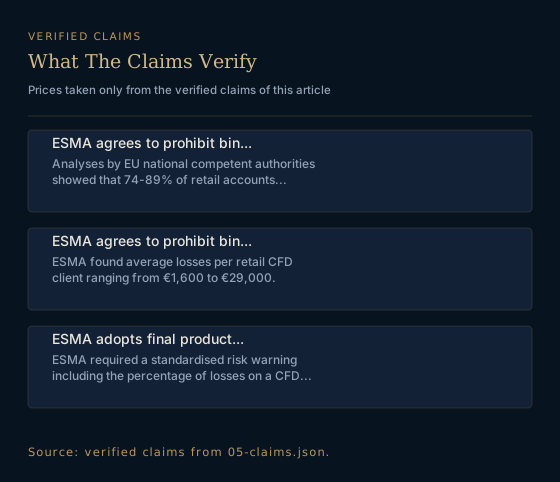
Forex profitability is a question of losses: analyses by EU national competent authorities (NCAs), cited by the European Securities and Markets Authority (ESMA), showed that 74-89% of retail accounts typically lose money on contract-for-difference (CFD) trading, including forex CFDs, and the Australian Securities and Investments Commission (ASIC) found 68% of retail CFD investors lost money in 2024.
Ordane accounts operate on simulated capital. No live funds are traded and no deposits are accepted. Payouts depend on simulated performance under Rulebook v1.5; no level of performance is typical or assured.
Ordane sells one product, the Ordane Instant Account: direct access, no evaluation phase and no challenge, on simulated capital (Ordane Rulebook v1.5, section 1, retrieved 2026-10-13).
Is Forex Trading Profitable? The Short Answer With Numbers
The honest answer replaces broker marketing with regulator data. The EU range comes first: 74-89% of retail accounts typically lose money on CFD trading, including forex CFDs (ESMA agrees to prohibit binary options and restrict CFDs to protect retail investors | ESMA, retrieved 2026-10-13). Australia shows the same picture at a slightly gentler rate: 68% of retail CFD investors lost money in the 2024 financial year (ASIC secures nearly $40 million in refunds to investors and drives change after CFD sector falls short | ASIC, retrieved 2026-10-13).
| Regulator / dataset | Period | Retail accounts losing money | Additional measured figure |
|---|---|---|---|
| EU national competent authorities (analyses cited by ESMA) | Typical | 74-89% | Average losses per client of €1,600 to €29,000 |
| ASIC (Australia) | 2024 financial year | 68% | More than $458 million lost, including $73 million in fees |
So when someone asks "is forex trading profitable?", the base rate answers: the majority of measured retail accounts lose money. The data does not establish a profitable share, because accounts that end at breakeven are counted in neither direction; no percentage of profitable accounts is stated here and none should be inferred. What the data does support is which rules cap the damage, and those rules are published: leverage caps, loss ceilings and position sizing discipline, covered below.
What Counts as Profitable in the Regulator Data
This article is about retail forex and CFD trading: private individuals speculating on currency pairs through a broker, typically with leverage, on margin. A CFD is a contract that pays the difference in an instrument's price between opening and closing, so a forex CFD tracks a currency pair. The regulator figures count accounts that ended the measured period losing money, and ASIC's totals include fees: $73 million of the $458 million lost in the 2024 financial year (ASIC secures nearly $40 million in refunds to investors and drives change after CFD sector falls short | ASIC, retrieved 2026-10-13). That is the strictest definition: money in versus money out, no survivorship stories. For the funded-account reader, the loss mechanics of a funded account is a related question with its own sourcing.
How Many Forex Traders Actually Lose Money?
The most-cited range in retail trading comes from ESMA. Before imposing its product intervention measures, ESMA reviewed analyses by national competent authorities across different EU jurisdictions, and the finding was consistent:
The range exists because it varies by jurisdiction and provider. This is account-level data collected by financial regulators, not a self-reported forum poll, and the loss warnings on broker homepages trace back to this evidence base.
ASIC's 2024 numbers: 68% losing, $458 million lost
In the 2024 financial year alone, 68% of Australian retail CFD investors lost money, totalling more than $458 million, including $73 million in fees (ASIC secures nearly $40 million in refunds to investors and drives change after CFD sector falls short | ASIC, retrieved 2026-10-13). Two details deserve attention. First, the loss is measured in money, not just percentages. Second, fees are counted inside the total: a meaningful slice of the damage is not dramatic blown accounts but the slow cost of trading itself.
Average loss per client: EUR 1,600 to EUR 29,000
The NCA analyses ESMA cited also measured how much the losing side loses on average: average losses per client ranging from €1,600 to €29,000 (ESMA agrees to prohibit binary options and restrict CFDs to protect retail investors | ESMA, retrieved 2026-10-13). That spread reflects different jurisdictions and client profiles. The low end is an expensive lesson; the high end is a life-changing amount for most people.
Which Published Rules Cap the Damage?
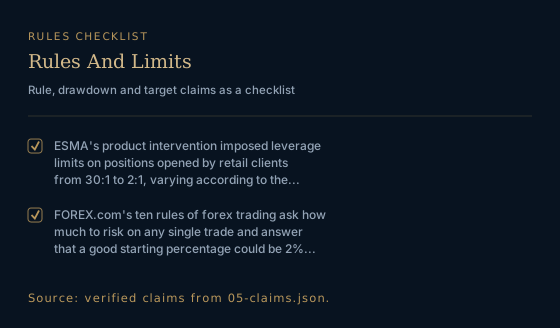
Leverage turns ordinary currency fluctuation into account-ending outcomes. ESMA's product intervention imposed leverage limits on positions opened by retail clients from 30:1 to 2:1, varying according to the volatility of the underlying instrument (ESMA adopts final product intervention measures on CFDs and binary options | ESMA, retrieved 2026-10-13). At 30:1, a 1% move in the position's value moves the margin by 30%; at 2:1 the same move shifts it by 2% (own arithmetic: move × leverage). The more volatile the instrument, the smaller the leverage allowed.
| Measure | What it caps |
|---|---|
| Leverage limits from 30:1 to 2:1 | The size of a position a retail client can open per unit of margin, varying with the volatility of the underlying instrument |
| Negative balance protection on a per account basis | An overall guaranteed limit on retail client losses |
| Standardised risk warning | Requires the provider to publish the percentage of losses on its retail investor accounts |
Negative balance protection: your loss ceiling
ESMA's measures include negative balance protection on a per account basis, an overall guaranteed limit on retail client losses (ESMA adopts final product intervention measures on CFDs and binary options | ESMA, retrieved 2026-10-13). Where this protection applies, the worst case is defined in advance; outside those jurisdictions, it may not be. Checking whether your account has it is a two-minute exercise; the difference between a daily loss limit and a max drawdown is the next check after it.
The 2% starting percentage as the discipline line
The third measure is not a regulator's: it is an attributed starting guideline from FOREX.com, a retail forex broker, and it addresses how you lose rather than whether the market moves against you. FOREX.com's ten rules of forex trading ask how much to risk on any single trade and answer that a good starting percentage could be 2% of your available trading capital (Ten rules of forex trading | FOREX.com US, retrieved 2026-10-13). At 2% per trade, ten consecutive losses cost about 18.3% of the account (own arithmetic: 1 − 0.98^10 = 0.183), while risking 10% per trade costs about 65.1% over the same streak (1 − 0.90^10 = 0.651). Saving the rules that will judge your trading, as in how to save a firm's rules before paying, keeps the discipline line visible.
Will the Rules That Protect You Still Exist Tomorrow?
A protective rule only helps if the system behind it persists. On that question this article stays with what its sources state: ESMA adopted final product intervention measures on CFDs, including leverage limits from 30:1 to 2:1 and a standardised risk warning that publishes the percentage of losses on a provider's retail investor accounts (ESMA adopts final product intervention measures on CFDs and binary options | ESMA, retrieved 2026-10-13). How long any individual broker persists is a vetting question, not a promise; how to audit a trading firm covers the checks.
How to read a broker's published loss rate before you open an account
Because the format is standardised, you can use it as a vetting step. Before depositing, find the provider's loss-percentage disclosure and compare it with the regulator range: a broker at the top of the 74-89% band is telling you something different from one at the bottom. If a broker targeting retail clients publishes no loss percentage at all, check which jurisdiction it answers to before assuming which of the rules above apply to your account.
What Does Trying Actually Cost You?
Of the more than $458 million lost by Australian retail CFD investors in the 2024 financial year, $73 million was fees (ASIC secures nearly $40 million in refunds to investors and drives change after CFD sector falls short | ASIC, retrieved 2026-10-13). A meaningful share of the money lost was not lost to market direction at all: it was the cost of trading itself, in spreads, commissions and overnight financing. The interaction between trading costs and drawdown develops that mechanic.
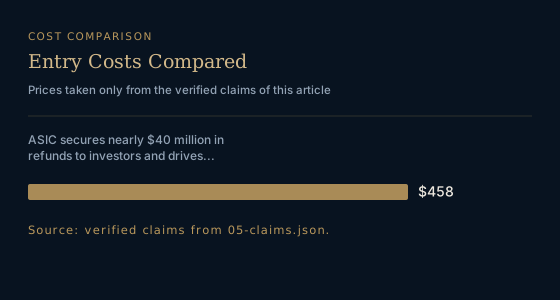
Original calculation: fees as a share of ASIC's total loss
- Inputs: $73 million in fees and $458 million in total losses, both from ASIC for the 2024 financial year (ASIC secures nearly $40 million in refunds to investors and drives change after CFD sector falls short | ASIC, retrieved 2026-10-13).
- Method: divide fees by total losses. 73 ÷ 458 = 0.159, which is 15.9%.
- Reading: because ASIC reports "more than" $458 million, 15.9% is an upper bound; roughly 16% of retail CFD losses or less was pure transaction cost.
- Second check, same method: the EU upper bound of 89% minus ASIC's 68% is 21 percentage points, and the lower bound of 74% minus 68% is 6 points. The datasets cover different regions and periods, so this is a spread between two measurements, not a like-for-like comparison.
Frequently Asked Questions
Direct answers about forex profitability.
Can you actually make money with forex trading?
ESMA's cited EU analyses and ASIC's Australian data do not measure who makes money; they measure who loses it: 74-89% of retail accounts typically lose money in the EU jurisdictions ESMA reviewed, and ASIC measured 68% losing money in Australia in the 2024 financial year. That is the honest frame, not "impossible" and not "easy money". Source: ESMA agrees to prohibit binary options and restrict CFDs to protect retail investors | ESMA.
What percentage of forex traders lose money?
In the EU analyses cited by ESMA, 74-89% of retail accounts typically lose money on CFDs; ASIC measured 68% of Australian retail CFD investors losing money in the 2024 financial year. These are account-level regulator figures, not estimates. Source: ESMA agrees to prohibit binary options and restrict CFDs to protect retail investors | ESMA.
What is the average loss per trader?
ESMA found average losses per retail client ranging from €1,600 to €29,000. Source: ESMA agrees to prohibit binary options and restrict CFDs to protect retail investors | ESMA.
Is forex trading basically gambling?
Not structurally: currency prices respond to measurable drivers, and risk can be capped by rules like leverage limits and negative balance protection. But traded without a written rule set, at high leverage and high frequency, the cost structure and loss base rate resemble it closely. Source: ESMA agrees to prohibit binary options and restrict CFDs to protect retail investors | ESMA.
Can a beginner be profitable in forex?
Both regulator datasets show most retail accounts losing money, ESMA's 74-89% range across EU jurisdictions and ASIC's 68% figure for Australia, and neither separates the remainder into profitable versus breakeven, so no profitable share is promised here. The realistic path runs through the rules that cap losses first, protected accounts, capped leverage, a fixed capped amount placed at stake on each position, before any attempt at generating profit. Source: ESMA agrees to prohibit binary options and restrict CFDs to protect retail investors | ESMA.
Sources
- ESMA agrees to prohibit binary options and restrict CFDs to protect retail investors | ESMA esma.europa.eu Retrieved 2026-10-13.
- ASIC secures nearly $40 million in refunds to investors and drives change after CFD sector falls short | ASIC asic.gov.au Retrieved 2026-10-13.
- ESMA adopts final product intervention measures on CFDs and binary options | ESMA esma.europa.eu Retrieved 2026-10-13.
- Ten rules of forex trading | FOREX.com US forex.com Retrieved 2026-10-13.