Home · The Ordane Journal · Rules and mechanics · What Is Forex Currency Trading? Rules and Risks
What Is Forex Currency Trading? Rules and Risks
Forex currency trading exchanges 2 currencies quoted as a pair, aiming to benefit from movements in their exchange rate. The market operates 24 hours a day, 5 days a week without a central exchange. Dealer costs, leverage and counterparty risk can turn an apparently favorable price movement into a loss.
Ordane accounts operate on simulated capital. No live funds are traded and no deposits are accepted. Payouts depend on simulated performance under Rulebook v1.5; no level of performance is typical or assured.
Ordane sells one product, the Ordane Instant Account: direct access, no evaluation phase and no challenge, on simulated capital.
Because the market has no central exchange, trades are executed over the counter through a network of banks and dealers, which shapes both how trades settle and what it costs to place them. This article walks through one complete trade path, using a warning from the Commodity Futures Trading Commission (CFTC) as the anchor.
What is forex currency trading, exactly?
At its core, forex (also written as FX) trading is the simultaneous purchase of one currency and sale of another. You never trade a currency in isolation; you always trade the relationship between two of them. That relationship is expressed as a currency pair, and understanding the pair is the fastest way to understand the whole market.
Currency pairs: the base currency and the quote currency
A currency pair is written with two codes, such as EUR/USD. The first currency is the base currency and the second is the quote currency. The price shown tells you how much of the quote currency you need to spend to buy one unit of the base currency. If EUR/USD is quoted at 1.08, one euro costs 1.08 US dollars. The pair is a single instrument: you cannot take a position on the euro without simultaneously taking the opposite position on the dollar.
Why buying one currency means selling another
When you "buy" EUR/USD, you are exchanging dollars for euros. The dollars leave your side of the trade and euros arrive. If you later close the position, you exchange back. Whether the round trip produces a gain depends entirely on where the rate moved in between. This is why the market is described in terms of pairs rather than single currencies: the trade is always an exchange, not a simple purchase.
Why exchange rates move as demand changes
Forex rates fluctuate constantly, based on patterns of demand between the two currencies in a pair. If more participants want to hold euros than dollars at a given moment, the euro side of the pair strengthens against the dollar side; if demand reverses, the rate moves the other way. The rate is therefore a live, continuously updated measure of relative demand: not a fixed price set by any authority.
How does one forex trade move through the market?
One trade, 2 currencies, 0 central exchange: here is the path.
The clearest way to see how forex works is to follow a single trade from quote to settlement. The stages below are sequential: each one depends on the previous one, and the trade is not complete until the final stage.
From a quoted currency pair to a spot trade
The trade begins with a quoted pair. A price appears for EUR/USD, reflecting current demand between the two currencies. A participant decides to act on that quote and places an order. In the most basic form of the market, spot forex, the order results in the physical exchange of a currency pair, which takes place at the exact point the trade is settled. That description covers the spot market itself; many retail traders instead access forex through derivative products, where no physical delivery of the two currencies occurs.
What spot settlement means
Spot settlement refers to settlement on the spot or within a short period. In spot forex the two currencies are actually exchanged at settlement, rather than promised for delivery at a distant date. The definition covers what is exchanged and when in the spot market; it does not describe derivative-based retail products, and it does not, by itself, describe execution speed, slippage or fill quality, which are separate questions.
Why there is no single central forex exchange
Since there is no centralized location, you can trade forex 24 hours a day (What is Forex (FX) Trading and How Does it Work? - IG, retrieved 2026-10-14). The institutional market runs through a global network of banks rather than through one exchange building or matching engine. This structure is why the market operates across the world on a continuous schedule, and it is also why the identity of your counterparty matters, as the next section explains.
| Stage | What happens | Who is involved | What the sources support | What it does not show |
|---|---|---|---|---|
| Pair quoted | A rate is published for a pair, reflecting demand between the two currencies | Pricing sources across the bank network | Rates fluctuate constantly on demand patterns | Not who sets the price or execution quality |
| Order placed | A participant exchanges at the quoted rate | The trader | A trade is an exchange of two currencies | Not order types or platform behaviour |
| Counterparty executes | The other side is taken | A dealer or bank on the OTC network | The market has no central exchange | Not every dealer's execution model |
| Trade settled | The currencies are exchanged | Both sides | Spot is the physical exchange at settlement | Exact settlement timing beyond "spot or a short period" |
Who is on the other side of an OTC forex trade?
Because there is no central exchange, every retail forex trade has an identifiable opposite side, and in over-the-counter (OTC) forex, that side is frequently a dealer. This fact changes the economics of the trade in ways that are easy to miss when you only look at the chart.
The dealer is not a neutral pipe to the market. According to the CFTC's own customer advisory, "Your dealer makes money when you trade more frequently, lose money, or pay fees, spreads, or commissions" (Customer Advisory: Eight Things You Should Know Before Trading Forex - CFTC, retrieved 2026-10-14). That is a statement about the incentive structure, not an allegation of misconduct against any specific firm: the dealer's revenue model is tied to volume and to the costs you pay on each trade.
For you as a trader, the practical reading is a cost map. Every round trip can carry fees, spreads or commissions, and those costs are paid whether the position wins or loses. A high-frequency approach multiplies the number of times those costs are charged; a wider spread on an exotic pair raises the cost per trade; and commissions add a fixed component on top. Reading the CFTC warning as a checklist, the three questions to answer before any OTC forex account are: how many trades per month the strategy implies, what the spread costs on the pairs traded, and what commissions apply per lot.
What changes when forex appears on a prop firm account?
Forex as a market and a prop firm account as a product are two different subjects, and keeping them separate prevents a common confusion. This article covers the first subject: what forex currency trading is and how trades move from quote to settlement. The market mechanics described above belong to the forex market itself. Ordane accounts operate on simulated capital under Rulebook v1.5: no live funds are traded and no deposits are accepted, and the account-level rules that wrap around the trading are set by the firm, not by the market.
Which adjacent guide answers each prop firm question
- To see which instruments a prop firm account makes available, including forex pairs, read what can you trade on a prop firm account.
- To understand how a simulated prop firm account differs from a broker demo, read is a prop firm account a demo account.
- To check for costs beyond the visible account price, read about prop firm hidden fees.
- To assess a prop firm counterparty separately from forex market mechanics, read are prop firms legit.
- To understand what a dealer relationship means for execution, read the analysis of prop firm trade manipulation and the method for prop firm spread verification.
Verified facts at a glance
| Verified fact | Source |
|---|---|
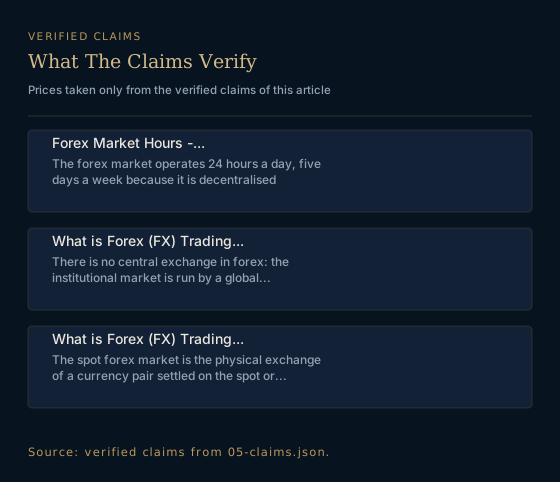
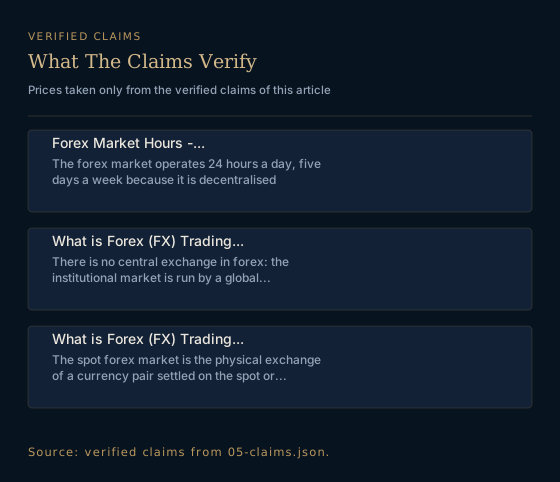
| The forex market operates 24 hours a day, five days a week because it is decentralised | Forex Market Hours - Capital.com |
| There is no central exchange: the institutional market is run by a global network of banks | What is Forex (FX) Trading and How Does it Work? - IG |
| Spot forex is the physical exchange of a currency pair settled on the spot or within a short period | What is Forex (FX) Trading and How Does it Work? - IG |
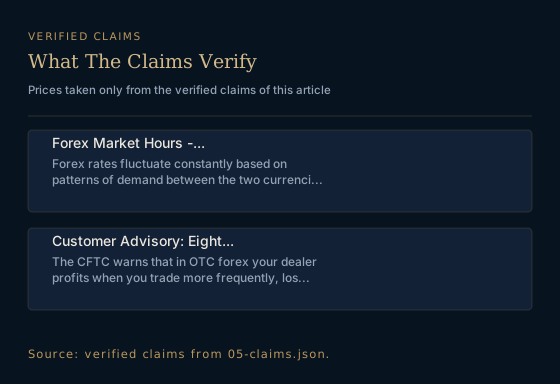
| Rates fluctuate constantly based on patterns of demand between the two currencies in a pair | Forex Market Hours - Capital.com |
| The CFTC warns that in OTC forex your dealer profits when you trade more frequently, lose money, or pay fees and spreads | Customer Advisory: Eight Things You Should Know Before Trading Forex - CFTC |
| Market mechanic | Belongs to | Example question |
|---|---|---|
| Currency pair quoting | The forex market | "What is a base currency?" |
| Spot settlement | The forex market | "When does the exchange happen?" |
| OTC counterparty structure | The forex market | "Who takes the other side?" |
| Drawdown limits and evaluation phases | The prop firm account | "What can I trade on this account?" |
Our own tally of this page: 5 verified claims from 3 independent domains (capital.com 2, ig.com 2, cftc.gov 1); every claim is definitional or structural (24/5 hours, no central exchange, pair mechanics, dealer incentive), and 0 of the 5 is a price quote or return figure : nothing here predicts what any pair will do (method: our own count of the claims verified on this page, 2026-10-14).
Frequently Asked Questions
Direct answers about how forex currency trading works.
Why is the forex market open 24 hours a day, five days a week?
Due to its decentralised nature, the forex market operates 24 hours a day, five days a week, across the world. Source: Forex Market Hours - Capital.com, retrieved 2026-10-14.
Is there a central exchange in forex?
No. There is no central exchange: the institutional market is run by a global network of banks, and since there is no centralized location, you can trade forex 24 hours a day. Source: What is Forex (FX) Trading and How Does it Work? - IG, retrieved 2026-10-14.
What does spot mean in forex settlement?
Spot forex is the physical exchange of a currency pair, which takes place at the exact point the trade is settled, on the spot or within a short period; derivative-based retail products involve no physical delivery. Source: What is Forex (FX) Trading and How Does it Work? - IG, retrieved 2026-10-14.
Why do forex rates fluctuate constantly?
Forex rates fluctuate constantly, based on patterns of demand between the two currencies in a pair. Source: Forex Market Hours - Capital.com, retrieved 2026-10-14.
How does an OTC forex dealer make money from your trades?
The CFTC warns that in OTC forex your dealer profits when you trade more frequently, lose money, or pay fees, spreads, or commissions. Source: Customer Advisory: Eight Things You Should Know Before Trading Forex - CFTC, retrieved 2026-10-14.
Sources
- Forex Market Hours - Capital.com capital.com Retrieved 2026-10-14.
- What is Forex (FX) Trading and How Does it Work? - IG ig.com Retrieved 2026-10-14.
- Customer Advisory: Eight Things You Should Know Before Trading Forex - CFTC cftc.gov Retrieved 2026-10-14.