Home · The Ordane Journal · Rules and mechanics · How to Read Forex Trading Hours Correctly
How to Read Forex Trading Hours Correctly
Forex trading hours describe the conventional 24-hour, five-day (24/5) currency market and four sessions: Sydney, Tokyo, London and New York. A session clock is a reference, not a promise of account access. Confirm its time zone and effective date against the broker’s instrument schedule, including daily maintenance and holidays.
Ordane accounts operate on simulated capital. No live funds are traded and no deposits are accepted. Payouts depend on simulated performance under Rulebook v1.5; no level of performance is typical or assured.
Ordane sells one product, the Ordane Instant Account: direct access, no evaluation phase and no challenge, on simulated capital.
What does a forex trading-hours clock show?
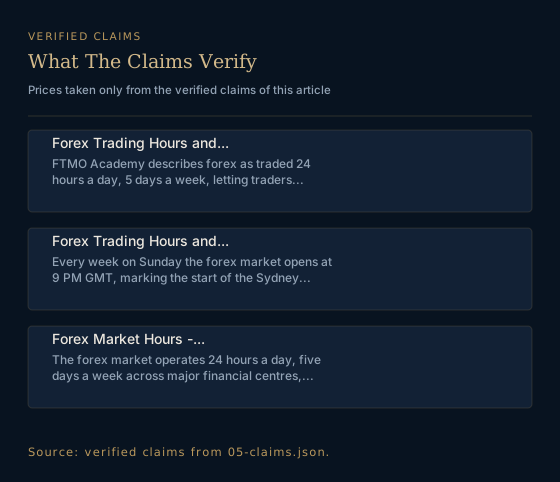
Most clocks are built on the same underlying convention. FTMO Academy describes forex as a market "traded 24 hours a day 5 days a week" because of its liquidity and size, which lets traders trade at times that suit their schedule (Forex Trading Hours and Sessions - FTMO Academy, retrieved 2026-10-14). Capital.com states the same structure from a different angle: the market "operates 24 hours a day, five days a week, across major financial centres worldwide, divided into four major trading sessions: London, New York, Sydney, and Tokyo" (Forex Market Hours - Capital.com, retrieved 2026-10-14).
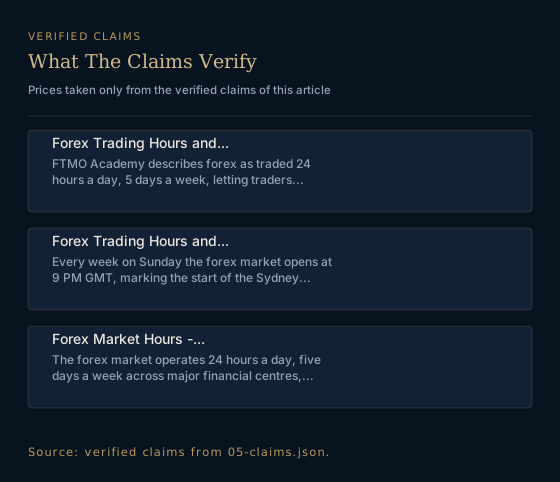
That 24/5 figure describes the broad trading week, not uninterrupted access to every instrument at every broker (Forex Trading Hours and Sessions - FTMO Academy, retrieved 2026-10-14; Forex Market Hours - Capital.com, retrieved 2026-10-14).
Session labels versus actual account access
A clock showing colored Sydney, Tokyo, London and New York bands is displaying a reference layer: the conventional sequence of global sessions. Your account access is controlled by a different layer: the dated broker and instrument schedule. The two usually overlap, but they are not the same document, and when they disagree, the broker schedule wins.
Why a clock can be accurate and still incomplete
A clock can be perfectly correct about GMT session boundaries and still tell you nothing about your broker's platform maintenance, your instrument's availability, or this week's holiday notice. Accuracy and completeness are separate tests, and the rest of this article checks both.
How do you verify the time zone on a forex clock?
FTMO Academy publishes the weekly opening in explicit GMT terms: "Every week on Sunday, the Forex market opens at 9 PM GMT, which makes the start of the Sydney session," with Tokyo starting two hours later at 11 PM GMT (Forex Trading Hours and Sessions - FTMO Academy, retrieved 2026-10-14). Notice what makes this citation usable: the number and the zone travel together. "9 PM" alone is meaningless: 9 PM where? The dedicated question of when the forex market starts is covered by our article on forex start times, and the complete session timetable belongs to our forex market hours guide; this page owns the audit of the clocks themselves. The first audit step is identifying which zone the clock is speaking in. Many widgets display your local time while citing sources that publish in GMT or UTC: close relatives, but not interchangeable labels on a published schedule. If a clock does not state its reference zone anywhere on the page, treat every hour shown as unverified.
Why daylight saving time changes local conversions
GMT means Greenwich Mean Time; UTC means Coordinated Universal Time; DST means daylight saving time. FTMO Academy is an educational source, Capital.com a broker publishing educational hours, and BabyPips a trading-education publisher. Their general explanations are not your account’s execution contract.
The GMT anchor is fixed, but your local offset is not. When your region shifts for daylight saving time, the local-clock equivalent of 9 PM GMT changes by an hour even though the GMT value never moved. A four-field verification box catches this:
- Source zone: the zone the schedule was published in (e.g., GMT)
- Displayed zone: the zone the clock renders (e.g., your local time)
- Effective date: the date the conversion applies to
- DST status: whether either zone is currently on summer time
If you cannot fill in all four fields, do not trust the displayed hour.
What do the four forex sessions mean?
The 4 session labels organize the trading day into the sequence in which major financial centres are active. They are a shared vocabulary, not a legal schedule: no global authority enforces them.
What a session label establishes, and what it does not
| Clock element | What it tells you | What it cannot tell you | Controlling source |
|---|---|---|---|
| Session band (e.g., "London") | Which centre's conventional window is active | Whether your broker is open | Broker schedule |
| "Market open" indicator | The 24/5 week is running | Instrument-specific availability | Instrument schedule |
| Time-zone label | The reference zone | DST status of your local clock | Your verification box |
| Holiday shading | A closure is expected | The exact dated notice | Broker holiday notice |
Why can broker and instrument hours differ?
The 24/5 convention describes currency trading broadly. Within that week, a broker may list different availability for major pairs, exotic pairs, indices or CFDs. The instrument schedule, not the market convention, controls when you can actually place an order.
Maintenance and platform interruptions
OANDA US specifies a 6-minute daily FX break, 16:59-17:05 New York time (OANDA US operating hours, retrieved 2026-10-16). This is one broker’s schedule, not a universal closure.
Brokers and platforms run scheduled maintenance: often around the weekly open or close, but sometimes midweek. During maintenance the market is technically trading while your access is paused. A generic clock cannot represent this because it does not know your broker.
The dated schedule that governs the account
When auditing your own access, capture five facts rather than trusting a widget: (1) the broker, (2) the instrument, (3) the schedule's date, (4) its time zone, and (5) any exception notice attached. If you trade with or evaluate a prop firm, also check its overnight and weekend holding rules, since platform access and firm permission are two different gates.
When are forex sessions usually busiest?
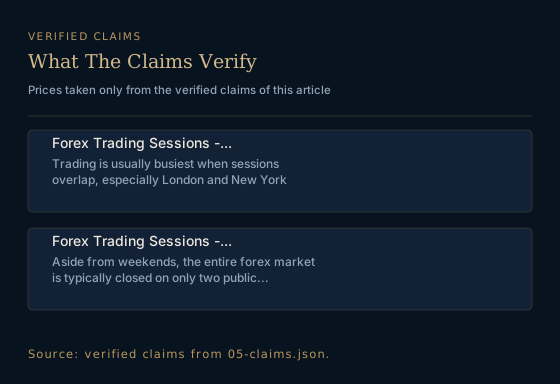
Because sessions follow the sun, consecutive sessions share hours. During those overlaps, 2 centres are active simultaneously, which concentrates participation. BabyPips summarizes the pattern plainly: "Trading is usually busiest when sessions overlap, especially London and New York" (Forex Trading Sessions - BabyPips, retrieved 2026-10-14).
The London and New York overlap
The London and New York overlap is the most commonly cited example: the two largest centres are both active, so more participants are quoting prices at the same time. That is a description of activity, and the word "usually" in the source matters: volume is a tendency, not a guarantee on any given day.
Why activity is not a trading recommendation
A busier session is not automatically a better one for you. Higher participation says nothing about your strategy, spreads at your broker, execution quality, or risk exposure. Traders who avoid trading around scheduled releases should check the news-trading policy of whichever firm they evaluate, because prop firm news trading rules differ between firms and the controlling document is always the firm's own rulebook. Activity is context, never advice.
How do weekends and holidays affect the clock?
The "5" in 24/5 counts trading days, not the length of the weekend break. The market runs continuously from the Sunday open until the weekly close, then stops. A clock that shows "open 24/7" is simply wrong for forex.
The five checks before relying on a displayed schedule
Before acting on any forex-hours clock, confirm:
- Source time zone: the zone the schedule was published in
- Effective date: the date the schedule applies to, including DST status
- Broker: whose schedule actually governs your access
- Instrument: whether the pair or product you trade has different availability
- Holiday or maintenance notice: the dated exception, if any
Original clock calculation
Our calculation, 2026-10-16: 24 hours × 5 days = 120 nominal market hours. Method: multiply the 24/5 convention documented above; do not subtract broker breaks without its full dated schedule. This is arithmetic, not measured uptime or a trading recommendation.
Related guides
Two layers govern when you can actually trade: the market clock and the account rules. For the account layer, read the firm's overnight and weekend holding policy and its news trading policy. For evaluating a firm's claims in general, see how to audit a prop firm, the prop firm scalping rules for short-hold strategies, and the trade-off in a one-step versus two-step evaluation.
Verified facts at a glance
| Verified fact | Source |
|---|---|
| FTMO Academy describes forex as traded 24 hours a day, 5 days a week, letting traders trade at any time that suits their schedule | Forex Trading Hours and Sessions - FTMO Academy (2026-10-14) |
| Every week on Sunday the forex market opens at 9 PM GMT, marking the start of the Sydney session, with Tokyo starting two hours later at 11 PM GMT | Forex Trading Hours and Sessions - FTMO Academy (2026-10-14) |
| The forex market operates 24 hours a day, five days a week across major financial centres, divided into the London, New York, Sydney and Tokyo sessions | Forex Market Hours - Capital.com (2026-10-14) |
| Trading is usually busiest when sessions overlap, especially London and New York | Forex Trading Sessions - BabyPips (2026-10-14) |
| BabyPips identifies Christmas and New Year’s Day as holiday exceptions; consult the dated broker schedule rather than assuming a universal closure | Forex Trading Sessions - BabyPips (2026-10-14) |
Frequently Asked Questions
Direct answers about forex trading hours and sessions.
Is the forex market open 24 hours a day?
Yes, five days a week. FTMO Academy describes forex as a market traded 24 hours a day, 5 days a week, because of its liquidity and size, which lets traders trade at times that suit their schedule. Source: Forex Trading Hours and Sessions - FTMO Academy, retrieved 2026-10-14.
Why do published Sunday opening times differ between clocks?
Because the reference time zone differs. The GMT anchor published by FTMO Academy is explicit: every week on Sunday, the forex market opens at 9 PM GMT, the start of the Sydney session, with Tokyo starting two hours later at 11 PM GMT. Source: Forex Trading Hours and Sessions - FTMO Academy, retrieved 2026-10-14.
What are the four forex trading sessions?
The forex market operates 24 hours a day, five days a week, across major financial centres worldwide, divided into four major trading sessions: London, New York, Sydney, and Tokyo. Source: Capital.com, Forex Market Hours, retrieved 2026-10-14.
When is forex trading busiest?
Trading is usually busiest when sessions overlap, especially London and New York. Source: Forex Trading Sessions - BabyPips, retrieved 2026-10-14.
Is the forex market ever closed besides weekends?
Other than the weekends, there are just two public holidays when the entire forex market is typically closed, Christmas and New Year's Day. Source: Forex Trading Sessions - BabyPips, retrieved 2026-10-14.
Sources
- Forex Trading Hours and Sessions - FTMO Academy academy.ftmo.com Retrieved 2026-10-14.
- Forex Market Hours - Capital.com capital.com Retrieved 2026-10-14.
- Forex Trading Sessions - BabyPips babypips.com Retrieved 2026-10-14.
- OANDA US hours of operation oanda.com Retrieved 2026-10-16.