Home · The Ordane Journal · Rules and mechanics · Forex Trading Strategies: Four Types, Defined
Forex Trading Strategies: Four Types, Defined
Forex trading strategies are methodologies for entering and exiting FX positions, and of the many approaches the source guides list, this article defines 4 with verified citations: trend, range, breakout and carry. Then derives 1 checkable decision rule from those 4 definitions.
Ordane accounts operate on simulated capital. No live funds are traded and no deposits are accepted. Payouts depend on simulated performance under Rulebook v1.5; no level of performance is typical or assured.
Ordane sells one product, the Ordane Instant Account: direct access, no evaluation phase and no challenge, on simulated capital. (Ordane Rulebook v1.5, section 1, retrieved 2026-10-13)
What is a forex trading strategy?
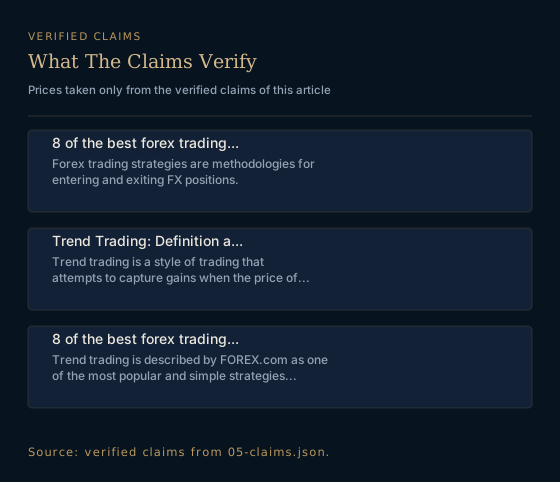
Start with the definition itself: forex trading strategies are methodologies for entering and exiting FX positions (8 of the best forex trading strategies | FOREX.com, retrieved 2026-10-13). That sentence does more than it appears to: a strategy is a methodology, a repeatable rule, for two discrete actions, entering a position and exiting it.
If something cannot tell you when to enter and when to exit, it is not a strategy in the sense FOREX.com defines. It is an observation. An observation leaves the exit decision to your mood at the worst possible moment, while a methodology closes the position by a rule you wrote in advance. For how account models differ, see the difference between an instant account and an evaluation-style account. The source guides describe further strategies beyond the four covered below; these are the four this article carries verified definitions for.
What is trend trading?
Of this article's 4 strategy families, trend trading is definition #1. Investopedia defines trend trading as a trading strategy that attempts to capture gains through the analysis of an asset's momentum in 1 given direction (Trend Trading: Definition, Strategy, and Indicators | Investopedia, retrieved 2026-10-13). "Attempts to capture gains", not guarantees; "momentum in a given direction" means the analysis rides a move already under way, not a forecast of one.
The Investopedia definition: capture gains from momentum in a given direction
The exact wording matters because the definition is the standard any written strategy gets tested against. The strategy attempts to capture gains, and it does so through the analysis of an asset's momentum in a given direction. If the price has no directional momentum to analyze, the definition's condition is not met and the label does not apply.
Why FOREX.com calls it one of the most popular and simple strategies
FOREX.com adds the reason this strategy dominates beginner guides: trend trading is one of the most popular and simple strategies because its only criterion is that you trade in the direction of the current market movement (FOREX.com, retrieved 2026-10-13). There is no second condition: no band to identify, no differential to calculate. You either trade in the direction the market is currently moving, or it is not trend trading by this definition. That gives the first line of the decision rule: a trend trade exists only when you can state the direction you are following.
What is range trading?
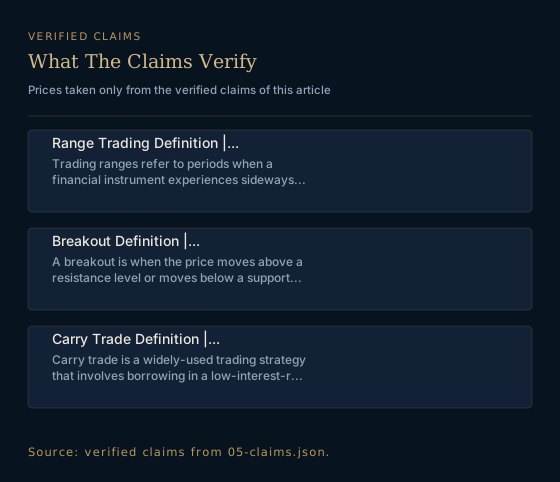
Strategy #2 of 4, defined by 2 boundaries. BabyPips, in its Forexpedia, defines the underlying condition: trading ranges refer to periods when a financial instrument experiences sideways price movement, fluctuating within a defined price band (Range Trading Definition | Forexpedia by BabyPips.com, retrieved 2026-10-13). The key qualifier is "sideways price movement" inside a "defined price band": without boundaries you can point to, there is no range, just price that has stopped trending.
Range vs trend: a defined band vs a sustained direction
The contrast with the trend definition above is exact and requires nothing beyond the two quotes. Trend trading, per Investopedia, captures gains when price moves in a sustained direction. Range trading, per BabyPips, operates when price moves sideways within a defined band. One strategy needs the market to keep going somewhere; the other needs it to stay inside walls it has drawn. Which of the two conditions you can name, direction or band, is the first question this article's decision rule asks.
What is breakout trading?
Strategy #3 of 4. BabyPips defines the breakout in one sentence with 2 possible events: a breakout is when the price moves above a resistance level or moves below a support level (Breakout Definition | Forexpedia by BabyPips.com, retrieved 2026-10-13). The definition names two events, a move above a resistance level or below a support level, both meaningless without the level being identified beforehand.
Why a breakout is a signal only with the level attached
The definition is level-relative: "above a resistance level" and "below a support level" both require naming the level itself. A breakout claim that cannot say "resistance at X" or "support at Y" is incomplete by the definition's own wording. Breakouts also carry an execution risk: fast movement through a level is where orders fill away from where you expected; to understand how a buffer between your stop and normal slippage works when price gaps through a level, see how a stop-loss slippage buffer handles breakout execution.
What is the carry trade?
Strategy #4 of 4, the only 1 of the four built on 2 interest rates instead of price direction. BabyPips defines the carry trade as a trading strategy that involves borrowing in a low-interest-rate currency and investing in a high-interest-rate currency to profit from the interest rate differentials (Carry Trade Definition | Forexpedia by BabyPips.com, retrieved 2026-10-13). Nothing in this definition depends on price direction: the profit mechanism is the differential between the two interest rates, you pay to borrow the low-yield currency and receive on the high-yield one. It is the only one of the four whose cited criterion is a rate relationship rather than a price behavior.
AUD/JPY and NZD/JPY: the pairs FOREX.com names as most popular
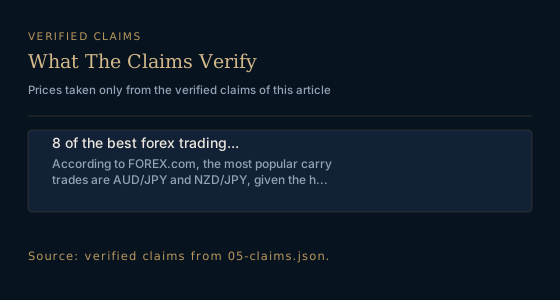
FOREX.com names the classic examples: some of the most popular carry trades are AUD/JPY and NZD/JPY, given the high interest rate spreads between them (FOREX.com, retrieved 2026-10-13). The stated reason is exactly the differential the BabyPips definition makes the source of profit. Because a carry position can involve holding offsetting exposure across pairs, whether multi-leg positioning is permitted on a prop firm account is worth checking separately; see whether prop firms allow hedging.
How do you choose between the four strategies?
Every cell in the table below is built only from the cited definitions above, nothing added, nothing inferred:
| Strategy | Source | The criterion its definition states |
|---|---|---|
| Trend | Investopedia / FOREX.com | Price moving in a sustained direction; trade in the direction of the current market movement |
| Range | BabyPips | Sideways price movement fluctuating within a defined price band |
| Breakout | BabyPips | Price moves above a resistance level or below a support level |
| Carry | BabyPips | Borrowing in a low-interest-rate currency, investing in a high-interest-rate currency, to profit from the differential |
The four criteria also give a practical identification order, this article's own arrangement rather than a rule the sources prescribe. A live market can satisfy more than one condition at the same time:
- Can you name the direction of the current market movement? If yes, trend trading is the definition that applies, and its only criterion is that you trade in that direction.
- If there is no direction, can you name the band? If yes, the range definition applies; if not, do not force one.
- Has price just moved through a level you identified in advance? If yes, that is a breakout by definition, including when it happens in the direction of an existing trend.
- Is your profit mechanism the interest rate differential? If yes, carry is the definition that applies, whether or not price is also moving in a direction.
Each definition supplies one testable condition, which is what makes the order checkable. The source guides list further strategies beyond these four; this rule covers the four defined here. Before risking an account, test your written strategy against its cited definition:
| # | Check | Pass condition |
|---|---|---|
| 1 | Which of the four definitions does it follow? | One named definition, written down |
| 2 | Can you state its criterion in one sentence? | Yes, matching the cited definition |
| 3 | Does it specify entry and exit? | Yes: per the FOREX.com definition, a strategy is a methodology for entering and exiting |
| 4 | Can you verify the criterion on the chart before entering? | Yes, every time, without improvisation |
What does a written strategy decide?
What a written strategy decides, for every position, is both ends of the trade. Per the definition this article opened with, a strategy is a methodology for entering and exiting positions: both actions exist as written rules before the position opens rather than as choices made in the moment. This section stays definitional on purpose: no claim about any firm's rules, none about results.
This article asserts nothing about loss limits, drawdown or breach rules, because its sources say nothing about them. Those specifics live behind their own sourcing: to understand the measurement basis of a daily loss limit, the interaction between a drawdown limit and a losing hold, and the consequences of breaching an account, read those pages directly. In the Ordane context, all accounts, capital and trading are simulated. Past results guarantee neither future performance nor payouts. What a written strategy fixes is the difference between an exit decided by rule and an exit left to reaction.
Our own tally of this page: 4 strategies defined, each from a named source, and all 4 definitions share 2 elements: a stated entry condition and a stated exit condition; 3 sources split the definitions (FOREX.com, Investopedia, Babypips) with none carrying more than 3 of the 7 verified claims (method: our own count of the claims verified on this page, 2026-10-14).
Frequently Asked Questions
Direct answers about the four strategies above.
#> "Forex trading strategies are methodologies for entering and exiting FX positions."
What does the source definition say a strategy is?
Per FOREX.com, forex trading strategies are methodologies for entering and exiting FX positions. The word "methodology" is the load-bearing one: a strategy is a repeatable written rule for both actions, not a pattern you recognize or a trade you like. Source: 8 of the best forex trading strategies | FOREX.com.
Which of these strategies is best for beginners?
The sources decline to crown one winner: FOREX.com states the best forex trading strategy will ultimately depend on what type of trader you are and your preferences. What it does say is that trend trading is one of the most popular and simple strategies because its only criterion is trading in the direction of the current market movement. "Simple" means one condition to check, not easy to profit from. Source: 8 of the best forex trading strategies | FOREX.com.
What is the difference between trend trading and range trading?
Per Investopedia, trend trading attempts to capture gains when price moves in a sustained direction. Per BabyPips, trading ranges are periods of sideways price movement within a defined price band. One needs sustained direction, the other a defined sideways band. Source: Trend Trading: Definition and How Strategy Aims For Profit | Investopedia.
What is a carry trade?
Per BabyPips, a carry trade involves borrowing in a low-interest-rate currency and investing in a high-interest-rate currency to profit from the interest rate differentials. FOREX.com names AUD/JPY and NZD/JPY as among the most popular carry trades, given the high interest rate spreads between them. Source: Carry Trade Definition | Forexpedia by BabyPips.com.
Does a strategy guarantee profit?
No. Investopedia's definition says trend trading attempts to capture gains: attempts, not assures. No strategy assures profit, and past results guarantee neither future performance nor payouts. What a written strategy provides is not profit but a rule for exiting. Source: Trend Trading: Definition and How Strategy Aims For Profit | Investopedia.
Sources
- 8 of the best forex trading strategies | FOREX.com forex.com Retrieved 2026-10-13.
- Trend Trading: Definition and How Strategy Aims For Profit | Investopedia investopedia.com Retrieved 2026-10-13.
- Range Trading Definition | Forexpedia by BabyPips.com babypips.com Retrieved 2026-10-13.
- Breakout Definition | Forexpedia by BabyPips.com babypips.com Retrieved 2026-10-13.
- Carry Trade Definition | Forexpedia by BabyPips.com babypips.com Retrieved 2026-10-13.