Home · The Ordane Journal · Before you pay · How to Read a Prop Firm's Trustpilot Page
How to Read a Prop Firm's Trustpilot Page
Ordane accounts operate on simulated capital. No live funds are traded and no deposits are accepted. Payouts depend on simulated performance under Rulebook v1.0; no level of performance is typical or assured.
Ordane sells one product, the Ordane Instant Account: direct access, no evaluation phase and no challenge, on simulated capital. (Ordane Rulebook v1.0, retrieved 2026-08-11) That disclosure is not a caveat buried in a footer. It is the same standard this page will apply to every star rating: does the words on screen prove a payment landed, or does it only prove someone typed something.
A Trustpilot star rating measures how many people wrote something and what score they attached to it. It does not measure whether a payout was paid on time, whether a rule was applied consistently, or whether the firm exists in the form the reviewer believes it does.
What Can and Cannot a Review Page Prove?
ESMA's product-intervention notice states that CFDs are complex instruments and come with a high risk of losing money rapidly due to leverage (ESMA, retrieved 2026-08-10). That leverage risk is the independent frame behind any prop CFD-style ticket.
The 45-word answer
A Trustpilot rating measures how many people wrote something and what score they attached to it. It does not measure whether a payout was paid on time, whether a rule was applied consistently, or whether the firm exists in the form the reviewer believes it does. Those three claims require separate evidence.
Rating, volume and recency are three different signals
Treat the star average, the review count and the date range as three separate numbers, not one blended impression.
The star average answers one question: given the sample that got collected, what did it say. It says nothing about the size of that sample or how old it is.
The review count answers a different question: how many people bothered, or were invited, to write something. A firm with 40 reviews and a firm with 4,000 reviews can carry the same four-star average, and the smaller sample is far more sensitive to a single incentivized batch or a single coordinated complaint.
Recency answers a third question that the other two hide: is this rating describing the firm as it operates today, or as it operated under a version of the rulebook that no longer exists. Ordane's rulebook is versioned and dated for exactly this reason, so a claim about "the rules" can be checked against the version that was live on the date the review was written. A rating with no recent reviews is a rating about the past.
None of the three signals settles whether money moved. That claim needs a different kind of evidence entirely, which is the subject of the next section.
What Is the Review-Strength Scale?
Star count and review count describe the page. They do not describe the review in front of you, and most reading mistakes happen at the level of a single review, not the aggregate. The following scale is an editorial tool built for this article, not a Trustpilot metric or an FTC standard. It scores what evidence a single review actually contains, from 0 to 4.
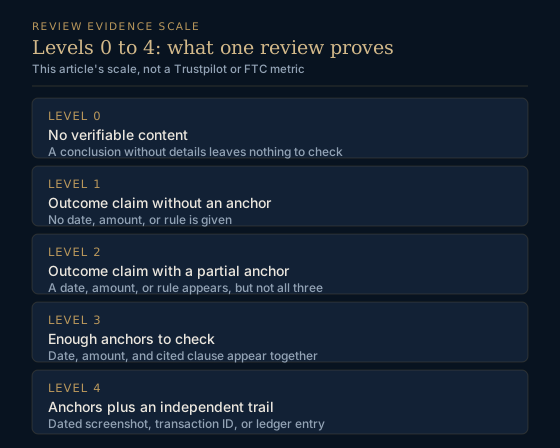
0, no verifiable content. The review states a conclusion with no supporting detail: "this firm is a scam" or "best prop firm ever" with nothing else. It cannot be checked against anything.
1, an unverifiable claim about outcome. The review states a specific outcome, "they paid me," "they didn't pay me," "they broke a rule," but gives no date, no amount, and no rule citation that would let a third party check it against the firm's own published terms.
2, an outcome claim with a partial anchor. The review names a date, an amount, or a specific rule number, but not enough of the three together to reconstruct the sequence of events.
3, an outcome claim with enough anchors to check. The review states what happened, when, and against which specific published rule, in enough detail that a reader could go to the firm's own rulebook and confirm or contradict the account.
4, an outcome claim with anchors plus an independent trace. Everything in level 3, plus something outside the review itself that corroborates it: a screenshot with a visible date, a transaction ID, a support ticket number the firm has publicly acknowledged, or a matching entry on the firm's own dated payout ledger.
Table 1: Claim Type Against the Evidence a Review Actually Carries
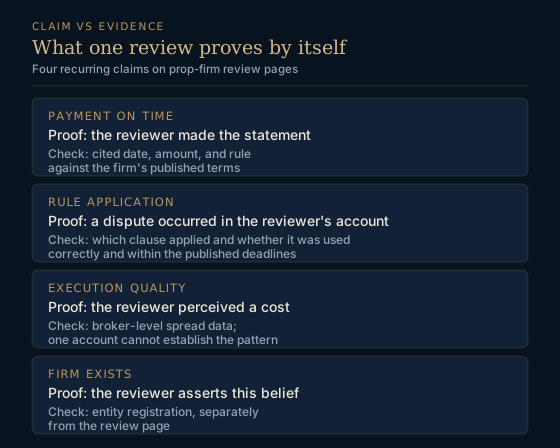
Declared inputs: the four claim types below are the ones that recur across prop firm review pages: payout timing, rule application, execution quality and existence of the firm. Each row states only what Trustpilot's and the FTC's own rules make checkable, plus the editorial criteria defined above. No row states a fact about any named firm.
| Claim type in the review | What the review alone can prove | What it cannot prove without more | What would raise it, using the scale above |
|---|---|---|---|
| "They paid me on time" | That the reviewer typed this sentence | Whether the payout amount, date or rule cited match anything the firm has published | A date, an amount and a rule citation moves it to level 3; a matching ledger entry moves it to level 4 |
| "They denied my withdrawal unfairly" | That a dispute occurred from the reviewer's perspective | Which rule was cited, whether it was applied correctly, whether the firm's 24-hour and 48-hour clocks were met | A cited clause number checked against the firm's own rulebook version live on that date |
| "Their execution is bad, spreads are wide" | That the reviewer perceived a cost | Broker-level or liquidity-provider-level spread data, which a single trader account cannot observe systematically | Nothing in a review resolves this; it needs the firm's published spread policy, not a testimonial |
| "This firm doesn't really exist" or "it's a scam" | That the reviewer holds this belief | The firm's registration status, entity name, or operating history | An entity check run separately from the review page entirely |
The pattern across every row is the same: a review can report a perception with full honesty and still carry zero evidence for the claim it makes, because the reviewer never had access to the underlying record.
Invited or Organic: Who Asked for the Review?
Trustpilot's own guidelines state that businesses should invite customers to express their honest experience with a business in a neutral way (Trustpilot, retrieved 2026-08-11). That single sentence, "neutral way," is the entire distinction between a solicited sample and a curated one. An invitation is not disqualifying. A curated invitation, sent only to customers the business already believes are satisfied, produces a page that looks organic and is not.
Neither sample is dishonest by default. Both are samples, and a sample chosen by the business under review is not neutral by construction, even before a single incentive changes hands.
This is a different failure mode than the incentive question that follows. Invitation biases who gets asked. Incentive biases what they say once asked. A page can fail on one, the other, both, or neither.
Why a discount code disqualifies a reviewer
A reader checking a page for incentive language should specifically look for phrases referencing a code, a bonus, or a referral in the review text itself, since a reviewer who received a benefit will often mention it, sometimes as a disclosure and sometimes as an unintentional tell.
Separately, Trustpilot requires that a review reflect the reviewer's own experience with narrow exceptions for someone writing on behalf of another person who cannot write it themselves (Trustpilot, retrieved 2026-08-11). A review written by an affiliate marketer about a firm's product, rather than about the marketer's own trading account experience, fails this requirement independent of any incentive question.
Which prohibitions bite a prop firm
For a reader evaluating a prop firm's page, the practical use of this rule is narrow but real: if a review page shows a pattern consistent with insider reviews with no disclosure, or a pattern of negative reviews disappearing shortly after being posted with no corresponding removal notice from the platform, that pattern is now describable in terms of a specific federal rule by part number, not only as a vague suspicion.
Which Six Checks Should You Run on a Prop Firm Review Page?
Run these six checks in order, and apply the review-strength scale from earlier to whatever the first two checks surface.
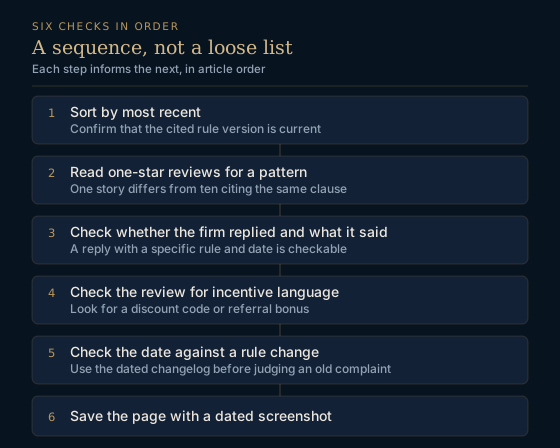
Score whatever the first two checks surface using the five-point scale. A one-star page dominated by level 0 and level 1 complaints, no dates, no rule citations, is weak evidence of anything specific, even if the volume feels alarming. A one-star page where multiple independent reviewers land at level 3, citing the same clause and a similar timeline, is a pattern worth treating seriously regardless of the star average sitting above it.
A firm with no history says so
An independent US regulator frames leveraged speculation the same way: like all futures products, speculating in these markets should be considered a high-risk transaction (CFTC, retrieved 2026-08-10).
For related published reading, see overnight and weekend holding rules, trading costs against drawdown, news trading restrictions, how to save prop firm rules before paying, static versus trailing drawdown.
Are five-star pages fake?
Not automatically. A high average can come from a genuinely satisfied, unincentivized sample, or from a curated invitation list, or from a batch of incentivized reviews that detection missed. The average alone does not distinguish between these. Checking invitation patterns, incentive language, and the review-strength score of the specific reviews driving the average is the only way to tell them apart.
Does a reply from the firm mean anything?
It means the firm engaged with the complaint publicly, which is worth something on its own. It only becomes evidence about the underlying dispute if the reply cites a specific rule, date, or amount that a reader can check against the firm's own published terms. A generic apology with no specifics settles nothing either way.
Should a rating decide which firm I buy?
No. A rating measures sentiment from a sample that may be invited, incentivized, or organic in unknown proportions. It cannot measure whether a firm's payout reserve exists, whether its rulebook is versioned, or whether its guarantee clock has ever been missed. Those are separate, checkable facts that a star average was never designed to carry.
Is there a reliable ranked list of the best prop firm by Trustpilot score?
No, and this page will not produce one, because the underlying number does not measure the thing the question is really asking about. A firm's Trustpilot score measures collected sentiment, not payout reliability, rule consistency, or the existence of a verifiable financial reserve. Two firms with the same score can differ completely on all three. Comparing published rulebooks, payout guarantees, and reserve or ledger transparency directly answers the underlying question a ranked list is trying to shortcut.
What Trustpilot fields actually prove
| Field on the page | What it can support | What it cannot prove alone |
|---|---|---|
| Star average | A crowd rating at the scrape date | That payouts are reliable for your account type |
| Review volume | How many written reviews exist | That the sample matches active traders on simulated capital |
| Company reply rate | Whether the firm answers in public | That a private ticket will be paid |
| Recent 1-star themes | Recurring complaint wording | A regulator finding or a Rulebook breach |
Declared inputs: reading a Trustpilot sample
Declared inputs for this check only: star average 4.2; review count 1800; share of last-30-day 1-star reviews 0.12; payout-theme mentions among those 1-star reviews 0.40.
| Input | Value | Derived figure | Arithmetic |
|---|---|---|---|
| Last-30-day 1-star share | 0.12 of 1800 | 216 | 1800 x 0.12 = 216 |
| Payout-theme share of those | 0.40 | 86.4 | 216 x 0.40 = 86.4 |
Under these declared inputs, 1800 x 0.12 = 216 recent 1-star reviews and 216 x 0.40 = 86.4 payout-themed complaints in that window. That is a density check on the public page, not a payout proof.
Sources
- Terms of use for consumers | Trustpilot corporate.trustpilot.com Retrieved 2026-08-11.
- Guidelines for Reviewers | Trustpilot corporate.trustpilot.com Retrieved 2026-08-11.
- Trade Regulation Rule on the Use of Consumer Reviews and Testimonials, 89 FR (August 22, 2024) govinfo.gov Retrieved 2026-08-11.
- Ordane Rulebook v1.0 ordanemarkets.com Retrieved 2026-08-11.
- Ordane Rulebook v1.0 ordanemarkets.com Retrieved 2026-08-11.
- Customer Advisory: Understand the Risks of Virtual Currency Trading | CFTC cftc.gov Retrieved 2026-08-10.
- Notice of product intervention decisions on CFDs and binary options | ESMA esma.europa.eu Retrieved 2026-08-10.