Home · The Ordane Journal · Rules and mechanics · Prop Firm Rules That Matter for Day Traders
Prop Firm Rules That Matter for Day Traders

Prop firm rules are the mechanical limits and behavioral constraints that govern a simulated trading account. These parameters dictate risk limits, position sizing, and payout eligibility for day traders. Understanding these hidden execution constraints is essential to survive the evaluation process and secure a reliable payout schedule.
Ordane accounts operate on simulated capital. No live funds are traded and no deposits are accepted.
What Are Prop Firm Rules for Day Traders?
To identify which prop firm rules matter most, day traders must verify trailing drawdowns, position close times, and news trading limits directly in the firm's official rulebook. These hidden mechanics constrain daily execution far more than headline profit targets. They dictate whether a strategy can actually survive the evaluation process.
Day trading demands strict risk management. When a trader enters the simulated capital industry, the evaluation parameters override personal trading plans. The industry relies on evaluation phases to filter traders. However, the constraints applied during these phases often force mechanical errors.
The transition from a personal retail account to a simulated corporate environment introduces structural friction. Retail environments generally only enforce margin requirements. In contrast, simulated prop firm environments impose behavioral mandates.
A trader might execute a perfectly logical technical setup. If that setup violates an arbitrary time limit or a percentage-based daily threshold, the account is terminated. Therefore, the trader is no longer just managing market risk. They are managing contract compliance risk simultaneously.
<blockquote id="quote">"Day traders fail evaluations not because of poor strategy, but because hidden execution rules and trailing drawdowns mathematically erode their edge." - Ordane Research Desk</blockquote>
The psychological pressure of a trailing metric or a looming time limit causes traders to abandon their tested strategies. Traders begin executing trades solely to appease the dashboard metrics rather than following structural market signals. This divergence between standard market execution and evaluation compliance is where the majority of failure occurs.
Traders must dissect the contract before paying any fee. The focus must shift from the maximum simulated funding amount to the precise definitions of daily loss limits and consistency rules.
Will You Actually Get Paid?
The primary concern for any day trader is the reliability of the payout schedule. Passing an evaluation phase does not automatically equate to a liquid environment. Firms impose minimum activity metrics and conditional refund clauses that delay or complicate the extraction of simulated profits.
The gap between passing an evaluation and receiving a payout is where many firms capitalize on trader fatigue. The psychological shift from attempting to hit a profit target to attempting to survive long enough to request a withdrawal often disrupts a trader's execution rhythm.
What Are Minimum Winning Days?
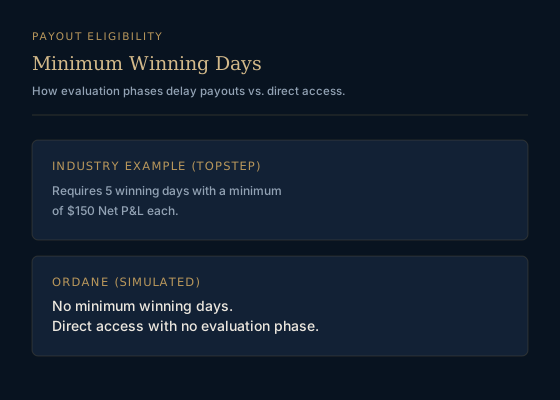
Evaluation structures often require a specific frequency of profitable sessions. For instance, Topstep (prop firm) currently requires five winning days with at least $150 Net P&L each for a Standard Express Funded Account payout request. (Topstep Payout Policy, retrieved 2026-09-03)
This means that a single large trade cannot qualify a trader for a payout. The trader must artificially spread out their activity to meet the metric.
Ordane operates on a different framework. Ordane sells one product, the Ordane Instant Account: direct access, no evaluation phase and no challenge, on simulated capital. Because there is no evaluation phase, there are no artificial winning day minimums to unlock an account.
To ensure accountability, Ordane uses a fixed service level agreement. This mechanism is known as The Ordane Guarantee.
How Do Conditional Entry Fee Refunds Work?
Many evaluation firms market the return of the initial purchase cost, but the conditions are tied to prolonged success. FTMO (prop firm) says its 2-Step entry fee may be refunded with the first Reward withdrawal. (Is the entry fee refunded?, retrieved 2026-09-03)
The trader must not only pass both phases but also trade the subsequent account into profit and request a payout before recovering the upfront cost. If a day trader fails the phase or breaches a rule before the first payout, the fee is lost entirely.
The refund is a conditional rebate, not a guaranteed return. Firms know that forcing a trader to maintain activity over a prolonged period increases the probability of a mechanical breach. The longer the delay between profit generation and withdrawal eligibility, the higher the risk for the trader.
What Hidden Rules Can Void Your Account?
Day traders operate on tight margins. A mechanical violation terminates the account immediately, regardless of the overall simulated equity. The most restrictive rules govern how drawdowns are calculated and how daily profits are distributed.
How Do Trailing Drawdowns Affect Unrealized P&L?
The method a firm uses to calculate maximum loss determines the true risk allowance. Topstep's current Maximum Loss Limit rises with the end-of-day balance and does not move downward. (What is the Maximum Loss Limit?, retrieved 2026-09-03)
Furthermore, Topstep counts both realized and unrealized P&L when monitoring its Maximum Loss Limit. (What is the Maximum Loss Limit?, retrieved 2026-09-03) When a firm calculates the maximum loss limit against unrealized gains, the trader is penalized for letting profits run.
Consider a scenario where a trader holds a position that moves deeply into profit. The trailing metric moves up behind the price action. If the market retraces significantly before the trader secures the exit, the account balance drops from the high-water mark.
Even if the trader closes the position for a net gain relative to the entry price, the distance from the peak may trigger a breach. This mathematical reality forces day traders to adopt aggressive scalping techniques to secure profits instantly. Traders must entirely abandon swing trades or intraday momentum strategies that require wide operational buffers.
At Ordane, the structure is static. A breach closes the account. FTMO currently sets the Maximum Daily Loss Amount for its 2-Step product at 5% of Initial Simulated Capital. (FTMO Trading Objectives, retrieved 2026-09-03)
What Is The Best Day Rule Limit?
Firms frequently cap how much a single trading day can contribute to the overall result. FTMO's current 1-Step Best Day Rule requires the best day to represent no more than 50% of Positive Days' Profit. (FTMO Trading Objectives, retrieved 2026-09-03)
If a day trader captures a massive market movement, the excess profit beyond the threshold may be nullified. The rule may also require the trader to execute additional forced trades to rebalance the percentages.
Ordane applies a strict consistency metric only at the point of withdrawal. The profit is never confiscated, and the remainder of the cycle pays out normally.
Are There News and Time Limits?
Day traders require uninterrupted access to the market. Restrictions on when a position can be held or how it interacts with macroeconomic data releases can severely disrupt a short-term strategy. Firms use time constraints to limit their own exposure.
Why Are There Mandatory Position Close Times?
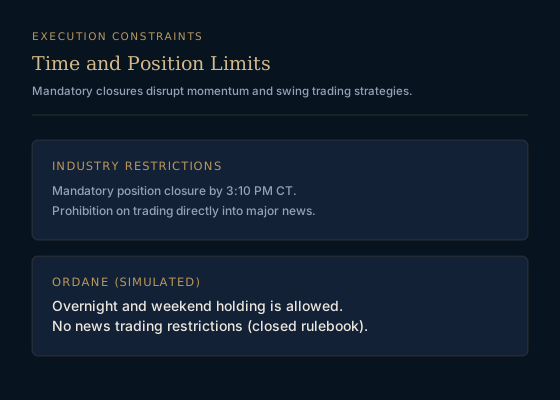
The requirement to flatten positions before the end of the session forces day traders to exit trades prematurely, often at sub-optimal prices. Topstep currently requires all positions to be closed by 3:10 PM CT every weekday. (When and What Products Can I Trade?, retrieved 2026-09-03)
Additionally, execution sizing is regulated based on instrument type. Topstep's current Trading Combine maximum-position rule counts micros and minis at a 10:1 ratio. (Trading Combine Parameters, retrieved 2026-09-03)
Day traders often look for late-session momentum. However, hard closure times force the trader to liquidate positions regardless of the technical setup or the current spread. Market liquidity often shifts dramatically in the final hours of the session.
If a trader is forced to execute a market order to meet a mandatory deadline, they may suffer severe slippage. This artificial constraint alters the expected value of a trading system. The system might indicate a hold, but the contract demands a close. The trader is no longer trading the market. They are trading the firm's liability schedule.
For swing traders or late-day momentum traders, these rigid closures are restrictive. Overnight and weekend holding is allowed at Ordane. Holding over the weekend is not on the R-6 closed list, and what is not listed is not a violation.
Are There Restrictions Around Major News?
Volatility around economic releases provides opportunities for day traders, but many firms restrict activity during these windows. Topstep currently prohibits purposefully trading the full Maximum Position Size directly into a scheduled major news event. (Prohibited Trading Strategies at Topstep, retrieved 2026-09-03)
Other firms apply different standards depending on the account phase. FTMO says its selected-news restrictions for Standard accounts apply on an FTMO Account but not during the Evaluation Process. (Can I trade news?, retrieved 2026-09-03) This creates a discrepancy where a strategy that passes the evaluation might be prohibited in the subsequent phase.
Ordane's prohibited-practice list is closed. If a behavior is not listed in that section, it is not a violation. Discretion is not a rule. Because R-6 is a closed list, no other clause restricts trading during news or high-impact events.
How Do Pricing and Rebill Rules Work?
The financial cost of an evaluation extends beyond the initial checkout. Day traders must read the billing terms carefully to understand recurring liabilities. Many evaluation programs are structured as ongoing subscriptions rather than single purchases.
A Topstep Trading Combine currently rebills every 30 days and remains active until the trader passes or cancels. (Trading Combine Subscriptions, retrieved 2026-09-03) If a day trader requires multiple months to navigate the trailing drawdowns and consistency limits, the cumulative cost of the evaluation phase increases significantly.
When a monthly rebill cycle is active, the trader operates under a time penalty. The pressure to pass the evaluation before the next billing date can lead to forced trades and compromised risk management. A strategy that requires patience and specific market conditions is incompatible with a ticking financial clock.
Furthermore, if a trader breaches an account near the end of the billing cycle, they often face a reset fee on top of the impending subscription renewal. This dual-cost structure creates a continuous revenue stream for the firm while draining the trader's capital.
In contrast, the Ordane model removes recurring charges. There are no recurring fees, no hidden tiers and no coupon games. The upfront cost is the final cost, allowing the trader to focus on execution without a monthly billing cycle approaching.
How to Verify Prop Firm Rules Before Paying?
Trusting marketing material is a severe operational risk. Day traders must independently audit the governing documents of any firm before committing capital or time. The regulatory landscape requires intense diligence.
The CFTC says to verify the registration status and disciplinary history of the person or firm selling a product or strategy. (Be Smart: Check Registration & Backgrounds Before You Trade, retrieved 2026-09-03) Beyond regulatory checks, the firm's internal documentation must be transparent.
The document must explicitly detail how every limit is measured. If a firm uses terms like reckless trading or gambling without a rigid mathematical definition, the contract is a trap. These vague terms allow the firm to retroactively classify a successful, high-volatility trade as a violation during the payout review process.
A legitimate rulebook defines violations entirely through observable, system-enforced metrics rather than human interpretation. If the exact parameters are not available to the public before purchase, the trader is essentially buying a blind liability.
Follow this verification checklist:
- Locate the official rulebook, not just the basic overview section.
- Confirm if maximum loss limits trail unrealized profit or remain static.
- Check the exact definition of prohibited trading practices.
- Identify the exact timeline for payout processing.
Why Is Auditing Disciplinary History Important?
Beyond the rulebook, regulatory background checks are essential. A firm that frequently alters terms retroactively or delays payouts often generates a paper trail of complaints. Traders should search public databases and regulatory portals to verify if the entity operating the firm has faced sanctions.
The corporate structure must be transparent, and the governing legal entity must be clearly identified in the footer of the website. If the operator's identity is concealed, enforcing a breach of contract becomes impossible.
The Ordane rulebook is public, numbered and versioned, and no rule is ever applied retroactively to an open account. Changes produce a new version with a dated changelog entry, and the version you sign up under is the version that governs your account. Transparency is the only metric that matters when evaluating a firm's integrity.
Frequently Asked Questions
Below is a comparative breakdown of standard industry practices versus the Ordane model.
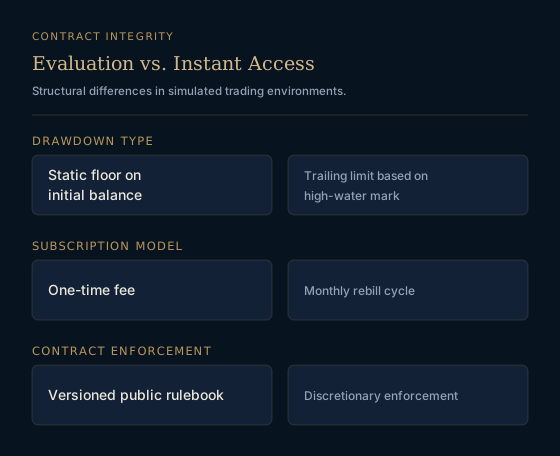
<table id="table"> <thead> <tr> <th>Metric/Feature</th> <th>Ordane (Simulated)</th> <th>Industry Standard</th> </tr> </thead> <tbody> <tr> <td>Drawdown Type</td> <td>Static floor on initial balance</td> <td>Trailing limit based on high-water mark</td> </tr> <tr> <td>Subscription Model</td> <td>One-time fee</td> <td>Monthly rebill cycle</td> </tr> <tr> <td>Contract Integrity</td> <td>Versioned public rulebook</td> <td>Discretionary enforcement</td> </tr> </tbody> </table>
What are prop firm rules?
Prop firm rules are the mechanical limits and behavioral constraints that govern a simulated trading account. These parameters dictate risk limits, position sizing, and payout eligibility for all participants.
How do I identify hidden rules?
Traders must read the official terms of service rather than the marketing homepage. Traders should look specifically for clauses regarding trailing drawdowns, consistency metrics, and mandatory time closures.
Do prop firms allow news trading?
News trading policies vary across the industry. Topstep currently prohibits purposefully trading the full Maximum Position Size directly into a scheduled major news event. Always check the prohibited practices list before trading.
What is a trailing loss limit?
A trailing loss limit is a risk metric that moves upward as the account balance increases, shrinking the operational buffer. Topstep's limit often calculates against unrealized profit, meaning a retracement can breach the account even on a winning trade.
Can rules change after evaluation?
In many firms, the rules shift between the evaluation phase and the subsequent account phase. Ordane uses a versioned rulebook that prevents retroactive changes to any specific account cohort. To trade without evaluation restrictions, review the instant account model and choose your account size at /accounts.
Sources
- Be Smart: Check Registration & Backgrounds Before You Trade cftc.gov Retrieved 2026-09-03.
- FTMO Trading Objectives ftmo.com Retrieved 2026-09-03.
- What is the Maximum Loss Limit? help.topstep.com Retrieved 2026-09-03.
- When and What Products Can I Trade? help.topstep.com Retrieved 2026-09-03.
- Trading Combine Parameters help.topstep.com Retrieved 2026-09-03.
- Trading Combine Subscriptions help.topstep.com Retrieved 2026-09-03.
- Is the entry fee refunded? ftmo.com Retrieved 2026-09-03.
- Topstep Payout Policy help.topstep.com Retrieved 2026-09-03.
- Prohibited Trading Strategies at Topstep help.topstep.com Retrieved 2026-09-03.
- Can I trade news? ftmo.com Retrieved 2026-09-03.