Home · The Ordane Journal · Before you pay · Can You Sell a Prop Firm Account?
Can You Sell a Prop Firm Account?

A proprietary trading firm account is a non-transferable service contract that grants a verified user the right to execute simulated trades. Ordane prohibits the sale or transfer of accounts to ensure strict compliance with identity verification and risk management protocols.
When a trader passes an evaluation and receives a funded status, they often consider the account an asset they own. They see a balance, they see a profit split, and they assume they can transfer that asset to someone else for a price. A secondary market exists entirely on this assumption.
Resale listings offer passed accounts to buyers who want to skip the evaluation phase. The buyer pays the seller, the seller hands over the login credentials, and the transaction appears complete.
The reality of the contract is entirely different. An account is not a physical object, and it is not a bearer bond. It is a digital service governed by a specific set of terms and conditions signed by a specific natural person. The right to access the trading platform, the right to execute simulated trades, and the right to request a payout all belong to the person who passed the identity verification process. Those rights cannot be detached from that person and sold to a stranger. The contract remains with the original signer, while the buyer receives nothing but unauthorized access to a system that will flag them the moment they try to withdraw money.
The published clause runs one way. The firm reserves the exact right that it denies to the customer. The company may assign the agreement to a third party, but the trader may not. What a bought account is actually worth is zero, because what the buyer inherits is a breach of contract rather than a valid balance.
Can a prop firm account be sold?
A proprietary trading firm account cannot be sold because the service agreement is permanently bound to the verified individual who signed it. The confusion arises because traders conflate three distinct elements of the service: the credentials, the account, and the contract.
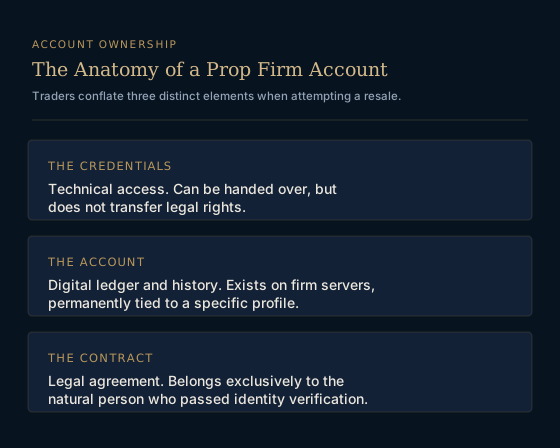
The credentials are the username and password required to log into the trading terminal. They are a technical mechanism for access. Anyone who possesses them can open the software and place orders. This technical reality makes selling an account seem possible, because the seller can simply email the credentials to the buyer.
The account is the digital ledger of simulated trades, the balance, and the performance history. It is the virtual environment where the trading activity is recorded. It exists on the firm's servers and is tied to a specific profile.
The contract is the legal agreement between the firm and the natural person who registered for the service. It defines who is authorized to trade, what the rules are, and who is entitled to receive a payout.
Selling the credentials does not sell the contract. The buyer of a resale listing acquires the technical ability to log in, but they do not acquire the legal right to operate the account or claim the profits. The firm does not recognize the transaction. As far as the firm is concerned, the original customer is still the sole authorized operator. When the buyer logs in from a new location, places trades, and eventually requests a withdrawal, they are doing so under the name of the original customer, which constitutes a severe breach of the terms.
What is the one-way assignment clause?
The one-way assignment clause is a contractual provision that permits the proprietary trading firm to transfer the agreement to a third party while expressly prohibiting the trader from doing the same. The assignment clause is a standard feature in commercial agreements, and in the proprietary trading industry, it is the clearest asymmetry in the text. It dictates who has the authority to transfer the rights and obligations of the contract to someone else.
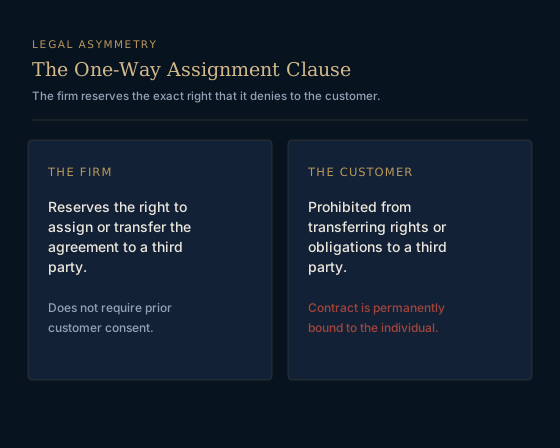
In almost every terms of use document, this clause is unilateral. The firm reserves the right to assign the agreement at its own discretion, while explicitly prohibiting the customer from doing the same.
FTMO (prop firm) terms let the firm assign or transfer the agreement, any part of it or any individual rights or obligations to a third party, and prohibit the customer from doing the same without prior written consent (FTMO Challenge Terms and Conditions, last updated 4 August 2026, clause 20.5, retrieved 2026-08-14). The customer cannot transfer the agreement, any part thereof, or any individual obligations or rights arising from it to a third party without that prior written consent. This means the firm can sell its business, transfer its liabilities, or migrate its user base to a new corporate entity without asking the trader for permission, but the trader cannot hand their account to a friend.
Topstep (prop firm) terms state that the customer is not authorised to transfer or assign their rights or obligations under the terms or any agreement or part of one (Terms of use | Topstep, section 31, retrieved 2026-08-14). The prohibition is absolute. The contract is permanently bound to the individual who created it.
This unilateral structure is not an oversight. It exists because the firm's risk model relies on knowing exactly who is operating the terminal. The firm evaluates the trading data, monitors for prohibited practices, and complies with financial regulations based on the identity of the registered user. If customers could freely trade accounts on a secondary market, the firm would lose all visibility into who is actually generating the simulated trades. The assignment clause ensures that the firm always knows its counterparty.
What do proprietary trading firms say about transfer and sharing rules?
Proprietary trading firms say that transferring an account is strictly prohibited and explicitly state this across their eligibility, usage, and legal terms. The prohibition against transferring an account is usually stated multiple times across different sections of a firm's rulebook. It appears in the eligibility criteria, the account usage rules, and the final legal boilerplate.
| Firm | Assignment and Transfer Clause | Account Sharing and Access Rules |
|---|---|---|
| FTMO | The firm may assign or transfer the agreement to a third party. The customer may not do so without prior written consent (FTMO Challenge Terms and Conditions, clause 20.5, retrieved 2026-08-14). | Services are for personal use only. Only the customer personally can access the services and perform simulated trades (FTMO Challenge Terms and Conditions, clause 7.2, retrieved 2026-08-14). |
| Topstep | The customer is not authorised to transfer or assign their rights or obligations under the terms ([Terms of use \ | Topstep, section 31](https://www.topstep.com/terms-of-use), retrieved 2026-08-14). |
The wording is exhaustive. Firms do not leave loopholes for gifting, informal sharing, or joint ventures. Topstep's terms state that the account is personal to the customer, that only one account is permitted, and that it cannot be sold, transferred, assigned to or shared with any other party. A customer attempting to bypass this by claiming they did not sell the account, but merely shared it with a partner, still breaches the rule.
Why does a bought account fail at the payout?
A bought account fails at the payout because the buyer cannot pass the mandatory identity verification required to claim the funds. A buyer who purchases an account from a reseller might log in successfully. They might place trades for weeks, manage risk perfectly, and generate a substantial simulated profit. The terminal will accept their orders because the terminal only checks if the credentials are valid. The terminal does not know who is sitting at the keyboard.
This creates a false sense of security. The buyer believes the transaction was successful because the software functions normally. The reality only surfaces when the buyer attempts to extract capital from the system. The firm's verification mechanisms are designed to trigger at the payout stage, which is the exact moment the money is on the line.
How does identity verification work?
Identity verification works by requiring the trader to submit a government-issued ID and proof of address that match the profile registered on the account. Before any funds are disbursed, the firm must verify the identity of the person receiving the money. This process is known as Know Your Customer, and it is a strict requirement for processing payments globally.
FTMO's eligibility clause requires a natural person at least eighteen years of age who is not subject to restrictions based on nationality or residency under the rules of each Restricted Jurisdiction (FTMO Challenge Terms and Conditions, last updated 4 August 2026, clause 1.1.1, retrieved 2026-08-14). The firm verifies this identity by requesting government-issued identification and proof of address. Industry compliance statistics show that 100% of regulated payment processors require identity verification to disburse funds (FATF Recommendations 2023, retrieved 2026-09-08).
When the buyer of a resale account reaches the withdrawal stage, they face an unsolvable problem. The account is registered in the seller's name. The firm will ask for the seller's passport and utility bill. The buyer cannot provide their own documents, because the names will not match the account profile. If the buyer manages to contact the seller and the seller submits their own documents, the process moves to the next hurdle, which is equally terminal.
What name must be on the payment method?
The name on the payment method must match the verified identity of the customer who originally registered the proprietary trading account. Prop firms do not send payments to arbitrary third parties. The name on the bank account, the cryptocurrency wallet profile, or the payment processor account must match the name of the verified customer on the trading account.
If the seller provides their documents to pass the identity check, the firm will only send the payout to a bank account in the seller's name. The buyer, who generated the profits, has no way to receive the funds directly from the firm. They must rely on the seller to receive the money and then forward it to them. This requires placing complete trust in a stranger who has already demonstrated a willingness to breach a commercial contract by selling the account in the first place.
If the firm detects a discrepancy between the registered user, the trading location data, and the payment destination, it will halt the withdrawal. FTMO's terms allow the firm to immediately cancel all services, including access to the User Area and the Trading Platform, and then terminate the agreements (FTMO Challenge Terms and Conditions, last updated 4 August 2026, clause 7.6.3, retrieved 2026-08-14). The account is closed, the profits are forfeited, and the fee is lost. The buyer is left with nothing.
Can you manage someone else's account for a cut?
You cannot manage someone else's account for a cut because proprietary trading firms strictly prohibit account management services and require the registered customer to be the sole operator. Some traders realize that outright selling an account is prohibited, so they attempt a different arrangement. Instead of selling the credentials, they offer to manage the account for the original owner in exchange for a percentage of the profits. The original owner keeps the account in their name, handles the identity verification, and receives the payouts, then manually sends a cut to the trader who executed the orders.
This structure is explicitly banned. Account management services, whether formal or informal, violate the core requirement that the customer must be the sole operator of the terminal.
FTMO's terms prohibit accessing another person's account, trading on behalf of or in coordination with another person, and performing account management or similar services, whether professionally or otherwise (FTMO Challenge Terms and Conditions, last updated 4 August 2026, clause 7.2.2, retrieved 2026-08-14). The prohibition covers every variation of the scheme. It does not matter if the arrangement is a professional service with a signed contract or a casual agreement between friends. The moment a second person logs in and places a trade, the account is in breach.
The firm monitors for IP address anomalies, device fingerprinting, and trading style shifts. When an account that was historically traded from a residential address in London suddenly executes high-frequency orders from a server in Frankfurt, the risk team flags the activity. The consequence is immediate closure.
What happens to an account when the holder dies?
When an account holder dies, the proprietary trading firm account ceases to exist because the non-transferable contract is tied exclusively to the deceased. The question of succession highlights the absolute nature of the non-transferability clause. When an account holder passes away, their physical assets and financial accounts generally become part of their estate, to be distributed to their heirs according to their will or local law.
Prop firm accounts do not follow this process. Because the account operates on simulated capital, the balance displayed on the screen is not a deposit of real funds. It is a performance metric. The trader does not own the capital, they own a service contract that entitles them to a payout based on specific conditions.
The terms of use across the industry establish that the agreement is personal to the natural person who signed it. The contracts heavily emphasize that the rights cannot be assigned or transferred, but they almost universally lack a specific succession or inheritance clause. The documents state what cannot be done, rather than outlining a procedure for what happens in the event of death.
Because the contract cannot be transferred, the heirs cannot step into the trader's shoes and continue operating the account. They cannot assume the role of the customer. The login credentials do not grant the heirs the legal right to execute trades. The firm's agreement was solely with the deceased. Consequently, the account effectively ceases to exist as a viable trading vehicle. Any pending approved payouts for past performance might be a matter for the estate to negotiate with the firm, but the account itself cannot be inherited as an ongoing concern.
What five things does a resale listing fail to transfer?
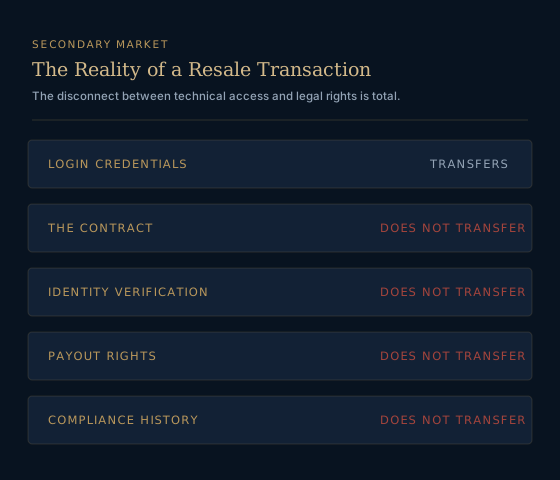
A resale listing fails to transfer the contract, identity verification, payout rights, compliance history, and actual ownership to the buyer. A buyer scanning a marketplace for a passed account must understand exactly what they are and are not receiving. The transaction is fundamentally incomplete.
| Element | Does It Transfer? | The Reality of the Transaction |
|---|---|---|
| Login Credentials | Yes | The seller can hand over the username and password, granting technical access to the platform. |
| The Contract | No | The agreement remains entirely with the original signer. The buyer has no legal standing with the firm. |
| Identity Verification | No | The account is permanently tied to the seller's name, nationality, and documents. |
| Payout Rights | No | The firm will only disburse funds to a payment method bearing the verified seller's name. |
| Compliance History | No | The buyer inherits any past warnings, IP flags, or borderline behavior executed by the seller. |
The disconnect between technical access and legal rights is total. The buyer pays a premium for an asset that is structurally designed to fail them when they need it to work.
How does the copy-trading rule catch workarounds?
The copy-trading rule catches workarounds by identifying synchronized entry times and matching latency footprints that reveal unauthorized account management. When traders realize they cannot sell an account or manage someone else's account, they often look for a technological workaround. Copy trading software allows a user to link a master terminal to multiple slave terminals. A trade executed on the master account is instantly mirrored across all the linked accounts.
Traders use this to operate a network of accounts registered in different names. One person sits at the master terminal, while the software executes the orders on accounts belonging to friends, family members, or paying clients.
This practice is categorically prohibited. Firms treat it as a severe violation because it consolidates risk and obscures the true operator of the accounts. FTMO's terms state that the initial simulated capital may not be transferred between products or combined, and that performance, service parameters, data or any other information may not be transferred or combined between products either (FTMO Challenge Terms and Conditions, last updated 4 August 2026, clause 3.15, retrieved 2026-08-14). Mirroring trades across profiles effectively combines their performance into a single risk node.
Ordane addresses this directly in its prohibited practices list. Copy trading is permitted exclusively between Ordane accounts that belong to the same person, meaning the same account holder and ultimate beneficial owner. Copy trading between person A and person B is always prohibited. (Ordane Rulebook v1.0, clause R-6, retrieved 2026-08-09).
The distinction is clear. A single trader copying their own strategy across their own legitimately purchased accounts is managing their own capital. A trader copying their strategy onto accounts owned by other people is running an unauthorized asset management scheme. The technology is identical, but the contractual violation is absolute. The firm will identify the synchronized entry times, the identical lot sizing, and the matching latency footprints. The accounts will be closed, regardless of who pressed the button on the master terminal.
How can you check the assignment clause before paying?
You can check the assignment clause before paying by searching the firm's terms of use document for keywords like assign, transfer, and personal. Before purchasing any service, a trader must verify the rules governing the contract. Relying on summaries or customer support chats is insufficient. The binding text is the terms of use document published on the firm's website.
The assignment clause is usually located near the end of the document, buried among the general provisions, governing law, and severability clauses. Finding it requires a systematic approach.
First, open the terms of use document and use the search function to locate the words assign, transfer, and personal. These keywords will highlight the sections dealing with ownership and delegation.
Second, read the sentences surrounding those keywords carefully. Note which party is granted the right to transfer the agreement, and which party is restricted. The standard structure will explicitly permit the firm to assign its rights while requiring the customer to obtain written consent to do the same. Look for language demanding that the service be used solely in a personal and individual capacity.
Third, save a dated copy of the document. Firms update their terms periodically. If a dispute arises, having a local copy of the terms as they existed on the date of purchase provides a definitive reference point. This ensures that any subsequent changes to the transfer rules cannot be applied retroactively to an existing account without notice.
Fourth, evaluate the restrictions against the cost of the account. Understanding that the account is a non-transferable service contract clarifies its true value. A trader who knows they cannot sell the account later will make a more accurate assessment of whether the initial fee is a sensible expenditure. They will recognize that the only return on investment comes from trading the account in compliance with the rules and requesting legitimate payouts.
Ordane sells one product, the Ordane Instant Account: direct access, no evaluation phase and no challenge, on simulated capital. (Ordane Rulebook v1.0, section 1, retrieved 2026-08-14). There are no recurring fees, no hidden tiers and no coupon games. The cost of a fresh account guarantees a clean history and a direct relationship with the firm. If you are comparing models, see how an instant account differs from an evaluation.
What are the most common questions about selling a prop firm account?
The most common questions about selling a prop firm account concern gifting to family members, liability for breaches, corporate contract assignment, payout rights, and VPN masking.
Can I gift an account to a family member?
No, a trader cannot gift a proprietary trading firm account to a family member because the identity verification process requires the account operator to be the exact natural person who originally registered the profile. The terms of use do not distinguish between selling an account for profit and gifting it to a relative. The prohibition is against transferring the rights and obligations of the agreement to any third party.
Is buying a passed account a breach for me or for the seller?
Buying a passed proprietary trading firm account is a breach for the seller because they violate the binding contract by handing over credentials, resulting in a total loss of simulated capital for the buyer. The seller is the party bound by the contract, and they breach it the moment they allow another person to access the terminal.
Can the firm sell my contract to someone else?
Yes, the proprietary trading firm can sell your contract to someone else because the asymmetrical assignment clause allows the company to transfer its obligations without requiring the customer's consent. This allows the firm to restructure its business, merge with another company, or sell its assets to a new corporate entity.
Will I receive a payout if I buy a funded account?
No, you will not receive a payout if you buy a funded proprietary trading firm account because the firm verifies identity before disbursing funds and only sends payments to a bank account matching the original verified customer. The firm owes no duty to the buyer, and the buyer has no recourse against the firm.
Can I use a VPN to hide that I bought an account?
No, you cannot use a Virtual Private Network to hide that you bought a proprietary trading firm account because risk management systems detect hardware fingerprinting and sudden changes in latency that expose unauthorized access. Firms monitor these anomalies specifically to prevent undisclosed account sharing.
Where are the sources for these prop firm rules?
The sources for these proprietary trading firm rules are the official terms of use documents and regulatory compliance standards linked inline throughout the article.
Primary sources are linked inline above.
This article is for information only and is not investment, financial, or tax advice.
Ordane accounts operate on simulated capital. No live funds are traded and no deposits are accepted. Payouts depend on simulated performance under Rulebook v1.0; no level of performance is typical or assured.
Sources
- FTMO Challenge Terms and Conditions, last updated 4 August 2026, clause 20.5 cdn.ftmo.com Retrieved 2026-08-14.
- Terms of use | Topstep, section 16 topstep.com Retrieved 2026-08-14.