Home · The Ordane Journal · Rules and mechanics · Prop Firm Crypto Trading Rules: What Changes
Prop Firm Crypto Trading Rules: What Changes
Ordane accounts operate on simulated capital. No live funds are traded and no deposits are accepted. Payouts depend on simulated performance under Rulebook v1.0; no level of performance is typical or assured.
Ordane sells one product, the Ordane Instant Account: direct access, no evaluation phase and no challenge, on simulated capital.
A prop firm crypto ticket is a spot-based contract for difference settled in cash against a spot price, not ownership of a coin and not an exchange-listed future. That distinction, published by the firms themselves, is the starting point for everything else that changes when the instrument switches from FX to crypto.
An independent regulator frames the underlying asset class without selling a challenge: the CFTC customer advisory on virtual currency trading states that, like all futures products, speculating in these markets should be considered a high-risk transaction (CFTC, retrieved 2026-08-10). That is not a prop-firm marketing line. It is the baseline risk language for leveraged crypto exposure, and it still applies when the ticket on a simulated prop account is a crypto CFD rather than a wallet of coins.
That instrument class is not a prop-firm invention. ESMA's product-intervention notice states that CFDs are complex instruments and come with a high risk of losing money rapidly due to leverage (ESMA, retrieved 2026-08-10). A crypto CFD ticket on a simulated prop account inherits that instrument risk label even when no coins sit in a wallet.
What do you actually hold when you trade crypto on a prop firm account?
Whether the account lets them hold coins, futures, or a CFD ticket depends on the specification page, not the marketing headline.
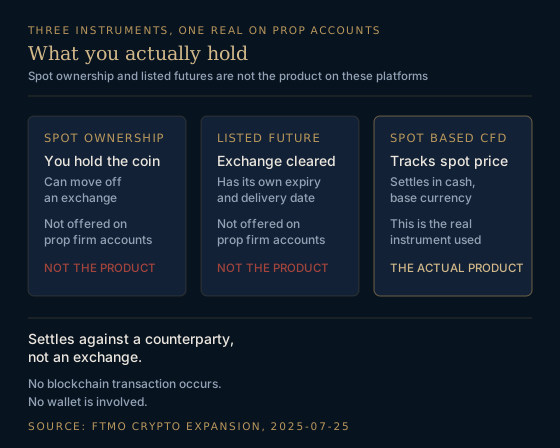
You do not own a coin. You hold a contract for difference that tracks a spot price, settles in your account's base currency, and disappears the moment you close the position. Nothing moves on a blockchain. Nothing sits in a wallet.
What that does to a lot size you saved in a template
The fix is mechanical, not clever: after any trading update that touches crypto, recompute position size from notional exposure rather than from a stored lot number. The specification page, not last month's spreadsheet, is the source of truth.
What does crypto cost per trade, and why is the answer different from indices?
Commission on a prop firm account is not a single number that applies to the whole account. It is set per instrument group, and crypto and indices land in different groups even on the same platform. Understanding these costs is crucial, as they can significantly impact your prop firm drawdown.
The practical consequence is that a trader who moves size between crypto and indices on the same account is not moving between two versions of the same cost. Crypto carries a round-trip commission on notional that indices, on this platform, do not carry at all. Commission rates on hosts that update crypto specifications by trading update rather than by a static page should be re-checked against the dated announcement, not assumed to be permanent.
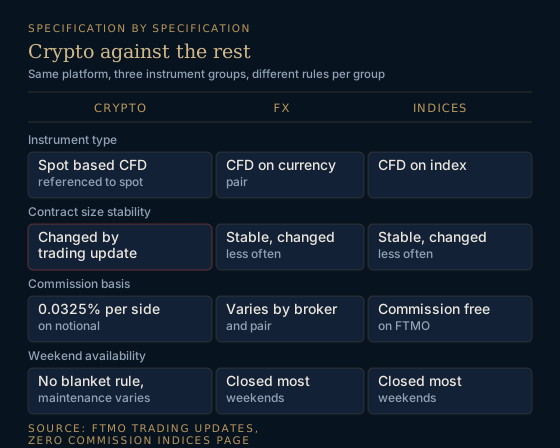
Table 1: crypto against the rest of the account, specification by specification
| Specification | Crypto | FX (majors and minors) | Indices |
|---|---|---|---|
| Instrument type | Spot-based CFD, referenced to spot price (FTMO, retrieved 2026-08-09) | CFD on currency pair | CFD on index |
| Contract-size stability | Changed by trading update, to better reflect real-world standards (FTMO, retrieved 2026-08-09) | Standard lot conventions, changed less frequently | Standard contract conventions, changed less frequently |
| Commission basis | 0.0325% per side on notional, on FTMO (FTMO, retrieved 2026-08-09) | Varies by broker and pair | Commission-free on FTMO (FTMO, retrieved 2026-08-09) |
| Weekend session | No blanket restriction; may be open (FTMO, retrieved 2026-08-09) | Closed most weekends | Closed most weekends |
| Weekend maintenance | Varies by platform, weekly scheduled maintenance windows (FTMO, retrieved 2026-08-09) | Not applicable at weekend close | Not applicable at weekend close |
| Reset clock | 00:00 CE(S)T daily, same as the rest of the account (FTMO, retrieved 2026-08-09) | 00:00 CE(S)T daily (FTMO, retrieved 2026-08-09) | 00:00 CE(S)T daily (FTMO, retrieved 2026-08-09) |
Every cell above traces to a dated source. This is a specification comparison, not a ranking, and the crypto column is the one most likely to have changed since the retrieval date on the cited pages.
No restriction on trading, if the market is open
FTMO states plainly that it does not restrict weekend trading: "We do not have any restrictions on executing trades on weekends. If the market is open, you are free to trade as usual." (FTMO, retrieved 2026-08-09). That statement, read alone, sounds like crypto is a 24/7 instrument on a 24/7 account.
The scheduled maintenance that closes it anyway
It is not, entirely. On the same firm's own Symbols page, a separate statement narrows the first one: weekend trading hours on cryptocurrencies may vary on each platform because of weekly scheduled maintenance times (FTMO, retrieved 2026-08-09). Both statements are true and both are published by the same firm. The first says nothing on the rulebook blocks weekend crypto trading. The second says the platform itself may not be open to trade it, on a schedule set by maintenance rather than by any trading rule.
Which clock ends your trading day on a 24/7 market?
A daily loss limit recalculated at 00:00 Central European time
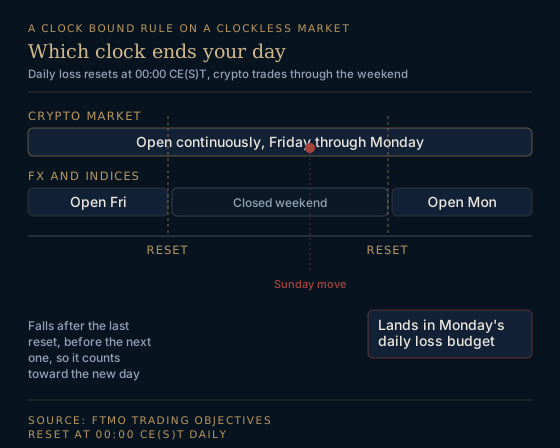
A daily loss limit needs a boundary that defines when one day ends and the next begins. On FTMO's published Trading Objectives, the Maximum Daily Loss is set at 3 percent of initial simulated capital on the 1-Step programme and 5 percent on the 2-Step, and it is recalculated daily at 00:00 CE(S)T (FTMO, retrieved 2026-08-09). That reset time governs every instrument on the account, crypto included. It is not tied to any crypto exchange's own daily settlement time, and it is not tied to the trader's local time zone unless the trader happens to be in Central Europe.
The Sunday move that lands in Monday's budget
Because crypto can move while the FX and indices markets are closed, a position opened Friday and held into the weekend can generate a floating loss on Saturday or Sunday that has not yet touched any daily loss calculation, since the calculation resets on a Central European clock rather than continuously. The moment that clock ticks past 00:00 CE(S)T into the new day, the account's daily loss budget resets and whatever floating result exists at that instant becomes the day's starting point. A large adverse weekend move in crypto can therefore consume the entire daily loss budget for the day it lands in, on a market that never itself closed, purely because of where the reset boundary falls relative to the price move.
This is the mechanism, not a warning dressed as one: the loss limit is a clock-bound rule applied to a clockless market, and the two do not automatically line up.
How to check a firm's crypto rules before you pay, in five steps
Save a dated copy, screenshot or archived link, of the specification page you checked. Crypto specifications on these platforms change by trading update, and the page you read today is not a commitment that the page reads the same way next month. For a comprehensive guide on how to vet a prop firm, see how to audit a prop firm.
Crypto in the instrument list, spreads passed through with no markup
Its published instrument list names crypto alongside FX majors and minors, metals, and indices, with no exotics (Ordane specification sheet, confirmed by the owner 2026-07-28, retrieved 2026-08-09). On pricing, the same specification states that Ordane charges no spread, no commission and no swap, which applies to crypto exactly as it applies to the other three groups (Ordane, Trading Specification, retrieved 2026-09-01).
A closed list, a 3 percent daily limit, and a leverage line still open
One number on Ordane's own specification sheet is stated as unset rather than implied: leverage on FX majors and minors is 1:50, and leverage for metals, indices, and crypto has not been set yet, as of this specification's retrieval date. That is a gap in the published record, not a hidden default, and a trader planning crypto exposure on an Ordane account should check the current specification page for whether that number has since been published before sizing a position against it.
Table 2: what changes on crypto, mapped to the clause or source that governs it
| What changes | Governing fact | Where it is published |
|---|---|---|
| Instrument you actually hold | Spot-based crypto CFD, not coin ownership, not a listed future (FTMO, retrieved 2026-08-09) | FTMO crypto expansion announcement, 25 July 2025 |
| Contract size per lot | Changed by trading update, to better reflect real-world standards (FTMO, retrieved 2026-08-09) | FTMO trading updates page |
| Per-side cost | 0.0325% per side on notional for crypto; commission-free for indices on the same platform (FTMO, retrieved 2026-08-09; FTMO, retrieved 2026-08-09) | FTMO commission and indices pages |
| Weekend availability | No blanket restriction, subject to platform-specific maintenance windows (FTMO, retrieved 2026-08-09; FTMO, retrieved 2026-08-09) | FTMO weekend FAQ and Symbols page |
| Reset clock | Daily loss recalculated at 00:00 CE(S)T regardless of the instrument's own market hours (FTMO, retrieved 2026-08-09) | FTMO Trading Objectives |
| Ordane's crypto position | Listed instrument, spreads passed through with no markup, weekend holding permitted, leverage not yet set (Ordane specification sheet, retrieved 2026-08-09) | Ordane specification sheet and Rulebook v1.0 |
Worked cost check: crypto commission versus commission-free indices
Declared inputs for this check only: FTMO crypto commission of 0.0325 percent per side on notional volume; a single round-turn on a $100,000 notional crypto position (two sides); index trades on the same platform described as commission-free.
| Input | Value | Source in ledger |
|---|---|---|
| Crypto commission per side | 0.0325% of notional | FTMO crypto commission page |
| Notional for the check | $100,000 | Declared input |
| Sides in a round-turn | 2 | Declared input |
| Index commission on same platform | $0 | FTMO indices commission contrast |
| Round-turn crypto cost | $100,000 × 0.000325 × 2 = $65 | Arithmetic from inputs above |
| Round-turn index cost | $0 | Same platform contrast |
| Difference the trader pays for choosing crypto | $65 − $0 = $65 | Arithmetic |
Under these declared inputs, 100000 × 0.000325 × 2 = 65. The same round-turn on the commission-free index category costs 0. The instrument group, not the challenge brand, sets the fee line.
For adjacent rule surfaces that interact with crypto tickets, see overnight and weekend holding rules, trading costs against drawdown, news trading restrictions, how to save prop firm rules before paying.
Ordane's prohibited-practice list is closed. Clause R-6 names six practices: latency, reverse or hedge arbitrage; high-frequency or bulk automated exploitation; copy trading between Ordane accounts; straddling news releases with paired opposing orders; platform or data-feed exploitation; and gap abuse. If a behavior is not listed in that section, it is not a violation. Discretion is not a rule. (Ordane Rulebook)
Do I ever actually own the coin?
No. The instrument on these accounts is a contract for difference referenced to a spot price, settled in cash in the account's base currency, and confirmed as such by FTMO's own description of its spot-based crypto CFDs (FTMO, retrieved 2026-08-09). No blockchain transaction occurs and no wallet is involved.
Can a contract-size change breach a position I already have open?
A contract-size change alters the notional of an open lot when it takes effect, and loss-limit calculations use current notional. Close or resize ahead of an announced trading update rather than assuming an open position is exempt.
What happens to a crypto trade left open across a maintenance window?
FTMO describes maintenance as varying trading hours by platform, not as a force-close rule (FTMO, retrieved 2026-08-09). Check the current symbol page for the specific platform before relying on weekend access.
Does a weekend crypto move count against Friday's daily limit or Monday's?
It depends entirely on which side of the 00:00 CE(S)T reset the price move and the resulting floating result fall on, since that is the boundary the daily loss calculation uses (FTMO, retrieved 2026-08-09). A move that occurs before that reset counts toward the day just ending; a move after it counts toward the new day, regardless of what time it is where the trader lives.
Is Ordane's crypto leverage published yet?
Not as of this specification's retrieval date. Leverage on FX majors and minors is confirmed at 1:50, but leverage for metals, indices, and crypto has not been set yet, so a trader planning crypto exposure on an Ordane account should check the current specification page before sizing a position (Ordane specification sheet, confirmed by the owner 2026-07-28, retrieved 2026-08-09).
Sources
- FTMO Enhances Crypto Trading: New Instruments and Better Spreads | FTMO.com ftmo.com Retrieved 2026-08-09.
- Trading updates | FTMO.com ftmo.com Retrieved 2026-08-09.
- Zero Commissions on Indices | FTMO.com ftmo.com Retrieved 2026-08-09.
- Can I trade on the weekend? | FTMO.com ftmo.com Retrieved 2026-08-09.
- Symbols | FTMO.com ftmo.com Retrieved 2026-08-09.
- Trading Objectives | FTMO.com ftmo.com Retrieved 2026-08-09.
- Ordane specification sheet, confirmed by the owner 2026-07-28 ordanemarkets.com Retrieved 2026-08-09.
- Ordane Rulebook v1.0, clause R-2 ordanemarkets.com Retrieved 2026-08-09.
- Customer Advisory: Understand the Risks of Virtual Currency Trading | CFTC cftc.gov Retrieved 2026-08-10.
- Notice of product intervention decisions on CFDs and binary options | ESMA esma.europa.eu Retrieved 2026-08-10.