Home · The Ordane Journal · Before you pay · How Do Prop Firms Make Money? The Revenue Mix
How Do Prop Firms Make Money? The Revenue Mix
Ordane accounts operate on simulated capital. No live funds are traded and no deposits are accepted. Payouts depend on simulated performance under Rulebook v1.0; no level of performance is typical or assured.
Ordane sells one product, the Ordane Instant Account: direct access, no evaluation phase and no challenge, on simulated capital. (Ordane Rulebook v1.0, clause P-2, retrieved 2026-08-09) That sentence matters here because it is the whole reason this question needs an answer at all: a firm whose own terms say no trade is ever executed cannot earn a dollar from the market moving.
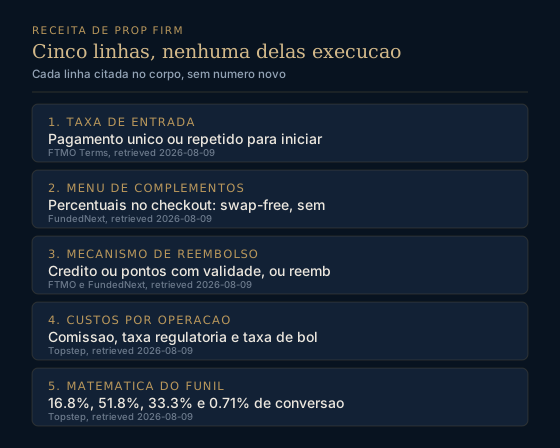
Every dollar a prop firm books has to come from somewhere you can name, and five revenue lines are visible in the firms' own published documents. Each one predicts a specific rule you will meet later, which turns the rulebook from house style into an income statement you can read backwards.
How Does a Prop Firm Make Money?
Independent enforcement context: (CFTC, retrieved 2026-08-16).
Adjacent reading: where prop firm payout money comes from.
The answer in 40 words, quotable as written
A prop firm makes money from fees paid before you trade, add-ons priced at checkout, refunds it converts into store credit instead of cash, per-trade costs charged on the account, and the arithmetic of how many buyers ever reach a payout. Nothing in that list requires the firm to take the other side of your trade.
Why "they profit when you fail" is too small an answer
The popular one-line answer, that a prop firm profits when you fail the evaluation, describes only the first of the five lines above: the entry fee. It is not wrong, but it is incomplete in a way that matters to your wallet. It skips the add-on menu you are offered at checkout, the refund mechanism that keeps money inside the firm even when it is advertised as returned, the per-trade costs that accrue after you have already paid to get in, and the published funnel math that tells you what fraction of buyers the fee-and-add-on model is actually built around. A trader who only understands "they profit when I fail" will overpay for the wrong add-on, misread a "refund" as cash, and underestimate the cost of a round turn. Reading all five lines together is what lets you read a rulebook and know, before you sign up, which clause exists to protect which piece of revenue.
Why do fees matter more than market side?
Fee revenue is the load-bearing cash for simulated accounts.
Line One: The Entry Fee, and the Clause That Says Nothing Is Executed
For the fee versus deposit distinction, see whether prop firms require a deposit.
What "no execution of trades in financial markets" means for revenue
Start with the clause that makes the whole business model necessary. FTMO's own Challenge Terms and Conditions, last updated 4 August 2026, define Simulated Trading as activity in which market data from real markets is used only to reproduce market conditions: no actual trading takes place and there is no execution of trades in financial markets. (FTMO, retrieved 2026-08-09) Read that clause slowly. If no trade is executed in a real financial market, the firm has no market position of its own to win or lose money on when a trader's account goes up or down. That single sentence, sitting inside a document most buyers never open, is the reason "how do prop firms make money" cannot be answered with "trading." The revenue has to be structural: fees paid by people who sign up, whether or not any of them ever see a payout.
The entry fee is the most visible line, and it is also the line that shapes every other clause in a rulebook, because a firm that earns primarily from entry fees is incentivized to sell as many entries as it profitably can, then let its rules determine who advances and who pays again.
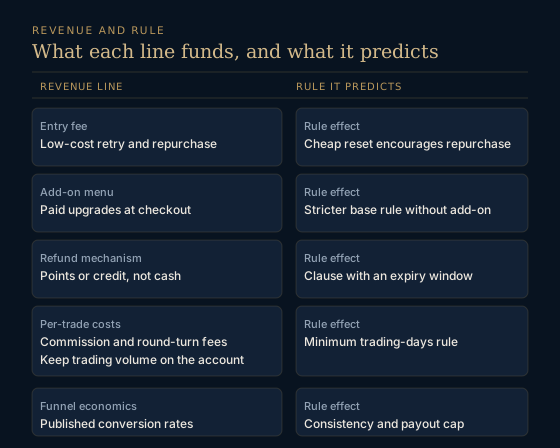
Table 1: The Five Revenue Lines and the Rule Each One Predicts
| Revenue line | What it looks like in practice | Rule it tends to predict |
|---|---|---|
| Entry fee | One-time or repeat payment to start a Challenge, Combine or evaluation | Retry, reset and re-purchase rules that make failing cheap to repeat |
| Add-on menu | Priced percentage uplifts at checkout (FundedNext, retrieved 2026-08-09) | Feature-gated rules until you pay for the exception |
| Refund mechanism | Store credit or points instead of cash (FTMO, retrieved 2026-08-09) | Narrow refund clauses with expiry or eligibility conditions |
| Per-trade costs | Commission and fees on simulated volume (Topstep, retrieved 2026-08-09) | Minimum trading day and volume conditions |
| Funnel math | Conversion rates from entry to payout (Topstep, retrieved 2026-08-09) | Consistency rules and payout caps |
Table 2: Where Ordane's Revenue Comes From, Stated Plainly
Company-entity checks sit beside revenue claims: matching the legal entity before you pay.
One product, one one-time fee, no coupon games
The fee is one-time: $139 for the $10,000 account, $299 for $25,000, $549 for $50,000 and $999 for $100,000. There are no recurring fees, no hidden tiers and no coupon games. (Ordane Rulebook v1.0, section 1, retrieved 2026-08-09) There is no add-on menu at checkout to compare against the two named competitors above, because there is nothing to add on: the price for a given account size is the price.
Payouts from fee revenue, and the address you can check
Payouts are paid in real money from company fee revenue. No client deposits are taken and no client capital is traded. (Ordane Markets, retrieved 2026-08-09) That sentence is the direct answer to the revenue question for Ordane specifically: the entry fee is the revenue line, and it is the same line that funds the money paid out. Ordane's payout reserve is published at a public TRON address on ordanemarkets.com and in Rulebook v1.0 clause PR-1, with a dated observed balance on the page, and the page itself states that the reserve is not a promise, it is an address. (Ordane Rulebook v1.0, clause PR-1, retrieved 2026-08-09)
That is the difference between a rulebook you have to trust and one you can check. An address is not a claim you take on faith; it is a record you can look up yourself, on any date, and compare against what the firm says the balance is.
Worked fee arithmetic scenario
Declared inputs: entry fee 549; add-on uplift 0.20; one retry at full fee.
| Input | Value | Arithmetic |
|---|---|---|
| Entry fee | 549 | Declared |
| With add-on | 658.8 | 549 x 1.20 = 658.8 |
| Retry | 549 | Declared |
| Total | 1207.8 | 658.8 + 549 = 1207.8 |
Assumptions: uplift once at checkout; retry full price. Arithmetically: 549 x 1.20 = 658.8; 658.8 + 549 = 1207.8 under these declared inputs.
For related published reading, see overnight and weekend holding rules.
Ordane's payout reserve is published at a public TRON address on ordanemarkets.com and in Rulebook v1.0 clause PR-1. The page carries a dated observed balance and states that the reserve is not a promise, it is an address. (Ordane Rulebook)
Questions Traders Ask About Prop Firm Revenue
Simulated capital is the substrate of every revenue line above: how a prop account differs from a demo balance.
Does a prop firm need me to fail in order to profit?
Not on every one of the five lines. The entry fee is the one line where a firm earns regardless of the outcome, which is why it is the line most associated with the "they profit when you fail" shorthand. The other four lines, add-ons, refund mechanics, per-trade costs and the funnel, either apply regardless of pass or fail, or in the case of per-trade costs, actually require you to keep trading, which is closer to needing you to continue than needing you to fail.
Do add-ons change the rules, or only the price?
Both, depending on the add-on. Some of FundedNext's published add-ons change price only, such as paying more for the same underlying rules. (FundedNext, retrieved 2026-08-09) Others explicitly change a rule: a no-minimum-trading-days add-on removes a rule that otherwise applies to every buyer who does not pay for it, and a maximum loss limit add-on changes the drawdown condition itself. Read the add-on description against the base rulebook before assuming price is the only thing changing.
What is a firm with no execution actually selling, if not access to a real market?
It is selling access to a simulated trading environment, evaluated against a published rulebook, with a payout mechanism attached if you clear the rules. FTMO's own terms state plainly that no actual trading is taking place and there is no execution of trades in financial markets (FTMO, retrieved 2026-08-09), and Ordane's rulebook makes the same declaration for its own accounts: no live funds are traded and no deposits are accepted. (Ordane Rulebook v1.0, clause P-2, retrieved 2026-08-09) What you are buying, at any firm operating this way, is a rules-based path to a payout funded by the firm's own revenue, not a brokerage account trading the trader's own funds.
Why does the denominator matter so much when a firm quotes a pass rate?
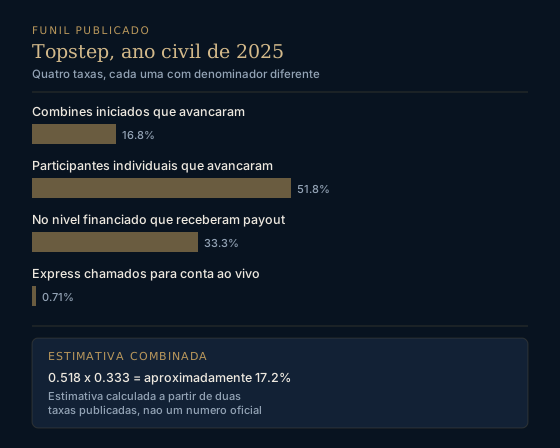
Because the same underlying data can produce two very different-looking numbers depending on what population sits underneath the percentage. Topstep's own 16.8 percent figure is measured against every Combine initiated, while its 51.8 percent figure is measured against individual participants. (Topstep, retrieved 2026-08-09) A marketing page that quotes the friendlier of the two without naming which one it is describing is not necessarily lying, but it is letting you draw the wrong conclusion. Always ask what the number is a percentage of before you repeat it.
Sources
- FTMO Challenge Terms and Conditions, last updated 4 August 2026 ftmo.com Retrieved 2026-08-09.
- The truth about prop firm payouts | Topstep topstep.com Retrieved 2026-08-09.
- TopstepX Commissions and Fees | Topstep Help Center help.topstep.com Retrieved 2026-08-09.
- How does the Add-On feature work with the FundedNext new Challenge purchase? | FundedNext Help Center help.fundednext.com Retrieved 2026-08-09.
- Are there any Hidden Fees or Recurring Fees? | FundedNext Help Center help.fundednext.com Retrieved 2026-08-09.
- ordanemarkets.com FAQ and Ordane Rulebook v1.0 clause PR-1 ordanemarkets.com Retrieved 2026-08-09.
- Ordane Rulebook v1.0, clause PR-1 ordanemarkets.com Retrieved 2026-08-09.
- CFTC Charges My Forex Funds with Fraudulently Taking Over $300 Million From Customers Hoping to Become Professional Traders cftc.gov Retrieved 2026-08-09.
- Notice of product intervention decisions on CFDs and binary options | ESMA esma.europa.eu Retrieved 2026-08-10.
- Customer Advisory: Understand the Risks of Virtual Currency Trading | CFTC cftc.gov Retrieved 2026-08-10.