Home · The Ordane Journal · Before you pay · Fxify Prop Firm: Rules, Costs & Payouts
Fxify Prop Firm: Rules, Costs & Payouts
What Is Fxify and Do They Actually Pay?
A proprietary trading firm provides traders with simulated capital to participate in financial markets, enforcing strict risk limits in exchange for a share of simulated profits. Ordane accounts operate on simulated capital. No live funds are traded and no deposits are accepted. (Ordane Rulebook v1.0, clause P-2, retrieved 2026-09-26)
The primary fear for any trader is passing an evaluation phase and never seeing a payout. Firms answer this fear in different ways, pointing to a long history or social proof. Ordane publishes the reserve address. The critical question for a buyer is whether the firm has a transparent mechanism to ensure payouts happen according to a public schedule. When evaluating a firm, traders should demand to see exactly how and when they will be compensated for their simulated performance. A clear rulebook is the only defense against arbitrary denials.
The 90% Profit Split
The profit split is the percentage of simulated profits a trader receives after passing all requirements. Traders can earn up to a 90% profit split on their simulated earnings with FXIFY upon successful evaluation and scaling. (FXIFY Official Website, retrieved 2026-09-25) This figure represents the ceiling of their offering, which is standard in the current competitive environment. However, a high split on an account that can be easily closed by a hidden clause is mathematically worthless. Transparency regarding these clauses separates reliable operators from the rest. Ordane sells one product, the Ordane Instant Account: direct access, no evaluation phase and no challenge, on simulated capital. (Ordane Rulebook v1.0, section 1, retrieved 2026-09-26) By removing the evaluation phase entirely, the path to a payout relies only on the public rulebook. Ordane's profit split starts at 80 percent and rises 2.5 percentage points with every completed withdrawal, reaching 100 percent from the ninth withdrawal onward. (Ordane Rulebook v1.3, clause PA-2, retrieved 2026-09-26) The split ladder is in writing and never resets. (Ordane Markets, retrieved 2026-09-26)
Are Hidden Rules Common in Proprietary Trading?
Yes, elastic clauses and discretionary terms are common in proprietary trading, putting the trader at a structural disadvantage just before a payout. A firm can offer excellent simulated conditions, but if the rulebook contains hidden rules, the trader is at risk. A closed list of prohibited practices is the only way to ensure fairness. If a behavior is not explicitly banned in writing, it should not be a violation. Ordane's prohibited-practice list is closed. Clause R-6 names six practices: latency, reverse or hedge arbitrage; high-frequency or bulk automated exploitation; copy trading between Ordane accounts; straddling news releases with paired opposing orders; platform or data-feed exploitation; and gap abuse. If a behavior is not listed in that section, it is not a violation. Discretion is not a rule. (Ordane Rulebook v1.0, clause R-6, retrieved 2026-09-26)
Trading on DXtrade and Match-Trader
Another critical element of stability is the technology stack. FXIFY offers multiple trading platforms to its simulated funded traders, including DXtrade and Match-Trader. (FXIFY Trading Platforms, retrieved 2026-09-25) Relying on third-party licenses introduces a layer of vulnerability. If a vendor revokes access, the firm and its traders are instantly paralyzed. Ordane runs on a trading platform it designed and built with its own engineering team, and licenses no third-party terminal: not MatchTrader, not MetaTrader, not any external vendor. Owning the technology ensures that no external provider can unilaterally terminate operations or disrupt trader access without warning.
The Longevity Question in Unregulated Environments
The third primary fear is the longevity of the firm. Will the company still exist in twelve months to honor its payout obligations? This concern is directly tied to regulatory status and operational transparency. Firms operating outside traditional financial regulation carry the burden of proving solvency and fair practice through their own published mechanisms, since traders cannot rely on an external body to intervene in a dispute. Without regulatory oversight, a firm must provide verifiable mechanisms to establish trust. A public reserve address and a versioned rulebook serve as private alternatives to public regulation. The Ordane rulebook is public, numbered and versioned, and no rule is ever applied retroactively to an open account. Changes produce a new version with a dated changelog entry, and the version you sign up under is the version that governs your account. (Ordane Rulebook v1.0, section 6 Changelog, retrieved 2026-09-26)
How Much Does Fxify Cost and What Is the Max Funding?
The cost to attempt these evaluations varies based on the size of the simulated account, with direct access models offering fixed fees like $59 for a $2,500 account. Traders pay an upfront fee to access the challenge. If they fail any of the trading objectives, the fee is forfeited, and they must purchase a new challenge to try again. This creates a cycle where the true cost of access may be significantly higher than the initial sticker price. Direct access models eliminate this cycle by charging a single fee for immediate access to the earning environment. The fee is one-time: $59 for the $2,500 account, $139 for the $10,000 account, $299 for the $25,000 account, $549 for the $50,000 account, $999 for the $100,000 account. There are no recurring fees, no hidden tiers and no charge to withdraw. (Ordane Rulebook v1.0, section 1, retrieved 2026-09-26) Clear pricing structures allow traders to calculate their exact exposure without factoring in the probability of failing multiple evaluation phases.
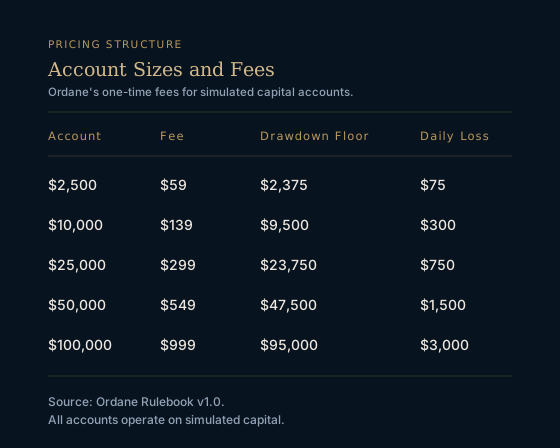
The table below illustrates the exact risk limits for each Ordane account size.
| Account Size | One-Time Fee | Static 5% Drawdown Floor | Daily 3% Loss Limit |
|---|---|---|---|
| $2,500 | $59 | $2,375 | $75 |
| $10,000 | $139 | $9,500 | $300 |
| $25,000 | $299 | $23,750 | $750 |
| $50,000 | $549 | $47,500 | $1,500 |
| $100,000 | $999 | $95,000 | $3,000 |
Up to $400,000 in Simulated Funding
FXIFY provides traders the opportunity to manage up to $400,000 in simulated funding after passing their evaluation process. (FXIFY Official Website, retrieved 2026-09-25) Achieving this maximum tier demands strict adherence to all risk management rules across multiple testing phases. Traders must maintain consistency and avoid breaching daily loss limits or maximum drawdowns.
How Do Simulated Capital Firm Structures Compare?
Simulated capital firm structures compare primarily on their access models, rule application, and payout mechanisms. The table below contrasts standard evaluation models with a direct access model.
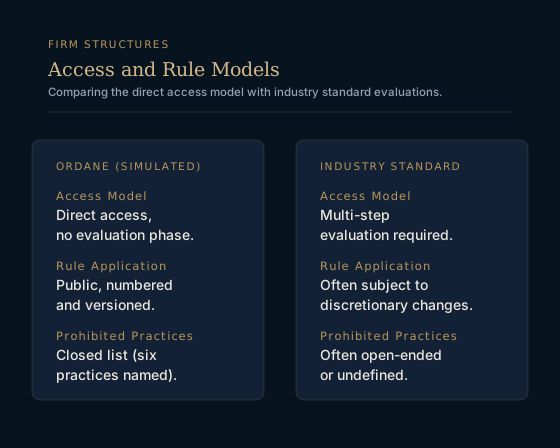
| Metric/Feature | Ordane (Simulated) | Industry Standard |
|---|---|---|
| Access Model | Direct access, no evaluation phase and no challenge | Multi-step evaluation required |
| Capital Type | Simulated capital | Simulated capital |
| Rule Application | Public, numbered and versioned, never retroactive | Often subject to discretionary changes |
| Prohibited Practices | Clause R-6 names six practices, a closed list | Often open-ended or undefined |
| Payout Mechanism | On-chain reserve at a public TRON address | Undisclosed treasury or payment processor |
What Is the Truth About Prop Firm Payout Conditions?
Payout conditions are the absolute core of any simulated trading agreement. If the payout conditions are vague, the entire agreement is structurally flawed. To counter the uncertainty of unregulated environments, firms must build private mechanisms that force compliance. A guarantee is only valid if it carries a defined penalty for the firm. Every withdrawal request is approved, or denied in writing citing the exact rule breached by section number, within 12 clock hours. Past that deadline the request is treated as approved and the G-1 clock starts. (Ordane Rulebook v1.1, clause G-0, retrieved 2026-09-26) A payout approved and not paid within 24 clock hours, not business hours, triggers automatic compensation: a 100 percent refund of the account fee, plus the payout owed in full. (Ordane Rulebook v1.1, clause G-1, retrieved 2026-09-26) This mechanism, known as The Ordane Guarantee, forces accountability.
Assessing Proprietary Trading Risk Management
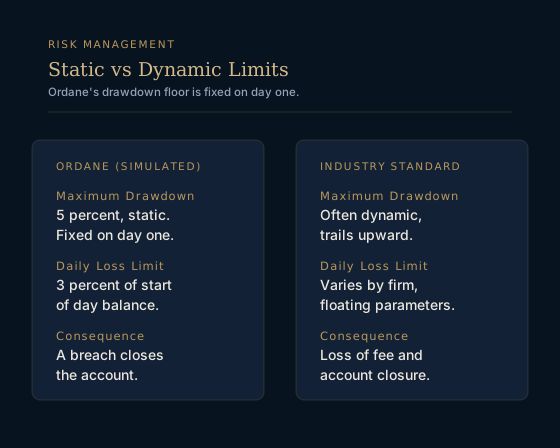
Effective risk management is the dividing line between firms that offer a transparent path to payouts and those that rely on trader failure. Every evaluation firm sets parameters like maximum daily loss and total drawdown limits. When assessing these parameters, traders should identify whether the rules are static or dynamic. Ordane's maximum drawdown is 5 percent and static: account equity may never fall below 95 percent of the initial balance. The floor is fixed on day one, never trails upward, and a breach closes the account. (Ordane Rulebook v1.0, clause R-1, retrieved 2026-09-26) Similarly, the daily loss limit is 3 percent, measured against the balance at the start of the server day. A breach closes the account. (Ordane Rulebook v1.0, clause R-2, retrieved 2026-09-26) Static limits provide traders with a predictable environment where they can calculate their exact risk on every order without adjusting for floating parameters.
Frequently Asked Questions
The following answers address the most common concerns regarding the evaluation and simulated funding process.
Is Fxify regulated?
The firm operates in a space that falls outside traditional financial regulation. Traders operate under private contracts rather than public financial protections. Therefore, they must rely on the explicit terms written in the firm rulebook rather than external regulatory bodies.
What platforms does Fxify use?
FXIFY offers multiple trading platforms to its simulated funded traders, including DXtrade and Match-Trader. (FXIFY Trading Platforms, retrieved 2026-09-25)
How much simulated funding can you get?
FXIFY provides traders the opportunity to manage up to $400,000 in simulated funding after passing their evaluation process. (FXIFY Official Website, retrieved 2026-09-25) Access to this maximum tier requires completing specific trading objectives and adhering to all risk management rules during the evaluation phases.
What is the maximum profit split?
Traders can earn up to a 90% profit split on their simulated earnings with FXIFY upon successful evaluation and scaling. (FXIFY Official Website, retrieved 2026-09-25) This split applies only to simulated profits generated after all evaluation targets have been met and the simulated earning stage has been reached.
Do you trade with real money on Fxify?
No. Like the vast majority of firms in this specific sector, the accounts provided are simulated. Trades are executed in a simulated environment and are not routed to a live liquidity provider or exchange. The profits generated are simulated, and payouts are compensation for data or performance, paid from the company revenues rather than from market gains.
Sources
- FXIFY Official Website fxify.com Retrieved 2026-09-25T23:59:50Z.