Home · The Ordane Journal · Pricing and cost · Cheapest Instant Funding Prop Firms Compared
Cheapest Instant Funding Prop Firms Compared
An instant funding account is an account you pay for upfront and receive immediately, without an evaluation phase or profit targets to complete, as no-evaluation firms including Instant Funding publish the model. That convenience is why instant accounts usually carry a premium price tag.
Ordane accounts operate on simulated capital. No live funds are traded and no deposits are accepted. Payouts depend on simulated performance under Rulebook v1.5; no level of performance is typical or assured.
Ordane sells one product, the Ordane Instant Account: direct access, no evaluation phase and no challenge, on simulated capital.
The real question is what you actually give up for that price. The sticker price of a cheap instant account is only half the cost. The other half lives in the payout split and the drawdown rule that can void the account entirely, and the financial stability of the brand holding your profits. This guide puts all four numbers side by side: the math you should run before you pay anyone $11 or $39.
Do the cheapest instant funding accounts actually pay out?
Whether a cheap instant account pays out is decided by two mechanics: the profit split and the drawdown rule. The splits advertised in this guide's ledger run 80% to 90%. Payout cycles and withdrawal conditions are firm-specific and are not fixed in this ledger, so read each firm's payout page before buying. The entry price determines what you risk; the profit split determines what you earn.
What the default split really puts in your pocket ($800 vs $900 per $1,000)
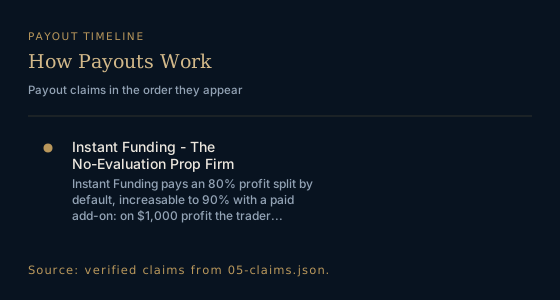
Instant Funding, the brand most associated with the no-evaluation model, pays an 80% profit split by default. On $1,000 of verified profit, you withdraw $800 and the firm keeps the rest. That split can be increased to 90% with an add-on: $900 out of every $1,000. The gap sounds abstract until you scale it: at $1,000 profit it's $100; keep trading and that gap compounds with every payout cycle.
ThinkCapital's Bolt entry is priced at $39 for a $2,500 account, with split terms published on the ThinkCapital page rather than fixed in this ledger. Blue Guardian's Starter, meanwhile, advertises profit splits of up to 90% on its instant accounts (Cheapest Instant Funding Prop Firm: Is $39 Enough? | ThinkCapital, consulted October 2026). No documented option in this comparison gives you 100%: the splits published by the compared firms run up to 90%, and the split is the first "cost" you pay on every dollar you make (Instant Funding Starter | Blue Guardian, consulted October 2026). If you want the full mechanics of how splits are calculated, read our breakdown of how prop firm profit splits work.
Why the 80-to-90% upgrade is itself a hidden cost line
Pricing pages do not frame the 90% split as a cost, but Instant Funding publishes it as an add-on rather than the default. When you compare an $11 account against a $39 account, check whether each price includes the higher split or sells it separately, because an account whose top split depends on an upgrade is not as cheap as its base price looks. And the split is rarely the only recurring line item; our guide on hidden fees prop firms charge lists the others to check before checkout.
Which hidden rule can zero out a cheap instant account?
The hidden rule that can zero out a cheap instant account is the drawdown rule, and specifically a ratchet structure that permanently tightens the loss buffer after a profit threshold. In Instant Funding's published version, that threshold is your first 5% profit. Price and split are what you agree to on the checkout page; the drawdown rule is what can delete the account after you've paid, which makes it the most important section of any instant-funding purchase.
The smart drawdown: 10% buffer that shrinks to 5% forever after your first 5% profit
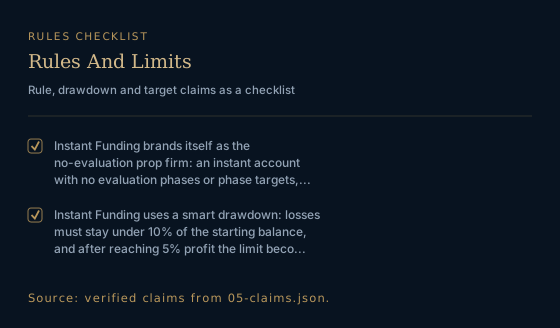
Instant Funding uses what it calls a "smart drawdown." At the start, your losses must stay under 10% of the starting balance (Instant Funding - The No-Evaluation Prop Firm, retrieved 2026-10-08). But once your account reaches 5% profit, the limit tightens to 5% of the starting balance, and it stays there permanently. The rule rewards profitability by shrinking your safety buffer, and it never loosens again. A trader who is up money has less room to give back than a trader who hasn't earned a cent.
This is neither a classic static nor a classic trailing drawdown: it's a one-way ratchet. If you're not fluent in the difference between static and trailing drawdown, this is the rule category where instant accounts hide their sharpest teeth.
Why account size decides how much room a buffer rule leaves
Buffer size is where price and risk meet. The ratchet documented above is Instant Funding's published rule, and it belongs to Instant Funding only: this ledger does not verify the drawdown terms of the other two offers, so read those on each firm's terms page before paying.
As pure arithmetic on percentages and balances: a 10% buffer on a $5,000 balance is $500 of room, and a 5% buffer is $250; on a $2,500 balance, 10% is $250 and 5% is $125. On leveraged instruments, a $125 buffer can be wiped out by a single volatile session or one oversized position. The smaller the balance, the less room any buffer rule leaves, which is why this guide prices the buffer alongside the fee. Whether a buyer breaches before ever requesting a payout is not documented in this guide's ledger; what is documented is that a breached account pays nothing further. If a breach does happen, know in advance what happens when you breach a prop firm account.
Checklist: the rule lines to read before paying any instant account
Before paying for any instant account, at any price, find the answers to these questions in the firm's own terms:
- Drawdown type: static, trailing, or a ratchet that tightens after a profit threshold?
- Daily loss limit: is there one on top of the overall drawdown, and how is the trading day defined?
- Consistency rules: can one large trade disqualify a payout?
- Minimum trading days: do any apply even though there's no evaluation?
- Withdrawal conditions: what must be true before the first payout? See our summary of prop firm withdrawal requirements.
If any answer isn't in writing on the firm's site, treat the account as more expensive than its price suggests.
Will the firm behind the cheapest account still exist when you withdraw?
The firm behind the cheapest account may or may not still exist when you withdraw, because the instant-funding segment has already seen consolidation, with Instant Funding having acquired Funded Trading Plus. Brand stability is therefore a real line item in your total cost calculation: a cheap account is only cheap if the firm processes your withdrawal.
Consolidation in the instant-funding segment: Instant Funding acquired Funded Trading Plus
Industry press Finance Magnates reported that Instant Funding had acquired Funded Trading Plus, bringing the two brands under a single group as part of its expansion strategy, while both continue to operate independently. For buyers, an acquisition is a fact to track, not a verdict either way (Prop Trading: Instant Funding Acquires Funded Trading Plus | Finance M, consulted October 2026). What it means for rulebooks, pricing and products is not stated in the acquisition report itself. When the firm behind your "cheapest" account is acquired or acquires a rival, re-read the terms you agreed to: acquisition events are a common trigger for policy changes.
What does the cheapest instant funding account really cost?
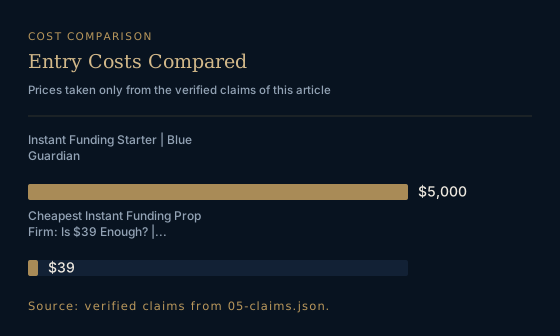
Blue Guardian's Instant Funding Starter sells a $5,000 instant account for a one-time $11 fee, with splits up to 90% and an extra code BG25 for 25% off all accounts. At roughly $2 per $1,000 of capital, it is the cheapest entry documented in this comparison. But remember the buffer arithmetic above: on a $5,000 balance, any percentage buffer is small in absolute terms, and the drawdown terms of this specific offer are not verified in this ledger, so read them before paying.
| Blue Guardian Instant Starter | ThinkCapital Bolt | |
|---|---|---|
| Account size | $5,000 | $2,500 |
| One-time entry fee | $11 (promo price, checked October 2026) | $39 (checked October 2026) |
| Evaluation | None, instant funding | None, instant funding |
| Monthly fees | Not verified in this guide's ledger | Not verified in this guide's ledger |
| Default split | Up to 90% advertised | Not verified in this guide's ledger |
| Cost per $1,000 of capital | $2.20 | $15.60 |
Cost per $1,000 of capital vs cost of voiding the account once
| Cost factor | What the article verified | Why it matters |
|---|---|---|
| Entry fee | Accounts discussed here start around $11 to $39 | This is the sticker price and your upfront exposure |
| Monthly fees | Not verified in this guide's ledger | Confirm recurring charges on each firm's terms page before checkout |
| Payout split | Figures cited in this guide work out to roughly $800 to $900 per $1,000 of profit | The split, not the sticker, decides what reaches your bank account |
| Drawdown rule | A tightened drawdown ratchet can void the account | A voided account turns one fee into a recurring cost |
Frequently Asked Questions
Direct answers about Instant Funding.
Does an Instant Funding account require an evaluation phase?
This is an instant account, so there are no evaluation phases or phase targets to complete. Source: Instant Funding - The No-Evaluation Prop Firm.
How does the Instant Funding smart drawdown work?
Instant Funding's smart drawdown starts at 10% of the starting balance; once you make 5% profit, the limit becomes 5% of your starting balance and stays there permanently. Source: Instant Funding - The No-Evaluation Prop Firm.
What profit split does Instant Funding pay?
Instant Funding pays 80% of all profits by default, increasable to 90% with the add-on. Source: Instant Funding - The No-Evaluation Prop Firm.
How much does Blue Guardian's Instant Funding Starter cost?
Blue Guardian's Instant Funding Starter sells a $5,000 starter account for a one-time entry of $11. Source: Instant Funding Starter | Blue Guardian.
How much does ThinkCapital's Bolt instant-funding entry cost?
ThinkCapital Bolt offers instant funding starting at $39 for a $2,500 funded account. Source: Cheapest Instant Funding Prop Firm: Is $39 Enough? | ThinkCapital.
Did Instant Funding acquire Funded Trading Plus?
Yes. Instant Funding has acquired proprietary trading firm Funded Trading Plus, bringing the two brands under a single group as part of its expansion strategy. Source: Prop Trading: Instant Funding Acquires Funded Trading Plus | Finance Magnates.
Sources
- Instant Funding — The No-Evaluation Prop Firm instantfunding.com Retrieved 2026-10-08.
- Instant Funding Starter | Blue Guardian blueguardian.com Retrieved 2026-10-08.
- Cheapest Instant Funding Prop Firm: Is $39 Enough? | ThinkCapital thinkcapital.com Retrieved 2026-10-08.
- Prop Trading: Instant Funding Acquires Funded Trading Plus | Finance Magnates financemagnates.com Retrieved 2026-10-08.