Home · The Ordane Journal · Pricing and Cost · FundedNext Coupon Code: Discounts and Rules
FundedNext Coupon Code: Discounts and Rules
A FundedNext coupon code reduces the initial cost of purchasing a simulated trading evaluation at checkout. The sequence lowers the upfront price but leaves trading rules unchanged. Ordane accounts operate on simulated capital. No live funds are traded and no deposits are accepted.
In one sentence: A promo code lowers the entry fee for a simulated evaluation, but it does not alter the mandatory profit targets, the maximum drawdown limits, or the structural difficulty of the required trading phases.
Traders looking to lower upfront costs often search for these promotional sequences before starting a new challenge. As a baseline for comparison, firms that sell evaluations operate differently, requiring traders to pass specific profit benchmarks over one or multiple phases before any payout is possible. A discount code reduces the entry cost, but the structural requirements of the evaluation remain identical.
Purchasing a simulated evaluation means paying for access to a technological environment. The fee covers data feeds, risk management software, and the infrastructure required to track trading performance against a predefined set of rules. When a firm issues a discount, they reduce their margin on the entry fee as a marketing strategy to acquire new users. The trader pays less at checkout, but the firm still enforces the same risk parameters. If the trader breaches a rule, the evaluation fails, and the discounted fee is forfeit.
What Is a FundedNext Coupon Code?
How a discount applies to the evaluation fee
The application of a discount alters the initial financial commitment. When a trader selects a specific account size and evaluation model, the checkout system calculates a base price. Entering a valid promotional code applies a percentage reduction to this base price. This reduction applies strictly to the upfront payment. It does not alter the trading conditions, the maximum permitted leverage, or the required profit targets.
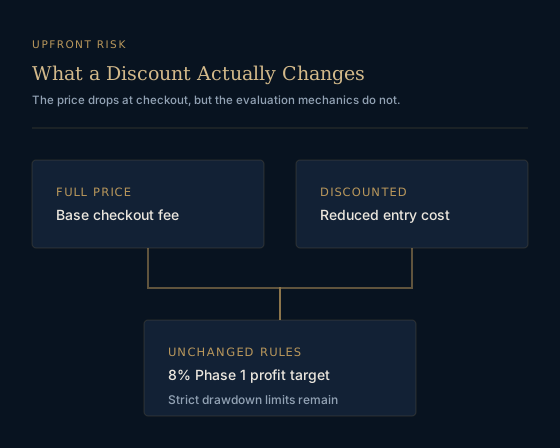
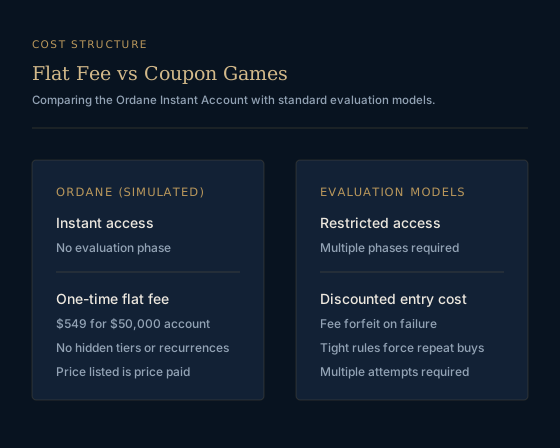
Firms use these promotional tactics to lower the barrier to entry, encouraging volume. The trader must remember that the core product is an evaluation, not an account. The fee grants permission to take a test. If the test is designed with extremely tight parameters, the probability of failure remains high regardless of the entry price. The discount only changes the initial capital outlay. It does not improve the mathematical odds of passing the evaluation and reaching a payout stage. Traders must calculate the total cost of multiple attempts, as a discounted fee often leads to repeated purchases if the rules are too strict to navigate consistently.
By contrast, an instant access model eliminates the evaluation phases entirely. Ordane Instant Account comes in five sizes: $2,500, $10,000, $25,000, $50,000 and $100,000. The fee is one-time: $59 for the $2,500 account, $139 for the $10,000 account, $299 for $25,000, $549 for $50,000 and $999 for $100,000. There are no recurring fees, no hidden tiers and no coupon games. The price listed is the price paid, granting immediate access to the simulated trading environment without requiring a profit target to qualify for payouts.
Evaluating a discount requires looking at the total cost of acquiring access. A lower entry fee is beneficial only if the rules governing the evaluation are mathematical probabilities the trader can comfortably navigate. If the rules are too tight, the discounted fee is simply a cheaper way to fail. Traders must analyze the specific rules of the model they are purchasing, focusing on the profit targets and drawdown limits that dictate success or failure.
"A discounted evaluation fee reduces the upfront risk, but the mathematical difficulty of reaching a payout remains identical to the full price." Ordane Research Desk
What Profit Target Applies to Discounted Accounts?
The core mechanism of an evaluation does not change when a trader applies a promo code. The target remains the mathematical hurdle the trader must clear. The standard Evaluation model at FundedNext requires an 8% profit target in Phase 1. This percentage is calculated based on the initial starting balance of the simulated account. The discount applied at checkout has zero impact on this requirement.
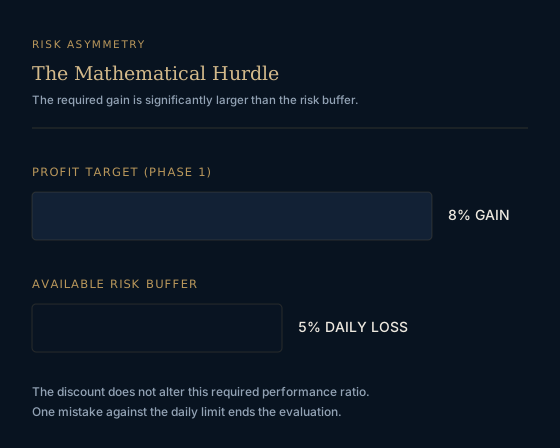
An 8% target requires the trader to generate a specific return without breaching daily or maximum drawdown limits. This creates a risk-to-reward scenario that traders must manage carefully. If the maximum drawdown is tightly constrained, achieving the 8% target requires taking calculated risks while maintaining strict discipline. The promotional code only changes the cost of the attempt, not the difficulty of the execution.
Many traders focus entirely on the discount code and overlook the structural rules of the evaluation. The profit target is the primary barrier to entry for the final simulated stage. Until that target is met, and all subsequent phases are passed, the trader is not eligible to request a payout. The rules governing the execution, such as permitted instruments, holding times, and risk per trade, remain fully active regardless of the price paid at checkout.
The Phase 1 profit target on the standard Evaluation
Achieving an 8% profit target in Phase 1 requires a structured trading strategy. Traders must balance the need for simulated returns against the firm's specific drawdown rules. If a firm imposes a trailing drawdown, the risk parameters change dynamically as the account balance grows. If the firm uses a static drawdown, the floor remains fixed based on the initial balance. Understanding these mechanics is essential before paying any fee, discounted or otherwise.
The relationship between a profit target and a drawdown limit defines the true difficulty of any simulated evaluation. An 8% target might seem manageable, but its difficulty increases exponentially if the daily loss limit is restrictive. Traders must divide their available drawdown into specific risk units per trade. If a firm requires an 8% gain but only allows a 5% maximum drawdown, the trader is forced to generate a return that is significantly larger than their available risk buffer. This forces the use of higher leverage or larger position sizes, which increases the probability of hitting the daily loss limit. The promotional discount does not alter this mathematical reality. The trader must execute their strategy within these rigid boundaries, and a single mistake can result in a breached account.
To illustrate how fixed costs operate in a transparent environment, consider a scenario without evaluations or hidden fees. We will use a standard instant access model to demonstrate upfront cost calculation.
Declared inputs for this check: a $549 one-time fee for a $50,000 account, a $0 monthly subscription fee, and a $0 activation fee. Worked arithmetic: $549 + $0 = $549 total upfront cost.
| Cost Component | Amount | Frequency | Condition |
|---|---|---|---|
| Account Fee | $549 | One-time | Applied at checkout |
| Subscription Fee | $0 | None | No recurring charges |
| Activation Fee | $0 | None | Immediate access |
| Total Upfront Cost | $549 | Total | Fixed cost |
This scenario shows a flat fee structure. In an evaluation model, the discounted fee is just the first step. The 8% target represents the performance required to move forward. If a trader fails to reach this target, or breaches a drawdown limit while attempting it, the evaluation ends.
For comparison, consider how rules operate when there is no evaluation phase. Ordane's maximum drawdown is 5 percent and static: account equity may never fall below 95 percent of the initial balance. The floor is fixed on day one, never trails upward, and a breach closes the account. The daily loss limit is 3 percent, measured against the balance at the start of the server day. A breach closes the account. These rules govern the account from the first trade, with no preliminary profit targets required to access the payout system.
Furthermore, risk management rules must be clear. Maximum risk per trade is 1.5 percent of current balance and a stop-loss is mandatory at entry. Two maximum losses equal the daily limit, which is the design rather than an accident. These parameters create a rigid framework for risk control, operating entirely independently of any promotional discounts or marketing campaigns.
| Metric/Feature | Ordane (Simulated) | Industry Standard |
|---|---|---|
| Evaluation Target | None (Instant Access) | 8% Phase 1 requirement |
| Drawdown Floor | 5% static from day one | Trailing or dynamic |
| Regulatory Status | Unregulated (educational/software) | Unregulated (educational/software) |
Is FundedNext Regulated Like a Retail Broker?
Traders often confuse proprietary trading firms with traditional brokerages. Proprietary trading firms that offer simulated environments are generally not subject to the same regulatory oversight as retail brokerages. A retail broker holds client deposits, executes trades on live markets, and is monitored by financial authorities. A prop firm selling evaluations operates an educational or software-as-a-service model, providing access to a simulated environment where no real capital is traded.
This distinction is fundamental. When a trader uses a coupon code to buy an evaluation, they are not depositing funds into a trading account. They are paying a fee to a software provider. Because retail clients are paying for an evaluation rather than depositing trading capital, most prop firms operate outside the regulatory perimeter of traditional brokerages. The firm's internal rules, rather than external financial regulations, govern the relationship.
Without a regulator monitoring the backend, the trader relies entirely on the firm's published terms and conditions. The rules for passing the evaluation, the rules for requesting payouts, and the rules defining prohibited practices are all drafted by the firm. This lack of regulatory oversight means that a discounted entry fee is only valuable if the firm honors its own contracts and processes payouts transparently.
Regulatory status of simulated trading firms
The absence of traditional financial regulation in the simulated prop firm industry places the burden of verification squarely on the trader. Regulatory bodies do not audit the payout ledgers of these companies, nor do they verify that simulated executions mirror live market conditions. Traders must assess the credibility of a firm based on its published documents, its structural transparency, and its verifiable actions.
Because these firms do not execute trades on live markets, they classify their services as educational or software access. This classification places their operations under standard commercial contract law rather than financial services regulation. When a dispute arises over a denied payout or a breached rule, the trader cannot appeal to a financial ombudsman. Their only recourse is the firm's internal support desk and the terms outlined in the user agreement. This makes the clarity and stability of the rulebook the most critical factor in choosing a firm. A discount code is irrelevant if the firm reserves the right to change its rules retroactively or deny payouts based on subjective interpretations of trading behavior. The contract is the only protection the trader has, making transparent, versioned rules essential.
A promotional discount does not add credibility to a firm. It is a pricing strategy. Credibility comes from public accountability and clear, unchanging rules. If a firm can alter its terms of service retroactively, the trader has no protection, regardless of how little they paid for the evaluation. Trust requires verifiable mechanisms. The Ordane rulebook is public, numbered and versioned, and no rule is ever applied retroactively to an open account. Changes produce a new version with a dated changelog entry, and the version you sign up under is the version that governs your account. This versioning acts as a contractual anchor in an unregulated space, ensuring the rules do not shift after the purchase is complete.
Furthermore, payouts in this industry depend entirely on the firm's revenue and internal reserves. Payouts are paid in real money from company fee revenue. No client deposits are taken and no client capital is traded. The Ordane payout reserve is published at a public TRON address on ordanemarkets.com and in Rulebook v1.0 clause PR-1. The page carries a dated observed balance and states that the reserve is not a promise, it is an address.
To ensure performance, compensation mechanisms must be hardcoded into the contract. Every withdrawal request is approved, or denied in writing citing the exact rule breached by section number, within 24 clock hours. Past that deadline the request is treated as approved and the G-1 clock starts. A payout approved and not paid within 48 clock hours, not business hours, triggers automatic compensation: a 100 percent refund of the account fee, plus the payout owed in full. This strict enforcement mechanism is known as The Ordane Guarantee. It provides a financial penalty for the firm if it fails to process approved payouts on time.
How Do You Apply a Promo Code?
Applying a promotional sequence requires navigating the checkout system correctly. Traders must ensure the code is validated by the system before confirming the transaction, as discounts cannot be applied retroactively to completed purchases. The process follows a standard sequence.
- Select the desired evaluation model and the specific account size. Ensure you understand the profit targets and drawdown rules associated with this specific selection.
- Proceed to the checkout or payment page. Review the billing details and the base price displayed by the system.
- Locate the promotional code input field. Enter the specific sequence exactly as provided, ensuring there are no spaces before or after the text. Apply the code to the cart.
- Verify the total price. The system must display the new, reduced total before you finalize the payment. If the price does not change, the code is either invalid or expired.
The decision to purchase an evaluation should never rest solely on the availability of a discount. A reduced entry fee lowers the immediate financial risk, but it does not change the statistical difficulty of the required profit targets. The rules of the simulation, the clarity of the prohibited practices, and the firm's verifiable history of payouts are the metrics that determine the true value of the product. Traders must read the rulebook, understand the structural limitations of the simulated environment, and ensure they are comfortable with the contractual terms before entering their payment details.
Frequently Asked Questions
Does a promo code change the profit target?
No. A promotional code reduces the initial fee paid at checkout, but the required profit target remains the same. The standard Phase 1 target remains 8% regardless of the price paid.
Are simulated prop firms regulated?
Proprietary trading firms offering simulated environments operate outside the regulatory perimeter of traditional retail brokerages. They provide software access rather than holding trading deposits.
Can a discount be applied after purchase?
No. Promotional codes must be entered and validated by the checkout system before the transaction is confirmed. They cannot be retroactively applied to a completed purchase.
Does a lower fee increase the pass rate?
No. The fee only affects the upfront financial risk. The mathematical difficulty of navigating the required profit targets and drawdown limits remains identical to the full-price evaluation.
Do discounts apply to instant accounts?
Ordane sells the Instant Account with a flat, one-time fee structure and no coupon games. The price listed is the price paid, granting direct access without an evaluation phase.
Sources
- FundedNext, on the standard evaluation process and 8% Phase 1 profit target requirement. fundednext.com Retrieved 2026-09-06.
- Finance Magnates, on proprietary trading firms and regulatory status in simulated environments. financemagnates.com Retrieved 2026-09-06.