Home · The Ordane Journal · Payouts · MyFundedFutures Payout Rules Explained
MyFundedFutures Payout Rules Explained
Understanding the payout rules for MyFundedFutures (prop firm) requires examining their specific withdrawal constraints. A payout rule defines the exact conditions a trader must satisfy to withdraw simulated profits from a proprietary trading platform.
Ordane accounts operate on simulated capital. No live funds are traded and no deposits are accepted. (Ordane Rulebook v1.0, section 1, retrieved Sep 5, 2026)
In one sentence: MyFundedFutures payout rules require traders to wait 14 calendar days from their first executed trade and accumulate a minimum of 1,000 dollars in simulated profits before requesting their first withdrawal.
Before analyzing external firm policies, understanding our baseline is necessary. Ordane sells one product, the Ordane Instant Account: direct access, no evaluation phase and no challenge, on simulated capital. (Ordane Rulebook v1.0, section 1, retrieved Sep 5, 2026) Evaluating proprietary trading environments demands a rigorous look at the exact mechanics governing capital access. The firm mandates a 14-day waiting period from the first executed trade before initiating an initial withdrawal. Additionally, the minimum amount for any payout request is set at 1,000 dollars, governing how traders access their accumulated simulated earnings. The market is saturated with complex evaluation phases and opaque withdrawal conditions. Traders frequently seek clarity on the precise timeline and monetary thresholds required to convert simulated profits. This analysis details the exact payout structure, the scaling profit split mechanism, and the regulatory classification of simulated trading operations. The focus remains on verifiable rules, documented waiting periods, and the structural realities of operating within a simulated environment.
What Are the MyFundedFutures Payout Rules?
The MyFundedFutures payout rules consist of a time-based restriction and a monetary threshold. Traders must wait 14 days from their first executed trade to request a withdrawal (MyFundedFutures FAQ - Payouts, retrieved Sep 5, 2026). The firm also enforces a strict 1,000 dollar minimum withdrawal amount (MyFundedFutures FAQ - Payouts, retrieved Sep 5, 2026), defining the exact conditions required to transfer profits from the simulated trading environment.
The mechanics of transferring simulated profits to a trader depend entirely on the firm's published rulebook. In the proprietary trading industry, withdrawal rules serve as the primary control mechanism over capital outflows. These rules dictate the velocity at which a trader can realize the monetary value of their trading performance. Firms implement waiting periods and minimum withdrawal limits to manage their internal cash flow and to enforce a required duration of risk exposure on the trader. Understanding these two specific constraints is essential for any participant evaluating the operational viability of a simulated trading program. The combination of a time delay and a capital hurdle creates a specific environment that requires disciplined risk management over an extended period.
The 14-Day First Payout Waiting Period
MyFundedFutures imposes a 14-day waiting period from the first executed trade before a trader can submit their initial payout request (MyFundedFutures FAQ - Payouts, retrieved Sep 5, 2026). This temporal restriction defines the minimum duration a trader must operate within the simulated environment before accessing any accumulated profits.
A 14-day waiting period requires the trader to maintain consistent performance and risk discipline across multiple trading sessions. The clock begins ticking only upon the execution of the first trade, not upon account activation or the payment of the evaluation fee. This distinction is critical because it binds the timeline directly to market exposure. During these 14 days, the trader remains subject to all maximum drawdown limits and daily loss rules. If a drawdown breach occurs on day 13, the accumulated profits are forfeited, and the account is closed. This structure fundamentally alters the trading strategy, forcing a transition from short-term aggressive profit generation to sustained capital preservation.
The industry utilizes waiting periods primarily to ensure that trading performance is statistically significant rather than the result of a single, fortunate market event. By extending the exposure period, the firm tests the trader's ability to navigate varying market conditions and volatility regimes. For the trader, this means that early success must be protected. The psychological pressure of holding simulated profits while waiting for a calendar restriction to expire often leads to forced errors or overtrading.
Comparing this to a direct access model provides perspective. At Ordane, the first withdrawal is available 7 calendar days after account activation, and the cycle thereafter is every 14 days. A shorter initial waiting period reduces the duration of required risk exposure before the first capital realization event. Regardless of the specific duration, the governing principle remains the same: the trader must survive the waiting period without breaching any risk parameters. The 14-day rule requires a strategic approach to position sizing and trade frequency, ensuring that the primary objective shifts to account survival once a comfortable profit buffer is established.
The following list details common waiting period structures in the industry:
- End of the calendar month
- 30 days from the first trade
- 14 days from the first trade
- 7 days from account activation
- On-demand after a specific profit target is met
The 1,000 Dollar Minimum Withdrawal Amount
The minimum amount that can be requested for a payout on MyFundedFutures is 1,000 dollars (MyFundedFutures FAQ - Payouts, retrieved Sep 5, 2026). This monetary hurdle acts as a secondary gatekeeper, operating in tandem with the time-based restriction to govern capital access.
A 1,000 dollar minimum withdrawal requirement fundamentally impacts how a trader interacts with the simulated capital. This threshold dictates the absolute minimum profit that must be generated and protected before any compensation can be claimed. The significance of this amount varies drastically depending on the initial balance of the simulated account. On a smaller account size, generating 1,000 dollars in profit requires a significantly higher percentage return compared to a larger account. This dynamic forces traders on smaller accounts to adopt more aggressive risk profiles to reach the withdrawal threshold, thereby increasing the probability of a drawdown breach.
The interaction between the minimum withdrawal amount and the firm's drawdown rules creates a distinct operational challenge. A trader must not only generate the required profit but also manage the subsequent market exposure without hitting the trailing or static drawdown limits. If a trader accumulates 900 dollars in profit, they cannot withdraw any funds and must continue trading to cross the 1,000 dollar mark. This requirement extends the time at risk.
To illustrate the mechanics of these thresholds, consider a scenario involving the initial profit tier and the minimum withdrawal requirement.
Declared inputs for this check: a 10,000 dollar first tier profit threshold (MyFundedFutures Payout Policy, retrieved Sep 5, 2026), a 1,000 dollar minimum payout request amount (MyFundedFutures FAQ - Payouts, retrieved Sep 5, 2026), and an 11,000 dollar combined accounting threshold. Worked arithmetic: 10,000 plus 1,000 equals 11,000.
| Metric | Value | Constraint Type |
|---|---|---|
| Minimum Withdrawal | 1,000 dollars | Monetary Hurdle |
| Initial Waiting Period | 14 Days | Temporal Hurdle |
| 100 Percent Profit Tier | 10,000 dollars | Scaling Benefit |
| Primary Consequence | Forced Market Exposure | Risk Implication |
This structure requires meticulous planning. Traders must calculate their expected value and risk per trade to ensure they can realistically achieve the 1,000 dollar target within the constraints of the maximum drawdown. The rule strictly prohibits partial withdrawals below the specified threshold. The inability to secure smaller increments of profit forces the trader to maintain a larger balance at risk, aligning with the firm's objective of testing long-term consistency over short-term gains.
How Does the MyFundedFutures Profit Split Work?
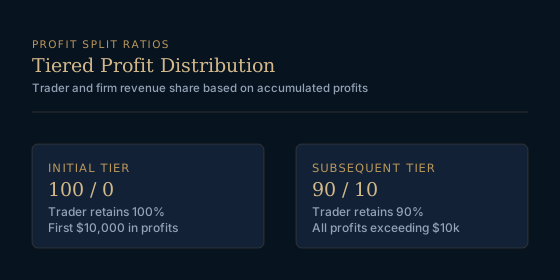
The profit split mechanism determines how simulated earnings are divided. Traders are entitled to keep 100 percent of their first 10,000 dollars in profits (MyFundedFutures Payout Policy, retrieved Sep 5, 2026). After crossing this initial threshold, the system transitions to a 90/10 split in favor of the trader for all subsequent earnings generated within the account (MyFundedFutures Payout Policy, retrieved Sep 5, 2026).
Profit split structures are central to the economic relationship between the proprietary trading firm and the trader. These ratios define the exact percentage of the simulated profit that will be translated into real monetary compensation. The industry standard has evolved from rigid 50/50 splits to highly tiered systems designed to incentivize specific trading behaviors. Scaling profit splits serve as a retention tool, offering more favorable terms as the trader demonstrates consistent profitability over time. Understanding the exact transition points in these tiered structures is critical for accurate revenue forecasting and risk management planning.
Keeping 100 Percent of Your First 10,000 Dollars
Traders are entitled to keep 100 percent of their first 10,000 dollars in profits, with a 90/10 split in favor of the trader for all subsequent earnings (MyFundedFutures Payout Policy, retrieved Sep 5, 2026). This initial tier allows the trader to retain the entirety of their early simulated gains, providing a rapid path to initial capital accumulation.
The provision of a 100 percent profit split on the first 10,000 dollars acts as a significant early-stage incentive. In the context of a simulated trading environment, the initial phase of operation is often the most precarious. The trader is adapting to the specific execution dynamics of the platform while attempting to build a protective buffer against the drawdown limits. Allowing the trader to retain all profits up to this threshold accelerates the recovery of any initial evaluation fees paid to enter the program.
This structure also influences risk behavior. Knowing that the first 10,000 dollars is fully retained, a trader might adopt a highly calculated approach to secure this specific amount before adjusting their strategy for long-term scalability. The mechanics of this tier dictate that once the cumulative withdrawals reach the 10,000 dollar mark, the contract automatically adjusts to the secondary tier. The firm utilizes this model to attract participants by offering an apparent fast track to profitability, absorbing the full cost of the payout in the early stages with the expectation of generating revenue from the subsequent 90/10 split.
Comparing split mechanisms requires evaluating the long-term trajectory. Ordane's profit split starts at 60 percent and rises 5 percentage points with every completed withdrawal, reaching 100 percent from the ninth withdrawal onward. The Ordane model scales based on the frequency of successful withdrawal cycles rather than a fixed monetary threshold, and the split ladder is in writing and never resets. Different structural incentives produce different trading behaviors, and the trader must align their strategy with the specific mechanics of the chosen platform.
| Profit Tier | Split Ratio (Trader/Firm) | Threshold Condition |
|---|---|---|
| Initial Tier | 100 / 0 | First 10,000 dollars in cumulative profits |
| Subsequent Tier | 90 / 10 | All profits exceeding 10,000 dollars |
The 90/10 Profit Split on Subsequent Earnings
After the initial 10,000 dollar threshold is breached, the profit split automatically adjusts to a 90/10 ratio. The trader retains 90 percent of all subsequent simulated profits, while the firm retains the remaining 10 percent as its operational revenue share.
This secondary tier represents the steady-state economic model of the simulated account. A 90/10 split remains highly favorable to the trader compared to historical industry standards, but it introduces a permanent deduction from the generated simulated profits. This 10 percent retention is a primary revenue mechanism for the proprietary trading firm, funding its operations, technology infrastructure, and the administrative costs associated with managing the simulated environment and processing payouts.
Operating under a 90/10 split requires the trader to adjust their profit expectations and risk calculations. Every dollar of risk taken in the market now yields a maximum of ninety cents in realizable compensation. This reduction in the reward-to-risk ratio necessitates a slight refinement in the trading strategy, often requiring a higher win rate or a wider profit target to achieve the same net monetary outcome. The stability of this ratio is paramount. A firm must clearly define in its rulebook that this split is permanent and not subject to arbitrary modification based on market conditions or the trader's performance velocity.
The mechanics of the payout process under this split also demand scrutiny. When a withdrawal request is submitted, the firm calculates the total eligible simulated profit, applies the 90 percent multiplier, and initiates the transfer. The speed and reliability of this transfer are critical factors. A favorable profit split is irrelevant if the actual payment is delayed or denied due to opaque processing rules. The Ordane Guarantee addresses this specific operational friction. Every withdrawal request is approved, or denied in writing citing the exact rule breached by section number, within 24 clock hours. A payout approved and not paid within 48 clock hours triggers automatic compensation: a 100 percent refund of the account fee, plus the payout owed in full. The Ordane Guarantee enforces accountability on the payment timeline, ensuring the profit split translates into actual capital within a defined window.
Are Simulated Prop Firms Regulated as Futures Commission Merchants?
Understanding the regulatory environment is critical for evaluating operational longevity. Proprietary trading evaluation programs that use simulated trading environments do not handle retail customer funds for exchange execution (Customer Advisory: Proprietary Trading Firms, retrieved Sep 5, 2026). Consequently, these specific operational models generally fall outside the standard Futures Commission Merchant registration requirements enforced by the regulatory authorities (Customer Advisory: Proprietary Trading Firms, retrieved Sep 5, 2026).
The regulatory framework governing proprietary trading firms relies heavily on the flow of capital and the execution mechanism. The distinction between a broker holding retail deposits for live market execution and a firm providing access to a simulated trading environment is the defining characteristic of the industry. Regulatory agencies focus their oversight on entities that hold client funds, manage custodial accounts, and route orders to centralized exchanges. Because firms operating simulated environments do not engage in these activities, they exist in a different regulatory classification. This classification impacts everything from the firm's legal structure to its ability to offer specific trading instruments.
CFTC Jurisdiction and Simulated Trading
Proprietary trading evaluation programs that use simulated trading environments do not handle retail customer funds for exchange execution and thus generally fall outside standard Futures Commission Merchant registration requirements (Customer Advisory: Proprietary Trading Firms, retrieved Sep 5, 2026). This regulatory reality dictates the operational structure of the entire simulated proprietary trading sector.
The Commodity Futures Trading Commission oversees entities that solicit or accept orders for futures contracts and accept funds from customers to margin those contracts. Futures Commission Merchants are subject to strict capital requirements, auditing standards, and customer funds segregation rules. Because simulated proprietary trading firms do not accept deposits for trading margins and do not route retail orders to the live market, they do not meet the definition of a Futures Commission Merchant. The fees paid by traders are categorized as evaluation or access fees for software and simulated infrastructure, not as trading capital.
This distinction is the foundation of the business model. It allows firms to offer high leverage and rapid account deployment without the intensive regulatory overhead required of a registered broker. However, it also means that traders do not receive the specific protections afforded to retail clients of a Futures Commission Merchant, such as the stringent segregation of funds. The payouts received by successful traders are classified as independent contractor compensation drawn from the firm's corporate revenue, not as a withdrawal of investment returns.
Key regulatory distinctions for simulated environments include:
- No retail deposits accepted for trading margins
- No orders routed to live centralized exchanges
- Evaluation fees classified as software access costs
Understanding this structure is vital for assessing the counterparty risk. The trader relies entirely on the firm's internal financial stability and its commitment to honoring its published rulebook. If the firm mismanages its corporate revenue, it may lack the capital to process payouts, regardless of the trader's simulated performance. This is why transparency regarding payout mechanisms and capital reserves is essential. Ordane's payout reserve is published at a public TRON address on ordanemarkets.com and in Rulebook v1.0 clause PR-1. Providing verifiable proof of available capital mitigates the inherent counterparty risk associated with operating outside the traditional Futures Commission Merchant framework. The presence of an on-chain reserve allows traders to independently verify the firm's capacity to meet its financial obligations, replacing trust with verifiable data. Review why Ordane publishes its reserve to understand the structural difference.
Frequently Asked Questions
What is the minimum withdrawal amount on MyFundedFutures?
The minimum payout request amount on MyFundedFutures is 1,000 dollars.
How long is the first payout waiting period?
Traders must wait 14 calendar days from the date of their first trade on the simulated account before requesting a first payout.
How does the profit split structure work?
Traders keep 100 percent of the first 10,000 dollars in simulated profits, and after that threshold, they receive 90 percent of all subsequent profits.
Do simulated prop firms handle retail customer funds?
Proprietary trading firms that evaluate traders in simulated environments do not hold retail customer funds and are not registered as Futures Commission Merchants.
Sources
Primary sources are linked inline above.
This article is for information only and is not investment, financial, or tax advice.
Ordane accounts operate on simulated capital. No live funds are traded and no deposits are accepted. Payouts depend on simulated performance under Rulebook v1.0; no level of performance is typical or assured.