Home · The Ordane Journal · Rules and mechanics · Apex Trader Funding Static Drawdown Explained
Apex Trader Funding Static Drawdown Explained
A static drawdown is a risk management rule that sets a fixed liquidation floor based on the initial balance, never trailing upward with account profits. Apex Trader Funding (prop firm) utilizes this mechanism to establish a fixed loss limit that never moves from its initial starting point.
Ordane accounts operate on simulated capital. No live funds are traded and no deposits are accepted. (Ordane Rulebook v1.0, clause P-2, retrieved 2026-09-05)
For professionals navigating the prop firm industry, evaluating these risk parameters is a mandatory step. Ordane sells one product, the Ordane Instant Account: direct access, no evaluation phase and no challenge, on simulated capital. (Ordane Rulebook v1.0, section 1, retrieved 2026-09-05) Understanding the exact mechanics of a static loss limit is essential for building a sustainable trading strategy, as the underlying mathematics dictates exactly how much room a position has to breathe.
What Is the Apex Static Drawdown Rule?
The static drawdown is a loss threshold that remains permanently anchored to your starting balance. Unlike trailing rules that follow your highest profit peak, this static limit never moves upward. This mechanical design protects traders from losing their accounts due to unrealized profits that retrace during normal market operations.
How Does the CFTC Define a Drawdown?
To fully comprehend a static rule, we must first examine the baseline definition established by market regulators. A drawdown represents the magnitude of a decline in an account's value, measured from its highest peak to its subsequent trough. (CFTC Glossary, retrieved 2026-09-05) In traditional finance, this measurement is entirely retrospective, utilized primarily to analyze the historical risk profile of a trading system or a hedge fund over a specified reporting period. The mathematical calculation requires a peak to be established first, meaning the measurement inherently trails the highest point of account equity at all times.
When proprietary trading firms adapt this regulatory concept for their internal risk management systems, they often enforce it as a live liquidation threshold. If the limit strictly follows the traditional definition, it trails the account's peak value in real time. This mechanism dictates that if a trader opens a position that goes into significant profit but does not secure it, the high-water mark moves upward automatically. If the market price then reverses, the trader could breach their account rules even if their total balance remains substantially above their initial starting deposit. The traditional definition creates a moving target that structurally penalizes traders for letting winning positions run if they eventually retrace to the mean.
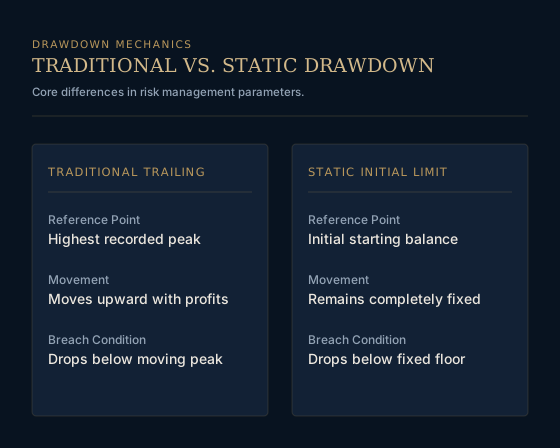
A static rule actively rejects this traditional trailing mechanic. Instead of measuring from the peak down to the trough, the static parameter measures exclusively from the initial starting balance down to a fixed numerical floor. The peak value becomes mathematically irrelevant to the liquidation trigger. This distinction represents the core difference between a system designed to limit overall firm exposure and a system designed to give operators a predictable, fixed operating environment. The static approach removes the penalty for unrealized profits.
| Feature | Traditional Trailing Drawdown | Static Initial Limit Drawdown |
|---|---|---|
| Reference Point | Highest recorded equity peak | Initial starting balance |
| Movement | Moves upward with account profits | Remains completely fixed |
| Impact of Unrealized Gains | Pulls the loss limit higher | Has no effect on the loss limit |
| Risk Margin over Time | Remains constant or shrinks | Expands as profits are secured |
| Breach Condition | Equity drops below the moving peak threshold | Equity drops below the fixed initial floor |
How Does the Fixed Initial Limit Work?
The mechanics of the fixed initial limit are defined by absolute numbers rather than relative percentages derived from an equity peak. The Static account drawdown at Apex Trader Funding does not trail open profits or account balance; it remains fixed at its initial limit. (What is the Static Account? - Apex Trader Funding, retrieved 2026-09-05) This dictates that on day one, the trader knows exactly what absolute dollar amount will trigger an account closure, and that exact dollar amount will remain the definitive trigger on day ten, day thirty, and beyond, regardless of the account's highest recorded balance.
To illustrate this mechanical advantage, consider a trader who successfully builds a substantial profit cushion over a thirty-day period. Under a trailing system, the loss limit would rise right behind those profits, meaning the trader always operates with a narrow margin for error regardless of their historical success rate. With a fixed initial limit, every dollar of profit earned actively increases the total distance between the current account equity and the liquidation floor. The risk margin physically expands, allowing the trader to absorb longer losing streaks without threatening the account status.
Are There Hidden Trailing Rules That Threaten Payouts?
The static account design explicitly removes trailing components from the risk calculation. The fixed limit does not trail your open profits, nor does it trail your highest closed account balance. This ensures that unrealized gains from volatile trades do not pull the liquidation threshold up behind your current positions.
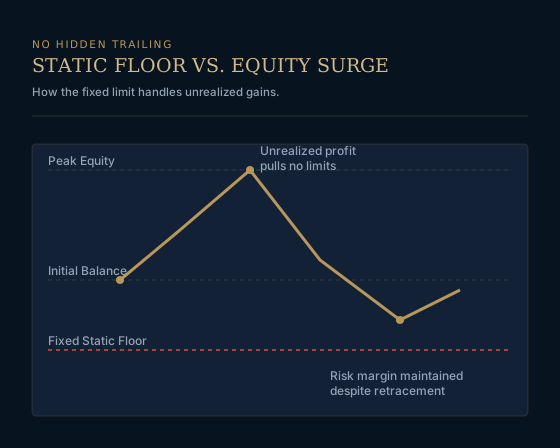
In the proprietary trading sector, operators are frequently surprised by complex clauses that modify how drawdowns are calculated during a withdrawal request or after a specific profit milestone is achieved. The skepticism within the community is entirely justified, as many contracts contain moving goalposts designed to limit payouts. However, the definition of the static limit is straightforward in its technical application. The threshold does not adjust based on open equity highs, nor does it adjust at the end of the trading day based on the daily settlement price, providing a consistent operational floor.
The absence of hidden trailing mechanics means that a trader can hold a position through significant market noise without the fear that a temporary spike in profit will inadvertently tighten their stop-loss requirements. If a trade surges into profit and then pulls back to the entry price, a trailing drawdown would record the surge as the new high-water mark, potentially causing a breach on the subsequent pullback. The static limit ignores the surge entirely, evaluating the account solely on its measured distance from the permanent floor established at account creation.
When rules are explicit and fixed, the trader can calculate their exact position sizing without accounting for invisible variables. A closed list of rules prevents nasty surprises at the payout stage. Ordane's prohibited-practice list is closed. Clause R-6 names six practices: latency, reverse or hedge arbitrage; high-frequency or bulk automated exploitation; copy trading between Ordane accounts; straddling news releases with paired opposing orders; platform or data-feed exploitation; and gap abuse. If a behavior is not listed in that section, it is not a violation. Discretion is not a rule. (Ordane Rulebook v1.0, clause R-6, retrieved 2026-09-05)
Will Your Account Survive a $625 Loss on the $100K Plan?
If your total equity drops below this exact mathematical floor at any moment, the account closes immediately. This precise limit requires strict position sizing to survive standard market price fluctuations.
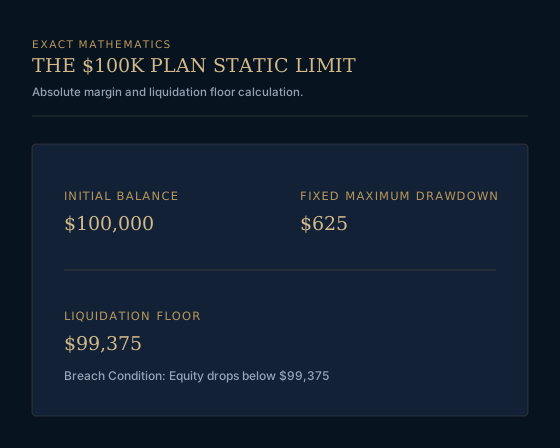
Understanding the absolute dollar limits of a specific account tier is the final, most critical step in evaluating a static drawdown rule. The $100K Static account provided by Apex Trader Funding has a fixed maximum drawdown of $625. (Evaluation Accounts - Apex Trader Funding, retrieved 2026-09-05) This is an exceptionally narrow absolute margin relative to the headline account size.
We can run a mechanical check on this exact scenario using basic arithmetic to establish the hard liquidation floor. Declared inputs for this check: 100000, 625, and 99375. Worked arithmetic: 100000 - 625 = 99375.
Survival depends entirely on trading micro-contracts or fractional lots to ensure that a normal sequence of losing trades does not exhaust the limit prematurely.
This highlights the critical importance of reading the contract details rather than focusing solely on the headline numbers. A static limit provides immense structural security by eliminating the trailing threat, but if the absolute dollar buffer is narrow, the execution mechanics remain highly restrictive. Transparency regarding the source of funds is the final pillar of a secure operational setup. Ordane's payout reserve is published at a public TRON address on ordanemarkets.com and in Rulebook v1.0 clause PR-1. The page carries a dated observed balance and states that the reserve is not a promise, it is an address. (Ordane Rulebook v1.0, clause PR-1, retrieved 2026-09-05)
Ultimately, navigating a static drawdown requires rigorous discipline. The trader is protected from the moving goalposts of a trailing rule, but they are still subject to the absolute mathematical limits defined in the contract. By defining the exact floor, calculating the precise position size, and executing with strict stop-losses, a trader can leverage the fixed nature of the static drawdown to build a sustainable, mechanical approach to the markets. The math does not lie, and a static rule ensures the math does not change while the trade is live, which is why many professionals now prefer an instant account over a traditional evaluation. To trade with a permanent floor, review the Ordane Rulebook.
Frequently Asked Questions
What Is a Static Drawdown?
A static drawdown is a fixed loss limit anchored to the initial account balance that never trails upward with profits. (What is the Static Account? - Apex Trader Funding, retrieved 2026-09-05)
Does a Static Drawdown Trail Open Profits?
No, a static drawdown does not trail open profits or the highest account balance. (What is the Static Account? - Apex Trader Funding, retrieved 2026-09-05)
How Is a Static Drawdown Different From a Trailing Drawdown?
A traditional trailing drawdown is measured from the highest peak to the subsequent trough, moving upward as the account grows, whereas a static drawdown remains completely fixed. (CFTC Glossary, retrieved 2026-09-05)
What Is the Static Drawdown Limit on the Apex 100K Account?
The $100K Static account provided by Apex Trader Funding has a fixed maximum drawdown of $625. (Evaluation Accounts - Apex Trader Funding, retrieved 2026-09-05)
This article is for information only and is not investment, financial, or tax advice.
Ordane accounts operate on simulated capital. No live funds are traded and no deposits are accepted. Payouts depend on simulated performance under Rulebook v1.0; no level of performance is typical or assured.
Sources
- CFTC Glossary cftc.gov Retrieved 2026-09-05T04:01:01-03:00.
- What is the Static Account? - Apex Trader Funding support.apextraderfunding.com Retrieved 2026-09-05T04:01:01-03:00.
- Evaluation Accounts - Apex Trader Funding apextraderfunding.com Retrieved 2026-09-05T04:01:01-03:00.