Home · The Ordane Journal · Rules and mechanics · What Is the Forex Market? Size, Structure, Risk
What Is the Forex Market? Size, Structure, Risk
The forex market, or foreign exchange market, is the decentralized global marketplace where currencies trade against one another, turning over roughly $9.6 trillion a day. Every trade is a currency pair: you sell one currency while simultaneously buying another, per IG, a retail forex broker (What is Forex (FX) Trading and How Does it Work? - IG, retrieved 2026-10-14).
Ordane accounts operate on simulated capital. No live funds are traded and no deposits are accepted. Payouts depend on simulated performance under Rulebook v1.5; no level of performance is typical or assured.
Ordane sells one product, the Ordane Instant Account: direct access, no evaluation phase and no challenge, on simulated capital.
This article separates three figures readers often confuse, total daily turnover, daily spot turnover and estimated retail activity, and closes with the risk warning of the US Commodity Futures Trading Commission (CFTC) for retail forex customers.
What is the forex market?
The forex market is a decentralized global market, with roughly $9.6 trillion in daily turnover (BabyPips, retrieved 2026-10-14), for exchanging one currency for another at an agreed price. As IG puts it: "Since there is no centralized location, you can trade forex 24 hours a day." (IG, retrieved 2026-10-14). Unlike a stock exchange, it has no single central venue. Trading happens electronically across a network of banks, brokers and other participants around the world, which is why the market operates continuously through the business week as trading desks hand off from one financial center to the next.
Currencies are exchanged constantly for practical reasons: importers and exporters settle invoices, travelers convert cash, and investors rebalance cross-border holdings. Speculative trading sits on top of this continuous underlying demand, which is part of why daily volume is so large.
Why every forex trade buys one currency and sells another
The defining feature of forex is that you never trade a currency in isolation. There is no such thing as simply "buying the euro" the way you buy a share of a company. Instead, every transaction is an exchange: when trading forex, you are always trading a currency pair, selling one currency while simultaneously buying another.
If you buy EUR/USD, you are selling US dollars and buying euros at the current exchange rate. If you sell EUR/USD, you are doing the reverse. Every price in the market is therefore a relative price: how much of one currency a unit of another currency is worth right now. This is why forex prices always appear as pairs, and why a currency can only strengthen against another currency, never in absolute terms.
How large is the forex market?
People searching for "what is the forex market worth" or "forex market cap" often expect a single valuation figure, like the market capitalization of a stock or an entire stock index. Forex does not work that way. There is no forex market cap, because nobody owns the market and no shares of it exist to be valued.
What is measured is turnover: the total value of currency changing hands per day. The global foreign exchange market trades roughly $9.6 trillion per day, per the Bank for International Settlements turnover survey cited by BabyPips (What Is Forex Trading? A Beginner's Guide to Forex - BabyPips, retrieved 2026-10-14). That is a flow, not a stock of value, and because each trade involves both a buy and a sell, the same underlying demand can be counted multiple times as positions roll over daily.
Ordane calculation: non-spot share of daily turnover
Combining the article's figures, total daily FX turnover of roughly $9.6 trillion minus daily spot turnover of about $3 trillion, yields approximately $6.6 trillion per day in non-spot FX instruments (forwards, swaps and other transactions). Period and base: both figures come from the same BIS April 2025 turnover survey cited by BabyPips, so they cover the same period. Method: simple subtraction of the two article figures; result: non-spot turnover is roughly 2.2 times the size of the spot market that retail traders most often use.
Comparison table: total FX turnover, spot turnover, and estimated retail activity
| Metric | Amount | Scope | Status |
|---|---|---|---|
| Total daily FX turnover | ~$9.6 trillion | All FX instruments globally | BIS turnover survey, via secondary citation |
| Daily spot turnover | ~$3 trillion | Spot transactions only | Subset of total turnover |
| Estimated retail activity | ~$200 to 500 billion (2.5 to 6%) | Retail traders' share of daily volume | Estimate |
Where retail traders fit inside the measured market
Retail traders account for only about 2.5 to 6% of overall daily FX trading volumes, roughly $200 to 500 billion per day (What Is Forex Trading? A Beginner's Guide to Forex - BabyPips, retrieved 2026-10-14).
The spot market, the part of the currency market most relevant to retail FX traders, is about $3 trillion per day, roughly a third of the total. The remainder of the $9.6 trillion total is turnover in transactions other than spot. So when you read that forex is "the largest market in the world," the accurate reading is: largest by daily turnover, of which retail spot trading is a modest subset.
How does a forex trade work?
Every currency pair has exactly 2 components. The first currency is the base currency; the second is the quote currency. In EUR/USD, the euro is the base and the US dollar is the quote. The quoted price tells you how many units of the quote currency buy one unit of the base. If EUR/USD is quoted at 1.08, one euro exchanges for 1.08 US dollars. Price movements in pairs are typically measured in pips, the standardized smallest increment of price change.
Leverage explains how retail activity is so small yet so visible
As IG notes, "a trade on EUR/USD, for instance, might only require a deposit of 2% of the total value of the position for it to be opened" (What is Forex (FX) Trading and How Does it Work? - IG, retrieved 2026-10-14).
What buying or selling a pair means
Because a trade always exchanges one currency for another, "buying" a pair means buying the base currency and selling the quote currency. You do this when you expect the base to strengthen against the quote. "Selling" a pair means selling the base and buying the quote, positioned to profit if the base weakens.
A forex position is a currency exchange plus a view on the future exchange rate.
What risk does the CFTC document for retail forex customers?
The CFTC, the US regulator overseeing retail forex offerings, publishes a direct warning for prospective traders: two out of three forex customers lose money. Most over-the-counter (OTC) forex customers lose money when all credits, financing charges, fees, and other expenses are factored in (Customer Advisory: Eight Things You Should Know Before Trading Forex - CFTC, retrieved 2026-10-14).
This is a primary regulatory source, not a marketing claim or a broker-selected statistic. It is the figure the CFTC itself uses to set expectations before someone opens a retail forex account.
How does forex trading connect to prop firm accounts?
The market mechanics are the same across account models: roughly $9.6 trillion in daily turnover and 2 currencies per pair (BabyPips, retrieved 2026-10-14). Many retail traders now practice forex on simulated capital through proprietary trading firms: this page cites 3 market numbers that stay identical on any account model ($9.6 trillion daily volume, 24/5 hours, 2 currencies per pair). The market mechanics above still apply: pairs, pips, relative prices. What changes is the account model, so the due-diligence questions move to the firm's rules.
Before paying for any simulated forex account, it helps to understand what you can trade on a prop firm account and how trading costs interact with prop firm drawdown. Risk rules deserve the same attention, from the difference between static and trailing drawdown to the choice between a one-step versus two-step evaluation.
Finally, verify the firm itself. Knowing how to audit a prop firm before you pay is the same proof-led habit this article applies to market statistics.
Verified facts at a glance
| Fact from the research ledger | Source |
|---|---|
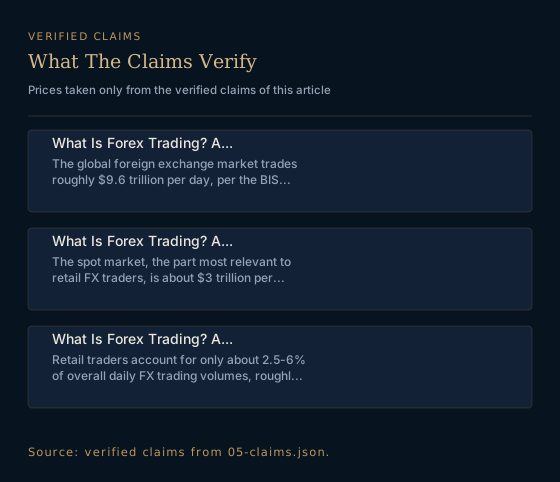
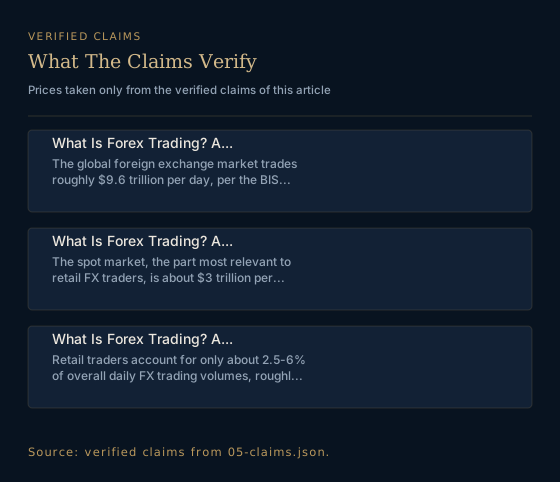
| The global foreign exchange market trades roughly $9.6 trillion per day, per the BIS turnover survey cited by BabyPips | What Is Forex Trading? A Beginner's Guide to Forex -… |
| The spot market, the part most relevant to retail FX traders, is about $3 trillion per day | What Is Forex Trading? A Beginner's Guide to Forex -… |
| Retail traders account for only about 2.5-6% of overall daily FX trading volumes, roughly $200-500 billion per day | What Is Forex Trading? A Beginner's Guide to Forex -… |
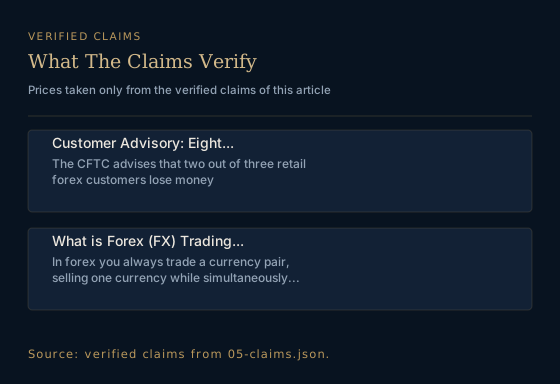
| The CFTC advises that two out of three retail forex customers lose money | Customer Advisory: Eight Things You Should Know Before… |
| In forex you always trade a currency pair, selling one currency while simultaneously buying another | What is Forex (FX) Trading and How Does it Work? - IG |
Frequently asked questions
Direct answers about the size and mechanics of the forex market.
How large is the forex market in daily turnover?
The global foreign exchange market trades roughly $9.6 trillion per day, according to the Bank for International Settlements turnover survey cited by BabyPips (What Is Forex Trading? A Beginner's Guide to Forex - BabyPips, retrieved 2026-10-14).
How much of daily forex turnover is spot trading?
The spot market, the part of the currency market most relevant to retail FX traders, is smaller at about $3 trillion per day (What Is Forex Trading? A Beginner's Guide to Forex - BabyPips, retrieved 2026-10-14).
How much of the forex market is retail trading?
Retail traders account for about 2.5-6% of overall daily FX trading volumes, roughly $200-500 billion per day (What Is Forex Trading? A Beginner's Guide to Forex - BabyPips, retrieved 2026-10-14).
Do most retail forex customers lose money?
Yes. The CFTC advises that two out of three forex customers lose money, and that most OTC forex customers lose money when all credits, financing charges, fees, and other expenses are factored in (Customer Advisory: Eight Things You Should Know Before Trading Forex - CFTC, retrieved 2026-10-14).
Do you ever buy a single currency in forex?
No. When trading forex, you are always trading a currency pair, selling one currency while simultaneously buying another (What is Forex (FX) Trading and How Does it Work? - IG, retrieved 2026-10-14).
Sources
- What Is Forex Trading? A Beginner's Guide to Forex - BabyPips babypips.com Retrieved 2026-10-14.
- Customer Advisory: Eight Things You Should Know Before Trading Forex - CFTC cftc.gov Retrieved 2026-10-14.
- What is Forex (FX) Trading and How Does it Work? - IG ig.com Retrieved 2026-10-14.