Home · The Ordane Journal · Rules and mechanics · What Is a Forex Trader? Role, Jobs and Loss Rate
What Is a Forex Trader? Role, Jobs and Loss Rate
A forex (foreign exchange) trader takes positions in currency pairs to profit from changes in currency demand, per the CFA Institute, the body behind the Chartered Financial Analyst credential (CFA Institute, retrieved 2026-10-14). The U.S. Commodity Futures Trading Commission (CFTC) reports that about one-third of customers at registered dealers profit and two-thirds lose money (CFTC, retrieved 2026-10-14).
Ordane accounts operate on simulated capital. No live funds are traded and no deposits are accepted. Payouts depend on simulated performance under Rulebook v1.5; no level of performance is typical or assured.
Ordane sells one product, the Ordane Instant Account: direct access, no evaluation phase and no challenge, on simulated capital (Ordane Rulebook v1.5, section 1, retrieved 2026-10-18).
What is a forex trader?
The CFA Institute definition quoted above has 4 parts (What is a Forex Currency Trader? - CFA Institute, retrieved 2026-10-14):
- Anticipating price changes: the trader forms an expectation about where a currency's price is heading before committing capital.
- Taking positions in currency pairs: positions are taken "in currency pairs", meaning one currency quoted against another.
- The foreign exchange market: the venue where those positions are taken.
- Profit motive: the stated purpose is "to profit from a change in currency demand".
House calculation, losing-to-profitable customer ratio: the CFTC discloses that about one-third of customers at registered over-the-counter (OTC) forex dealers made a profit while two-thirds lost money (Customer Advisory: Eight Things You Should Know Before Trading Forex - CFTC, retrieved 2026-10-14). Dividing the losing share (2/3) by the profitable share (1/3) gives 2 losing customers for every 1 profitable customer, a 2:1 ratio. Method: simple ratio of the two CFTC-reported shares (two-thirds ÷ one-third = 2); no other data points were used or inferred.
The source establishes what a forex trader does and why; it does not establish how much a forex trader earns or controls, and this page does not speculate beyond it.
The difference between a forex trader and forex trading
A forex trader is the person or the role; forex trading is the activity of buying and selling currency pairs. The distinction matters for statistics: the CFTC figure below covers a specific population of customers, not the profession as a whole.
Who does a forex trader trade for?
A forex trader can trade in 3 contexts, per the CFA Institute (What is a Forex Currency Trader? - CFA Institute, retrieved 2026-10-14): for financial institutions, "on behalf of clients", or "as individual investors". In the first two the trader acts for someone else; in the third the trader is the beneficiary. The table maps each context to its evidence and states what the sources do not establish.
| Context | Who the trader acts for | Supported workplace examples | Source-backed limit |
|---|---|---|---|
| Institutional trading | A financial institution that employs the trader | Brokerages, hedge funds, investment banks, multinational banks and corporations, investment management firms, central banks | The sources do not establish earnings, account size or which setting is most common |
| Client trading | Clients who delegate or direct the trading | Brokerages and investment management firms | The sources do not establish employment prevalence or compensation |
| Individual / self-employed | The trader themselves | Self-employed | The sources do not establish account size, income or typical results for this group |
The CFTC loss-rate statistic below applies to a narrower population: customers at registered OTC forex dealers. It is not an outcome measure for institutional employees or every self-employed trader (Customer Advisory: Eight Things You Should Know Before Trading Forex - CFTC, retrieved 2026-10-14).
Where do forex traders work?
Forex traders work across 7 settings named by the CFA Institute (What is a Forex Currency Trader? - CFA Institute, retrieved 2026-10-14): they "can be self-employed or work for brokerages, hedge funds, and institutional investors such as investment banks, multinational banks and corporations, investment management firms, or central banks." The source gives no ranking and no earnings figure for any of the 7, so the CFTC result that two-thirds of retail dealer customers lost money (CFTC, retrieved 2026-10-14) must not be read as an outcome for these employers' staff.
What qualifications do entry-level forex trader jobs require?
A bachelor's degree is required for most entry-level forex trader positions, per the CFA Institute (What is a Forex Currency Trader? - CFA Institute, retrieved 2026-10-14): that is 1 stated minimum credential, and "most" means not all positions. The source names no field of study, licence or certification, so this article claims none. Unlike the CFTC finding that two-thirds of retail dealer customers lost money (CFTC, retrieved 2026-10-14), the degree requirement says nothing about performance. Verify specific requirements with each employer.
What does the CFTC loss rate say about retail forex customers?
The CFTC advises: "Over the past year, about one-third of customers at registered OTC forex dealers made a profit, while two-thirds lost money" (Customer Advisory: Eight Things You Should Know Before Trading Forex - CFTC, retrieved 2026-10-14).
- Population: customers at registered OTC forex dealers, a specific retail population, not all forex traders.
- Period: the past year, relative to the CFTC's publication.
- Measure: the share of customers who made a profit versus the share who lost money.
Before paying for any simulated account, read what can you trade on a prop firm account, understand the risk of losing money with a prop firm, and check rules such as prop firm news trading rules, the prop firm stop loss slippage buffer and prop firm hedging permissions.
Verified facts at a glance
| Verified fact | Source |
|---|---|
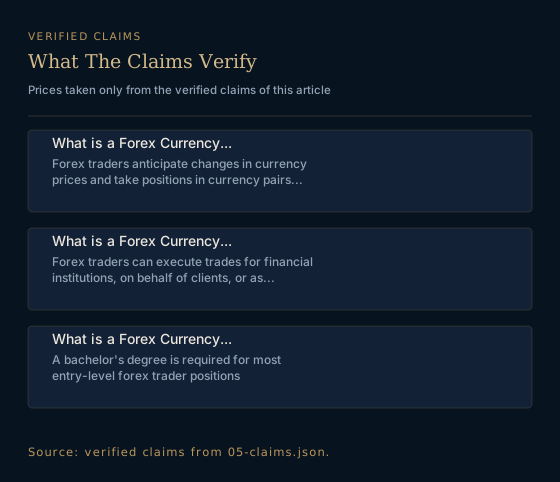
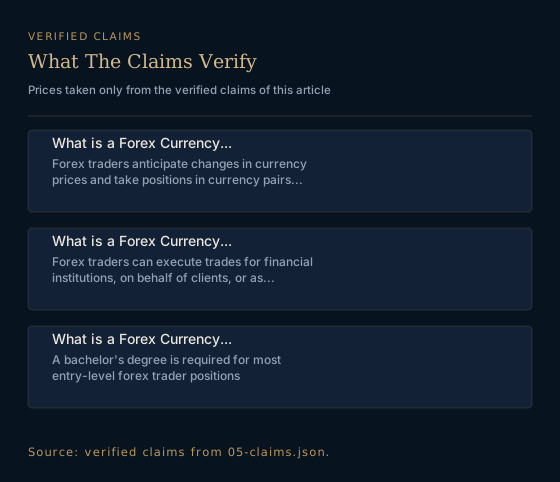
| Forex traders anticipate changes in currency prices and take positions in currency pairs to profit from changes in currency demand | What is a Forex Currency Trader? - CFA Institute, retrieved 2026-10-14 |
| Forex traders can execute trades for financial institutions, on behalf of clients, or as individual investors | What is a Forex Currency Trader? - CFA Institute, retrieved 2026-10-14 |
| A bachelor's degree is required for most entry-level forex trader positions | What is a Forex Currency Trader? - CFA Institute, retrieved 2026-10-14 |
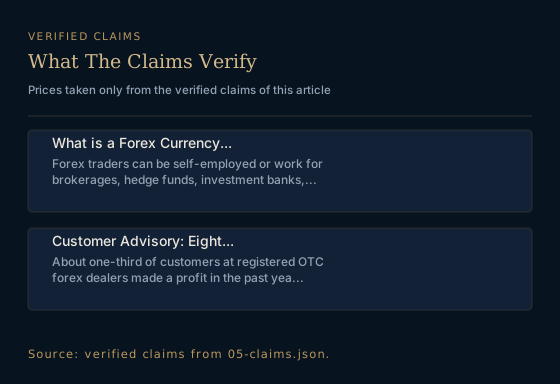
| Forex traders can be self-employed or work for brokerages, hedge funds, investment banks, multinational banks and corporations, investment management firms, or central banks | What is a Forex Currency Trader? - CFA Institute, retrieved 2026-10-14 |
| About one-third of customers at registered OTC forex dealers made a profit in the past year, while two-thirds lost money, per the CFTC | Customer Advisory: Eight Things You Should Know Before Trading Forex - CFTC, retrieved 2026-10-14 |
Frequently Asked Questions
Direct answers about what forex traders do and where they work.
What is a forex trader?
A forex trader anticipates changes in currency prices and takes trading positions in currency pairs on the foreign exchange market to profit from a change in currency demand, per the CFA Institute. Source: What is a Forex Currency Trader? - CFA Institute, retrieved 2026-10-14.
Who do forex traders trade for?
Forex traders can execute trades for financial institutions, on behalf of clients, or as individual investors. Source: What is a Forex Currency Trader? - CFA Institute, retrieved 2026-10-14.
Where can a forex trader work?
Forex traders can be self-employed or work for brokerages, hedge funds, investment banks, multinational banks and corporations, investment management firms, or central banks. Source: What is a Forex Currency Trader? - CFA Institute, retrieved 2026-10-14.
Do most entry-level forex trader jobs require a degree?
Yes: a bachelor's degree is required for most entry-level forex trader positions, according to the CFA Institute. Source: What is a Forex Currency Trader? - CFA Institute, retrieved 2026-10-14.
What percentage of retail OTC forex customers lose money?
Per the CFTC, over the past year about one-third of customers at registered OTC forex dealers made a profit, while two-thirds lost money. Source: Customer Advisory: Eight Things You Should Know Before Trading Forex - CFTC, retrieved 2026-10-14.
Sources
- What is a Forex Currency Trader? - CFA Institute cfainstitute.org Retrieved 2026-10-14.
- Customer Advisory: Eight Things You Should Know Before Trading Forex - CFTC cftc.gov Retrieved 2026-10-14.