Home · The Ordane Journal · Payouts · Topstep Funded Account
Topstep Funded Account
A simulated funded account is a trading environment where users pay an evaluation fee to trade firm capital in a simulated market, keeping a percentage of the virtual profits generated. Ordane accounts operate on simulated capital. No live funds are traded and no deposits are accepted.
Topstep (prop firm) requires a multi-step evaluation before granting access to its payout-eligible simulated account. In contrast, Ordane sells one product, the Ordane Instant Account: direct access, no evaluation phase and no challenge, on simulated capital.
What Is a Topstep Funded Account?
A Topstep Express Funded Account is a simulated environment where approved traders earn a share of the profits they generate.topstep.com/terms-of-use), retrieved 2026-09-29). This means that while the trader earns real money based on their performance, the trades themselves do not go to a live exchange. The firm copies the data and manages the risk internally. Traders must pass the Trading Combine to access this account. The Trading Combine is an evaluation phase with strict rules on daily loss limits, maximum drawdowns, and consistency. Only after passing this phase does a trader receive the Express Funded Account.
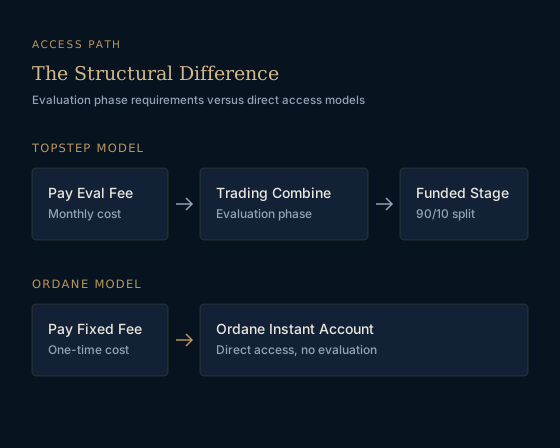
The prop firm industry has grown rapidly, offering various paths to simulated capital. Firms in this industry have different models for how traders access these simulated environments. Some require one step, others require two steps, and some offer direct access. Knowing exactly what you are paying for helps you manage your expectations and your budget.
The distinction between simulated and live trading is a matter of both mechanics and compliance. In a simulated setup, the firm acts as the counterparty to the trades in its internal ledger. If a trader makes a profit, the firm pays that profit from its own revenue or capital reserves. This is why verifying a firm's ability to pay is the most critical step a trader can take before signing up. Without a transparent reserve, the firm's ability to honor payouts is merely a promise.
Understanding the product you are buying is the foundation of a sound trading plan. The Topstep model requires traders to prove their consistency over time before they can request a withdrawal. This evaluation phase serves as a filter for the firm, ensuring that only those who can manage risk within strict parameters progress to the funded stage.
What Are the Documented Costs and Evaluation Fees?
The primary cost to access a Topstep account is the monthly subscription fee for the Trading Combine.
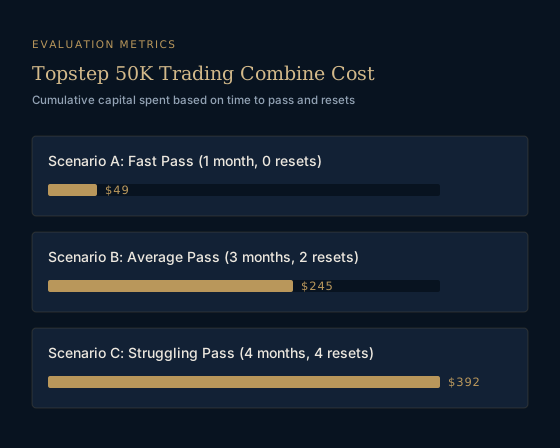
Evaluating the total cost of a prop firm requires looking at both the upfront fees and the ongoing subscription costs. Topstep charges $49/month for the 50K Trading Combine (Topstep Pricing, retrieved 2026-09-29). This fee recurs every month until the trader either passes the evaluation or cancels the subscription. If a trader breaches a rule during the evaluation, they can pay a reset fee to try again, which adds to the total cost of acquisition.
When comparing firms, traders should calculate the average time it takes to pass an evaluation to understand the true cost. A monthly subscription model means the longer an evaluation takes, the more expensive it becomes.
For example, if a trader takes three months to pass the 50K Combine without any rule breaches, the total base evaluation cost reaches $147. If the same trader requires two resets during those three months at $49 each, the cumulative acquisition cost rises to $245 before they ever reach the funded stage.
Cost structures vary wildly across the industry. Some firms charge a one-time fee, while others rely on recurring subscriptions. The one-time fee model provides predictability, as the trader knows exactly what their maximum exposure is on day one. The subscription model requires the trader to pass quickly to keep costs low. Traders must assess their own trading style and consistency to determine which pricing model aligns with their performance timeline.
| Evaluation Metric | Scenario A (Fast Pass) | Scenario B (Average Pass) | Scenario C (Struggling Pass) |
|---|---|---|---|
| Months to Pass | 1 month | 3 months | 4 months |
| Base Subscription Cost | $49 | $147 | $196 |
| Number of Resets Needed | 0 resets | 2 resets | 4 resets |
| Total Reset Cost | $0 | $98 | $196 |
| Total Capital Spent | $49 | $245 | $392 |
The table above illustrates the basic parameters of the Topstep offering. The monthly cost of $49 is only the baseline. Traders must budget for the realistic cost of an evaluation, not just the best-case scenario.
What Are the Core Trading Rules and Data Feeds?
Topstep enforces strict risk management rules and connects to established data feeds to simulate market conditions.
Every prop firm enforces rules to protect its capital and assess trader discipline. Topstep monitors daily loss limits and maximum drawdowns closely. If a trader hits the daily loss limit, their account is locked for the rest of the day. If they hit the maximum drawdown, the account is breached and closed. These rules are designed to simulate the risk parameters of a professional trading desk.
Data integrity is another critical factor for traders using simulated accounts.topstep.com), retrieved 2026-09-29). This feed provides the pricing for the simulated executions, ensuring that traders are evaluated against standard market movements rather than internal, manipulated pricing. The quality of the data feed directly impacts a trader's ability to execute their strategy accurately. Slippage, latency, and artificial spikes can all trigger a rule breach if the feed is unreliable.
Traders must read the rulebook carefully to understand exactly what constitutes a violation. Some firms employ hidden rules or vague clauses that allow them to deny payouts at their discretion. A transparent firm publishes a versioned rulebook with a closed list of prohibited practices. If a behavior is not on the list, it should not result in an account closure or a denied payout.
The rigidity of the rules during the evaluation phase often contrasts with the rules in the funded stage. Traders must verify whether the rules change once they pass the Combine. Consistency rules, scaling plans, and withdrawal gates can alter the trading experience significantly once real money is on the line.
How Do Payouts and Profit Splits Work?
Payouts at Topstep are processed according to a specific schedule and a defined profit split structure.
The most important question for any trader is whether and how the firm pays. Prop firm traders typically keep 70-90% of profits, with top firms in 2026 offering 80-100% splits (2026 Guide to Prop Firms, retrieved 2026-09-29).topstep.com/terms-of-use), retrieved 2026-09-29). This means the trader retains 90 percent of the eligible simulated profits they generate.
Traders must understand the conditions attached to these payouts. Firms often require a certain number of winning days or a minimum account balance before a withdrawal request can be submitted. The speed of the payout also varies. Some firms process requests on specific days of the month, while others process them on demand. The rules governing payouts are the most important part of any prop firm contract. A high profit split is meaningless if the withdrawal conditions are impossible to meet.
Payout mechanics define the reliability of a prop firm. When a trader requests a withdrawal, the firm must have the capital available to process the payment. Because these are simulated accounts, the firm pays successful traders out of its own revenue pool. This creates a structural risk: if the firm's revenue drops, its ability to pay traders may be compromised.
What Should You Verify Before Paying?
Before paying any firm, traders must verify the company's registration, rules, and payout mechanisms.
Traders face three primary fears when evaluating a prop firm: passing an evaluation and never getting paid, having a hidden rule applied at withdrawal, and the firm vanishing with fees before payouts occur. The prop firm industry operates largely outside standard financial regulations, making independent verification essential to address these fears. The CFTC strongly urges the public to verify a company's registration with the Commission (CFTC Customer Advisory, retrieved 2026-09-29). Traders should check the legal entity, the registered address, and any regulatory warnings associated with the firm. Operating in an unregulated space means that traders have limited recourse if a firm defaults on its obligations.
Beyond registration, traders must verify the firm's rules. The rulebook should be public, versioned, and clear. If a firm can change the rules retroactively, the trader has no protection. A closed list of prohibited practices ensures that traders know exactly what is allowed and what is forbidden. Discretionary rules give the firm the power to deny payouts based on subjective interpretations of trading behavior.
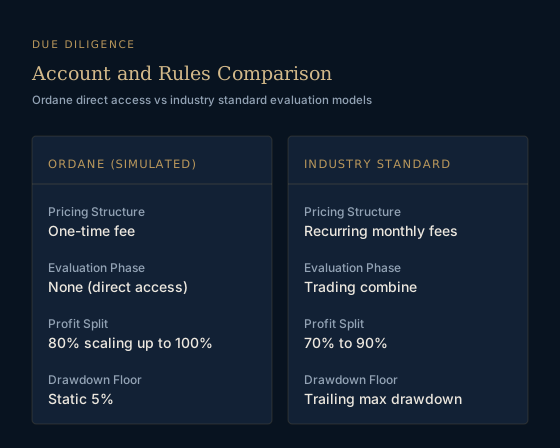
| Metric/Feature | Ordane (Simulated) | Industry Standard |
|---|---|---|
| Pricing Structure | One-time fee, no subscriptions | Recurring monthly fees |
| Evaluation Phase | None (direct access) | Multi-step trading combine |
| Profit Split | 80% scaling up to 100% | 70-90% of profits |
| Data Feed source | Proprietary terminal | Varies (e.g. Every trader should complete these steps before entering payment information. The industry is filled with firms that make aggressive promises without providing the documentation to back them up. Verification is the only defense against deceptive marketing practices. |
Finally, traders must look for proof of payouts. A firm should be able to demonstrate that it has the capital reserve to pay its successful traders. Without proof of a reserve or a verifiable ledger, a firm is asking traders to trust a promise. The most reliable firms publish their reserve addresses publicly, allowing anyone to audit their capital position at any time.
| Aspect | Details |
|---|---|
| Entry fee | Varies by firm and account size |
| Profit split | 80-90% typical in 2026 |
| Risk rules | Daily loss limit + max drawdown |
| Evaluation | 1-2 phases or instant funding |
FAQ: Topstep Funded Account
What is the cost of the 50K account evaluation?
Topstep charges $49/month for the 50K Trading Combine (Topstep Pricing, retrieved 2026-09-29). This is a recurring monthly subscription that continues until the trader passes the evaluation or cancels the service. Traders should factor in the time it takes to pass when calculating total costs.topstep.com/terms-of-use), retrieved 2026-09-29). The trader retains 90 percent of their eligible simulated profits.topstep.com), retrieved 2026-09-29). This ensures that the simulated executions are based on standard market movements.
Should I verify the firm's registration before paying?
Yes. The CFTC strongly urges the public to verify a company's registration with the Commission (CFTC Customer Advisory, retrieved 2026-09-29). Independent verification of the legal entity and regulatory status is a crucial step in evaluating any prop firm.
This article is for information only and is not investment, financial, or tax advice.
Sources
Primary sources are linked inline above.
This article is for information only and is not investment, financial, or tax advice.
Topstep applies a 5% daily loss limit on its Express Funded Accounts. (Topstep Pricing, retrieved 2026-09-29)
Is the Topstep Express Funded Account a live trading account?
No. An Express Funded Account is a Simulated Account (Topstep Terms of Use, retrieved 2026-09-29). Trades are executed in a simulated environment and do not go to a live exchange. The firm acts as the counterparty and manages the risk internally, paying profits from its own capital.
What data feed does Topstep use?
Topstep states that its price data comes from the CME exchange feed (Topstep, retrieved 2026-09-29). This ensures that the simulated executions are based on standard market movements.
| Aspect | Details |
|---|---|
| Evaluation | 1-2 phases or instant |
| Profit split | 80-90% typical |
| Risk rules | Daily loss + max drawdown |
| Aspect | Details |
|---|---|
| Evaluation | 1-2 phases or instant |
| Profit split | 80-90% typical |
Ordane accounts operate on simulated capital. No live funds are traded and no deposits are accepted. Payouts depend on simulated performance under Rulebook v1.3; no level of performance is typical or assured.
Sources
- Topstep Pricing help.topstep.com Retrieved 2026-09-29.
- CFTC Customer Advisory cftc.gov Retrieved 2026-09-29.