Home · The Ordane Journal · Payouts · Trade Day Payout Rules and Profit Split Explained
Trade Day Payout Rules and Profit Split Explained
Trade Day (prop firm) operates a simulated evaluation model where participants keep 100% of their first $10,000 in simulated profits, and a 90% allocation thereafter. This two-stage structure front-loads distributions. Ordane accounts operate on simulated capital. No live funds are traded and no deposits are accepted.
<a id="quote"></a>
How Does the Trade Day Profit Split Work?
Trade Day allows participants to keep 100% of their first $10,000 in simulated profits, and 90% of profits thereafter (Trade Day Funded Trader Program, retrieved 2026-09-13). This tiered allocation ensures participants receive the entire initial payout up to that specific threshold, before the permanent ninety percent distribution rate applies.
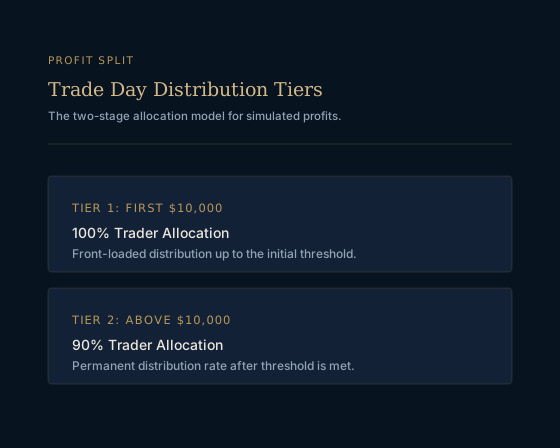
Understanding how is prop firm profit split calculated is critical for accurate financial planning. The initial tier acts as an accelerated distribution mechanism, while the subsequent tier represents the steady state of the relationship. When modeling potential outcomes over multiple withdrawal cycles, participants must account for this transition to project their effective blended split rate over time. Before any split percentage is applied, the simulated profits must pass a rigorous verification phase. This phase is designed to confirm that all trading activity adhered strictly to the platform's rulebook. Typical checks include verifying adherence to daily loss limits, maximum drawdown parameters, and consistency rules.
- The accounting methodology used to track cumulative simulated profits across multiple cycles.
- The prop firm withdrawal requirements needed to verify trading activity before authorizing a distribution.
- The impact of drawdown limits on the ability to reach the initial threshold.
- The permanence of the subsequent percentage applied after the threshold is met.
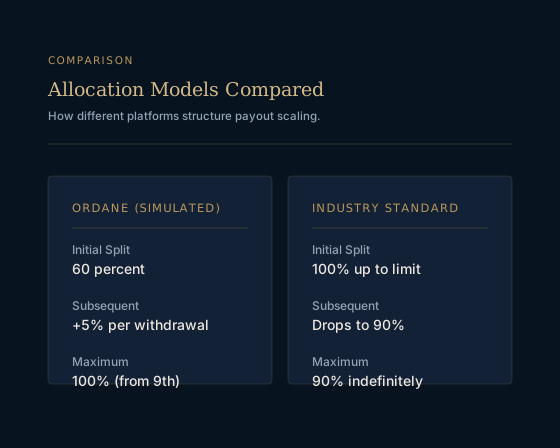
To provide context for these mechanics, we can compare this structure to alternative models present in the market, such as an instant account vs evaluation prop firm. Ordane sells one product, the Ordane Instant Account: direct access, no evaluation phase and no challenge, on simulated capital. (Ordane Rulebook v1.0, section 1, retrieved 2026-09-13) Ordane's profit split starts at 60 percent and rises 5 percentage points with every completed withdrawal, reaching 100 percent from the ninth withdrawal onward. (Ordane Rulebook v1.0, clause PA-2, retrieved 2026-09-13) The contrast between a fixed initial threshold and a scaling ladder demonstrates the diverse approaches platforms utilize to manage distributions and incentivize longevity.
<a id="table"></a>
| Metric/Feature | Ordane (Simulated) | Industry Standard |
|---|---|---|
| Initial Profit Split | 60 percent | 100 percent up to specific limit |
| Subsequent Progression | Rises 5 percentage points per withdrawal | Drops to 90 percent after threshold |
| Maximum Split | 100 percent from ninth withdrawal | 90 percent indefinitely |
| Capital Type | Simulated capital | Simulated capital |
A scaling ladder requires consistent performance over a longer duration to reach the maximum allocation, whereas a front loaded threshold provides immediate maximum allocation up to a fixed dollar amount. Both structures operate entirely within the realm of simulated capital, meaning that the distributions are paid from corporate revenue rather than actual trading profits generated in live markets.
How Are Trade Day Withdrawals Processed via Deel?
Trade Day processes trader withdrawals through the Deel platform (Trade Day Help Center - Withdrawals, retrieved 2026-09-13). This integration delegates the administrative burden of international compliance, tax document collection, and currency conversion to a specialized third party provider, establishing a standardized timeline for transferring simulated trading profits to the user and clarifying how long do prop firms take to pay.
The utilization of contractor management platforms fundamentally changes how independent participants interact with payout structures. Instead of relying on manual bank wires or disparate payment gateways managed directly by the platform, the entire process is centralized within a compliant infrastructure. This centralization provides an immutable audit trail for both the platform operating the evaluation and the participant receiving the funds. When a withdrawal request is submitted, it moves through a sequence of internal reviews before being authorized for disbursement. Once authorized, the funds are pushed from the platform's corporate treasury to the participant's individual account. From there, the participant assumes control over the final routing and selects their preferred destination method.
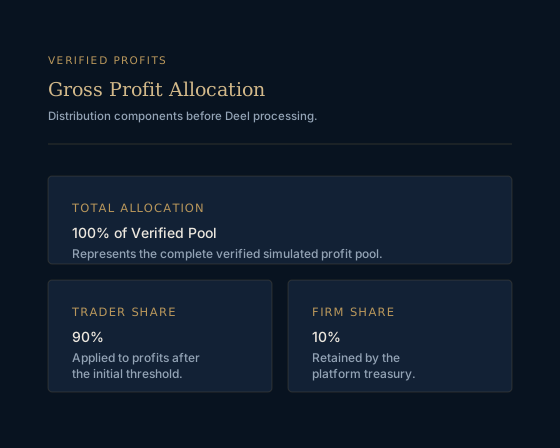
To illustrate how an allocation is calculated before reaching the payment processor, we present a baseline scenario using the stated percentages. Declared inputs for this check: a 90 percent trader share (Trade Day Funded Trader Program, retrieved 2026-09-13), a 10 percent firm share (Trade Day Funded Trader Program, retrieved 2026-09-13), and a 100 percent total allocation (Trade Day Funded Trader Program, retrieved 2026-09-13). Worked arithmetic: 90 + 10 = 100.
| Allocation Component | Percentage Value | Application Phase |
|---|---|---|
| Trader Share | 90 percent | Applied to profits after the initial threshold |
| Firm Share | 10 percent | Retained by the platform treasury |
| Total Allocation | 100 percent | Represents the complete verified simulated profit pool |
The distinction between gross simulated profits and net distributions is vital. The platform calculates the gross eligible amount, applies the contractual split percentage, and then initiates the transfer to the contractor management platform. If you wonder where does prop firm payout money come from, once the funds arrive at the contractor platform, they are treated as independent contractor revenue. The participant is then entirely responsible for their own tax reporting and compliance obligations within their local jurisdiction.
- Direct bank transfers utilizing local clearing networks.
- International wire transfers for cross border settlements.
- Digital wallet transfers for immediate access to funds.
- Cryptocurrency withdrawals for blockchain based settlement.
The integration of a contractor management system also introduces a rigid identity verification protocol. Before any funds can be received, the participant must successfully complete the verification process mandated by the payment processor. This process is entirely independent of the trading platform's own onboarding procedures. The requirement to maintain valid identification ensures that the distribution of funds complies with global financial regulations. The separation of trading operations from payment processing operations is a structural design chosen to maximize operational efficiency and regulatory compliance.
Why Does the CFTC Futures Definition Matter for Longevity?
The operational longevity of a platform depends heavily on its classification under financial regulations. A futures contract is an agreement to purchase or sell a commodity for delivery in the future at a price determined at the initiation of the contract (CFTC Glossary, retrieved 2026-09-13). This definition separates regulated derivatives from simulated evaluations.
The primary fear of any participant is whether the platform will still exist to process future payouts. Ensuring strict adherence to simulated capital models and maintaining transparent corporate treasury operations are the only ways to address this existential risk. If a platform crosses the line into offering actual futures contracts without the proper licensing, the risk of sudden closure increases exponentially. Regulatory enforcement actions have historically targeted entities that fail to maintain a strict barrier between simulated environments and live execution. The use of simulated capital is not merely a business model choice; it is a fundamental structural necessity for maintaining operations without acting as an unregistered broker or exchange.
Another critical aspect of maintaining the separation from regulated futures contracts involves the licensing of market data. Simulated platforms must secure explicit agreements with data providers to display live pricing. These agreements strictly prohibit the use of the data for live trade execution unless the platform holds the requisite brokerage licenses. By operating entirely within a simulated environment, platforms can license this data for educational and evaluation purposes. The integrity of the data feed is paramount; it must accurately reflect the underlying market to provide a realistic evaluation, but it must never cross the threshold into live order routing.
When a platform explicitly states that all trades are simulated, it confirms that no underlying asset is being exchanged. The pricing data displayed on the platform may mirror real market conditions down to the millisecond, but the transactions occur entirely on internal ledgers. This distinction is precisely what allows platforms to offer large nominal account sizes to participants without requiring equivalent cash capital reserves in a prime brokerage account.
- Clear contractual documentation stating that all capital is simulated.
- Transparent withdrawal processes that distribute corporate revenue.
- Defined execution rules that prevent market manipulation within the simulation engine.
- Total avoidance of any language offering financial advice.
To contrast this theoretical stability with a verifiable structure, consider the physical mechanisms required to prove capitalization. Promises of longevity are meaningless without observable facts. Ordane's payout reserve is published at a public TRON address on ordanemarkets.com and in Rulebook v1.0 clause PR-1. The page carries a dated observed balance and states that the reserve is not a promise, it is an address. Furthermore, every withdrawal request is approved, or denied in writing citing the exact rule breached by section number, within 24 clock hours. Past that deadline the request is treated as approved and the G-1 clock starts. A payout approved and not paid within 48 clock hours, not business hours, triggers automatic compensation: a 100 percent refund of the account fee, plus the payout owed in full. These mechanisms constitute The Ordane Guarantee.
The intersection of regulatory definitions and operational structure dictates the future of the simulated trading industry. Platforms that clearly understand the boundaries of a futures contract and ensure their operations remain firmly within the realm of simulated data evaluation are positioned to operate sustainably. Participants evaluating where to dedicate their time and effort must prioritize platforms that can demonstrate their structural separation from live financial derivatives through clear rulebooks, verifiable reserves, and uncompromising adherence to simulated capital models.
Frequently Asked Questions
What is the Trade Day profit split?
Trade Day uses a tiered structure where participants keep 100% of their first $10,000 in simulated profits, and 90% of all subsequent simulated profits (Trade Day Funded Trader Program, retrieved 2026-09-13).
How are Trade Day payouts processed?
Withdrawals from Trade Day are processed through Deel, which handles international compliance and currency conversion for the distributions (Trade Day Help Center - Withdrawals, retrieved 2026-09-13).
What is a futures contract according to the CFTC?
The CFTC defines a futures contract as an agreement to purchase or sell a commodity for delivery in the future at a price determined at the initiation of the contract (CFTC Glossary, retrieved 2026-09-13).
Are Ordane accounts traded on live markets?
Ordane accounts operate on simulated capital. No live funds are traded and no deposits are accepted. (Ordane Rulebook v1.0, section 1, retrieved 2026-09-13)
Sources
- Trade Day Funded Trader Program tradeday.com Retrieved 2026-09-13.
- CFTC Glossary cftc.gov Retrieved 2026-09-13.