Home · The Ordane Journal · Rules and Mechanics · The Funded Trader Scaling Plan Explained
The Funded Trader Scaling Plan Explained
A scaling plan is a reward structure that increases a trader's simulated account balance after they meet specific performance metrics over a set duration. Ordane accounts operate on simulated capital. No live funds are traded and no deposits are accepted.
In one sentence: A scaling plan is a prop firm mechanism that increases your simulated trading balance after you prove consistent profitability over a set duration, providing a larger absolute drawdown buffer for future cycles.
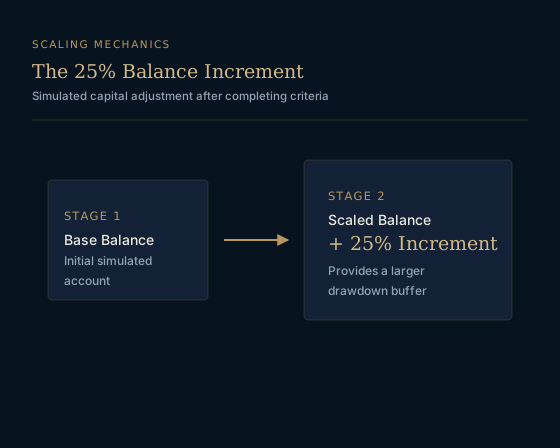
The Funded Trader (prop firm) offers a standard scaling plan that increases the initial account balance by 25 percent after a trader meets the eligibility criteria. (The Funded Trader Scaling Plan, retrieved 2026-09-05) To be eligible for scaling, a trader must show consistent profitability over a 3-month period with at least a 6 percent return. (The Funded Trader FAQ - Scaling, retrieved 2026-09-05)
Traders evaluating this firm often search for clarity on how the mechanics operate in practice. Understanding the time commitment required is essential before purchasing an evaluation. Ordane sells one product, the Ordane Instant Account: direct access, no evaluation phase and no challenge, on simulated capital. (Ordane Rulebook v1.0, section 1, retrieved 2026-09-05)
What Is The Funded Trader Scaling Plan?
This increase applies only to the simulated capital base, providing a larger absolute drawdown buffer and higher position sizing capacity for future trading cycles.
Definition of the 25% Account Balance Increment
The Funded Trader's standard scaling plan increases the initial account balance by 25 percent after a trader meets the eligibility criteria. (The Funded Trader Scaling Plan, retrieved 2026-09-05) A trader starting with a base balance receives this precise increment upon completing the verification stage. This means the absolute value of the maximum allowable drawdown increases, which provides more room to navigate market volatility. However, the trader must first navigate a prolonged period of strict performance metrics to access this increment. The time invested to unlock this additional simulated capital represents a significant opportunity cost. Many traders focus solely on the final percentage increment without properly calculating the hours and market exposure required to reach that point.
How Simulated Scaling Differs from Real Broker Margin
It is vital to understand that proprietary trading firms operate on simulated environments. The balance increment does not represent a loan or a margin extension from a prime broker. The capital is entirely simulated. When a firm scales an account, they are simply adjusting the parameters of a simulated environment to allow for larger position sizes within their internal risk management software. The trader is trading data, and the firm uses that data. The scaling plan is a reward structure designed to retain profitable traders within the simulated ecosystem. Traders must recognize that they are not receiving real funding, but rather a modification to their evaluation parameters.
What Is The Hidden Catch With The 3-Month Consistency Rule?
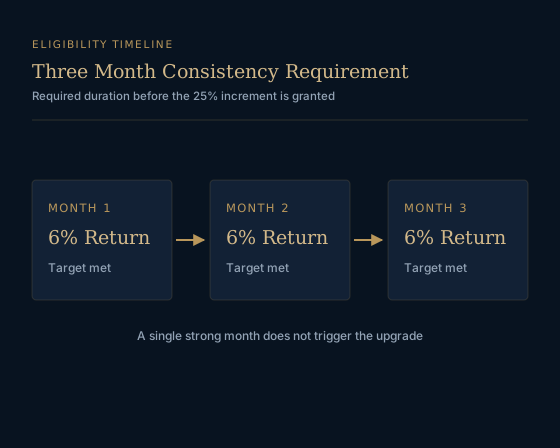
The primary barrier to scaling is the strict eligibility criteria, which requires a trader to show consistent profitability over a 3-month period with at least a 6 percent return. (The Funded Trader FAQ - Scaling, retrieved 2026-09-05) This time constraint locks traders into a prolonged evaluation phase before any balance increase is granted.
Why You Need a 6% Return for Three Consecutive Months
The requirement to achieve a specific profit target over an extended duration is designed to filter out variance. To be eligible for scaling, a trader must show consistent profitability over a 3-month period with at least a 6 percent return. (The Funded Trader FAQ - Scaling, retrieved 2026-09-05) This means a single strong month of performance does not trigger the account upgrade. The trader must replicate that success repeatedly. The firm mitigates its own risk by ensuring only traders capable of sustained profitability over a long horizon receive the increment. This extended timeline significantly delays the realization of the scaling benefits.
How Consistency Rules Block Payouts and Scaling
Consistency rules are frequently used across the industry to manage the pace at which traders scale and withdraw. A failure to meet the target in the final month often resets the progress clock. It is never confiscated, and the remainder of the cycle pays out normally.
Will The Firm Still Exist Due To Regulatory Risk?
The CFTC has issued advisories warning retail customers about the risks associated with unregistered proprietary trading firms. (CFTC Customer Advisory: Beware of Unregistered Proprietary Trading Firms, retrieved 2026-09-05) When a firm closes, accumulated simulated profits and scaling progress are permanently lost.
The Ordane rulebook is public, numbered and versioned, and no rule is ever applied retroactively to an open account. Changes produce a new version with a dated changelog entry, and the version you sign up under is the version that governs your account. (Ordane Rulebook v1.0, notice above section 0, retrieved 2026-09-05) This provides a contractual baseline that protects the trader from sudden policy shifts.
Are Evaluation Costs Worth The Scaling Rewards?
Evaluating the true cost of a scaling plan requires measuring the upfront fee against the time required to trigger the increment. Traders must calculate the total capital committed during the mandatory eligibility months and weigh it against the expected profit split from the increased simulated balance.
Declared inputs for this check: 25, 6, and 31. Worked arithmetic: 25 + 6 = 31.
There are no recurring fees, no hidden tiers and no coupon games. The split ladder is in writing and never resets.
Ordane offers no scaling plans because it requires no evaluation. Traders start with direct access. Read the Ordane Instant Account model.
| Metric | Target | Source |
|---|---|---|
| Scaling Increment | 25 percent | (The Funded Trader Scaling Plan, retrieved 2026-09-05) |
| Required Return | 6 percent | (The Funded Trader FAQ - Scaling, retrieved 2026-09-05) |
| Time Duration | 3 months | (The Funded Trader FAQ - Scaling, retrieved 2026-09-05) |
| Regulatory Notice | Unregistered warning | (CFTC Customer Advisory: Beware of Unregistered Proprietary Trading Firms, retrieved 2026-09-05) |

Frequently Asked Questions
Understanding the exact mechanics of the scaling rules is necessary for proper risk management.
Does the 25% increment apply to the initial balance?
Yes, the increment is calculated based on the starting value of the simulated account. The Funded Trader's standard scaling plan increases the initial account balance by 25 percent after a trader meets the eligibility criteria. (The Funded Trader Scaling Plan, retrieved 2026-09-05)
What happens if I miss the 6% target in month three?
Failing to meet the performance threshold typically resets the eligibility period. To be eligible for scaling, a trader must show consistent profitability over a 3-month period with at least a 6 percent return. (The Funded Trader FAQ - Scaling, retrieved 2026-09-05) A missed month means the trader must begin a new consecutive streak to qualify for the balance increase.
Does scaling increase my absolute daily loss limit?
The daily loss limit is generally calculated as a percentage of the new base balance. The floor is fixed on day one, never trails upward, and a breach closes the account. (Ordane Rulebook v1.0, clause R-1, retrieved 2026-09-05) A breach closes the account.
Do I have to pay another evaluation fee to scale?
The scaling plan is typically a built-in feature of the original evaluation contract. Once the initial fee is paid, the trader does not need to purchase a new account to receive the simulated increment.
Does a payout reset my scaling eligibility period?
Requesting a withdrawal during the eligibility period depends on the specific terms of service. Most firms require the account to maintain a positive balance to remain active.
Sources
- The Funded Trader Scaling Plan Retrieved 2026-09-05.
- The Funded Trader FAQ - Scaling Retrieved 2026-09-05.
- CFTC Customer Advisory: Beware of Unregistered Proprietary Trading Firms Retrieved 2026-09-05.
- Ordane Rulebook v1.0 Retrieved 2026-09-05.