Home · The Ordane Journal · Before you pay · Prop Firm Wind-Down: The Signs That Prove It
Prop Firm Wind-Down: The Signs That Prove It
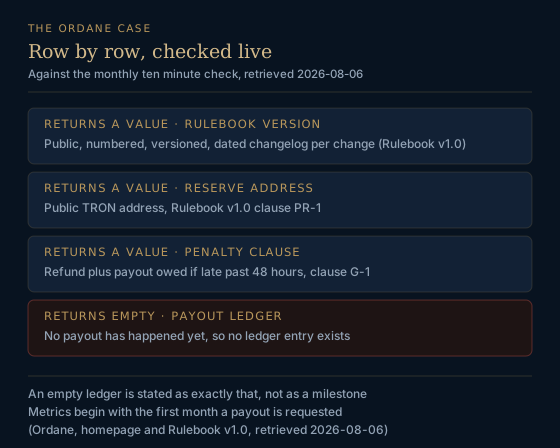
Ordane accounts operate on simulated capital. No live funds are traded and no deposits are accepted. Payouts depend on simulated performance under Rulebook v1.0; no level of performance is typical or assured.
Ordane sells one product, the Ordane Instant Account: direct access, no evaluation phase and no challenge, on simulated capital.
A prop firm ready for collapse is not a firm evaluated by feeling; it is a firm with three checkable, dated signs, each with a stated limit on what it does and does not prove.
A prop firm heading for a wind down leaves a trail before it says a word. Three signs qualify as evidence, and each one leaves a specific, checkable mark. The rest is noise dressed up as insight.
What Does It Look Like When a Prop Firm Is About to Wind Down?
A sign counts only if a dated closure demonstrates it, and every sign carries a stated limit on what it does not prove. Three qualify: a retroactive rule change, a payment rail that steps back before the firm speaks, and a firm's own words that go silent on payouts. Everything else, including affiliate churn and social media panic, gets named later and dismissed for exactly the reason it carries no weight.
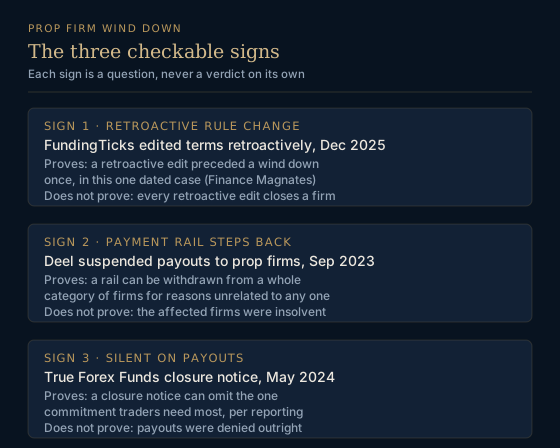
A sign is a question, never a verdict, because the same event can precede a healthy correction or a collapse. The grading rule below is what keeps this article different from a list ranked by how alarming each item feels: alarm is not evidence, a dated outcome is.
The dated case, and how it ended
In December 2025, FundingTicks (a prop trading firm) changed its trading rules and applied them retroactively to accounts that had already passed, reducing or invalidating profit that traders believed was already booked (Finance Magnates, retrieved 2026-08-05). The backlash was immediate. On 18 January 2026 the firm announced it was winding down operations, with all active evaluation and master accounts refunded in full regardless of profit or drawdown (Finance Magnates, retrieved 2026-08-05).
Why an edit to old terms is a cash-flow tell
A firm that changes the terms on accounts already sold, after the money has already changed hands, is usually solving a cash problem the announcement does not name. Retroactive application means the firm needed the reduced payout obligation now, not at the next contract cycle. That urgency is the tell, not the rule change itself.
A processing delay versus a refusal to pay
A processing delay has a cause a support agent can name: a new compliance step, a backlog, a rail migration. A refusal to pay names a rule, cites a section, and stops there. If the firm cannot say why a payout is late, or the answer changes each time you ask, that is a different category of problem than a rail that is simply slower this cycle.
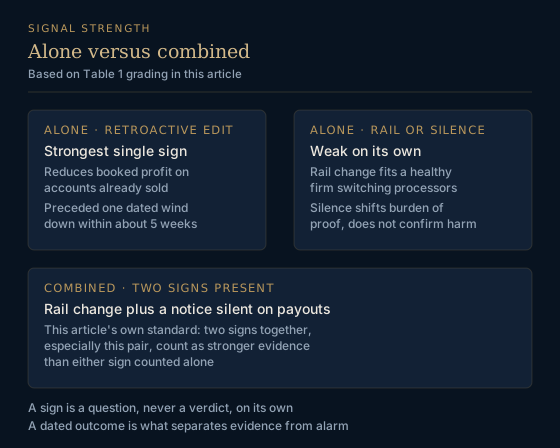
A payment rail changing hands is fully compatible with a healthy firm switching processors for better rates or wider coverage. This sign is weak on its own. It counts as evidence only alongside a second sign, such as a rule change or a notice that goes quiet on payouts. What actually happens when a firm denies a payout, and on what grounds a denial is defensible versus a clawback, is a separate question this article does not answer.
What one closure announcement actually said
On 28 November 2024, Finance Magnates reported that Smart Prop Trader (a prop trading firm) would stop onboarding new traders starting the next day and would cease operations entirely on 29 December 2024. Current traders would continue trading until that date, regular payout schedules would be maintained, and refunds were offered to qualifying account holders who had joined in November (Finance Magnates, retrieved 2026-08-06). That is a notice that named a date, named what continued, and named what was refunded.
Compare that to what Finance Magnates reported on 13 May 2024: True Forex Funds (a prop trading firm) was ending operations and planned to permanently close, stating it had been unable to improve its financial situation, which led to the discontinuation of its services (Finance Magnates, retrieved 2026-08-06). The reporting on that closure carries no statement from the firm about pending payouts or refunds. The complaints referenced elsewhere are trader commentary, not a company statement, and the two should never be treated as the same kind of evidence.
Reading a wind-down notice for what it does not promise
Read a closure notice the way you would read a contract: for the specific commitment it makes, not for its tone. A notice can sound calm, orderly, even reassuring, and still say nothing about what happens to money already owed. The Smart Prop Trader notice named payout continuity and refund eligibility directly. The True Forex Funds coverage did not carry an equivalent statement.
A calm, well-written notice does not prove payouts will actually arrive on schedule, and a notice's silence on payouts does not by itself prove a trader will not get paid. It shifts the burden of proof. Silence on the specific point that matters most, whether pending payouts will be honored, is the part worth weighing, not the overall tone of the announcement.
Table 1: The Sign, the Dated Case, What It Proves, What It Does Not
| Sign | Dated case | What it proves | What it does not prove |
|---|---|---|---|
| Retroactive rule change | FundingTicks changed rules retroactively in December 2025 and announced a wind-down on 18 January 2026, refunding all active accounts in full (Finance Magnates, retrieved 2026-08-05) | A firm editing already-sold terms to reduce booked profit was, in this case, followed by a full wind-down within about five weeks | It does not prove every retroactive rule change precedes a closure, and it does not set a timeline for how long a firm can operate after making one |
| Payment rail withdrawal | Deel suspended payout services to prop trading firms on 13 September 2023 following the CFTC action against My Forex Funds, after facilitating over $72 million in payouts to that firm (Finance Magnates, retrieved 2026-08-06) | A payout rail can be withdrawn from an entire category of firms for reasons unrelated to any single firm's solvency | It does not prove the affected firms were themselves insolvent, and it does not prove a rail change signals anything on its own, without a second sign present |
| Firm notice silent on payouts | True Forex Funds announced it was ending operations on 13 May 2024, citing an inability to improve its financial situation, with no statement in the reporting about pending payouts (Finance Magnates, retrieved 2026-08-06) | A closure notice can omit the one commitment that matters most to traders with money still in the system | It does not prove payouts were denied, only that the notice, as reported, did not address the question |
Filed in 2023, dismissed with prejudice in 2025
On August 28, 2023, the CFTC filed an enforcement action against Traders Global Group Inc., doing business as My Forex Funds, alleging approximately $310 million taken from more than 135,000 customers under CFTC Release 8771-23. The case ended with a dismissal with prejudice , a dismissal that bars refiling the same claims , and an order for the agency to pay the defendants over $3 million in attorneys' fees and costs, which defense counsel Quinn Emanuel describes as the largest monetary sanction to date against a U.S. government agency (CFTC Release 8771-23, full text mirror; Quinn Emanuel, retrieved 2026-08-09).
What a reader should do while a case is open
An open regulatory filing is an allegation, stated in a legal document, that a court has not yet ruled on. It is not a finding of fact, and treating it as one before a disposition is the same error as treating a firm's calm tone as proof of solvency: mistaking a stage in a process for its result. The transferable lesson from the My Forex Funds arc is procedural, not narrative: track the disposition date, not just the filing date, before drawing a conclusion about any firm under investigation. The fuller account of what happened to that firm's traders and their funds sits elsewhere.
What a young firm cannot show yet
A firm with no operating history cannot show a payout track record, because there is no history to show one from. It cannot show how it behaves under stress, because it has not yet been tested by a large payout cycle, a market shock, or a rail change. That absence is a real limit on what a trader can verify, and it should be named as a limit rather than argued away.
Table 2: The Monthly Ten-Minute Check
| Artifact to check | What a changed value there would mean | Time required |
|---|---|---|
| Terms page and its version or revision date | A new version number or revision date since your last check means the terms changed; find out what changed before assuming it does not affect you | 2 minutes |
| Changelog or revision history | A new entry with no corresponding version bump on the terms page is inconsistent record-keeping, which is itself worth noting | 1 minute |
| Payout ledger | A ledger that stops updating, or that shows a growing gap between request dates and paid dates, is the most direct read on whether money is actually moving | 2 minutes |
| Reserve or proof-of-funds address | A reserve balance that drops sharply with no matching rise in payout ledger entries is worth investigating before your own withdrawal is due | 2 minutes |
| Status or announcement page | Any new post, especially one framed as routine, should be read fully for what it does and does not commit to about your account | 2 minutes |
| Your own dated archive of the rules | Compare your saved copy against the live terms page; a difference between what you saved and what is live now is the retroactive-change sign, directly | 1 minute |
For related published reading, see overnight and weekend holding rules, trading costs against drawdown, news trading restrictions.
Should I withdraw everything the moment I see one sign?
No single sign, on its own, justifies pulling everything out immediately. A payment rail change alone is compatible with a perfectly healthy firm switching processors. Weigh the sign against the grading standard in this article: does a dated closure demonstrate it, and is a second sign present alongside it.
How many signs before I stop trading the account?
There is no fixed number that applies across every firm, because the three signs are not equally weighted and do not combine by simple addition. A retroactive rule change on your own account, on its own, is a stronger reason to act than a rail change alone. Two signs together, especially a rail change plus a notice that goes silent on payouts, are stronger evidence than either alone.
My firm's terms page changed date but the rules look the same. Does that count?
A date change with no substantive change to the rule text is a minor and often unremarkable event, such as a typo fix or a formatting update. What matters is whether the version number moved without a corresponding changelog entry explaining why, which is the inconsistency worth flagging, not the date by itself.
Where can I check whether a firm has already closed?
Trade press coverage, such as the Finance Magnates reporting cited throughout this article, is the most reliable place to find a dated closure announcement, because those outlets track the industry specifically and cite dates and figures. A firm's own status page, if it still resolves, is the second place to check.
If the firm closes, does my fee come back?
That depends entirely on what the closure notice says about refunds, and the two dated cases above show that this varies: FundingTicks refunded all active accounts in full, while the True Forex Funds coverage carried no equivalent statement. What actually happens to your account, your profit and your fee once a firm has already shut down is a separate question with its own detailed answer.
Sources
- Finance Magnates, prop firm FundingTicks retroactive rule change financemagnates.com Retrieved 2026-08-05.
- Finance Magnates, another prop firm announces closure financemagnates.com Retrieved 2026-08-06.
- Finance Magnates, True Forex Funds shuts down financemagnates.com Retrieved 2026-08-06.
- Finance Magnates, HR startup stops payouts to prop trading firms financemagnates.com Retrieved 2026-08-06.
- CFTC Press Release 8771-23 (full text mirror) business.cch.com Retrieved 2026-08-09.
- Ordane Rulebook v1.0, clause PR-1 ordanemarkets.com Retrieved 2026-08-06.
- Ordane, homepage and Rulebook v1.0 ordanemarkets.com Retrieved 2026-08-06.
- Quinn Emanuel, Historic Rule 11 Dismissal and Fee Victory Against the CFTC quinnemanuel.com Retrieved 2026-08-09.
- Customer Advisory: Understand the Risks of Virtual Currency Trading | CFTC cftc.gov Retrieved 2026-08-10.