Home · The Ordane Journal · Before you pay · Prop Firm Passing Services: What You Buy
Prop Firm Passing Services: What You Buy
Ordane accounts operate on simulated capital. No live funds are traded and no deposits are accepted. Payouts depend on simulated performance under Rulebook v1.0; no level of performance is typical or assured. No performance outcome should therefore be treated as typical or guaranteed.
Ordane sells one product, the Ordane Instant Account: direct access, no evaluation phase and no challenge, on simulated capital.
Someone offers to pass your evaluation for a flat fee. You keep the login, they place the trades, and once the account clears you take over the balance. That is the pitch. Here is what the arrangement actually transfers, and at which step it stops working.
What Does a Passing Service Actually Sell?
A passing service sells access to your evaluation account and a fee for trading it on your behalf. It does not sell a payout. (Ordane Rulebook, retrieved 2026-08-11)
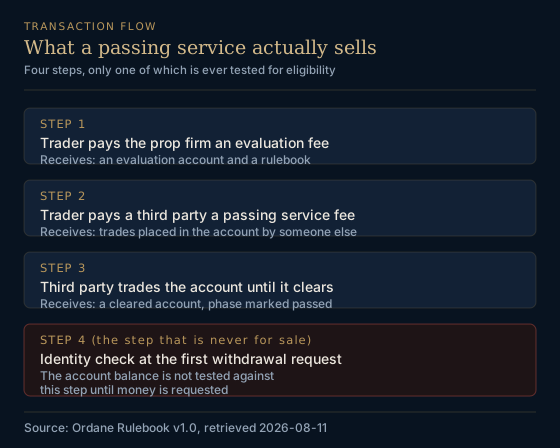
The evaluation pass and the payout claim are two separate things, and only one of them changes hands when you pay. For a deeper look at the different models, read about the difference between an instant account vs evaluation prop firm.
The evaluation is not the payout
This matters because the sale is structured to look like one transaction. You pay once, you wait, you get a passed account. But eligibility for a payout is not a property of the account balance. It is a property of how the account was traded, who traded it, and whether that trading matches what you told the firm when you signed up. A passing service changes the answer to that last question, and it changes it in the one direction that a firm's rules are written to catch.
Table 1: What You Pay, What You Receive, What You Keep
| Line item | Who is paid | What you receive | What you keep at withdrawal |
|---|---|---|---|
| Evaluation fee | The prop firm | An evaluation account and a rulebook | Nothing on its own; this is the ticket to try |
| Passing service fee | The third party | A cleared account, phase marked passed | Nothing; the service's job ends when the account clears |
| Account credentials shared | The third party | Trades placed in your account by someone else | A trading history that does not match your own activity |
| Payout claim | You, from the firm | An entitlement to be paid, if the account is eligible | Contingent on the third-party clause and the identity check below |
Read the last column top to bottom. Three of the four rows produce nothing you can bank. The fourth row, the payout claim, is the only one that pays out money, and it is also the only one that was never for sale. You bought a cleared account. You did not buy the firm's agreement to pay it.
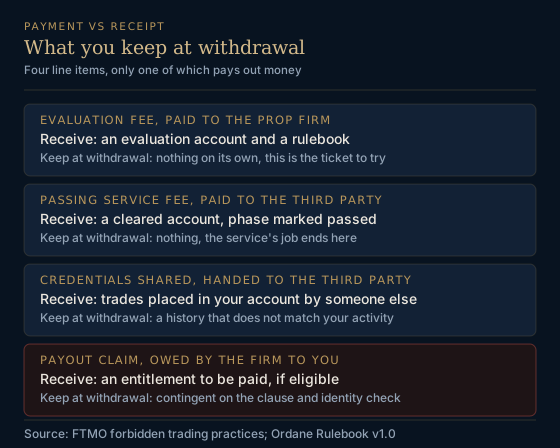
Table 2: Two Fees, Three Outcomes
No clause cited above obligates anyone to hand either payment back, in any outcome.
| Payment | If the arrangement is never caught | If caught at the identity check | If caught after a payout |
|---|---|---|---|
| Evaluation fee, paid to the firm | Spent; the account exists | No refund obligation appears in the clauses cited | No refund obligation appears in the clauses cited |
| Passing service fee, paid to the third party | Spent; the service is complete | The service already delivered; there is nothing to claw back from it | The same; the firm's corrective list runs against you, not the service |
What Does a Breach Actually Do?
A firm that finds a passing service arrangement is not choosing between forgiving it and terminating the account. The consequences are listed, and they are broader than account closure. FTMO's published list includes removing the trades from your history, restricting your platform access, disqualifying you from the evaluation process, forfeiting any reward you would have received, or terminating every agreement you have with the firm (FTMO, retrieved 2026-08-11). That list is not a menu the firm chooses one item from. It is the range of what "corrective action" is defined to include, and a firm can apply more than one. For more on what happens after a rule break, read what happens when you breach a prop firm account.
The practical effect: the cleared account you paid to produce can be un-cleared. The trades that got it there can be struck from the record entirely, which means the profit target you thought you hit no longer shows as hit. This is why the phrase "the account already passed" is doing less work than it sounds like. Passed is a status the firm assigned based on a history it believed was yours. If that belief turns out to be wrong, the firm does not owe you the status it gave you by mistake.
Topstep (prop firm) works from the same structure with different wording. Its prohibited list catches any trade performed in conflict with its Terms of Use or its Trading Combine terms (Topstep, retrieved 2026-08-11), which is broad enough to cover a third party trading your combine on your behalf even without a clause naming "passing services" specifically. Topstep separately bans software, AI, or mass data entry that manipulates or provides an unfair advantage (Topstep, retrieved 2026-08-11), which matters for the version of this arrangement sold as an automated signal or algorithm rather than a human trader: the tool is covered even if no human ever touches your login.
The name on the payout
A payout is not paid to an account number. It is paid to a person, and that person has to be verified before the money moves. This is where the arrangement runs into its second problem, one that has nothing to do with the third-party clause at all.
Why the check comes at the withdrawal, not the purchase
The identity check on Ordane accounts happens once, at the first withdrawal request, not at the point of purchase (Ordane Rulebook, retrieved 2026-08-11). That timing is not incidental. It means the firm has no reason to verify identity on an account that has not yet asked to be paid, and every reason to verify it the moment one does. A passing service can get an account through an evaluation phase without ever touching identity verification, because that phase does not require it. The verification arrives exactly when the arrangement's second cost becomes visible: the person whose name is on file has to match the person the firm believes traded the account, and a passing service, by definition, means those are two different people. For more on this process, read about prop firm KYC verification explained.
Why Do the Reviews of These Services Settle Nothing?
A five-star page for a passing service tells you what the review platform's own rules say it cannot tell you. Trustpilot's guidelines for reviewers state that a person is not eligible to write a review after receiving or being offered an incentive connected to writing or editing it, and the list of disqualifying incentives explicitly includes discounts, promo codes, refunds and freebies (Trustpilot, retrieved 2026-08-11). A passing service has an obvious incentive to offer exactly those things in exchange for a review, and a reviewer who accepted one is not supposed to be counted at all under the platform's own rule.
This sits alongside a separate, harder rule that applies regardless of platform. The U.S. Federal Trade Commission's Rule on the Use of Consumer Reviews and Testimonials took effect on October 21, 2024, and it prohibits selling or purchasing fake consumer reviews or testimonials outright (Federal Register, retrieved 2026-08-11). That rule does not require you to prove a specific review is fake. It establishes that the practice of buying reviews is itself the violation, which is relevant here because the entire category of "best prop firm passing services" list pages runs on exactly the kind of testimonial density that both rules were written to catch. For more on this, read can you trust prop firm reviews.
None of this proves any specific five-star review is bought. It proves a page of reviews cannot function as evidence either way, because the review ecosystem for a paid pass-through service has a structural incentive problem that star volume does not settle.
Four Checks If Someone Offers to Pass Your Account
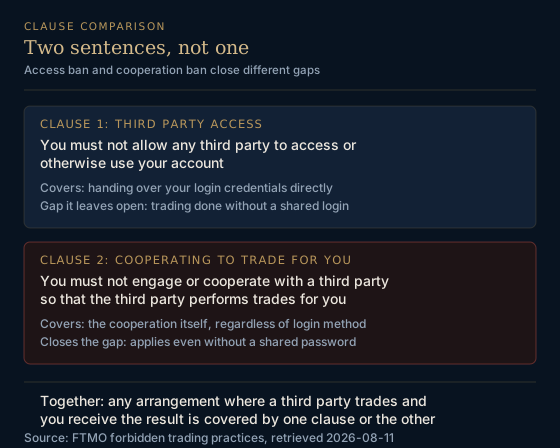
- Find the exact clause in the firm's own rulebook on third-party access or cooperation, not a forum summary of it, and read both sentences: the access ban and the cooperation ban are usually separate. For more on finding and saving these rules, read how to save prop firm rules before paying.
- Confirm when identity verification happens. If it is at first withdrawal rather than at purchase, understand that a passed account has not yet been tested against the one check that catches this arrangement.
- Never share account credentials with anyone, including a service that says it only needs read-only access; the clauses above do not distinguish access levels.
- Assume the firm can strike trades from the history retroactively rather than treating a "passed" status as final, since removal of trades is explicitly listed as an available corrective action (FTMO, retrieved 2026-08-11).
A closed list, read exactly
Ordane's structure removes the specific mechanic a passing service is built to exploit, since there is no separate evaluation phase to pay someone else to clear. Ordane's own prohibited-practice list is closed: clause R-6 names six practices, latency, reverse or hedge arbitrage; high-frequency or bulk automated exploitation; copy trading between Ordane accounts; straddling news releases with paired opposing orders; platform or data-feed exploitation; and gap abuse (Ordane Rulebook, retrieved 2026-08-11). Read that list before any review page: if a behavior is not named in that section, it is not a violation, and discretion is not a rule.
One identity check, at the first withdrawal
On identity, Ordane's KYC happens once, at the first withdrawal request, not at purchase, with no re-verification loop at every payout (Ordane Rulebook, retrieved 2026-08-11). That single, later checkpoint carries the same structural weight described above: an arrangement that produces a healthy-looking account balance still meets a moment where the name on file has to match the person who actually traded it. The payment side is time-boxed the same way: The Ordane Guarantee approves every withdrawal request, or denies it in writing citing the exact rule breached by section number, within 24 clock hours, and past that deadline the request is treated as approved and the G-1 clock starts (Ordane Rulebook, clause G-0, retrieved 2026-08-11).
Declared inputs: worked check
Declared inputs: account size 50000; daily loss limit 0.03; max drawdown 0.05; risk per trade 0.015.
Assumptions for this check only: percentages come from Ordane Rulebook clauses R-1, R-2 and R-3 as published on the rulebook page.
Worked arithmetic:
50000 × 0.03 = 1500
50000 × 0.05 = 2500
50000 × 0.015 = 750
| Limit | Rate | On $50,000 |
|---|---|---|
| Daily loss | 0.03 | 1500 |
| Max drawdown | 0.05 | 2500 |
| Risk per trade | 0.015 | 750 |
Frequently asked questions
Is a passing service illegal?
Paying someone to trade your evaluation account is a breach of most firms' terms of service, which is a contract matter, not automatically a criminal one. Whether it rises to fraud depends on facts like misrepresentation to the firm and jurisdiction, which is outside what any rulebook clause alone settles. What the clauses above establish clearly is that it is prohibited under the contract you signed when you bought the evaluation, and that the firm has remedies for that breach independent of any criminal question.
What if the service uses my own strategy?
The clauses cited above do not turn on whose strategy is used. FTMO's rule bans allowing a third party to access or use the account (FTMO, retrieved 2026-08-11) and separately bans cooperating with a third party so they perform the trades (FTMO, retrieved 2026-08-11). Both are about who executes the trade, not what the trade is based on. A third party trading your strategy from your login is still a third party trading your account.
Can I get my money back?
The evaluation fee and the passing service fee are two separate payments to two separate parties, and neither clause above obligates either party to refund you if the arrangement is caught. If a firm applies its published corrective action and disqualifies the account, that outcome is listed as available to the firm (FTMO, retrieved 2026-08-11), not something the firm has to reverse on request. Absence of a refund clause is not evidence that a refund is owed; it is evidence that the arrangement's downside was priced into the sale from the start, and the sale was for a cleared account, not for the payout that account was never guaranteed to produce.
Does using a passing service trigger the identity check faster?
No. The identity check on Ordane accounts happens at the first withdrawal request regardless of how the account was traded (Ordane Rulebook, retrieved 2026-08-11). A passing service does not accelerate or avoid that check; it simply means the account has not yet been tested against it at the point the sale completes.
What happens if a firm strikes trades from my history after I already withdrew?
The clauses above describe corrective action available to a firm once a breach is found, including removal of trades from history (FTMO, retrieved 2026-08-11). Whether that action can be applied after a withdrawal has already been paid is a contract and timing question specific to each firm's terms, and is not settled by the clauses cited here.
Sources
- Forbidden Trading Practices | FTMO.com ftmo.com Retrieved 2026-08-11.
- Prohibited Trading Strategies at Topstep | Topstep Help Center help.topstep.com Retrieved 2026-08-11.
- Guidelines for Reviewers | Trustpilot corporate.trustpilot.com Retrieved 2026-08-11.
- Trade Regulation Rule on the Use of Consumer Reviews and Testimonials, 89 FR (August 22, 2024) govinfo.gov Retrieved 2026-08-11.
- Ordane Rulebook v1.0 ordanemarkets.com Retrieved 2026-08-11.
- Customer Advisory: Understand the Risks of Virtual Currency Trading | CFTC cftc.gov Retrieved 2026-08-10.