Home · The Ordane Journal · Rules and Mechanics · Instant Funding vs Evaluation Prop Firms Compared
Instant Funding vs Evaluation Prop Firms Compared
Traders constantly compare instant access models against traditional multi-step evaluations to determine which path offers better value. An instant funding account provides immediate access to live simulated trading parameters for a higher upfront fee, whereas an evaluation requires passing strict profit targets over weeks for a lower initial cost.
An instant access account removes the demonstration phase and allows a trader to operate under the final rule structure immediately. Ordane accounts operate on simulated capital. No live funds are traded and no deposits are accepted.
In one sentence: An instant funding account allows a trader to bypass the traditional evaluation phase by paying a premium upfront fee to access the firm's defined simulated capital limits and withdrawal rules immediately.
There is a growing trend among proprietary trading firms to offer instant funding options as an alternative to traditional multi-step evaluations (Finance Magnates, retrieved 2026-09-05). This shift happens because many traders experience failure during challenges not due to poor strategy, but due to the artificial time pressure and aggressive parameters imposed by the testing phases. The traditional model forces a trader to take unusual risks to meet a deadline or a high target, which contradicts long-term risk management principles.
What is an instant funding prop firm account vs an evaluation?
An instant access account removes the demonstration phase and allows a trader to operate under the final rule structure immediately. An evaluation requires passing simulated performance phases before withdrawal eligibility. The industry shifts toward direct access for traders who prefer paying a higher fee to skip the testing period entirely.
How the instant funding model skips the challenge
In a traditional evaluation, the trader must prove their strategy across one or two rigid phases before gaining access to a withdrawable account. For example, FTMO (prop firm) requires reaching a 10% profit target in a standard Phase 1 evaluation (FTMO, retrieved 2026-09-05). Only after passing these parameters, and often a secondary Phase 2 with a slightly lower target, does the trader move to the final stage. This process often takes weeks or months of consistent execution.
The direct model bypasses this requirement completely. The trader purchases the account and operates under the firm's core rules from the first execution. Ordane sells one product, the Ordane Instant Account: direct access, no evaluation phase and no challenge, on simulated capital. The focus shifts entirely from hitting an arbitrary milestone to managing risk within the defined limits of the account. This structural change aligns the trader's incentives with steady execution rather than high-risk gambles aimed at passing a test.
To summarize the structural differences clearly:
* Entry requirement: Evaluations demand a strict profit target, while direct models require only the upfront fee to begin.
* Time to first payout: Evaluations delay the process by weeks, whereas direct access enables earlier withdrawal cycles based on the firm's specific calendar.
* Psychological pressure: The absence of a target removes the urgency to over-leverage positions, allowing the trader to execute their standard system.
Who holds the trading capital in simulated environments
Both models operate strictly on simulated capital. The firm does not deposit real money into a brokerage account for the trader to execute orders in the market. Instead, the firm provides a simulated environment where trades are tracked by an internal system, and payouts are calculated based on the simulated performance of the trader.
This structural reality means the firm pays successful traders from its own revenue or internal reserves. Firms that obscure this fact mislead their customers about the nature of the business. Transparency requires admitting that the entire operation runs on internal ledgers and simulated pricing feeds, rather than external liquidity providers. When a trader requests a withdrawal, the firm must have the cash on hand to honor the simulated profit.
Transparency in the proprietary trading industry requires admitting that the entire operation runs on internal ledgers and simulated pricing feeds, and payouts come from company revenue.
Are you paying more for instant funding?
Direct access accounts carry higher initial fees than evaluations of the same nominal balance. The higher fee offsets the risk the firm takes by removing the testing phase. A trader must calculate the true cost by comparing the upfront fee against the actual drawdown limit provided by the account size.
Upfront fee comparison
When a trader purchases an evaluation, the upfront fee appears relatively low compared to the nominal account size. However, the failure rate in evaluations is structurally high. Traders frequently purchase multiple attempts before successfully passing Phase 1 and Phase 2, which inflates the actual cost of entry significantly. A low challenge fee multiplies into a heavy expense if it takes multiple attempts to secure the final account.
Direct models charge a premium upfront. The trader pays a larger sum on day one, but they eliminate the mathematical probability of failing a challenge and having to purchase a new one to continue trading. This makes the cost predictable.
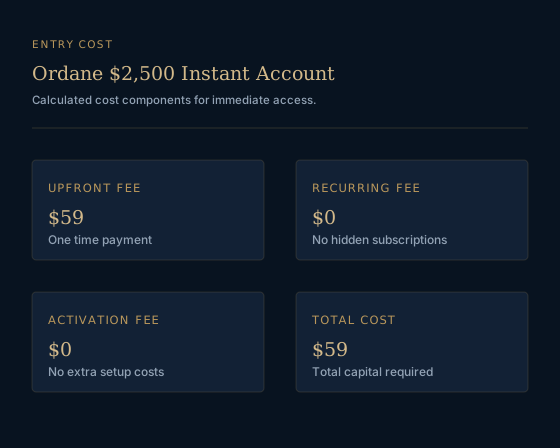
Let us define the numbers exactly. Ordane Instant Account comes in five sizes: $2,500, $10,000, $25,000, $50,000 and $100,000. The fee is one-time: $59 for the $2,500 account, $139 for the $10,000 account, $299 for $25,000, $549 for $50,000 and $999 for $100,000. There are no recurring fees, no hidden tiers and no coupon games.
Declared inputs for this check: a $59 upfront fee, a $0 recurring fee, and a $0 activation fee. Worked arithmetic: $59 + $0 = $59.
| Cost Component | Amount | Source |
| :--- | :--- | :--- |
| Upfront fee | $59 | Ordane $2,500 Account |
| Recurring fee | $0 | Ordane Rulebook |
| Activation fee | $0 | Ordane Rulebook |
| Total Entry Cost | $59 | Calculated |
Cost per drawdown dollar
The nominal account size displayed on a website is not the real purchasing power of the trader. The real purchasing power is dictated entirely by the drawdown limit. If a firm offers a $100,000 account with a 5 percent absolute drawdown, the trader effectively controls exactly $5,000 of risk capital. The remaining $95,000 serves only to calculate leverage and position sizing.
Comparing the upfront fee directly to the drawdown limit reveals the true price of the capital.
* Evaluation model: Low initial fee, but the trader must earn the drawdown limit by trading flawlessly for weeks.
* Direct model: Higher initial fee, but the drawdown limit is immediately available for execution.
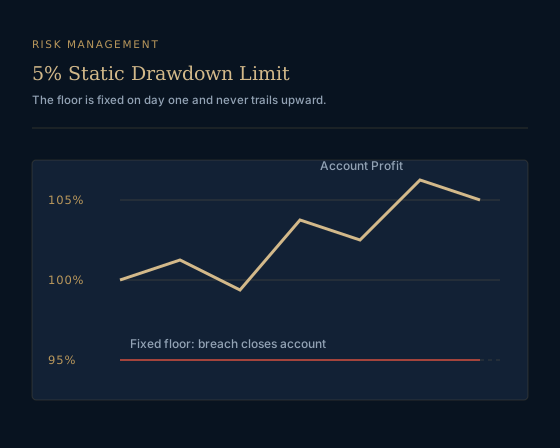
Ordane's maximum drawdown is 5 percent and static: account equity may never fall below 95 percent of the initial balance. The floor is fixed on day one, never trails upward, and a breach closes the account. The daily loss limit is 3 percent, measured against the balance at the start of the server day. A breach closes the account.
A static floor provides mathematical certainty. Trailing drawdowns, common in many evaluations, drag the floor higher as the account profits, forcing the trader into a tighter margin of error even after successful trades.
What hidden rules apply to instant accounts?
Firms offering direct access often impose strict rules to mitigate their exposure. These restrictions frequently include tight scaling milestones, lower drawdown limits, and consistency requirements. Traders must read the rulebook to identify clauses that delay withdrawals or mandate specific profit targets before the account can grow or request a payout.
Strict profit targets for scaling
While direct models remove the evaluation phase, many firms still require traders to hit profit milestones before they can scale their capital or even request a full withdrawal. The 5%ers (prop firm) is one example where instant funding accounts allow traders to scale their capital after hitting a 10% profit milestone (The 5%ers, retrieved 2026-09-05). These scaling targets act as delayed evaluations, holding back the trader's progress until they prove consistency over time.
At Ordane, there is no mandatory profit target to request a payout. The first withdrawal is available 7 calendar days after account activation, and the cycle thereafter is every 14 days. Withdrawals #1 and #2 are each capped at 3 percent of initial balance. From withdrawal #3 onward there is no cap.
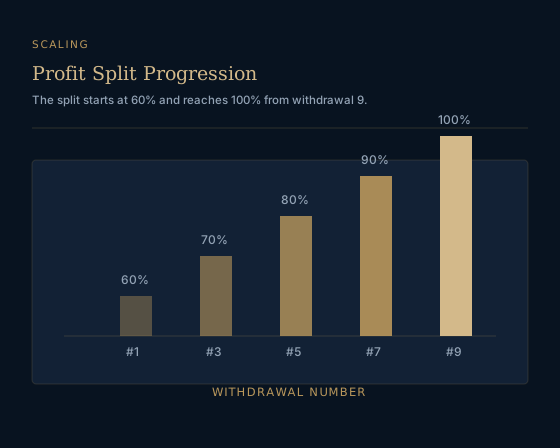
Ordane's profit split starts at 60 percent and rises 5 percentage points with every completed withdrawal, reaching 100 percent from the ninth withdrawal onward. The split ladder is in writing and never resets. Withdrawals reduce the account balance, and the R-1 drawdown floor stays anchored to the initial balance.
Drawdown rule differences
Drawdown rules define survival in this industry. Firms use trailing drawdowns, absolute drawdowns, and daily limits to control risk. Understanding the interaction between these rules and the firm's trading conditions is essential.
Ordane lists four asset classes: FX pairs (majors and minors), metals, indices and crypto. No exotics. Ordane's settled leverage is 1:50 on FX majors and minors. Leverage for metals, indices and crypto has not been set yet. To manage this leverage, Maximum risk per trade is 1.5 percent of current balance and a stop-loss is mandatory at entry. Two maximum losses equal the daily limit, which is the design rather than an accident.
Another common restriction is the consistency rule, designed to prevent single-trade luck from bypassing the system. Ordane's consistency rule is 20 percent: at the moment of a withdrawal request, no single trading day may account for more than 20 percent of the cycle's total profit. If a day exceeds 20 percent, the excess profit from that day is deferred to the next cycle. It is never confiscated, and the remainder of the cycle pays out normally.
Traders must also understand what constitutes activity. Accounts with no trading activity for 30 consecutive days are closed. The 30 consecutive days in clause R-5 are calendar days (dias corridos), not business days. Under clause R-5, trading activity means at least one filled order. Pending orders and platform logins do not count.
Finally, traders must review prohibited practices. Ordane's prohibited-practice list is closed. Clause R-6 names six practices: latency, reverse or hedge arbitrage; high-frequency or bulk automated exploitation; copy trading between Ordane accounts; straddling news releases with paired opposing orders; platform or data-feed exploitation; and gap abuse. If a behavior is not listed in that section, it is not a violation. Discretion is not a rule.
Automation is addressed clearly. Expert Advisors are fully permitted at Ordane: a trader may run an EA executing the trader's own strategy on an Ordane account. Appendix A of Rulebook v1.0 is published (changelog entry dated 2026-08-01) and defines each R-6 practice with examples. A-2 states that R-6(b) does not ban all automation, only bulk or high-frequency exploitation: a single expert advisor or script placing discretionary or rules-based trades at human-scale frequency, with a stop-loss on every position under R-3, is the example that does NOT close the account.
Furthermore, the rules on copying across multiple prop firm accounts are precise. The R-6 prohibition on copy trading between Ordane accounts applies only between different people. Copy trading is permitted exclusively between Ordane accounts that belong to the same person, meaning the same account holder and ultimate beneficial owner. Copy trading between person A and person B is always prohibited.
Will an instant funding firm exist long enough to pay you?
The proprietary trading industry sees high turnover, and firms operating direct models face significant cash flow pressures. A sustainable firm publishes its reserve mechanism and enforces a strict rulebook instead of relying on trader failures. Transparent operations provide a public ledger and concrete penalty clauses for delayed payout processing times.
The sustainability of the business model
A firm that sells direct access takes on immediate liability. If traders perform well, the firm must pay them from its reserves. A firm without a transparent reserve mechanism poses a severe counterparty risk. Many firms operate on the assumption that enough traders will fail to cover the few who succeed. When that ratio flips, the firm collapses.
Ordane's payout reserve is published at a public TRON address on ordanemarkets.com and in Rulebook v1.0 clause PR-1. The page carries a dated observed balance and states that the reserve is not a promise, it is an address. Payouts are paid in real money from company fee revenue. No client deposits are taken and no client capital is traded. Rulebook v1.0 clause PR-1 commits Ordane to publish the payout reserve on-chain; the live rulebook and homepage publish the TRON address.
Another critical factor in sustainability is technology dependence. Ordane runs on a trading platform it designed and built with its own engineering team, and licenses no third-party terminal: not MatchTrader, not MetaTrader, not any external vendor. The distinction is structural, not cosmetic. A firm that licenses its terminal can be closed by a decision it does not control, and in 2024 that is exactly what happened: MetaQuotes withdrew MT4 and MT5 access from prop firms, True Forex Funds announced permanent closure on 13 May after its licences were terminated, and SurgeTrader ceased all operations on 24 May, one week after losing its Match-Trader licence. Ordane owns the terminal its traders use, so no vendor can revoke it, reprice it, or decide it will no longer serve this industry.
Risk of denied payouts
The greatest fear of any trader is executing their strategy perfectly, only to have the payout denied by vague terms and conditions. Firms often use discretionary clauses to reject withdrawals when their internal cash flow is under pressure.
Ordane removes discretion entirely from the process. Every withdrawal request is approved, or denied in writing citing the exact rule breached by section number, within 24 clock hours. Past that deadline the request is treated as approved and the G-1 clock starts.
This mechanism enforces accountability through The Ordane Guarantee. A payout approved and not paid within 48 clock hours, not business hours, triggers automatic compensation: a 100 percent refund of the account fee, plus the payout owed in full.
The Ordane Guarantee has two objective exclusions: documented fraud or KYC review, and declared force majeure. Both carry a hard deadline, and beyond it G-1 applies regardless. Both G-2 exclusions (documented fraud or KYC review, and declared force majeure) are capped at 10 business days each. Past that deadline, G-1 applies regardless.
A breach closes the account. That is the whole consequence: no partial confiscations, no surprise fees, no renegotiation.
Instant funding vs evaluation pricing comparison
Evaluating the true cost requires analyzing the upfront fee alongside the rules that govern capital retention. Evaluations look cheaper but demand weeks of flawless trading. Direct models charge more upfront but remove the time cost. The correct choice depends on a trader's capital availability and their specific risk management strategy.
Standard Phase 1 evaluation fees
Evaluation fees appear incredibly low because the firm knows the vast majority of participants will fail. The firm collects the fee and assumes very little risk, as the trader must pass strict mathematical parameters before any payout is even theoretically possible.
When comparing prices, traders must consider the statistical cost of multiple attempts. If an evaluation costs a low entry fee but requires several attempts on average to pass, the true cost of entry multiplies rapidly. The time spent passing those evaluations also represents a missed opportunity to generate actual returns under the final account parameters.
Instant access premiums
Direct access models charge a premium because the firm assumes the liability immediately. The trader bypasses the evaluation entirely and accesses the risk capital limits from day one. The premium is the price of certainty and speed.
Ordane charges no commission, no spread and no swap. The account fee is the only cost the trader pays. The reason is structural, not promotional: accounts run on simulated capital, so no order is routed to an exchange and nothing is financed overnight, which means neither line has an underlying bill behind it.
Furthermore, holding trades over periods of low liquidity is addressed clearly in the rulebook. Overnight and weekend holding is allowed at Ordane. It is not on the R-6 closed list, and what is not listed is not a violation.
The comparison boils down to personal risk preference and strategy execution. A trader with ample time, limited upfront capital, and a strategy that performs well under tight deadlines might prefer an evaluation. A trader who values immediate access, rejects artificial time pressures, and possesses a proven strategy will likely favor the direct model. To trade with direct parameters and no evaluation phase, explore the Ordane Instant Account.
| Feature Comparison | Evaluation Model | Ordane Instant Account |
| :--- | :--- | :--- |
| Upfront Cost Structure | Lower nominal fee | Premium one-time fee |
| Profit Target to Start | Mandatory to pass phases | None |
| Drawdown Mechanics | Often trailing or complex | 5% Static |
| Commission & Swap Fees | Often charged per trade | None |
| Payout Processing | Often discretionary | The Ordane Guarantee |
FAQ
Is there a profit target on an Ordane Instant Account?
At Ordane, there is no mandatory profit target to request a payout. The first withdrawal is available 7 calendar days after account activation, and the cycle thereafter is every 14 days (Ordane Rulebook v1.0, clause PA-1, retrieved 2026-09-05).
How does Ordane calculate maximum drawdown?
Ordane's maximum drawdown is 5 percent and static. Account equity may never fall below 95 percent of the initial balance, and the floor never trails upward (Ordane Rulebook v1.0, clause R-1, retrieved 2026-09-05).
Can you hold trades overnight at Ordane?
Yes, overnight and weekend holding is allowed at Ordane. It is not on the R-6 closed list, and what is not listed is not a violation (Ordane Rulebook v1.0, clause R-6, retrieved 2026-09-05).
What happens if an account breaches a rule?
A breach closes the account. That is the whole consequence, meaning there are no partial confiscations, no surprise fees, and no renegotiations (Ordane Rulebook v1.0, clause R-1, retrieved 2026-09-05).
Are expert advisors permitted at Ordane?
Expert Advisors are fully permitted at Ordane. A trader may run an EA executing the trader's own strategy on an Ordane account, provided it is not bulk or high-frequency automated exploitation (Ordane Rulebook v1.0, Appendix A-2, retrieved 2026-09-05).
Sources
Primary sources are linked inline above.
This article is for information only and is not investment, financial, or tax advice.
Ordane accounts operate on simulated capital. No live funds are traded and no deposits are accepted. Payouts depend on simulated performance under Rulebook v1.0; no level of performance is typical or assured.
FAQ
Is there a profit target on an Ordane Instant Account?
At Ordane, there is no mandatory profit target to request a payout. The first withdrawal is available 7 calendar days after account activation, and the cycle thereafter is every 14 days.
How does Ordane calculate maximum drawdown?
Ordane's maximum drawdown is 5 percent and static. Account equity may never fall below 95 percent of the initial balance, and the floor never trails upward.
Can you hold trades overnight at Ordane?
Yes, overnight and weekend holding is allowed at Ordane. It is not on the R-6 closed list, and what is not listed is not a violation.
What happens if an account breaches a rule?
A breach closes the account. That is the whole consequence, meaning there are no partial confiscations, no surprise fees, and no renegotiations.
Are expert advisors permitted at Ordane?
Expert Advisors are fully permitted at Ordane. A trader may run an EA executing the trader's own strategy on an Ordane account, provided it is not bulk or high-frequency automated exploitation.
Sources
- The Rise of Instant Funding Prop Firms. www.financemagnates.com/forex/brokers/the-rise-of-instant-funding-prop-firms/ Retrieved 2026-09-05.
- What are the rules of the FTMO Challenge?. ftmo.com/en/faq/what-are-the-rules-of-the-ftmo-challenge/ Retrieved 2026-09-05.
- The 5%ers Bootcamp & Instant Funding. the5ers.com/bootcamp/ Retrieved 2026-09-05.