Home · The Ordane Journal · Rules and mechanics · Audacity Capital Max Loss Limit Explained
Audacity Capital Max Loss Limit Explained
What Is the Audacity Capital Max Loss Limit?
The Audacity Capital maximum loss limit is a strict 10% absolute drawdown threshold that dictates how much equity a trader can lose before their account is permanently closed. Ordane accounts operate on simulated capital. No live funds are traded and no deposits are accepted. This rule is absolute and strictly enforced for all participants. (Ordane Rulebook v1.0, clause P-2, retrieved 2026-09-05)
Audacity Capital (prop firm) enforces a maximum absolute drawdown limit of 10% (Audacity Capital, retrieved 2026-09-05). Strict maximum drawdown limits are the primary mechanism proprietary trading firms use to manage risk capital allocation (Finance Magnates, retrieved 2026-09-05). This absolute limit governs how much equity an account can lose before the system closes it.
The 10% threshold serves as a strict boundary for risk exposure. When a trader acquires an evaluation or an instant access program, the provider allocates a defined risk buffer. This buffer protects the firm's overarching risk model while granting the trader adequate space to deploy their strategy. A thorough understanding of this limit is the foundational step toward maintaining an active account. Countless traders face premature account closures simply because they misinterpret how their platform measures equity drops.
Daily Loss Limit vs. Maximum Loss Limit
It is necessary to distinguish between a maximum loss limit and a daily loss limit. The daily limit dictates the maximum allowable equity drop within a single 24-hour server cycle. The maximum loss limit, conversely, caps the total allowable drawdown from the initial starting balance of the account. Both restrictions operate simultaneously in the background. A disciplined trader might survive several days of minor, controlled losses without ever triggering the daily limit, yet they could eventually accumulate enough losses to breach the total maximum loss limit.
The standard across the industry varies significantly. A 10% metric provides a highly balanced structure. It offers enough breathing room for swing traders who hold wider stop-losses, while also accommodating high-volume day traders. However, the raw percentage is less relevant than the underlying calculation method. A 10% limit applied to a moving base behaves entirely differently than a 10% limit applied to a fixed base.
How Is the 10% Drawdown Limit Calculated?
The maximum loss limit at Audacity Capital is calculated based on the initial account balance rather than a trailing high watermark (Audacity Capital, retrieved 2026-09-05). This means the floor is fixed on day one and does not move upward as you accumulate simulated profits. The calculation provides a static boundary for risk management.
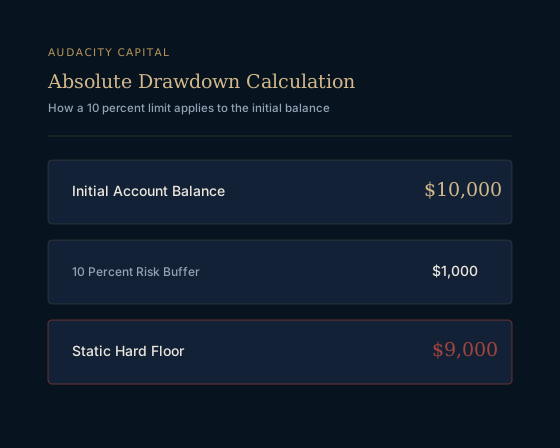
To understand the exact mechanics, we can model a standard numerical scenario. Declared inputs for this check: a $9,000 static floor, and a $1,000 permitted drawdown based on the 10% maximum absolute drawdown limit (Audacity Capital, retrieved 2026-09-05). Worked arithmetic: $9,000 + $1,000 = $10,000 initial balance. The system anchors the absolute failure point at $9,000, and it remains there permanently, regardless of any future trading success.
| Ordane Account Size | One-Time Fee | Profit Split Start |
|---|---|---|
| $2,500 | $59 | 60 percent |
| $10,000 | $139 | 60 percent |
| $25,000 | $299 | 60 percent |
| $50,000 | $549 | 60 percent |
| $100,000 | $999 | 60 percent |
| Metric | Calculation Value |
|---|---|
| Initial Account Balance | $10,000 |
| Maximum Drawdown Limit | 10% |
| Permitted Loss Amount | $1,000 |
| Static Hard Floor | $9,000 |
When a trader executes a position, the trading platform continuously monitors the real-time equity. Equity represents the closed account balance plus or minus any floating profits or losses from open positions. If the floating equity touches the $9,000 mark for even a fraction of a second, the system registers a definitive breach. The trade does not need to be closed for the violation to trigger.
Volatility and Environmental Variables
This real-time equity monitoring means traders must account for environmental variables like spread widening, slippage, and overnight swap charges. A position might appear safe on a static chart, but a sudden spike in the spread during an economic news release can briefly push the floating equity below the static floor. Effective risk management requires calculating stop-losses based on total equity exposure, not just the static balance.
Volatility impacts this calculation heavily. Different asset classes consume the risk buffer at different speeds. Ordane lists four asset classes: FX pairs (majors and minors), metals, indices and crypto. No exotics. A trader holding a highly volatile crypto position must use smaller position sizing than a trader holding a major currency pair, simply because the wider price swings pose a greater threat to the static equity floor.
Ordane charges no commission, no spread and no swap. The account fee is the only cost the trader pays. The reason is structural, not promotional: accounts run on simulated capital, so no order is routed to an exchange and nothing is financed overnight, which means neither line has an underlying bill behind it. This structure removes hidden variables that can unexpectedly drag floating equity toward the maximum loss limit.
Does Initial Balance Differ From Trailing Drawdown?
The distinction between an initial balance calculation and a trailing drawdown determines whether a trader can survive long-term. A trailing drawdown follows the highest point the account equity reaches. If an account starts at $10,000 and the trader generates a $2,000 profit, the new high watermark is $12,000. If the firm applies a 10% trailing drawdown, the new floor automatically moves up to $10,800.
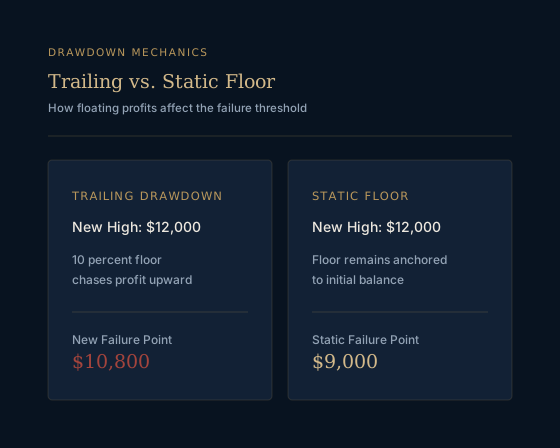
Trailing drawdowns create a structural trap. Unrealized floating profits become a new liability. If a trade runs into deep profit and then reverses back to break-even, the trader might breach the account without ever losing their original starting capital. In the scenario above, a drop to $10,700 results in account closure, even though the trader is still $700 in profit overall. The floor chased the profit upward and locked in a higher failure threshold.
The Psychological Impact of Drawdowns
When a trader operates under a trailing drawdown, the psychological pressure increases with every winning trade. Instead of feeling secure, the trader fears giving back the profit because it brings the failure threshold closer. This dynamic often forces traders to close winning positions prematurely, cutting their profits short to protect the new, higher floor. A static limit removes this pressure. The trader can let their winners run, knowing that the original floor remains anchored at the initial balance.
A static floor anchored to the initial balance eliminates this exact trap. As the trader generates profit, the distance to the failure point increases proportionally. If the balance grows from $10,000 to $12,000 under a static model, the floor remains securely at $9,000. The trader now possesses $3,000 of breathing room instead of the original $1,000. This structure rewards consistency and allows traders to hold longer-term positions without the constant fear of the floor moving against them.
Ordane sells one product, the Ordane Instant Account: direct access, no evaluation phase and no challenge, on simulated capital. (Ordane Rulebook v1.0, section 1, retrieved 2026-09-05) Ordane's maximum drawdown is 5 percent and static: account equity may never fall below 95 percent of the initial balance. The floor is fixed on day one, never trails upward, and a breach closes the account. The daily loss limit is 3 percent, measured against the balance at the start of the server day. A breach closes the account.
Both models rely on a fixed starting parameter, but the static limit provides transparency. Whether a firm utilizes 5% or 10%, the static nature of the rule ensures the trader always knows their exact exit parameter. Clear rules remove anxiety and allow the trader to focus on execution rather than opaque platform mechanics. The Ordane rulebook is public, numbered and versioned, and no rule is ever applied retroactively to an open account. Changes produce a new version with a dated changelog entry, and the version you sign up under is the version that governs your account.
Will You Lose Your Account If You Breach?
Yes, breaching the 10% maximum absolute drawdown limit (Audacity Capital, retrieved 2026-09-05) results in immediate account closure. Strict maximum drawdown limits are the primary mechanism proprietary trading firms use to manage risk capital allocation (Finance Magnates, retrieved 2026-09-05). Firms enforce these thresholds automatically, and crossing the line terminates trading access permanently without exception.
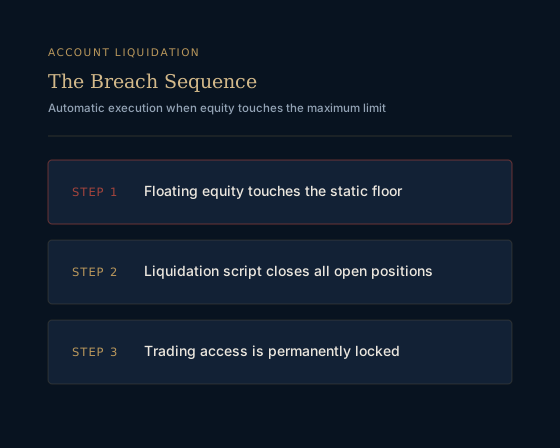
When the equity hits the predetermined limit, the trading server executes a predefined liquidation script. The system sends market orders to close all open positions instantly. It then disables trading permissions, preventing the user from executing any new trades. The account is moved to a breached state in the dashboard. There is no manual review process, no grace period, and no opportunity to inject capital to save the account.
Some traders fear hidden clauses that might trigger a breach unfairly. This fear is justified in an industry where terminology changes frequently and rules are often buried in dense terms of service documents. However, a maximum loss limit based on the initial balance is a mathematical absolute. It relies purely on the numerical equity value reported by the trading terminal data feed.
| Firm Name | Drawdown Metric | Base Metric | Core Purpose |
|---|---|---|---|
| Audacity Capital | 10% absolute limit | Initial account balance | Manage risk capital allocation |
At Ordane, a breach closes the account. That is the whole consequence: no partial confiscations, no surprise fees, no renegotiation. The industry standard is finality. Once the account is closed, the historical data remains available for the trader to review and analyze, but the trading environment is permanently locked. The trader loses the right to request payouts on any simulated profits that existed in the account prior to the breach.
Trading Over the Weekend and News Events
To prevent a breach, traders must build a systematic and mechanical approach to risk management. Maximum risk per trade is 1.5 percent of current balance and a stop-loss is mandatory at entry. Two maximum losses equal the daily limit, which is the design rather than an accident. While this is the specific rule for Ordane accounts, the mathematical principle applies universally across all platforms. Limiting per-trade exposure is the only reliable way to avoid hitting the absolute maximum drawdown.
Traders must also consider the risks associated with holding positions over the weekend. Gap abuse is prohibited across many firms, but normal market gaps can also cause unexpected drawdowns that trigger a breach. Overnight and weekend holding is allowed at Ordane. It is not on the R-6 closed list, and what is not listed is not a violation. However, holding through a weekend means accepting the risk of the market opening significantly below a stop-loss, causing severe slippage that could instantly trigger a maximum loss breach upon market open.
Furthermore, news trading introduces severe volatility that can threaten the static floor. Ordane's rulebook does restrict one thing around news: clause R-6(d) prohibits straddling news releases with paired opposing orders. Because R-6 is a closed list, no other clause restricts trading during news or high-impact events. A trader must actively manage their exposure during these events to ensure a sudden spread widening does not consume their remaining drawdown allowance.
Automation and Copy Trading Rules
Automation introduces another layer of complexity to risk management. Expert Advisors are fully permitted at Ordane: a trader may run an EA executing the trader's own strategy on an Ordane account. Appendix A of Rulebook v1.0 is published (changelog entry dated 2026-08-01) and defines each R-6 practice with examples. A-2 states that R-6(b) does not ban all automation, only bulk or high-frequency exploitation: a single expert advisor or script placing discretionary or rules-based trades at human-scale frequency, with a stop-loss on every position under R-3, is the example that does NOT close the account. Using an EA can help enforce a strict stop-loss protocol, preventing emotional decisions that lead to a maximum loss breach.
Copy trading also requires careful attention to the rules. The R-6 prohibition on copy trading between Ordane accounts applies only between different people. Copy trading is permitted exclusively between Ordane accounts that belong to the same person, meaning the same account holder and ultimate beneficial owner. Copy trading between person A and person B is always prohibited. Appendix A, entry A-3 (definitive 2026-08-09), defines R-6(c) as mirroring, copying, or mechanically linking orders across two or more Ordane accounts held by different people (different account holders or ultimate beneficial owners), so that one person's risk is transferred or duplicated onto another person's account. Managing risk across multiple linked accounts means a single market event could breach the maximum loss limit on every account simultaneously.
Hedging is another tool traders use to mitigate drawdowns. Ordane's prohibited-practice list is closed: clause R-6 names six practices, and the only hedge-related one is latency, reverse or hedge arbitrage (R-6(a)). If a behavior is not listed, it is not a violation, so ordinary hedging inside one account is not a violation at Ordane. Ordane's Appendix A, entry A-1, names a normal hedge of a single Ordane position with a stop-loss under R-3, with no cross-feed exploit, as an example that does NOT close the account. Proper hedging can freeze the current equity level, preventing it from dropping further toward the maximum loss limit during periods of extreme volatility.
What Are the Costs After a Breach?
After a breach closes the account, a trader must purchase a new assessment or instant access program to resume trading. The previous fee is completely forfeited. Firms do not refund the initial cost for failed accounts. Traders must evaluate their strategy before paying another fee to ensure better risk control.
The financial cost of a breach is strictly limited to the upfront fee paid to access the environment. Because these programs operate entirely on simulated capital, the trader is never liable for any negative balance. If a catastrophic market event causes the account equity to drop far below the 10% limit before the server can execute the liquidation script, the firm absorbs the simulated negative balance. The trader walks away owing nothing beyond the initial purchase price.
Financial and Opportunity Costs
The opportunity cost is often significantly higher than the monetary cost. A breach resets the trader's progress to zero. Any accumulated equity buffer is gone. The time spent building consistency and managing risk is lost, and the psychological impact can lead to rushed decisions. Many traders fall into a cycle of revenge trading, purchasing replacement accounts immediately without fixing the underlying strategy flaw that caused the initial breach.
Inactivity and Replacement Fees
Drawdown is not the only mechanism that closes an account. Inactivity also plays a role in risk management. Accounts with no trading activity for 30 consecutive days are closed. The 30 consecutive days in clause R-5 are calendar days, not business days. Under clause R-5, trading activity means at least one filled order. Pending orders and platform logins do not count. Traders must actively engage the market to maintain access, but they must do so within the strict boundaries of the maximum loss limit.
Pricing models vary widely across the industry. Some firms charge recurring monthly subscriptions that drain capital slowly, while others utilize a transparent one-time fee model. The fee is one-time: $59 for the $2,500 account, $139 for the $10,000 account, $299 for $25,000, $549 for $50,000 and $999 for $100,000. There are no recurring fees, no hidden tiers and no coupon games. Knowing the exact replacement cost helps traders manage their overall business expenses and avoid unpredictable billing cycles.
A common fear among traders is passing an evaluation, maintaining discipline, reaching the payout stage, and then getting denied due to an obscure technicality. Firms with clear, published rules eliminate this anxiety by committing to strict timelines. Every withdrawal request is approved, or denied in writing citing the exact rule breached by section number, within 24 clock hours. Past that deadline the request is treated as approved and the G-1 clock starts.
Accountability is the only metric that matters when evaluating a firm. A payout approved and not paid within 48 clock hours, not business hours, triggers automatic compensation: a 100 percent refund of the account fee, plus the payout owed in full. This mechanism, known as The Ordane Guarantee, forces the firm to honor its commitments financially. When a firm attaches a financial penalty to its own operational delays, the trader has verifiable proof of intent, not just an empty marketing promise.
Once a trader successfully navigates the maximum loss limit and generates profit, the focus shifts to the payout structure. Ordane's profit split starts at 60 percent and rises 5 percentage points with every completed withdrawal, reaching 100 percent from the ninth withdrawal onward. The split ladder is in writing and never resets. The first withdrawal is available 7 calendar days after account activation, and the cycle thereafter is every 14 days. Withdrawals #1 and #2 are each capped at 3 percent of initial balance. From withdrawal #3 onward there is no cap. Withdrawals reduce the account balance, and the R-1 drawdown floor stays anchored to the initial balance. This ensures that taking a payout does not artificially trigger a maximum loss limit breach.
Traders should view the cost of an account as a fixed business expense. A breach is simply a business loss. Maintaining a disciplined approach to the maximum loss limit ensures that this expense is incurred rarely. The ultimate goal is to reach a stage where payouts outpace replacement costs. Ordane's payout reserve is published at a public TRON address on ordanemarkets.com and in Rulebook v1.0 clause PR-1. The page carries a dated observed balance and states that the reserve is not a promise, it is an address. Verifying the reserve allows the trader to focus entirely on execution, knowing the capital is waiting when they successfully navigate the drawdown limits.
Frequently Asked Questions
Is the Audacity Capital maximum loss limit a trailing drawdown?
No, the 10% maximum absolute drawdown limit at Audacity Capital is calculated from the initial starting balance, not a trailing high watermark (Audacity Capital, retrieved 2026-09-05). This creates a static floor that does not move up as the account accumulates profit.
What happens if I breach the maximum loss limit?
Breaching the maximum absolute drawdown limit results in immediate and permanent account closure (Audacity Capital, retrieved 2026-09-05). The trading server automatically executes a liquidation script, closing all open positions and revoking trading permissions without a manual review process.
Are maximum drawdown limits common in prop firms?
Yes, strict maximum drawdown limits are the primary mechanism proprietary trading firms use to manage risk capital allocation across their platforms (Finance Magnates, retrieved 2026-09-05). Every major evaluation provider enforces a variation of this limit to protect the core risk model.
Does Ordane use a static maximum drawdown?
Yes. Ordane's maximum drawdown is 5 percent and static: account equity may never fall below 95 percent of the initial balance. The floor is fixed on day one, never trails upward, and a breach closes the account.
Sources
- Funded Trader Program - Audacity Capital audacitycapital.co.uk Retrieved 2026-09-05T04:01:32-03:00.
- FAQ - Audacity Capital audacitycapital.co.uk Retrieved 2026-09-05T04:01:32-03:00.
- Prop Trading Risk Management: Drawdowns Explained financemagnates.com Retrieved 2026-09-05T04:01:32-03:00.