Home · The Ordane Journal · Rules and mechanics · Alpha Capital Group Max Loss Limit
Alpha Capital Group Max Loss Limit
A max loss limit is the strict equity boundary that triggers immediate account termination if breached. Ordane accounts operate exclusively on simulated capital. No live funds are traded and no deposits are accepted. (Ordane Rulebook v1.0, clause P-2, retrieved 2026-09-05)
Proprietary trading evaluation programs attract traders looking for capital leverage, but understanding the exact loss limits is the only way to protect the upfront fee. We evaluate the mechanics of Alpha Capital Group (prop firm) to show exactly how their drawdown limits function during daily trading execution.
What Is the Alpha Capital Group Max Loss Limit?
Alpha Capital Group limits trading losses through two rigid boundaries that determine account survival. Breaching either limit results in immediate account closure and the loss of the initial fee.
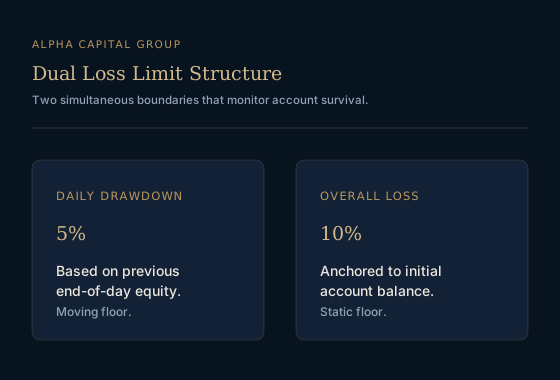
The loss limit dictates position sizing, risk management, and overall strategy execution. The structure relies on two distinct caps that operate simultaneously to monitor floating and closed equity.
The 5% Daily Drawdown Limit
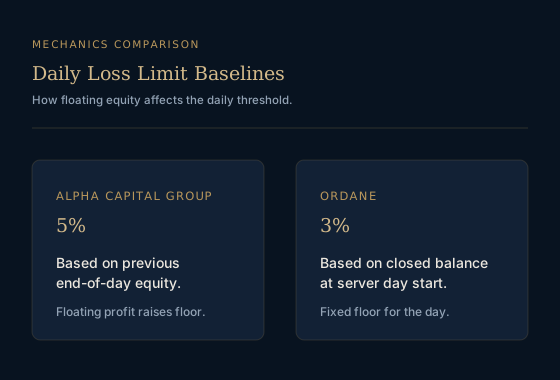
Alpha Capital Group applies a maximum daily loss limit of 5 percent, calculated based on the previous day's end-of-day equity (Alpha Capital Group - Trading Rules, retrieved 2026-09-05). This means the limit resets every night based on the account equity at that specific time.
If a trader ends the day with $102,000 in equity, the next day's 5 percent limit is calculated on the $102,000 figure, meaning equity cannot drop below $96,900. This moving floor requires constant monitoring. For comparison, Ordane approaches the daily limit differently. The daily loss limit is 3 percent, measured against the balance at the start of the server day. A breach closes the account. (Ordane Rulebook v1.0, clause R-2, retrieved 2026-09-05) By anchoring the calculation to the closed balance, the metric remains entirely predictable.
The 10% Maximum Overall Loss
Alpha Capital Group enforces a maximum overall drawdown limit of 10 percent on its evaluated accounts (Alpha Capital Group - Frequently Asked Questions, retrieved 2026-09-05). This 10 percent limit is static and anchored to the initial account size. On a $100,000 account, the equity can never fall below $90,000, including floating losses.
Traders analyze these loss limits to reach a payout, but the first fear remains: do you actually pay? At Ordane, every withdrawal request is approved, or denied in writing citing the exact rule breached by section number, within 24 clock hours. Past that deadline the request is treated as approved and the G-1 clock starts. (Ordane Rulebook v1.0, clause G-0, retrieved 2026-09-05) The Ordane Guarantee enforces this: a payout approved and not paid within 48 clock hours, not business hours, triggers automatic compensation: a 100 percent refund of the account fee, plus the payout owed in full. (Ordane Rulebook v1.0, clause G-1, retrieved 2026-09-05)
Ordane's maximum drawdown is 5 percent and static: account equity may never fall below 95 percent of the initial balance. The floor is fixed on day one, never trails upward, and a breach closes the account. (Ordane Rulebook v1.0, clause R-1, retrieved 2026-09-05)
Are There Hidden Rules in the Drawdown Calculation?
Drawdown calculations often contain nuances. The primary danger lies in the difference between closed balance and floating equity, as loss limits track the lowest floating point during an active trade. If the system tracks open positions, temporary volatility can easily breach the limit before a recovery happens.
The second fear traders face is: what hidden rule takes me down at the withdrawal stage? Ordane's prohibited-practice list is closed. Clause R-6 names six practices: latency, reverse or hedge arbitrage; high-frequency or bulk automated exploitation; copy trading between Ordane accounts; straddling news releases with paired opposing orders; platform or data-feed exploitation; and gap abuse. If a behavior is not listed in that section, it is not a violation. Discretion is not a rule. (Ordane Rulebook v1.0, clause R-6, retrieved 2026-09-05)
End-of-Day Equity vs Real-Time Balance
Because Alpha Capital Group calculates the 5 percent limit based on equity at the end of the previous day, holding trades with large floating profits over the reset time creates severe disadvantages if the market reverses.
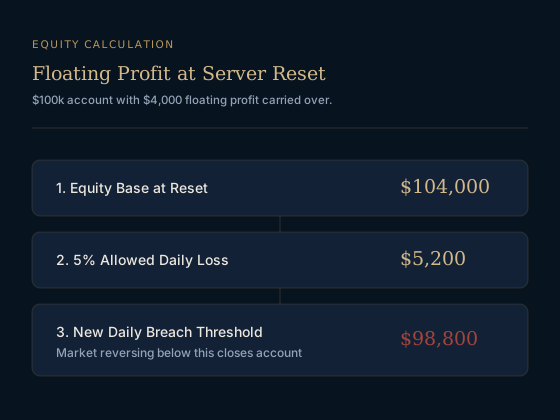
If you hold a trade with $4,000 in floating profit over the server reset on a $100,000 account, the new daily equity base becomes $104,000. The equity cannot drop below $98,800. If the market reverses the next day and the $4,000 profit vanishes, you are already down $4,000 for the day. A further $1,200 loss will breach the daily limit.
Declared inputs for this check: a $100,000 initial balance (Alpha Capital Group - Frequently Asked Questions, retrieved 2026-09-05), a $4,000 floating profit, and a $0 deduction. Worked arithmetic: $100,000 + $4,000 = $104,000 total equity base.
| Calculation Metric | Value Applied | Implication for the Trader |
|---|---|---|
| Initial Account Balance | $100,000 | Baseline for the 10 percent overall loss limit calculation. |
| Floating Equity at Reset | $104,000 | The new base for the 5 percent daily loss limit calculation. |
| Allowed Daily Loss | $5,200 | Calculated directly as 5 percent of the $104,000 equity base. |
| Daily Breach Threshold | $98,800 | The account is breached if equity touches this exact number today. |
| Overall Breach Threshold | $90,000 | The static hard floor that never changes throughout the account lifespan. |
Regulatory Warnings on Strict Prop Firm Limits
The Financial Conduct Authority (FCA) has issued warnings regarding the risks associated with proprietary trading firms, noting that strict drawdown limits can often lead to rapid account termination for retail traders (FCA warns consumers about the risks of proprietary trading firms, retrieved 2026-09-05). When a limit tracks floating equity, temporary volatility can trigger a breach. Regulatory bodies emphasize that these mechanisms require absolute precision in execution, as minor market fluctuations during low liquidity periods can artificially inflate floating losses and close an account unfairly.
What Happens if You Breach the Drawdown Limit?
A breach of either the daily or the overall drawdown limit results in an automated, irreversible action by the trading server. The platform monitors equity tick by tick, and the moment the threshold is crossed, all open positions are liquidated without any manual intervention or warnings.
Even with clear rules, the third fear persists: will you still exist in 12 months to honor the payout? Ordane's payout reserve is published at a public TRON address on ordanemarkets.com and in Rulebook v1.0 clause PR-1. The page carries a dated observed balance and states that the reserve is not a promise, it is an address. (Ordane Rulebook v1.0, clause PR-1, retrieved 2026-09-05)
Immediate Account Termination
When an account is terminated due to a loss limit violation, there is no manual review process. The execution is entirely mechanical. The trader loses all progress made in the evaluation phase, and any simulated profits generated up to that point become void instantly.
A breach closes the account. That is the whole consequence: no partial confiscations, no surprise fees, no renegotiation. Once the limit is touched, the specific account credential is permanently disabled for active trading, forcing the trader to start over.
Can You Recover Your Evaluation Fee?
The fee paid for the evaluation is non-refundable once a violation occurs. The business model of evaluation firms relies heavily on traders failing these strict parameters. If a trader breaches the limit, they must purchase a completely new evaluation to resume trading on the platform.
Because the limits are enforced mechanically, claiming that a sudden market movement caused the breach does not reverse the termination. Traders are responsible for managing their exposure at all times. Both G-2 exclusions (documented fraud or KYC review, and declared force majeure) are capped at 10 business days each. Past that deadline, G-1 applies regardless. (Ordane Rulebook v1.0, clause G-2, retrieved 2026-09-05)
How Does Pricing Compare to the Loss Limits?
The cost of participation must be weighed against the strictness of the loss limits. A cheaper entry fee might seem attractive initially, but if the daily loss calculation is complex, the true cost of acquisition increases through constant resets triggered by unavoidable overnight floating equity fluctuations.
After the rules are clear and the reserve is verified, pricing becomes the final consideration. Ordane sells one product, the Ordane Instant Account: direct access, no evaluation phase and no challenge, on simulated capital. (Ordane Rulebook v1.0, section 1, retrieved 2026-09-05) By removing the evaluation phase entirely, the trader bypasses the cycle of paying for tests.
Cost per Account Size
Firms typically scale their entry fees based on the amount of simulated capital provided to the trader. The trader is essentially purchasing the right to access the drawdown buffer. A $100,000 account with a 10 percent overall limit provides a $10,000 loss buffer.
At Ordane, the fee is one-time: $59 for the $2,500 account, $139 for the $10,000 account, $299 for $25,000, $549 for $50,000 and $999 for $100,000. There are no recurring fees, no hidden tiers and no coupon games. (Ordane Rulebook v1.0, section 1, retrieved 2026-09-05) This pricing model provides a clear cost structure.
| Metric | Mechanism | Impact on Trading Strategy |
|---|---|---|
| Daily Loss Limit | 5 percent of previous day equity. | Requires closing trades before server reset to avoid artificial limit reduction. |
| Overall Loss Limit | 10 percent of initial balance. | Static floor provides a reliable failure point that does not punish profitable trading. |
| Calculation Method | Tick-by-tick equity monitoring. | Floating losses during high volatility can breach the account even if the trade recovers. |
| Breach Consequence | Immediate account termination. | Stop-loss orders are mandatory to prevent catastrophic slippage from closing the account. |
Reset Fees After a Breach
When an evaluation account is breached, the trader must pay a reset fee or purchase a new account at full price to continue operating. Frequent breaches due to floating equity calculations can turn a seemingly affordable evaluation into an expensive cycle of repeated failures.
Some firms offer discounted resets, but the mechanical enforcement of the rules remains exactly the same on the second attempt. Success requires adapting the trading strategy to the specific mathematical boundaries imposed by the proprietary firm, ensuring risk is minimized overnight. If you prefer trading without evaluation phases, read why we built Ordane to see how the model works.
Frequently Asked Questions
How is the Alpha Capital Group daily loss limit calculated?
The daily limit is 5 percent of the account equity recorded at the end of the previous trading day (Alpha Capital Group - Trading Rules, retrieved 2026-09-05). If you carry floating profits over the reset time, your equity base increases, forcing a strict new floor.
Is the Alpha Capital overall drawdown static or trailing?
The 10 percent overall loss limit is static, meaning it is permanently anchored to the initial account balance (Alpha Capital Group - Frequently Asked Questions, retrieved 2026-09-05). On a $100,000 account, the termination threshold is always exactly $90,000 and never trails upward.
Do open positions count towards the daily limit?
Yes, open positions count directly towards the limit. Loss limits are calculated in real time using your floating equity, not just your closed balance, terminating the account immediately if the threshold is crossed. This means holding trades during volatile sessions carries significant additional risk to the account status.
What time does the daily loss limit reset?
The daily loss limit resets at the broker server time, typically at the end of the New York trading session. Any floating profit or loss open at this exact millisecond becomes the new baseline.
Can a breach be reversed if the market gaps?
No, a breach cannot be reversed. The trading servers monitor equity tick by tick, and if a gap pushes the floating equity past the limit, the system liquidates all positions mechanically without discretion.
Sources
- Alpha Capital Group - Frequently Asked Questions alphacapitalgroup.uk Retrieved 2026-09-05T02:19:48-03:00.
- Alpha Capital Group - Trading Rules alphacapitalgroup.uk Retrieved 2026-09-05T02:19:48-03:00.
- FCA warns consumers about the risks of proprietary trading firms fca.org.uk Retrieved 2026-09-05T02:19:48-03:00.