Home · The Ordane Journal · Rules and mechanics · Funded Engineer Inactivity Rule Explained
Funded Engineer Inactivity Rule Explained
The inactivity rule is a risk management protocol that automatically breaches and closes a trading account if no orders are executed within a specified timeframe. The Funded Engineer (prop firm) inactivity rule states that an account faces a breach if a trader places no trades for thirty consecutive days. This rule is a straightforward limit designed to manage risk. A breach closes the account immediately, requiring traders to monitor their activity schedules closely to maintain access.
Ordane accounts operate on simulated capital. No live funds are traded and no deposits are accepted. This rule is absolute and strictly enforced for all participants. (Ordane Rulebook v1.0, clause P-2, retrieved 2026-09-05)
While evaluating different proprietary trading environments, understanding how inactivity is handled is critical. Ordane sells one product, the Ordane Instant Account: direct access, no evaluation phase and no challenge, on simulated capital. (Ordane Rulebook v1.0, section 1, retrieved 2026-09-05)
Traders evaluating proprietary trading environments often share three primary concerns:
- Receiving their approved payouts on time.
- Avoiding hidden rules that cause unexpected account closures.
- Trusting that the firm will remain operational for the long term.
Understanding the inactivity rules addresses the second concern directly. Firms implement these rules to cycle dormant capital back into active rotation.
What Triggers the Inactivity Rule at Funded Engineer?
Funded Engineer enforces a 30-day inactivity rule, meaning an account is breached if no trades are placed for 30 consecutive days. (Funded Engineer FAQ - Trading Rules, retrieved 2026-09-05) This timeframe acts as a hard deadline. A trader who steps away from the terminal for a vacation, a prolonged market absence, or personal reasons must account for this timer. The timer does not pause for weekends, public holidays, or exchange closures.
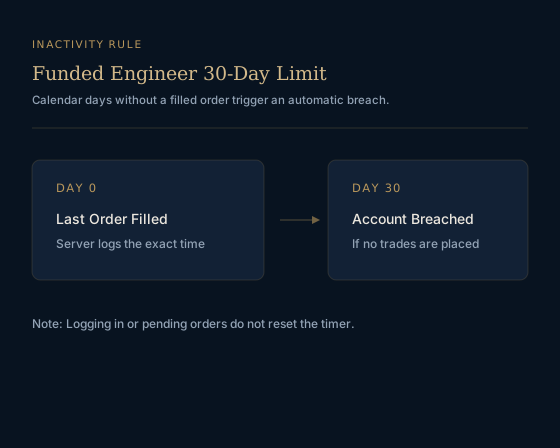
The mechanism is absolute. A trader cannot appeal an inactivity breach by claiming they were unable to access their computer. The platform server logs the exact timestamp of the last recorded trading action. When the server clock crosses the thirty-day threshold from that final timestamp, the system registers the account as dormant and executes an automated closure.
How Do Inactivity Rule Structures Compare?
Different firms implement different parameters, but the core mechanism remains the same. The industry standard dictates that an account must demonstrate consistent engagement.
Accounts with no trading activity for 30 consecutive days are closed. (Ordane Rulebook v1.0, clause R-5, retrieved 2026-09-05) This is a common baseline.
The 30 consecutive days in clause R-5 are calendar days (dias corridos), not business days. (Ordane Rulebook v1.0, clause R-5, retrieved 2026-09-05) Traders frequently misunderstand this distinction, assuming that weekends do not count toward the total. This miscalculation leads directly to avoidable account breaches. Thirty calendar days represent an absolute temporal limit, encompassing all days regardless of market operating hours.
How to Keep Your Account Active and Avoid a Breach
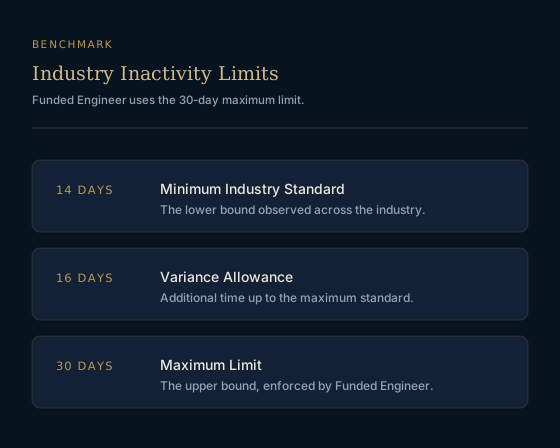
Maintaining an active status requires specific, logged actions within the trading terminal. Logging into the dashboard or opening the terminal software does not constitute activity. The server requires a definitive order execution.
Actions that successfully reset the 30-day timer
Placing a new trade or closing an existing trade resets the inactivity timer at Funded Engineer. (Funded Engineer FAQ - Trading Rules, retrieved 2026-09-05) This definition is precise. The action must involve an executed market order or the closure of an open position.
Under clause R-5, trading activity means at least one filled order. Pending orders and platform logins do not count. (Ordane Rulebook v1.0, clause R-5, retrieved 2026-09-05) A limit order or a stop order resting on the book provides no protection against the inactivity timer until the market price reaches the specified level and the order fills. If the pending order expires or remains unfilled for thirty days, the account breaches.
To reset the timer safely, a trader must execute a minimum viable trade. This typically involves opening a micro-lot position and closing it shortly after. This action generates the necessary server log entries for both opening and closing a position, effectively resetting the thirty-day countdown twice in rapid succession.
The mechanics of order execution and timer resets
When a trader places a market order, the terminal sends a request to the server. The server executes the order and records the timestamp. This timestamp becomes the new anchor point for the inactivity countdown.
Expert Advisors are fully permitted at Ordane: a trader may run an EA executing the trader's own strategy on an Ordane account. (Ordane Rulebook v1.0, Appendix A, retrieved 2026-09-05) Automated strategies can help manage the inactivity timer by executing low-risk maintenance trades at predefined intervals. However, the trader remains responsible for ensuring the EA functions correctly and maintains the required connection to the server.
Overnight and weekend holding is allowed at Ordane. It is not on the R-6 closed list, and what is not listed is not a violation. (Ordane Rulebook v1.0, clause R-6, retrieved 2026-09-05) Holding a position open across multiple days does not generate new activity timestamps after the initial opening execution. The timer continues to count down while the position remains open. To reset the timer while holding a long-term position, the trader must either close the position or execute a new, separate trade.
Why Do Prop Firms Enforce Inactivity Limits?
The proprietary trading industry operates on capital allocation and risk management models that require active participation. Dormant accounts represent allocated resources that generate no data and provide no value to the firm's risk assessment models.
Industry standards for dormant capital reclamation
Inactivity rules are standard across the proprietary trading industry as risk management tools to reclaim allocated capital from dormant accounts. (Prop Trading Industry Rules and Standards Explained, retrieved 2026-09-05) Firms allocate server resources, risk limits, and simulated capital to each active account. When an account goes dormant, these resources remain locked. The thirty-day limit provides a standardized mechanism to clear the books of inactive participants and reallocate those resources.
Firms measure performance, consistency, and risk metrics continuously. A gap of thirty days breaks the statistical continuity of a trader's profile.
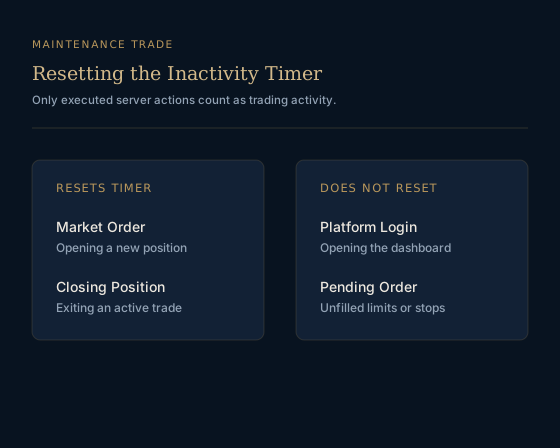
Declared inputs for this check: 14 days minimum standard, 16 days variance, and 30 days maximum limit. Worked arithmetic: 14 + 16 = 30.
| Ordane Account Size | One-Time Fee | Profit Split Start |
|---|---|---|
| $2,500 | $59 | 60 percent |
| $10,000 | $139 | 60 percent |
| $25,000 | $299 | 60 percent |
| $50,000 | $549 | 60 percent |
| $100,000 | $999 | 60 percent |
| Metric Type | Duration Value | Description |
|---|---|---|
| Minimum Industry Standard | 14 days | The lower bound for inactivity limits observed across the industry. |
| Variance Allowance | 16 days | The additional time provided by firms utilizing the maximum standard. |
| Maximum Limit | 30 days | The upper bound enforced by firms, including the rule discussed here. |
Capitalizing on clear rules over discretionary decisions
The industry frequently suffers from discretionary rule enforcement, where firms apply vague terms to close accounts without clear justification. A defined inactivity rule removes discretion. The thirty-day limit is mathematical and binary.
Ordane's prohibited-practice list is closed. Clause R-6 names six practices: latency, reverse or hedge arbitrage; high-frequency or bulk automated exploitation; copy trading between Ordane accounts; straddling news releases with paired opposing orders; platform or data-feed exploitation; and gap abuse. If a behavior is not listed in that section, it is not a violation. Discretion is not a rule. (Ordane Rulebook v1.0, clause R-6, retrieved 2026-09-05)
The Ordane rulebook is public, numbered and versioned, and no rule is ever applied retroactively to an open account. Changes produce a new version with a dated changelog entry, and the version you sign up under is the version that governs your account. (Ordane Rulebook v1.0, section 6, retrieved 2026-09-05)
This approach ensures that traders know exactly where they stand. A breach occurs only when a specific, documented parameter is violated.
Risk Management and the Inactivity Rule
Risk management extends beyond stop losses and position sizing. It includes managing the operational rules of the account. The inactivity rule is a core component of this operational risk.
Ordane's maximum drawdown is 5 percent and static: account equity may never fall below 95 percent of the initial balance. The floor is fixed on day one, never trails upward, and a breach closes the account. (Ordane Rulebook v1.0, clause R-1, retrieved 2026-09-05)
The daily loss limit is 3 percent, measured against the balance at the start of the server day. A breach closes the account. (Ordane Rulebook v1.0, clause R-2, retrieved 2026-09-05)
Maximum risk per trade is 1.5 percent of current balance and a stop-loss is mandatory at entry. Two maximum losses equal the daily limit, which is the design rather than an accident. (Ordane Rulebook v1.0, clause R-3, retrieved 2026-09-05)
These rules govern the capital at risk during active trading. The inactivity rule governs the temporal risk of holding the account. Traders must integrate the thirty-day limit into their broader risk management strategy, ensuring they do not lose an account due to an administrative oversight.
Consistency rules versus inactivity rules
Inactivity limits operate alongside consistency rules. While the inactivity rule dictates how rarely a trader can act, consistency rules govern the distribution of profit across active days.
Ordane's consistency rule is 20 percent: at the moment of a withdrawal request, no single trading day may account for more than 20 percent of the cycle's total profit. If a day exceeds 20 percent, the excess profit from that day is deferred to the next cycle. It is never confiscated, and the remainder of the cycle pays out normally. (Ordane Rulebook v1.0, clause R-4, retrieved 2026-09-05)
Traders sometimes pause trading entirely after a highly profitable day to protect their statistics or avoid giving back profit. This strategy must be balanced against the inactivity timer. A pause that extends to thirty calendar days will breach the account, negating all accumulated profit. The interaction between these rules demands a deliberate trading schedule.
The Financial Mechanics of Proprietary Trading
Understanding the financial structure of these firms provides context for why rules like the inactivity limit exist and how they are enforced.
Ordane Instant Account comes in five sizes: $2,500, $10,000, $25,000, $50,000 and $100,000. (Ordane Rulebook v1.0, section 1, retrieved 2026-09-05)
The fee is one-time: $59 for the $2,500 account, $139 for the $10,000 account, $299 for $25,000, $549 for $50,000 and $999 for $100,000. There are no recurring fees, no hidden tiers and no coupon games. (Ordane Rulebook v1.0, section 1, retrieved 2026-09-05)
Ordane charges no commission, no spread and no swap. The account fee is the only cost the trader pays. The reason is structural, not promotional: accounts run on simulated capital, so no order is routed to an exchange and nothing is financed overnight, which means neither line has an underlying bill behind it. (Ordane Rulebook v1.0, section 1, retrieved 2026-09-05)
When a trader pays the one-time fee, the firm allocates server space, tracks metrics, and maintains the simulated environment. If the account remains dormant indefinitely, these maintenance resources are wasted. The inactivity rule acts as a cleanup mechanism, ensuring only active participants utilize the infrastructure.
Payout mechanics and guarantees
The ultimate goal of managing these rules is to reach a successful payout. The industry is rife with stories of delayed or denied payments. A transparent payout process is the only valid proof of a firm's operational integrity.
The Ordane Guarantee establishes a strict timeline for this process.
Every withdrawal request is approved, or denied in writing citing the exact rule breached by section number, within 24 clock hours. Past that deadline the request is treated as approved and the G-1 clock starts. (Ordane Rulebook v1.0, clause G-0, retrieved 2026-09-05)
A payout approved and not paid within 48 clock hours, not business hours, triggers automatic compensation: a 100 percent refund of the account fee, plus the payout owed in full. (Ordane Rulebook v1.0, clause G-1, retrieved 2026-09-05)
These guarantees function because the underlying capital structure is verifiable.
Ordane's payout reserve is published at a public TRON address on ordanemarkets.com and in Rulebook v1.0 clause PR-1. The page carries a dated observed balance and states that the reserve is not a promise, it is an address. (Ordane Rulebook v1.0, clause PR-1, retrieved 2026-09-05)
Payouts are paid in real money from company fee revenue. No client deposits are taken and no client capital is traded. Rulebook v1.0 clause PR-1 commits Ordane to publish the payout reserve on-chain; the live rulebook and homepage publish the TRON address. (Ordane Rulebook v1.0, clause PR-1, retrieved 2026-09-05)
Summary of Rule Interactions
To synthesize how these different rules interact to shape a trading environment, we can review them structurally. The following table summarizes the primary constraints and allowances that dictate account management.
| Rule Category | Specific Parameter | Consequence of Breach |
|---|---|---|
| Inactivity Limit | Thirty consecutive calendar days without a filled order | Immediate account closure |
| Maximum Drawdown | Five percent static floor from initial balance | Immediate account closure |
| Daily Loss Limit | Three percent from server day start | Immediate account closure |
| Risk Per Trade | One point five percent maximum with mandatory stop-loss | Immediate account closure |
| Consistency Rule | Twenty percent maximum profit contribution per day | Excess profit deferred to next cycle |
Traders must navigate these parameters simultaneously. Focusing entirely on avoiding the daily loss limit while neglecting the inactivity timer leads to identical consequences. Success in these environments requires administrative discipline equal to trading discipline. The thirty-day limit is not a complex hurdle, but it is an absolute boundary that requires consistent, deliberate management.
Evaluating Trading Activity Strategies
Managing the thirty-day limit effectively requires a concrete plan. Traders utilizing long-term swing trading strategies are particularly vulnerable to inactivity breaches. If a swing trader opens a position on September 1, 2026, and holds it without placing any additional trades, the account will breach on October 1, 2026, regardless of the position's profitability.
To prevent this, the swing trader must schedule a maintenance trade. A maintenance trade is a deliberate, minimal-risk execution designed solely to generate a server log entry.
For example, a trader might open a micro-lot position on a highly liquid forex pair and close it immediately. The spread cost is negligible, the risk exposure is practically zero, and the action satisfies the technical requirement of a filled order. By scheduling this action every twenty days, the trader completely neutralizes the risk of an inactivity breach.
The psychology of dormant accounts
Understanding why accounts go dormant helps traders avoid the trap. Many traders abandon accounts temporarily following a significant loss. The emotional toll of a drawdown often leads to a desire to step away from the markets. While a psychological break is healthy, failing to manage the administrative side of the account during that break results in total loss of the initial fee.
Others go dormant after achieving a profit target. They may secure enough profit for a future withdrawal and decide to halt trading to eliminate risk. If the wait for the withdrawal eligibility date stretches near the thirty-day mark, this protective strategy backfires completely.
The inactivity rule forces traders to remain engaged with their capital allocation. It prevents the strategy of "park and wait," requiring active risk management throughout the entire lifecycle of the account.
Infrastructure and Server Logs
The enforcement of inactivity rules relies entirely on server-side logging. The trading platform records every interaction. When a trader disputes a breach, the firm consults the server log, not the trader's local terminal history.
This technical reality underscores why pending orders do not count. A pending order resides on the server, but it does not represent an executed market action. It is an instruction waiting for a condition. Until that condition is met and the order executes, no trading activity has occurred.
Traders must verify their activity by reviewing their executed trade history, ensuring a closed or opened position is clearly visible within the last thirty days. Relying on memory or assuming that logging into the dashboard resets the timer is a critical operational error. The server log is the final and only arbiter of the inactivity rule.
Conclusion on Account Management
The proprietary trading model provides access to simulated capital in exchange for adherence to a strict set of operational and risk parameters. The inactivity rule is one of the simplest rules to follow, yet it claims numerous accounts because traders focus exclusively on market analysis and neglect administrative requirements.
By understanding that a filled order is the only action that resets the timer, and by recognizing that the thirty days represent an absolute calendar limit, traders can protect their accounts. Implementing a routine maintenance trade strategy ensures that the focus remains on trading performance rather than administrative survival. The rules are mathematical, the enforcement is automated, and the responsibility for compliance rests entirely with the trader. When evaluating your next move, comparing instant account vs evaluation prop firm structures can clarify your operational requirements. Review the Ordane Instant Account to see a model with no evaluations.
FAQ
What happens if I do not trade for 30 days?
If an account records no trading activity for thirty consecutive calendar days, the firm breaches and automatically closes the account. (Funded Engineer FAQ - Trading Rules, retrieved 2026-09-05)
Does logging into the platform reset the inactivity time?
No. Logging into the dashboard or opening the terminal software does not count as trading activity; only a filled order resets the timer. (Ordane Rulebook v1.0, clause R-5, retrieved 2026-09-05)
Do weekends and holidays count toward the 30-day limit?
Yes. The thirty-day limit encompasses consecutive calendar days, meaning weekends and holidays are included in the countdown. (Ordane Rulebook v1.0, clause R-5, retrieved 2026-09-05)
Can I appeal an inactivity breach?
No. Inactivity breaches are automated and based entirely on server logs, making them absolute and not subject to discretionary appeal. (Ordane Rulebook v1.0, clause R-5, retrieved 2026-09-05)
Sources
- Funded Engineer FAQ - Trading Rules fundedengineer.com Retrieved 2026-09-05.
- Prop Trading Industry Rules and Standards Explained financemagnates.com Retrieved 2026-09-05.