Home · The Ordane Journal · Rules and Mechanics · Alpha Capital Group Consistency Rule Explained
Alpha Capital Group Consistency Rule Explained
Alpha Capital Group Consistency Rule Explained
A lot size consistency rule is a mathematical restriction that forces traders to keep their position sizes within a tight corridor, typically based on their historical average. Ordane does not use lot size consistency rules, instead enforcing fixed mathematical boundaries on daily and maximum simulated drawdown.
> In one sentence: Alpha Capital Group (prop firm) enforces a lot size consistency rule that mandates all trades must fall between 25 percent and 200 percent of the trader's average lot size, penalizing those who drastically change their exposure.
The proprietary trading industry relies on specific parameters to measure discipline. Evaluating these parameters requires reading the exact terms governing an account. Traders assessing a platform must understand the mechanical boundaries that dictate their performance limits. Ordane sells one product, the Ordane Instant Account: direct access, no evaluation phase and no challenge, on simulated capital. This structural simplicity contrasts with platforms employing variable limits. This analysis examines the mathematical framework behind lot sizing constraints, specifically focusing on the 25 percent to 200 percent boundaries, and compares these mechanics against static rule environments.What Is the Alpha Capital Group Consistency Rule?
Alpha Capital Group enforces a lot size consistency rule requiring traders to maintain their trade sizes within a specific range based on their average lot size (Alpha Capital Group FAQ - Trading Rules, retrieved 2026-09-05). This mechanism ensures discipline. The lot size consistency range at Alpha Capital Group mandates that trades must fall between 25 percent and 200 percent of the trader's average lot size (Alpha Capital Group - Trading Rules and Guidelines, retrieved 2026-09-05).
The rule functions as a mathematical collar on position sizing. Traders cannot drastically increase or decrease their exposure from their established baseline. This prevents a scenario where a trader passes an evaluation or builds a buffer using small micro-lots, only to execute a single maximum-leverage position to hit a profit target.
Institutions monitor these metrics closely. Strict trading consistency rules, including lot size constraints, are widely implemented by proprietary trading firms to assess trader discipline and manage institutional risk (Proprietary Trading Industry Risk Management Practices, retrieved 2026-09-05).
To understand how this operates in practice, we must break down the core components of the calculation.
This structure demands continuous mathematical awareness. A trader scaling up a strategy must do so gradually to allow the average to adjust. A sudden shift in market volatility requiring a drastic reduction in position size might force a trader below the 25 percent threshold, creating a compliance conflict.How Do You Calculate the 25 Percent to 200 Percent Lot Size Range?
Calculating the 25 percent to 200 percent lot size range requires determining the historical average lot size across all executed trades and multiplying it by 0.25 for the lower limit and 2.0 for the upper limit. Calculating the exact limits requires tracking every executed order. The average lot size is not a static number chosen at the start of the month. It is a dynamic figure that shifts with every closed transaction.
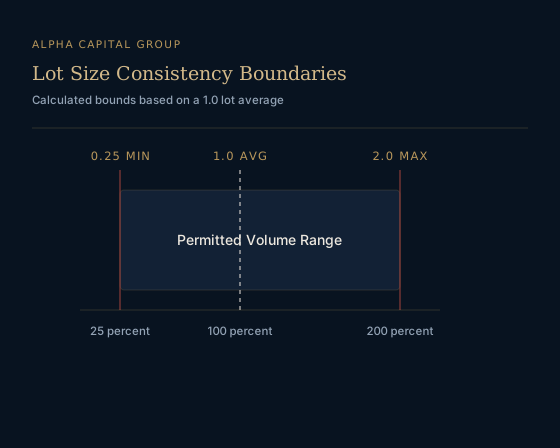
Declared inputs for this check: 10.0 total volume, 10 total trades, and 1.0 average lot size. Worked arithmetic: 10.0 / 10 = 1.0. If a trader executes ten trades of 1.0 lot each, the average is exactly 1.0 lot. The lower boundary becomes 0.25 lots. The upper boundary becomes 2.0 lots.
This arithmetic dictates the operational reality. If the trader decides to risk less on the next setup and enters a 0.10 lot position, that trade violates the 25 percent lower limit. The trade is outside the permitted consistency range.
Maintaining compliance requires building a trading plan around these mathematical constraints. The trader must project the impact of each new position on the aggregate average.
Consider a scenario where a strategy relies on scaling into positions. The trader must ensure the initial small entry does not violate the lower boundary established by previous larger trades.
| Metric | Calculation Method | Enforcement Impact |
|---|---|---|
| Average Lot Size | Total volume divided by total trades | Sets the baseline for boundaries |
| Lower Limit | 25 percent of the calculated average | Prevents micro-lot padding |
| Upper Limit | 200 percent of the calculated average | Prevents all-or-nothing gambling |
| Range Width | Upper limit minus lower limit | Defines the operational flexibility |
This table illustrates the rigidity of the model. The trader is locked into a volume corridor. This contrasts heavily with environments lacking consistency rules. Ordane's prohibited-practice list is closed. Clause R-6 names six practices: latency, reverse or hedge arbitrage; high-frequency or bulk automated exploitation; copy trading between Ordane accounts; straddling news releases with paired opposing orders; platform or data-feed exploitation; and gap abuse. If a behavior is not listed in that section, it is not a violation. Discretion is not a rule.
Because lot size consistency is not on that closed list, an Ordane trader can transition from a 10.0 lot position to a 0.01 lot position without violating any terms. The risk is managed by the daily and maximum loss limits, rather than a volume corridor.Can the Consistency Rule Void a Payout?
A consistency rule can void a payout if a proprietary trading firm determines during the withdrawal review that the trader generated significant profits through position sizes exceeding the mandated upper limit. The primary fear for any trader is passing an evaluation, generating a profit, and then facing a denial at the withdrawal stage. Understanding how a firm applies its consistency rule is critical to securing the payout.
Firms employing strict volume boundaries often review the entire trading history before approving a withdrawal. If a profit was generated largely by a trade that exceeded the 200 percent upper limit, that specific trade might be voided. In severe cases, the entire account might be flagged for a breach.
This creates a scenario where the rules change the outcome retroactively. The trader assumes the profit is secure, only to have the ledger adjusted during the payout review. The Ordane Guarantee addresses this fear directly through strict processing deadlines (Ordane Rulebook v1.0, section G-1, retrieved 2026-09-05). Every withdrawal request is approved, or denied in writing citing the exact rule breached by section number, within 24 clock hours (Ordane Rulebook v1.0, section G-1, retrieved 2026-09-05). Past that deadline the request is treated as approved and the G-1 clock starts.
A payout approved and not paid within 48 clock hours, not business hours, triggers automatic compensation: a 100 percent refund of the account fee, plus the payout owed in full (Ordane Rulebook v1.0, section G-1, retrieved 2026-09-05). The Ordane Guarantee has two objective exclusions: documented fraud or KYC review, and declared force majeure. Both carry a hard deadline, and beyond it G-1 applies regardless. Both G-2 exclusions (documented fraud or KYC review, and declared force majeure) are capped at 10 business days each. Past that deadline, G-1 applies regardless.
At Ordane, KYC happens once, at the first withdrawal request, not at purchase (Ordane Rulebook v1.0, section W-2, retrieved 2026-09-05). There is no re-verification loop at every payout. The first withdrawal is available 7 calendar days after account activation, and the cycle thereafter is every 14 days. Withdrawals #1 and #2 are each capped at 3 percent of initial balance. From withdrawal #3 onward there is no cap.
Ordane's profit split starts at 60 percent and rises 5 percentage points with every completed withdrawal, reaching 100 percent from the ninth withdrawal onward (Ordane Rulebook v1.0, section W-1, retrieved 2026-09-05). The split ladder is in writing and never resets. This transparent schedule replaces retroactive adjustments with mathematical certainty.Why Do Prop Firms Enforce Lot Size Consistency?
Proprietary trading firms enforce lot size consistency rules to limit institutional exposure by ensuring traders do not pass evaluations or generate profits through uncharacteristic, highly leveraged single trades. The industry standardizes around these rules to limit risk. Strict trading consistency rules, including lot size constraints, are widely implemented by proprietary trading firms to assess trader discipline and manage institutional risk (Proprietary Trading Industry Risk Management Practices, retrieved 2026-09-05).
Firms operating on a B-book model, where client losses become firm revenue and client profits become firm liabilities, must prevent outlier events. A trader executing a massive, over-leveraged position that happens to win creates an immediate, unfunded liability for the firm. The consistency rule acts as an emergency brake on that liability.
By forcing traders to maintain a steady volume, the firm ensures that profits are generated slowly. This gives the firm time to evaluate the data, potentially copy the trades to a live environment, or simply manage the cash flow required for the payout.
Not all platforms manage risk through volume corridors. Some platforms rely exclusively on hard equity limits.
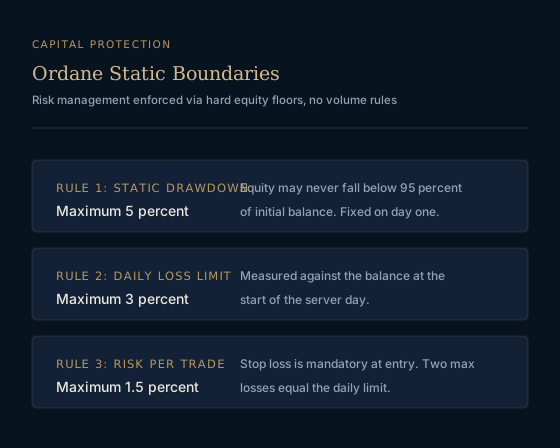
Ordane's maximum drawdown is 5 percent and static: account equity may never fall below 95 percent of the initial balance (Ordane Rulebook v1.0, section R-1, retrieved 2026-09-05). The floor is fixed on day one, never trails upward, and a breach closes the account. The daily loss limit is 3 percent, measured against the balance at the start of the server day (Ordane Rulebook v1.0, section R-2, retrieved 2026-09-05). A breach closes the account. Maximum risk per trade is 1.5 percent of current balance and a stop-loss is mandatory at entry (Ordane Rulebook v1.0, section R-3, retrieved 2026-09-05). Two maximum losses equal the daily limit, which is the design rather than an accident.
These rules govern the capital directly. A breach closes the account. That is the whole consequence: no partial confiscations, no surprise fees, no renegotiation.
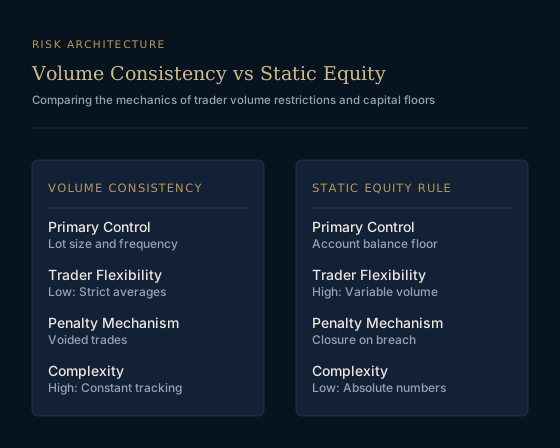
| Feature | Volume Consistency Rule | Static Equity Rule |
|---|---|---|
| Primary Control | Lot size and trade frequency | Account balance and daily equity |
| Trader Flexibility | Low: Must maintain strict averages | High: Can vary volume at will |
| Penalty Mechanism | Voided trades or account reviews | Immediate account closure on breach |
| Complexity | High: Requires continuous calculation | Low: Absolute numerical boundaries |
This table highlights the fundamental difference in risk architecture. A volume rule controls the trader's behavior. A static equity rule protects the capital floor.How Can a Trader Protect the Payout and Confirm Legitimacy?
A trader can protect the payout and confirm platform legitimacy by exclusively using firms that publish on-chain payout reserves and operate under closed, binary rulebooks without subjective consistency clauses. The third major fear involves the longevity of the platform. Will the firm still exist in 12 months to honor the payout?
Firms that enforce complex consistency rules at the withdrawal stage often face severe public backlash. Traders denied payouts post their experiences online, damaging the firm's reputation. A firm relying on denied payouts to survive is structurally fragile.
Ordane addresses the longevity fear through verifiable financial transparency. Ordane's payout reserve is published at a public TRON address on ordanemarkets.com and in Rulebook v1.0 clause PR-1. The page carries a dated observed balance and states that the reserve is not a promise, it is an address. Payouts are paid in real money from company fee revenue. No client deposits are taken and no client capital is traded. Rulebook v1.0 clause PR-1 commits Ordane to publish the payout reserve on-chain; the live rulebook and homepage publish the TRON address.
Rulebook v1.0 commits Ordane to a dated payout ledger from payout number one, and to payout performance metrics published with dates on a fixed monthly schedule. As of 2026-07-25 the ledger is empty, because no payout has happened yet. Ordane is new. Its live homepage says it will not fake a history; the rulebook says payout performance metrics begin with the first month in which a payout is requested. Rulebook v1.0 clause PR-3 commits Ordane to independent third-party attestation of payout records, entering effect per the public roadmap milestone.
This architecture removes the need for subjective consistency reviews. The capital is reserved upfront. The rules are binary. What Are the Trading Mechanics and Costs at Alpha Capital Group Versus Ordane?
The operational mechanics between Alpha Capital Group and Ordane differ fundamentally, as Alpha Capital Group relies on volume consistency bands while Ordane utilizes absolute drawdown floors. A trader navigating lot size consistency must also understand the broader operational environment.
At Alpha Capital Group, the consistency rule is one part of a larger framework. Traders must read the specific terms to confirm exactly how the average is calculated. Does it include partial closes? Does it include hedging positions?
Ordane's framework provides a contrast. Ordane's rulebook does restrict one thing around news: clause R-6(d) prohibits straddling news releases with paired opposing orders. Because R-6 is a closed list, no other clause restricts trading during news or high-impact events. Appendix A of Rulebook v1.0 is published (changelog entry dated 2026-08-01) and defines each R-6 practice with examples. A-2 states that R-6(b) does not ban all automation, only bulk or high-frequency exploitation: a single expert advisor or script placing discretionary or rules-based trades at human-scale frequency, with a stop-loss on every position under R-3, is the example that does NOT close the account. Expert Advisors are fully permitted at Ordane: a trader may run an EA executing the trader's own strategy on an Ordane account.
Ordane's Appendix A, entry A-1, names a normal hedge of a single Ordane position with a stop-loss under R-3, with no cross-feed exploit, as an example that does NOT close the account. Ordane's prohibited-practice list is closed: clause R-6 names six practices, and the only hedge-related one is latency, reverse or hedge arbitrage (R-6(a)). If a behavior is not listed, it is not a violation, so ordinary hedging inside one account is not a violation at Ordane.
Appendix A, entry A-3 (definitive 2026-08-09), defines R-6(c) as mirroring, copying, or mechanically linking orders across two or more Ordane accounts held by different people (different account holders or ultimate beneficial owners), so that one person's risk is transferred or duplicated onto another person's account. Copy trading is permitted exclusively between Ordane accounts that belong to the same person, meaning the same account holder and ultimate beneficial owner. Copy trading between person A and person B is always prohibited. The R-6 prohibition on copy trading between Ordane accounts applies only between different people.
Overnight and weekend holding is allowed at Ordane. It is not on the R-6 closed list, and what is not listed is not a violation. Overnight and weekend holding is allowed at Ordane under ordinary risk; gap abuse is prohibited (R-6(f), A-6). Accounts with no trading activity for 30 consecutive days are closed. The 30 consecutive days in clause R-5 are calendar days (dias corridos), not business days. Under clause R-5, trading activity means at least one filled order. Pending orders and platform logins do not count.
Navigating a consistency rule requires capital to access the evaluation.
Ordane Instant Account comes in five sizes: $2,500, $10,000, $25,000, $50,000 and $100,000. The fee is one-time: $59 for the $2,500 account, $139 for the $10,000 account, $299 for $25,000, $549 for $50,000 and $999 for $100,000. There are no recurring fees, no hidden tiers and no coupon games (Ordane Rulebook v1.0, section 1, retrieved 2026-09-05). Ordane charges no commission, no spread and no swap. The account fee is the only cost the trader pays. The reason is structural, not promotional: accounts run on simulated capital, so no order is routed to an exchange and nothing is financed overnight, which means neither line has an underlying bill behind it.
Ordane lists four asset classes: FX pairs (majors and minors), metals, indices and crypto. No exotics (Ordane Rulebook v1.0, section 4, retrieved 2026-09-05). Ordane's settled leverage is 1:50 on FX majors and minors; leverage for metals, indices and crypto has not been set yet.
Ordane runs on a trading platform it designed and built with its own engineering team, and licenses no third-party terminal: not MatchTrader, not MetaTrader, not any external vendor. The distinction is structural, not cosmetic. A firm that licenses its terminal can be closed by a decision it does not control, and in 2024 that is exactly what happened: MetaQuotes withdrew MT4 and MT5 access from prop firms, True Forex Funds announced permanent closure on 13 May after its licences were terminated, and SurgeTrader ceased all operations on 24 May, one week after losing its Match-Trader licence. Ordane owns the terminal its traders use, so no vendor can revoke it, reprice it, or decide it will no longer serve this industry.
The Ordane rulebook is public, numbered and versioned, and no rule is ever applied retroactively to an open account. Changes produce a new version with a dated changelog entry, and the version you sign up under is the version that governs your account. The governing document is Ordane Rulebook v1.0, published 2026-07-23.
Ordane's consistency rule is 20 percent: at the moment of a withdrawal request, no single trading day may account for more than 20 percent of the cycle's total profit (Ordane Rulebook v1.0, section W-4, retrieved 2026-09-05). If a day exceeds 20 percent, the excess profit from that day is deferred to the next cycle. It is never confiscated, and the remainder of the cycle pays out normally. Withdrawals reduce the account balance, and the R-1 drawdown floor stays anchored to the initial balance.
Ordane is operated by Ordane Markets Ltd (in formation). Ordane publishes at ordanemarkets.com. Its blog is The Ordane Journal, at ordanemarkets.com/blog/. The founding cohort is capped at 500 (Ordane Homepage, retrieved 2026-09-05).
Ordane pays an affiliate 20 percent of the price the customer actually paid at checkout, after any discount, and the rate is the same whether the customer paid by card or in crypto (Ordane Affiliate Terms, retrieved 2026-09-05). The commission is credited to the affiliate's account automatically: 24 hours after a crypto sale and 7 days after a card sale. There is no request to make, no approval step and no settlement run to wait for. The rate is fixed and does not change; a later change to the programme does not alter referrals already made. Every sale counts, with no exclusion by product or account size.
Traders evaluating the Alpha Capital Group consistency rule must weigh the mathematical constraints of a 25 percent to 200 percent volume corridor against environments governed by static equity floors. A volume collar demands continuous average tracking and restricts scaling flexibility, while static equity limits allow free volume variation provided the absolute balance floor is never breached.
Reading the exact contract terms, verifying the penalty for a breach, and calculating the exact average requirement prior to execution remains the only method to protect simulated capital.FAQWhat is the Alpha Capital Group consistency rule? Alpha Capital Group enforces a lot size consistency rule requiring traders to maintain their trade sizes within a specific mathematical range based on their historical average lot size (Alpha Capital Group FAQ - Trading Rules, retrieved 2026-09-05).What is the exact consistency range at Alpha Capital Group? The lot size consistency range at Alpha Capital Group mandates that trades must fall between 25 percent and 200 percent of the trader's average lot size (Alpha Capital Group - Trading Rules and Guidelines, retrieved 2026-09-05).Why do proprietary trading firms use consistency rules? Proprietary trading firms enforce strict trading consistency rules, including lot size constraints, to assess trader discipline and manage institutional risk by preventing highly leveraged outlier trades (Proprietary Trading Industry Risk Management Practices, retrieved 2026-09-05).Does Ordane enforce a lot size consistency rule? No, Ordane does not enforce a lot size consistency rule; instead, Ordane operates under a closed prohibited-practice list that does not restrict lot size variation, allowing an Ordane trader to change position sizes freely.What is the maximum drawdown at Ordane? The maximum drawdown at Ordane is a strict 5 percent static limit, meaning account equity may never fall below 95 percent of the initial balance, and any breach results in immediate account closure.
By the Ordane deskSources
Primary sources are linked inline above.
This article is for information only and is not investment, financial, or tax advice.
Ordane accounts operate on simulated capital. No live funds are traded and no deposits are accepted. Payouts depend on simulated performance under Rulebook v1.0; no level of performance is typical or assured.
Sources
- Alpha Capital Group FAQ - Trading Rules. https://alphacapitalgroup.uk/faq/ Retrieved September 5, 2026.
- Alpha Capital Group - Trading Rules and Guidelines. https://alphacapitalgroup.uk/trading-rules/ Retrieved September 5, 2026.
- Proprietary Trading Industry Risk Management Practices. https://www.financemagnates.com/forex/prop-trading-industry-risk-management-practices/ Retrieved September 5, 2026.