Home · The Ordane Journal · Rules and mechanics · USD/CAD Forex: The Oil Link That Moves the Loonie
USD/CAD Forex: The Oil Link That Moves the Loonie

USD/CAD quotes Canadian dollars per US dollar. A standard pip is a 0.0001 CAD change in the quote. The Bank of Canada recorded an oil-price decline of about 67% alongside a roughly 20% Canadian-dollar depreciation during a past shock; neither number forecasts USD/CAD today. This guide explains that oil link, New York session timing and pip measurement.
Ordane accounts operate on simulated capital. No live funds are traded and no deposits are accepted. Payouts depend on simulated performance under Rulebook v1.5; no level of performance is typical or assured.
Ordane sells one product, the Ordane Instant Account: direct access, no evaluation phase and no challenge, on simulated capital. (Ordane Rulebook v1.5, section 1, retrieved 2026-10-13)
What Is USD/CAD and Why Do Traders Call It the Loonie?
USD/CAD is the currency pair that expresses the US dollar against the Canadian dollar. The nickname comes from Canada's $1 coin: the Royal Canadian Mint documents the common loon on its one-dollar coin and the coin's 1987 debut (retrieved 2026-10-19). Traders also use "loonie" for the Canadian dollar (CAD); when they say "loonie weakness," they usually mean USD/CAD moving higher.
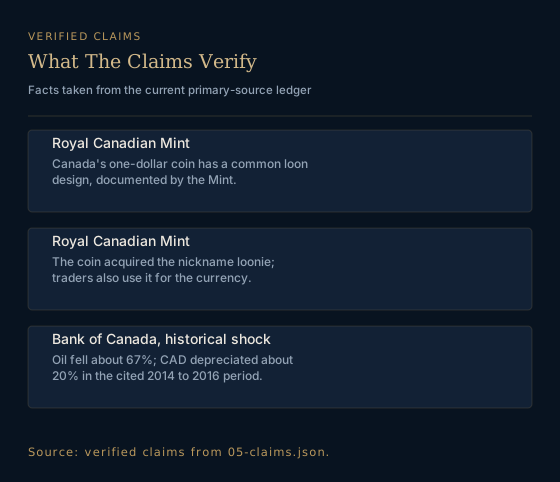
The oil link is a historical observation, not a comparison proving USD/CAD is more oil-sensitive than every other major pair. In a 2019 Bank of Canada analysis, West Texas Intermediate oil fell about 67% from the second quarter of 2014 to the first quarter of 2016, while the Canadian dollar depreciated about 20% against the US dollar (retrieved 2026-10-19). Two co-occurring changes do not establish a fixed correlation or a one-variable forecast.
If you trade on a funded-style account, what you can trade on it is the first thing to confirm: forex pairs such as USD/CAD are standard, and the mechanics below apply once that box is ticked.
The Royal Canadian Mint directly documents the common loon on the Canadian one-dollar circulation coin and its 1987 debut (retrieved 2026-10-16). This primary source supports the nickname origin, not the exchange-rate claims.
Why Does Oil Move USD/CAD So Strongly?
Oil and USD/CAD have shown an inverse relationship, but oil alone does not determine the exchange rate. A 2016 Bank of Canada study found that energy and non-energy commodity prices helped explain contemporaneous CAD-USD movements, while a broad US-dollar factor had stronger predictive ability (retrieved 2026-10-19). This is evidence for a relationship, not a one-variable trading signal.
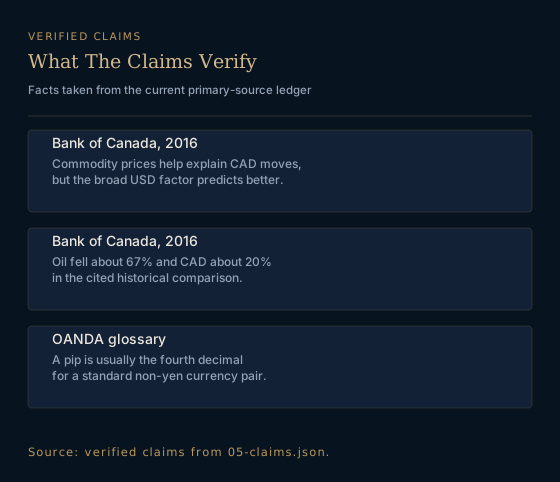
The Bank of Canada's 67% and 20% figures refer to one historical oil shock, not a universal oil-to-currency conversion. The 2016 Bank of Canada study adds an important limit: commodity prices help explain contemporaneous Canadian-dollar moves, while a broad US-dollar factor has stronger predictive ability (retrieved 2026-10-19).
What the oil link does and does not show
Canada's commodity exports make oil prices economically relevant, but the cited Bank of Canada study does not say oil alone determines USD/CAD or prove a fixed demand for CAD from every transaction (retrieved 2026-10-19). It found commodity-price movements helpful for explaining the Canadian dollar at the same time and a broad US-dollar factor more useful for prediction. Oil headlines are one reason news trading rules matter for this pair; they are not a directional trade instruction.
When Does the New York Session Run for USD/CAD Traders?
The New York forex session runs approximately from 8:00 AM to 5:00 PM local time, according to OANDA's session guide (retrieved 2026-10-19). OANDA includes USD/CAD among pairs traders watch during this session. In New York standard time the window is from 13:00 to 22:00 UTC; during daylight saving time it is from 12:00 to 21:00 UTC. No cited source quantifies USD/CAD activity in every hour.

The New York session window in GMT and local time
The session is approximately 8:00 AM to 5:00 PM New York local time (OANDA, retrieved 2026-10-19). Convert from the local clock for the trading date: from 13:00 to 22:00 UTC in standard time and from 12:00 to 21:00 UTC in daylight saving time. These conversions are calendar arithmetic, not a promise about liquidity or fills.
Why overlap hours matter for spreads and fills
The OANDA session guide describes an overlap with London trading hours (retrieved 2026-10-19), but it does not measure a particular USD/CAD spread or fill for your platform. A trader who scalps on a funded-style account should check observed spreads and the firm's rules. Session timing does not change the difference between a daily loss limit and maximum drawdown.
How Do You Measure USD/CAD Moves: What Is a Pip?
For standard non-yen pairs, OANDA's glossary defines a pip as a price movement usually measured at the fourth decimal (retrieved 2026-10-19). In a worked USD/CAD example calculated here, 1.3510 minus 1.3500 is 0.0010 CAD per USD; dividing by 0.0001 gives 10 pips. These are illustrative prices, not observed market data or a return forecast.
The pip measures a change in the quoted exchange rate. The 10-pip example above shows the method: subtract the two quotes, then divide by 0.0001 for this pair.
The reason pips matter is cash-in-view. When you read "USD/CAD is down 40 pips after an oil rally," the pip gives you a standardized way to size that move and translate it into what it means for a position in your account, given your lot size. The pip is the bridge between a price chart and your P&L: without it, a move is just a squiggle; with it, the move has a measurable magnitude you can plan around. The exact dollar value of a pip depends on your position size and the account currency, so work it out for your own setup rather than assuming a fixed figure; for how sizing interacts with account choice, see choosing a trading account size.
USD/CAD at a Glance: Key Facts Summarized
The table below consolidates facts already covered in this article into a single reference:
| Item | Fact | Source |
|---|---|---|
| Nickname origin | Canada's $1 coin features a common loon | Royal Canadian Mint |
| Historical oil shock | Oil fell about 67% and CAD depreciated about 20% during the cited 2014 to 2016 comparison | Bank of Canada, 2019 |
| Oil direction | Commodity prices are one explanatory factor, not a guaranteed response | Bank of Canada, 2016 |
| New York session window | Approximately 8:00 AM to 5:00 PM local time; UTC conversion changes with daylight saving | OANDA; calendar conversion shown above |
| Pip definition | Usually the fourth decimal for standard non-yen pairs; worked example: 0.0010 / 0.0001 = 10 pips | OANDA; calculation shown above |
The limits of the historical comparison, restated as scenarios:
| Oil move | Historical USD/CAD tendency | Documented basis |
|---|---|---|
| The cited 2014 to 2016 shock | Oil fell and the Canadian dollar weakened against USD | Bank of Canada, 2019 |
| A future oil rise | No direction for USD/CAD can be inferred from this source alone | Bank of Canada, 2016 |
| A future oil fall | No fixed CAD response or percentage can be inferred | Bank of Canada, 2016 |
Frequently Asked Questions
Direct answers about USD/CAD and the oil link.
What is USD/CAD in forex?
USD/CAD expresses how many Canadian dollars one US dollar buys. The Canadian dollar is popularly called "the loonie" after the loon on Canada's one-dollar coin. Source: Royal Canadian Mint, retrieved 2026-10-19.
Why is the Canadian dollar called the loonie?
The Royal Canadian Mint says Canada's one-dollar coin debuted in 1987 with a common loon design and acquired the nickname "loonie." Traders also use the nickname for the Canadian dollar. Source: Royal Canadian Mint, retrieved 2026-10-19.
How does oil affect USD/CAD?
In the Bank of Canada's historical comparison, oil fell about 67% and the Canadian dollar depreciated about 20% from 2014 to 2016. That co-movement does not prove a fixed response: separate Bank research finds commodity prices helpful in explaining Canadian-dollar moves but a broad US-dollar factor stronger for prediction. Sources: Bank of Canada, 2019 and Bank of Canada, 2016, retrieved 2026-10-19.
When does the New York session run for USD/CAD traders?
For a USD/CAD trader, the New York session is approximately 8:00 AM to 5:00 PM New York local time. In standard time that is from 13:00 to 22:00 UTC; during daylight saving time it is from 12:00 to 21:00 UTC. The cited guide names USD/CAD but does not quantify pair-specific activity at each hour. Source: OANDA session guide, retrieved 2026-10-19; UTC conversions are calendar arithmetic.
What is a pip in USD/CAD?
A pip measures a change in a currency-pair quote, usually at the fourth decimal for a standard non-yen pair. In the illustrative USD/CAD quotes 1.3500 and 1.3510, the difference 0.0010 divided by 0.0001 is 10 pips. Source: OANDA glossary, retrieved 2026-10-19; arithmetic calculated here.
The oil and Canadian-dollar percentages above describe one historical period; they are neither a current correlation coefficient nor a forecast.
Sources
- OANDA US Glossary help.oanda.com Retrieved 2026-10-19.
- OANDA: When Is the Best Time for Forex Trading? oanda.com Retrieved 2026-10-19.
- Predictive Ability of Commodity Prices for the Canadian Dollar bankofcanada.ca Retrieved 2026-10-16.
- How Canada’s 1-dollar Coin Became the Loonie mint.ca Retrieved 2026-10-16.
- Bank of Canada: Flexible Exchange Rates, Commodity Prices and Price Stability bankofcanada.ca Retrieved 2026-10-19.