Home · The Ordane Journal · Before you pay · Prop Firm Pass Rates: Read the Denominator
Prop Firm Pass Rates: Read the Denominator
Ordane accounts operate on simulated capital. No live funds are traded and no deposits are accepted. Payouts depend on simulated performance under Rulebook v1.0; no level of performance is typical or assured.
Ordane sells one product, the Ordane Instant Account: direct access, no evaluation phase and no challenge, on simulated capital.
A prop firm publishes four numbers from the same year and calls them all a pass rate. They are not the same number. One counts attempts. Another counts people. A third counts payouts. A fourth counts something that happens to almost nobody. Put them in one sentence without their denominators and you get a headline. Put them in separate columns and you get something you can actually use before paying a fee.
What Is a Prop Firm Pass Rate?
ESMA's product-intervention notice states that CFDs are complex instruments and come with a high risk of losing money rapidly due to leverage (ESMA, retrieved 2026-08-10). That leverage risk is the independent frame behind any prop CFD-style ticket.
The 40-word definition
A pass rate is a ratio: a numerator that counts a specific outcome, divided by a denominator that counts a specific population, over a stated period, at a stated account stage. Change any one of the four and the number changes meaning, even if the digits look identical.
The failure mode is not that firms lie about the digits. The failure mode is that readers, and answer engines summarizing for readers, drop the denominator and keep the number. "16.8 percent" becomes "the pass rate," and nobody asks 16.8 percent of what.
Why Attempt Rate and Trader Rate Answer Different Questions
An attempt-level rate answers: out of every evaluation that started, how many finished successfully? A person-level rate answers a different question: out of every person who tried, how many succeeded at least once? These are not competing measurements of the same thing. They are two different populations, because one person can generate several attempts.
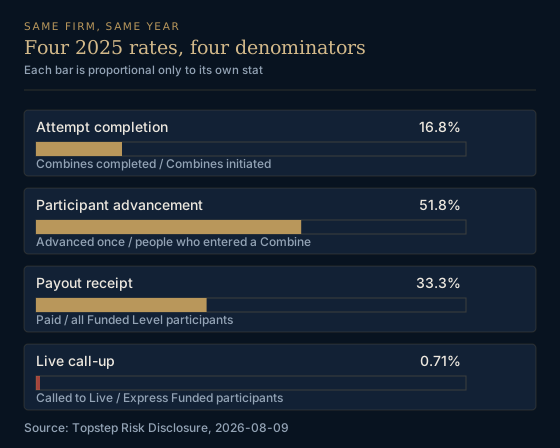
Topstep discloses both, for the same 2025 calendar year, on the same page. The firm reports that 16.8 percent of Trading Combines initiated from January through December 2025 were completed and advanced to its Funded Level (Topstep Risk Disclosure, retrieved 2026-08-09). On the same page, Topstep reports that 51.8 percent of individual participants who entered one or more Trading Combines advanced to its Funded Level in at least one attempt during 2025 (Topstep Risk Disclosure, retrieved 2026-08-09). Same firm, same year, same stated destination, three times the number when the denominator switches from attempts to people.
That is not a contradiction. It is what happens when traders who fail once, adjust, and try again are counted as one success in the person-level rate but as one failure plus one success in the attempt-level rate.
Table 1: The Four Published 2025 Rates and Their Denominators
| Rate | Numerator | Denominator | Period |
|---|---|---|---|
| Attempt completion | Trading Combines completed | Trading Combines initiated | Jan to Dec 2025 |
| Participant advancement | Participants who advanced at least once | Individual participants who entered one or more Combines | Jan to Dec 2025 |
| Payout receipt | Funded Level participants who received a payout | All individual participants at the Funded Level | 2025 |
| Live call-up | Participants called up to a Live post-evaluation account | Individual participants trading in Express post-evaluation accounts | 2025 |
| Rate | Next stage described | Source |
|---|---|---|
| Attempt completion | Funded Level (aggregate) | Topstep Risk Disclosure, retrieved 2026-08-09 |
| Participant advancement | Funded Level (aggregate) | Topstep Risk Disclosure, retrieved 2026-08-09 |
| Payout receipt | Payout event | Topstep Risk Disclosure, retrieved 2026-08-09 |
| Live call-up | Live post-evaluation accounts (real exchange capital) | Topstep Risk Disclosure, retrieved 2026-08-09 |
Four rows, four different denominators. None of them can be multiplied together to produce a fifth number, and the reasons why are the rest of this article.
Why 16.8 Percent and 51.8 Percent Can Both Be True
One denominator is attempts
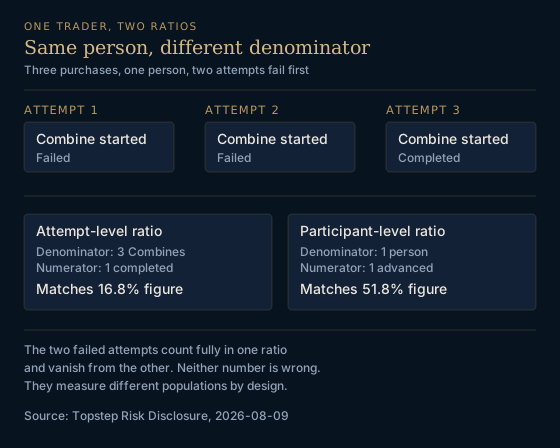
The 16.8 percent figure divides successful Trading Combines by initiated Trading Combines (Topstep Risk Disclosure, retrieved 2026-08-09). If a person starts three Combines in 2025 and fails twice before succeeding on the third, that person contributes three units to the denominator and one unit to the numerator. The attempt rate treats each purchase as its own trial, independent of who bought it.
The other denominator is people with one or more attempts
The 51.8 percent figure divides participants who advanced by participants who tried (Topstep Risk Disclosure, retrieved 2026-08-09). The same person from the example above contributes one unit to the denominator, because they are one person, and one unit to the numerator, because they eventually advanced. Their two failed attempts vanish from this ratio. They still happened, they still cost money, and they simply do not appear once the measurement shifts from attempts to people.
Neither rate is inflated and neither is deflated. They measure different things and answer different questions: "what fraction of purchases succeed" versus "what fraction of buyers eventually succeed, however many purchases it takes." A reader who only sees 51.8 percent and assumes it describes a single attempt is measuring the wrong population.
Pass, Payout and Live Call-Up Are Three Separate Events
A pass rate answers only the first of at least three separate questions a buyer has: will I pass, will I get paid, and will any of this ever touch a real exchange account. Topstep's disclosure keeps these three events in three separate rows. Conflating them is the most common misreading of the page.
Passing an evaluation and advancing to the Funded Level is event one, covered by the attempt and participant rates above. Topstep defines its Funded Level statistic as an aggregate of Express post-evaluation accounts and Live post-evaluation accounts, so the word funded in that disclosure does not by itself mean every account is trading real exchange capital (Topstep Risk Disclosure, retrieved 2026-08-09). Receiving a payout at that Funded Level is event two: Topstep reports that 33.3 percent of all individual participants at the Funded Level received a payout during 2025 (Topstep Risk Disclosure, retrieved 2026-08-09). That payout rate is conditioned on already reaching Funded Level. Multiplying it by the advancement rate to invent a single "chance of getting paid from day one" compounds two ratios with different denominators into a figure neither disclosure supports.
Migration to a Live post-evaluation account, meaning Topstep's real-capital stage, is event three, and it is rare: 0.71 percent of individual participants trading in Express post-evaluation accounts were called up to a Live post-evaluation account during 2025 (Topstep Risk Disclosure, retrieved 2026-08-09). That denominator is Express post-evaluation participants only, not everyone who ever entered a Combine. Reading 0.71 percent as "0.71 percent of everyone who buys an evaluation reaches real exchange capital" is a denominator swap the disclosure does not support.
Table 2: Claims the Disclosure Supports and Claims It Does Not
| Claim | Supported | Why |
|---|---|---|
| "16.8 percent of Trading Combines started in 2025 were completed." | Yes | Direct restatement of the attempt-level figure (Topstep Risk Disclosure, retrieved 2026-08-09) |
| "51.8 percent of people who tried advanced at least once." | Yes | Direct restatement of the participant-level figure (Topstep Risk Disclosure, retrieved 2026-08-09) |
| "51.8 percent of attempts succeed." | No | Swaps the person-level denominator for the attempt-level one |
| "A third of post-evaluation traders get paid." | Yes, with the Funded Level defined as Express plus Live | Matches the 33.3 percent payout figure at that specific stage (Topstep Risk Disclosure, retrieved 2026-08-09) |
| "0.71 percent of everyone who signs up reaches a real-capital account." | No | The 0.71 percent denominator is Express post-evaluation participants, not all starters (Topstep Risk Disclosure, retrieved 2026-08-09) |
| "Multiply the advancement rate by the payout rate to get overall payout odds from day one." | No | The two rates use different denominators and different starting populations; the disclosure does not present a chained figure |
| "Funded Level participants are trading real exchange capital." | No, not necessarily | The Funded Level aggregates Express and Brokerage accounts, and only the Live stage is described as the real-capital destination (Topstep Risk Disclosure, retrieved 2026-08-09) |
How Should Simulated Performance Statistics Be Labelled?
What the firm's own risk disclosure says
The numbers above come from the same document that states its own limitation. Topstep's risk disclosure states that simulated results do not represent actual trading and may understate or overstate the effect of certain factors, including liquidity (Topstep Risk Disclosure, retrieved 2026-08-09). That sentence is not boilerplate to skip past. It is the firm defining, in writing, what its own advancement and payout rates can and cannot tell a reader about trading outcomes generally.
Why a demo result is not an actual trading record
The pattern is not unique to one firm. FTMO (prop firm) states that its Challenge, Verification and FTMO Account operate in a demo trading environment that simulates real market conditions (FTMO, retrieved 2026-08-09). A pass rate measured inside that environment describes performance against a specific rule set, under specific simulated execution conditions, over a specific period. It does not describe how the same person would perform trading a real brokerage account, where slippage, liquidity and psychological pressure from the trader's own funds at risk can differ from a simulated environment.
Any statistic quoted from a simulated or demo stage should carry that label every time it is repeated, not once in a footnote and then dropped from every subsequent restatement. Removing the label does not make the number more impressive. It makes the number describe something other than what was actually measured.
How to Audit Any Prop Firm Success-Rate Claim in Six Steps
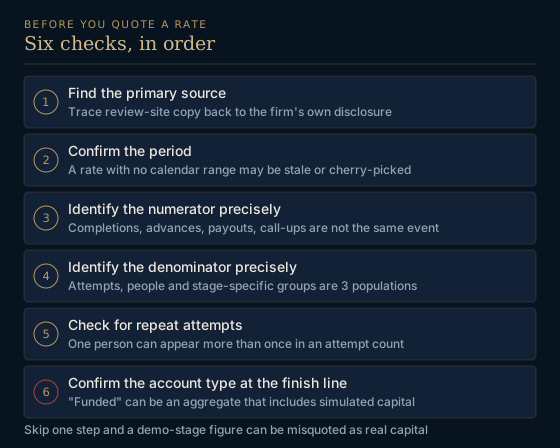
- Find the primary source. Trace the rate to the firm's own risk disclosure or terms, not a review copy. See how to audit a prop firm.
- Confirm the period. Topstep states January through December 2025 for attempt and participant figures (Topstep Risk Disclosure, retrieved 2026-08-09). A rate with no range is not comparable.
- Identify the numerator. Completed evaluations, participants who advanced, payouts issued and live call-ups are four different events.
- Identify the denominator. Attempts, individual participants, and participants already at a stage are three different populations.
- Check for repeat attempts. Topstep's gap between 16.8 percent (attempts) and 51.8 percent (people) is the textbook case (Topstep Risk Disclosure, retrieved 2026-08-09).
- Confirm the finish-line account type. Topstep's Funded Level aggregates Express and Brokerage accounts (Topstep Risk Disclosure, retrieved 2026-08-09), so "reached Funded Level" is not proof of real exchange capital.
Why Does Ordane Have No Challenge Pass Rate?
No evaluation phase means no pass-rate denominator
A pass rate needs a population that attempts and a population that fails. Ordane sells one product, the Ordane Instant Account: direct access, no evaluation phase and no challenge, on simulated capital. (Ordane Rulebook, retrieved 2026-08-09) There is no Combine to complete and no attempt-level or participant-level denominator to publish.
This is a structural fact about the product, not a claim about superiority. A firm with a multi-stage evaluation has pass-rate statistics because it has a pass-or-fail gate. A firm without that gate answers a different question.
The product question that replaces it
The question that replaces "what is your pass rate" is "what rules keep the account open, and what happens when a payout is due." Those answers live in numbered rulebook clauses (drawdown floor, daily loss limit, consistency rule, The Ordane Guarantee), not in aggregate pass statistics.
Worked pass-rate arithmetic
Declared inputs for this check only (Topstep 2025 disclosure restated as decimals): attempt completion rate 0.168; participant advancement rate 0.518; Funded Level payout rate 0.333; Express-to-Live call-up rate 0.0071.
| Input | Value | Source of the input |
|---|---|---|
| Attempt rate | 0.168 | Combines completed / Combines initiated (Topstep Risk Disclosure, retrieved 2026-08-09) |
| Participant rate | 0.518 | People who advanced / people who tried (Topstep Risk Disclosure, retrieved 2026-08-09) |
| Funded Level payout rate | 0.333 | Payouts / Funded Level participants (Topstep Risk Disclosure, retrieved 2026-08-09) |
| Express-to-Live call-up | 0.0071 | Live call-ups / Express participants (Topstep Risk Disclosure, retrieved 2026-08-09) |
| Attempt vs participant gap | 0.350 | 0.518 minus 0.168 |
Arithmetically: 0.518 - 0.168 = 0.350 under these declared inputs. Multiplying 0.518 * 0.333 would invent a day-one payout odds figure the disclosure does not publish. The four rates stay in four rows.
Questions traders ask before paying
What is a prop firm pass rate?
A pass rate is a ratio with a stated numerator, denominator, period and account stage. Change any one of the four and the percentage changes meaning even if the digits look the same.
Why can one firm publish both 16.8 percent and 51.8 percent for the same year?
Because one figure divides by attempts and the other divides by people. Topstep discloses both for 2025 on the same risk page (Topstep Risk Disclosure, retrieved 2026-08-09).
Does a Funded Level payout rate mean most buyers get paid from day one?
No. Topstep's 33.3 percent payout figure is conditioned on participants already at Funded Level. It is not a day-one odds figure for everyone who buys an evaluation (Topstep Risk Disclosure, retrieved 2026-08-09).
Does Ordane publish a challenge pass rate?
No. Ordane sells an Instant Account with no evaluation phase, so there is no pass-or-fail denominator to publish (Ordane Rulebook, retrieved 2026-08-09).
Sources
- Topstep Risk Disclosure, on the 2025 Trading Combine completion rate, the 2025 participant advancement rate, the Funded Level payout rate, the Express-to-Live call-up rate, the composition of the Funded Level, and the stated limitations of simulated results. topstep.com/risk-disclosure Retrieved 2026-08-09.
- European Securities and Markets Authority, notice of product intervention decisions on CFDs and binary options, on CFDs being complex instruments carrying a high risk of losing money rapidly due to leverage. esma.europa.eu Retrieved 2026-08-10.
- FTMO, on the Challenge, Verification and FTMO Account operating in a demo trading environment that simulates real market conditions. ftmo.com/en/challenge Retrieved 2026-08-09.
- Ordane Rulebook v1.0, on Ordane selling one product, the Ordane Instant Account, with direct access, no evaluation phase and no challenge, on simulated capital. ordanemarkets.com/rulebook Retrieved 2026-08-09.