Home · The Ordane Journal · Before you pay · Prop Firm Affiliate Programs: Who Pays Whom
Prop Firm Affiliate Programs: Who Pays Whom
Ordane accounts operate on simulated capital. No live funds are traded and no deposits are accepted (Ordane Rulebook, retrieved 2026-08-11).
A prop firm affiliate program pays a commission to whoever referred a buyer, calculated as a percentage of that buyer's purchase and triggered the moment checkout completes, entirely separate from any discount code the buyer might use.
That is the whole transaction. A reviewer posts a link. A reader clicks it, buys an evaluation or an instant account, and the firm pays the reviewer a cut of what the reader just paid. Nothing about the trader's skill, the pass rate, or the eventual payout enters the calculation. The commission is priced on the sale, not on the outcome.
What Does a Prop Firm Affiliate Program Actually Pay?
A prop firm affiliate program pays a commission to whoever referred a buyer, calculated as a percentage of that buyer's purchase, triggered the moment the buyer completes checkout. The buyer's discount code, if one exists, is a separate mechanism that may or may not lower the price they pay.
Commission, Referral Bonus and Discount Code Are Three Things
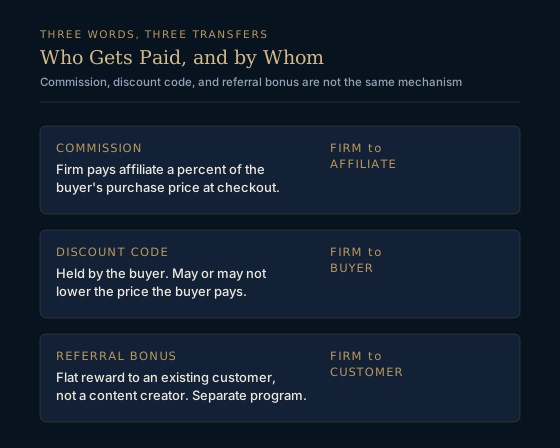
Three words get used interchangeably in prop firm marketing, and they name three different transfers of money.
A commission is what the firm pays the affiliate. It is a percentage of the buyer's fee, paid to the person who posted the link, and the buyer never sees this number unless the affiliate discloses it.
A discount code is what the buyer receives. It may lower the sticker price, or it may do nothing to the price and exist purely to route the sale to a specific affiliate's tracking link. These are not the same code, and a reader cannot tell which one they are holding just by looking at it.
A referral bonus is a smaller category: some firms pay an existing customer, not a content creator, a flat reward for bringing in a new buyer. It is a different program with different terms, and it is not the subject of this article.
The reason to separate these three is simple: a reader who sees "use code SAVE10" assumes the 10 is for them. Sometimes it is. Sometimes the 10 refers to the affiliate's commission tier, and the buyer's price does not move at all. FTMO (prop firm) states that affiliates earn a commission when a client referred through their unique affiliate link completes their first purchase (FTMO.com, retrieved 2026-08-11).
What Does FTMO's Published Rate Card Convert to in Dollars?
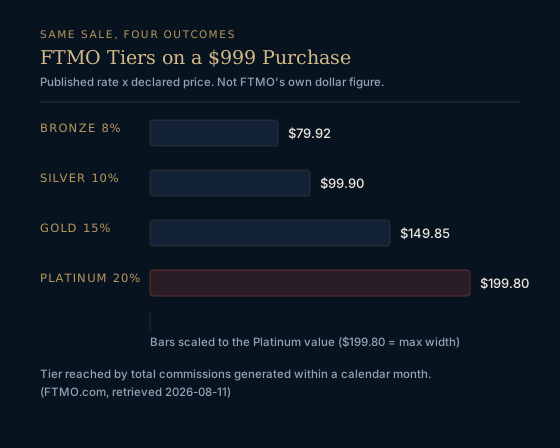
FTMO publishes its affiliate commission structure directly in its own FAQ, not through a third party summarizing it (FTMO.com, retrieved 2026-08-11). The rate rises with a tier system based on commissions generated inside a calendar month (FTMO.com, retrieved 2026-08-11).
| Tier | Commission rate | On a $299 purchase | On a $999 purchase |
|---|---|---|---|
| Bronze | 8% | $23.92 | $79.92 |
| Silver | 10% | $29.90 | $99.90 |
| Gold | 15% | $44.85 | $149.85 |
| Platinum | 20% | $59.80 | $199.80 |
The two dollar columns are not FTMO's numbers. They are a straightforward multiplication: the published rate times a purchase price, calculated here to show what an affiliate would actually earn from one sale at that tier, against Ordane's own published price points of $299 and $999. Declared inputs: Bronze 8% x $299 = $23.92; Platinum 20% x $999 = $199.80. The buyer pays the sticker price either way. The commission is what moves in the other direction, from the firm's revenue to the affiliate's account, and it scales with how much commission the affiliate has already generated that month, not with anything about the buyer.
This is also why a Platinum-tier affiliate has a stronger incentive to push a $999 purchase than a $299 one: the same 20 percent rate returns roughly $140 more per sale, independent of account size fit.
What Triggers the Commission, and What Does Not?
FTMO states plainly that the commission is earned when a referred client completes a first purchase (FTMO.com, retrieved 2026-08-11). Nothing downstream of that purchase enters the calculation.
The commission does not depend on whether the buyer passes the evaluation. It does not depend on whether the buyer ever requests a payout. It does not depend on how long the buyer keeps trading, or whether the buyer loses the account on day one to a drawdown breach. The trigger is the transaction, full stop.
The same logic separates the affiliate's interest from the trader's interest at the moment it matters most: before the money changes hands, not after.
Where the commission money comes from is a short answer worth stating plainly rather than re-deriving: it is paid out of the fee the buyer already handed over, before any of that fee reaches a firm's payout reserves for existing traders. A fuller trace of how that fee money moves, from checkout to payout obligation, is covered in where does prop firm payout money come from.
What Disclosure Rule Applies to an Affiliate Recommendation?
Undisclosed Material Connections
The U.S. Federal Trade Commission's Rule on the Use of Consumer Reviews and Testimonials, codified at 16 CFR Part 465, took effect on October 21, 2024 (Federal Register, via govinfo.gov, retrieved 2026-08-11). The rule targets fake and manipulated reviews directly, and it separately restricts insiders, meaning anyone with a financial connection to the business being reviewed, from writing or publishing a review without clearly disclosing that connection (Federal Register, via govinfo.gov, retrieved 2026-08-11).
An affiliate relationship is exactly this kind of connection. A reviewer earning 8 to 20 percent of a reader's purchase price has a financial stake in that reader clicking "buy," and the rule's insider provision exists precisely to make that stake visible rather than hidden inside a friendly-sounding recommendation.
Trustpilot (review platform) runs a parallel rule at the platform level. Its guidelines for reviewers state that a person is not eligible to write a review after receiving or being offered an incentive connected to writing or editing that review, and the guidelines name discounts, promo codes, prize draw entries, refunds and freebies as disqualifying examples (Trustpilot corporate guidelines, retrieved 2026-08-11).
Why an Incentivised Review Is Disqualified
Put the two rules side by side and the position is consistent across a federal regulator and a private review platform: a review written by someone who stands to gain financially from the reader's purchase is required to disclose that gain, and on at least one major platform, the incentive disqualifies the review outright rather than merely requiring a footnote.
This is not a judgment about the reviewer's honesty. A disclosed affiliate can still write an accurate, useful comparison. The rule exists because the reader has no way to weigh the recommendation correctly without knowing the financial relationship sits underneath it, and a recommendation that hides the relationship is the one both the FTC and Trustpilot treat as defective regardless of whether the content itself happens to be true.
Six Checks Before You Use a Discount Code
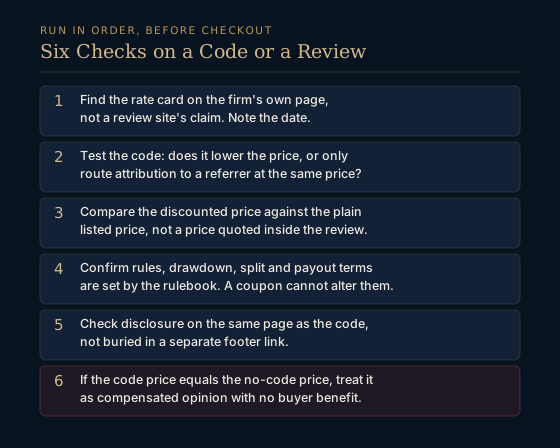
- Find the rate card. Locate the firm's own published affiliate FAQ or terms page, not a review site's claim about it, and note the date you retrieved it.
- Check whether the code changes the price or only the attribution. Some codes lower the sticker price for the buyer; others only route a commission to the referrer at the same price. Test the code against the price with no code at checkout.
- Compare the discounted price against the plain listed price on the firm's own pricing page, not against a price quoted inside the review.
- Confirm what the code does NOT change: rules, drawdown, profit split and payout terms are set by the rulebook, not by the checkout page, and a coupon cannot alter them.
- Check whether the reviewer discloses the affiliate relationship on the same page as the code, not buried in a separate disclosure page linked from the footer.
- If the price with the code is identical to the price without it, treat the recommendation as compensated opinion with no buyer benefit, and weigh it accordingly.
What Does Ordane's Price Ladder Say About Codes?
One Fee, Five Sizes
Ordane sells one product, the Ordane Instant Account: direct access, no evaluation phase and no challenge, on simulated capital (Ordane Rulebook, retrieved 2026-08-11). The account comes in five sizes: $2,500, $10,000, $25,000, $50,000 and $100,000 (Ordane Rulebook, retrieved 2026-08-11).
The fee is one-time: $59 for the $2,500 account, $139 for the $10,000 account, $299 for $25,000, $549 for $50,000 and $999 for $100,000 (Ordane Rulebook, retrieved 2026-08-11). Those five numbers are the whole price list. There is no separate evaluation fee stacked on top, no renewal fee for holding the account past a certain date, and no second tier of pricing revealed only after clicking through a coupon link.
The Sentence That Closes the Coupon Question
The Rulebook states it directly: there are no recurring fees, no hidden tiers and no coupon games (Ordane Rulebook, retrieved 2026-08-11). That sentence is written into the governing document, not into a marketing page that can be revised without a version note. If Ordane were to introduce a discount code tomorrow, the rulebook's changelog would carry the date, because the rulebook is versioned and no rule change applies retroactively to an account already open.
The practical difference for a reader comparing firms: at Ordane, checking whether a code beats the listed price is a five-second lookup against a fixed five-line price table below.
| Account size | One-time fee | Recurring fees | Coupon tiers |
|---|---|---|---|
| $2,500 | $59 | None | None |
| $10,000 | $139 | None | None |
| $25,000 | $299 | None | None |
| $50,000 | $549 | None | None |
| $100,000 | $999 | None | None |
At a firm running a tiered affiliate structure with variable codes, the answer depends on which reviewer's link the reader clicked, which the six-step checklist above exists to resolve.
For the wider set of checks worth running before paying any firm, including affiliate structure alongside drawdown rules, payout timing and fee transparency, see how to audit a prop firm. For a closer look at what a paid recommendation is required to disclose before a reader should trust it, see can you trust prop firm reviews. And for the fees that sit underneath a headline price, whether or not a discount code is involved, see prop firm hidden fees.
Declared inputs: one FTMO affiliate sale
Declared inputs: Bronze rate 0.08; purchase 299; Platinum rate 0.20; purchase 999.
Assumptions for this check only: rates come from FTMO's published affiliate FAQ as retrieved on 2026-08-11; the purchase amounts are Ordane Instant Account sticker prices used as worked examples.
Worked arithmetic: 299 × 0.08 = 23.92 and 999 × 0.20 = 199.80.
| Tier | Rate | Purchase | Commission |
|---|---|---|---|
| Bronze | 0.08 | 299 | 23.92 |
| Platinum | 0.20 | 999 | 199.80 |
Questions Traders Ask About Prop Firm Affiliates
Does a code make the account cheaper?
Sometimes. Test it directly: add the account to checkout, apply the code, and compare the resulting price against the firm's own listed price with no code applied. If the two numbers match, the code changed nothing about what the buyer pays. It only tagged the sale to a specific affiliate's account, which changes who gets paid, not how much the buyer is charged.
Is an affiliate review worthless?
No. An affiliate relationship is a reason to weigh a review differently, not a reason to discard it. A disclosed affiliate who publishes the rate card, states the commission openly, and still walks through a firm's actual rulebook clause by clause has given a reader more to verify than an anonymous "best prop firm 2026" listicle with no disclosure at all. The defect is the absence of disclosure and the absence of verifiable specifics, not the existence of a commission.
Can I earn a commission on my own purchase?
This depends entirely on the individual firm's terms and is outside what any general answer can responsibly state, because self-referral policies vary and some firms explicitly prohibit it as a form of the same incentive-gaming that FTC Rule 16 CFR Part 465 (Federal Register, via govinfo.gov, retrieved 2026-08-11) and Trustpilot's guidelines (Trustpilot corporate guidelines, retrieved 2026-08-11) both target. Check the specific firm's affiliate terms directly rather than assuming the answer transfers from one program to another.
Does the commission rate change what a trader is charged?
No. The commission rate determines only how much of the buyer's payment the affiliate keeps as a referral fee. It has no mechanical connection to the sticker price, which is set independently by the firm's own pricing page.
Why does FTMO tie affiliate tiers to monthly commission totals?
FTMO ties affiliate tier progression to the total commissions generated within a calendar month (FTMO.com, retrieved 2026-08-11). That structure rewards volume within a fixed window rather than a single large sale, which is why a Platinum-tier affiliate's rate resets against the following month's total rather than carrying forward permanently.
Sources
- FTMO.com, affiliate FAQ, on the published commission rates by tier (Bronze 8 percent, Silver 10 percent, Gold 15 percent, Platinum 20 percent), on the commission being earned when a referred client completes a first purchase, and on tier progression being determined by the total commissions generated within a calendar month. ftmo.com, how do I earn commissions as an affiliate Retrieved 2026-08-11.
- Federal Register, via govinfo.gov, Trade Regulation Rule on the Use of Consumer Reviews and Testimonials, 89 FR (August 22, 2024), on the rule codified at 16 CFR Part 465 taking effect on October 21, 2024, on the prohibition of selling or purchasing fake consumer reviews or testimonials, and on insiders creating reviews without clearly disclosing their relationships to the business. govinfo.gov Retrieved 2026-08-11.
- Trustpilot, Guidelines for Reviewers, on a person not being eligible to write a review after receiving or being offered an incentive connected to writing or editing it, with discounts, promo codes, prize draw entries, refunds and freebies named as examples. corporate.trustpilot.com Retrieved 2026-08-11.
- Ordane Rulebook v1.0, on the Ordane Instant Account coming in five sizes ($2,500, $10,000, $25,000, $50,000 and $100,000), on the one-time fee ladder ($59, $139, $299, $549 and $999), and on there being no recurring fees, no hidden tiers and no coupon games. ordanemarkets.com/rulebook Retrieved 2026-08-11.