Home · The Ordane Journal · Before you pay · Best Funded Account for Trading: Fit Checklist
Best Funded Account for Trading: Fit Checklist
The best funded account for trading is the one whose documented rules preserve collectible cash under your strategy, schedule, risk tolerance, and budget: this guide runs the documented FTMO 100K offer and the verified The5ers 100K offer at $149 through the same checklist.
Ordane accounts operate on simulated capital. No live funds are traded and no deposits are accepted. Payouts depend on simulated performance under Rulebook v1.5; no level of performance is typical or assured.
Ordane sells one product, the Ordane Instant Account: direct access, no evaluation phase and no challenge, on simulated capital.
This guide compares the best funded accounts for trading, two firms whose offers are documented in verifiable primary sources: FTMO and The5ers, on the factors that actually determine whether you collect money: payout access, loss rules, restrictions, cost, and fit, with related guides on how long prop firms take to pay and how to save the firm's rules before paying. The question of whether a prop firm account is a demo account applies to both, and by the end you will have a checklist you can run against any offer before paying.
The 3% versus 5% The5ers daily loss difference across program pages
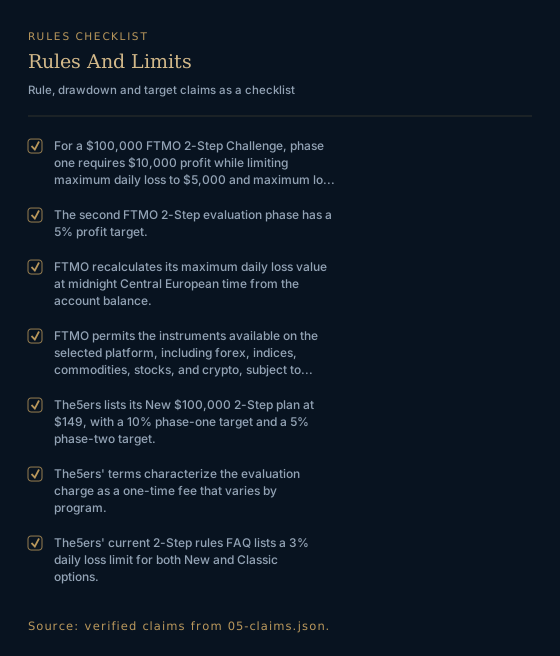
The5ers' documentation states different daily loss limits on two different program pages. Its 2-Step rules FAQ lists a 3% daily loss limit, described as 3% of the previous day's closing balance or equity balance, whichever is higher, for both the New and Classic options. The same page states, "The 2-Step plan offers two entry tiers for the $100,000 account to fit your budget and strategy: New ($149): Phase 1 profit target is 10%; Phase 2 is 5%." Its High Stakes product page separately lists a 5% maximum daily loss (2 Step Program: Unlock High-Stakes Growth Plan | The5ers, retrieved 2026-09). That same 2-Step FAQ also confirms the evaluation-wide ceiling: "Both the New and Classic versions share the same evaluation risk model: Maximum Loss: 10% of your initial balance." (2-Step Plan Rules & Specifications | The5ers, retrieved 2026-09-27). Ordane index: cost-to-first-payout-threshold ratio (own calculation). Dividing each documented minimum payout by the entry cost of the account gives a rough measure of how many multiples of your fee the firm requires in profit before a withdrawal is even possible. For The5ers' New 2-Step $100K plan: $250 minimum withdrawal ÷ $149 entry fee = 1.68×: you must clear roughly 1.7 times your fee in simulated profit before a payout request opens. Method: this ratio uses only figures stated in this article ($250 minimum, $149 fee) and is our own aggregation, not a firm-published metric. FTMO's equivalent ratio cannot be computed here because FTMO's current Challenge price is not established in the sources verified. We do not average the 3% and 5% figures and we do not assert any mapping between these pages and the contract you would buy: the only reliable statement of which figure governs your account is the firm's written confirmation. Assume the stricter number (3%) for your risk planning until proven otherwise, because planning around the looser figure risks a breach the firm enforces under the tighter one.
What does each documented account cost?
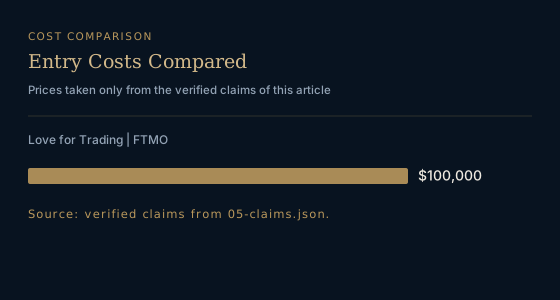
FTMO documents its charges as a one-time purchase fee: the firm states it charges only a one-time purchase fee for the 1-Step FTMO Challenge, 2-Step FTMO Challenge, and FTMO Instant Account, with no additional or hidden fees, and for the 2-Step FTMO Challenge it refunds the initial purchase fee once the trader requests the first Reward withdrawal. Verify the current figure on FTMO's own pricing page: FTMO Pricing, and the governing terms at FTMO Account Terms & Conditions (Do we charge any other fees? Are the fees recurrent? | FTMO.com, retrieved 2026-09). The current price of the $100,000 2-Step Challenge is not established by the sources verified here, so read the fee on FTMO's own pricing page before any comparison.
The5ers' documented 100K evaluation fee
The5ers lists its New $100,000 2-Step plan at $149, with a 10% phase-one target and a 5% phase-two target, promoted on the page as "Industry's Lowest $100K For $149", with full program rules at The5ers 2-Step Plan Rules & Specifications and governing terms at The5ers Terms and Conditions (2-Step Plan Rules and Specifications | The5ers, retrieved 2026-09-27). FTMO's current Challenge price was not verifiable in the sources reviewed here, so this article draws no price comparison between the two offers: read both firms' current pricing pages before comparing, and treat headline price as only one input.
One-time versus recurring costs
FTMO explicitly states that its Challenge products carry no recurring fees (Do we charge any other fees? Are the fees recurrent? | FTMO.com, retrieved 2026-09). For The5ers, the documented evidence establishes a one-time evaluation fee, but it does not establish the absence of recurring costs, and this article will not infer that. Whether The5ers charges ongoing monthly or platform fees at the funded stage is not covered by the available claims; check the current terms before assuming. Cost comparison must rest on what each firm documents, not on symmetry.
Why headline price is not total economic fit
On targets, the documented structures match: FTMO's phase one requires $10,000 profit (10%) with a 5% second phase, and The5ers New requires 10% then 5%. The buffers differ: FTMO documents a 5% daily and 10% total buffer, while The5ers' governing daily figure depends on the program page (3% or 5%). Total economic fit is fee times expected attempts plus time cost.
Will the account actually pay you?
That separates into two questions: eligibility, which you can verify in the documented payout conditions, and receipt, which depends on the firm honoring them. Both firms document withdrawal conditions tied to their account terms; timing, minimums, caps, and splits define when a request becomes possible, while no product page can prove that the firm pays. A $100,000 simulated balance with a payout cap of $2,000 per cycle behaves very differently from an account with no documented cap, even if both are labeled "funded" (2-Step Plan Rules and Specifications | The5ers, retrieved 2026-09-27).
This cash-first definition matters because both compared firms disclose simulation in their own documentation, each with its own scope. FTMO states that FTMO Traders trade with simulated capital only and are entitled to receive a Reward in real money once they generate a profit on their FTMO Account, provided all Trading Objectives are fulfilled and the FTMO Account Terms & Conditions are followed (How do I withdraw my reward? | FTMO.com, retrieved 2026-09). The5ers states that all evaluation activities conducted through its Company Hub operate exclusively within a simulated environment (Disclaimer | The5ers, retrieved 2026-09). The Reward documented above is a contractual arrangement with the firm, and that reframes what you are buying: access to a rules-based payout arrangement, not a slice of real market capital.
Independent regulatory context reinforces why payout mechanics deserve scrutiny. In its complaint against Traders Global, the CFTC alleged that some account types required customers to generate simulated profits in a demo account before receiving access to so-called live trading funds (CFTC Complaint: Traders Global Group Inc. and My Forex Funds, retrieved 2026-09). That case concerns a different firm and is not evidence against FTMO or The5ers, but it explains why regulators and experienced traders focus on documented payout conditions rather than headline balances. For a deeper grounding, see our guide on how to audit a prop firm before paying.
FTMO payout timing, profit share, and eligibility
FTMO's documented payout mechanics center on a defined waiting period and a base split. An FTMO reward can be requested on the fourteenth day or later after the account's first placed trade, and the request requires positions and pending orders to be closed (How do I withdraw my reward? | FTMO.com, retrieved 2026-09). That means your first payout request becomes possible on day 14 or later after you start trading the funded stage, not two weeks after you pay the fee.
The base reward ratio for a 2-Step account is 80% of profit, with higher ratios available only under separate scaling or premium conditions (How do I withdraw my reward? | FTMO.com, retrieved 2026-09-27). In cash terms, if you generate $2,000 in qualifying profit at the funded stage under base terms, $1,600 is your documented share.
For traders whose priority is speed to first payout, the fourteen-day clock plus the closed-positions condition is the number to model against your expected pace.
The5ers payout frequency, profit share, and caps
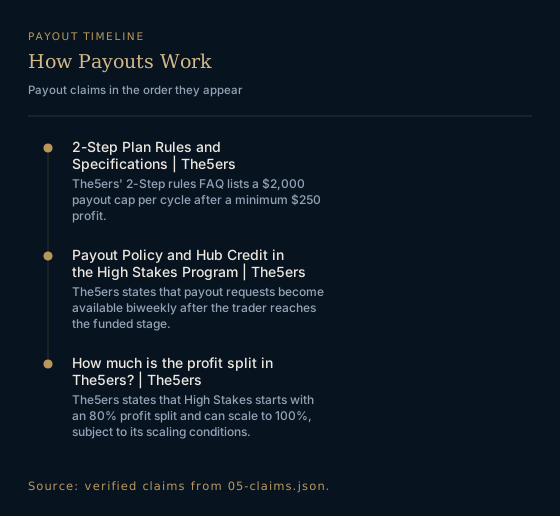
For the High Stakes program, The5ers documents a biweekly cadence: payout requests become available biweekly once the trader reaches the funded stage (Payout Policy and Hub Credit in the High Stakes Program | The5ers, retrieved 2026-09). The profit split for the High Stakes program starts at 80% and can scale to 100%, subject to the firm's scaling conditions (How much is the profit split in The5ers? | The5ers, retrieved 2026-09). Neither the cadence nor the split is established for the New 2-Step plan on the pages verified here.
The5ers' 2-Step rules FAQ presents the New $100,000 plan at $149 and, on the same page, its payout limits: a minimum $250 profit to request a withdrawal and a payout cap of $2,000 per cycle. A separate payout-policy FAQ for the $100,000 High Stakes account lists a $4,000 cap with a $500 minimum P&L (Payout Policy and Hub Credit in the High Stakes Program | The5ers, retrieved 2026-09-27). The High Stakes figures are not established as applying to the New plan: before paying, ask the firm in writing which figures govern the account you are buying.
Why simulated capital does not make payouts automatic
Both firms document a simulated evaluation environment; what their own words say about the stage after you pass differs. FTMO states its Traders trade with simulated capital only and receive a Reward in real money under its objectives and terms, while The5ers' 2-Step FAQ describes the account received after passing both phases as a live $100,000 funded account, subject to a 50% consistency requirement (2-Step Plan Rules and Specifications | The5ers, retrieved 2026-09-27). Your payout depends on satisfying the contractual conditions of whichever arrangement you join: evaluation completion, loss-limit compliance, request timing, minimums, and caps, and on the firm honoring its payment terms. Passing an evaluation earns you the next stage; it does not by itself place money in your bank account. For the structural background, see is a prop firm account a demo account.
Which hidden rule can breach the account?
The daily loss limit binds every single trading day, not just at the end of the evaluation. For a $100,000 FTMO 2-Step Challenge, phase one limits maximum daily loss to $5,000 (5%) alongside a $10,000 (10%) maximum loss (How it works | FTMO.com, retrieved 2026-09). Critically, FTMO recalculates the maximum daily loss value every day at midnight Central European time based on the account balance (Trading and Drawdowns | FTMO.com, retrieved 2026-09); what that recalculation changes is defined by the firm's own drawdown documentation, and traders in distant time zones must anchor their day to CE(S)T midnight, not their local clock.
The5ers' daily loss picture depends on which program page governs your contract, covered above. Before choosing any account, be able to state from memory your daily loss allowance, what triggers a breach, and the exact reset time. Our explainer on prop firm daily loss limits compares these definitions in depth.
Maximum loss and drawdown structure
The overall maximum loss defines how much cumulative drawdown your account can absorb before termination. FTMO's phase-one document sets it at 10% ($10,000 on a $100,000 account) (How it works | FTMO.com, retrieved 2026-09-27). The5ers' High Stakes product page lists maximum loss at 10%.
On paper the two figures match, but the underlying structure, static versus trailing, is not documented identically in the claims available here: verify the drawdown mechanics on the firm's current terms before paying, because two accounts with "10% maximum loss" can behave very differently after a profitable week.
News, holding-period, and platform restrictions
Loss limits are not the only rules that can void an account. The5ers prohibits executing High Stakes orders from two minutes before until two minutes after high-impact news, while holding open trades over the news is allowed on all of its programs (What are the general rules for the High Stakes Program? | The5ers, retrieved 2026-09). If your strategy is built around news volatility, the execution window still shapes when you enter, even though open positions may ride through the release.
Instruments and platforms draw the same fit boundary. FTMO permits the instruments available on the selected platform, including forex, indices, commodities, stocks, and crypto, subject to its trading-practice rules (Which instruments can I trade and what strategies am I allowed to use? | FTMO.com, retrieved 2026-09), while The5ers lists forex, metals, indices, oil, and crypto as its High Stakes assets (2 Step Program: Unlock High-Stakes Growth Plan | The5ers, retrieved 2026-09).
On holding periods, FTMO identifies its Swing account type as suitable for swing traders who need to hold positions for longer periods, and notes this option is exclusive to the 2-Step Challenge (FTMO Swing account type | FTMO.com, retrieved 2026-09). Platform access also differs by geography: The5ers states that US-based CFD clients can use TradingView, while its broader platform selection applies to non-US clients (Which Trading Platform Do You Use For CFDs? | The5ers, retrieved 2026-09).
Will the firm still exist when payout day comes?
No documented evidence answers that for either firm: pricing pages, FAQs, terms and conditions, and a regulatory complaint establish what FTMO and The5ers currently promise (prices, targets, loss limits, payout conditions, splits, restrictions), not whether they will honor payouts in the future. That is genuinely valuable: it lets you compare offers on documented terms rather than affiliate marketing, and gives you a written baseline to hold the firm to after you pay.
What this evidence cannot prove about future solvency
What this evidence cannot do is predict whether either firm will honor payouts six months or two years from now. The research available for this article contains no firm-specific solvency, reserve, longevity, or shutdown evidence for FTMO or The5ers. Neither firm is documented as safer or riskier than the other, and this article will not rank their stability. The honest answer to "will the firm still exist when payout day comes?" is that publicly documented product terms cannot answer it.
Which records to preserve before paying
Since you cannot verify solvency in advance, minimize the damage if things go wrong. Before paying any evaluation fee: save dated PDFs or screenshots of the exact pages governing your program (pricing, loss rules, payout policy, restrictions); capture the confirmation of any conflicting figures in writing from support; keep your payment receipt and the terms version in force at purchase; and note the first-trade date that starts any payout waiting clock. These records are what you will rely on in a dispute or shutdown. Our guide on what happens if a prop firm shuts down covers the failure scenario in detail.
Which account fits your trading style?
If you hold positions for days or weeks, the documented picture on each side is concrete. FTMO's Swing account type carries no restriction on holding positions past market close for more than 2 hours, over the weekend or overnight for equities, at the cost of base leverage reduced from 1:100 to 1:30 (FTMO Swing account type | FTMO.com, retrieved 2026-09). The5ers' High Stakes page states that overnight and weekend actions are allowed, and that holding indices over the weekend is allowed but carries a high swap (2 Step Program: Unlock High-Stakes Growth Plan | The5ers, retrieved 2026-09). On swing-specific labeling the documented option is FTMO's; on multi-day holding permission, both firms document it. Longer holds interact with risk rules in a specific way: overnight and weekend exposure means floating drawdown can approach the daily or maximum loss thresholds while you sleep, so FTMO's documented midnight CE(S)T recalculation schedule belongs in your position sizing plan. The5ers' documentation reviewed for this article contains no swing-specific account type, so longer-hold traders should scrutinize whether its generic rules accommodate multi-day exposure before concluding fit.
Use this checklist before choosing
Before paying for any funded account, these two or any other, run this five-step sequence.
- Confirm capital type. Read the firm's own statement on what you will trade, at which stage. Both compared firms document simulated evaluation environments; FTMO documents simulated capital at the account level with a Reward in real money, and The5ers' 2-Step FAQ describes the post-evaluation funded account as live. If a firm is vague about what you trade at each stage, treat the vagueness as a red flag and move on.
- Calculate fee exposure. Write down the exact fee, whether it is one-time or recurring, any refund condition, and any promotion eligibility limits. Then multiply the fee by your honest estimate of attempts under the documented loss rules: that is your realistic cost of reaching the funded stage.
- Map every loss threshold and reset time. List daily loss, maximum loss, trigger definition, and reset time in your local clock. FTMO: 5% daily / 10% max, reset at midnight CE(S)T from balance. The5ers: 10% max, daily 3% on the 2-Step FAQ or 5% on the High Stakes page, depending on program.
- Calculate first collectible payout. Combine payout frequency, waiting period, minimum profit, cap, and split into one number: the earliest date and amount you could realistically collect. FTMO: day 14 or later after first trade, 80% base. The5ers 2-Step: $2,000 cap after a $250 minimum per its FAQ; biweekly cadence and 80-100% split documented for High Stakes, not established for the New plan.
- Match restrictions to your strategy. Check news windows, holding periods, instruments, and platform availability against how you actually trade. Any hard conflict here eliminates the account regardless of everything else.
Which account offers earlier payout access?
For the High Stakes program, The5ers documents a biweekly cadence for payout requests once funded, while FTMO documents a first request on day 14 or later after the first placed trade with positions closed; both are request dates, not receipt dates, and receipt follows each firm's processing time. Neither cadence is established for the other firm's program, and The5ers' biweekly figure carries its own minimums and caps. FTMO documents no payout cap in the claims reviewed here, which may matter more than cadence for high earners.
How do the documented costs compare?
The table below reorganizes the verified cost ledger for both documented 100K offers.
| Documented item | FTMO 100K (Standard 2-Step) | The5ers 100K (New 2-Step) |
|---|---|---|
| Headline fee | One-time purchase fee; current price not verified here | $149 one-time evaluation fee |
| Recurring fees | None, per FTMO's FAQ | Not established in the ledger |
| Refund condition | Initial purchase fee refunded at first Reward withdrawal request (2-Step) | Not established in the ledger |
| First payout request | Day 14 or later after first trade | Not documented on the 2-Step FAQ; biweekly documented for High Stakes |
| Payout cap | Not documented in the ledger | $2,000 per cycle after $250 minimum (2-Step FAQ, same page as the plan); $4,000/$500 High Stakes FAQ, applicability not established |
| Profit split | 80% documented | 80% scaling to 100% documented for High Stakes; New-plan split not established here |
| Daily / max loss | 5% daily, 10% max | 3% daily and 10% max per the 2-Step FAQ; 5% daily per the High Stakes page, applicability not established |
Cost per successful funded account, not price per attempt, is the number that decides value, and that depends on your probability of passing under each firm's loss rules.
Verified facts at a glance
| Fact from the research ledger | Source |
|---|---|
| The CFTC complaint against Traders Global alleged that some account types required customers to generate simulated profits in a demo account before accessing so-called live trading funds | CFTC complaint |
| FTMO states that FTMO Traders trade with simulated capital only and can receive a Reward in real money once they generate a profit, provided all Trading Objectives are fulfilled and the FTMO Account Terms & Conditions are followed | How do I withdraw my reward?, FTMO.com |
| FTMO states that it charges only a one-time purchase fee for its Challenge products and refunds the 2-Step initial purchase fee at the first Reward withdrawal request | Do we charge any other fees?, FTMO.com |
| The5ers documents that a 50% consistency requirement applies to trading on the funded account after passing both 2-Step phases | 2-Step Plan Rules and Specifications, The5ers |
Frequently Asked Questions
What is the best funded account for trading?
There is no documented universal best. The best funded account for trading is the one whose published payout conditions, loss rules, restrictions, and total cost fit your strategy and budget: FTMO fits traders who value documented clarity on loss resets, no additional fees, and a swing-labeled account type; The5ers fits traders whose budget matches its $149 dollar-denominated 2-Step entry fee and its documented $2,000 cycle cap after a $250 minimum. Choose by documented fit, not by brand or advertised balance.
Which funded account is best for swing trading?
On the swing-specific option, FTMO. Its Swing account is explicitly identified as suitable for traders who need to hold positions longer, exclusive to the 2-Step Challenge, with no restriction on holding past market close for more than 2 hours and base leverage reduced from 1:100 to 1:30. On multi-day holding permission, The5ers' High Stakes page documents that overnight and weekend actions are allowed, with weekend index holds carrying a high swap.
Which account has the clearest loss rules?
FTMO, on the evidence available: a single documented set of figures, $5,000 (5%) daily and $10,000 (10%) maximum on the $100,000 2-Step, with a stated reset mechanism. The5ers lists a 3% daily loss limit in its 2-Step rules FAQ and 5% on its High Stakes product page, figures tied to different program pages rather than one documented contract; confirm which governs your program before relying on it.
Is the advertised account balance real money?
No, and the scope differs by firm and stage. FTMO states that FTMO Traders trade with simulated capital only; The5ers describes the evaluation activities in its Hub as operating exclusively within a simulated environment, while its 2-Step FAQ describes the post-evaluation funded account as live. The advertised balance is the evaluation's size, not cash handed to you.
What fees does FTMO charge?
FTMO states on its fees FAQ at FTMO.com that it charges only a one-time purchase fee for the 1-Step FTMO Challenge, 2-Step FTMO Challenge, and FTMO Instant Account, with no additional or hidden fees; for the 2-Step FTMO Challenge, the initial purchase fee is refunded once the trader requests the first Reward withdrawal. The current price of the $100,000 2-Step Challenge is not established by the sources verified here. Source: Do we charge any other fees? | FTMO.com.
How hard are the targets on the FTMO $100,000 2-Step Challenge?
On FTMO's $100,000 2-Step Challenge, phase one requires $10,000 in profit (10%) without exceeding the 5% ($5,000) Maximum Daily Loss or the 10% ($10,000) Maximum Loss, and the verification phase target is 5% (How it works | FTMO.com).
Sources
- Complaint for Injunctive Relief, Civil Monetary Penalties, and Other Equitable Relief cftc.gov Retrieved 2026-09-27.
- How do I withdraw my reward? | FTMO.com ftmo.com Retrieved 2026-09-27.
- Do we charge any other fees? Are the fees recurrent? | FTMO.com ftmo.com Retrieved 2026-09-27.
- How it works | FTMO.com ftmo.com Retrieved 2026-09-27.
- Trading and Drawdowns | FTMO.com ftmo.com Retrieved 2026-09-27.
- Which instruments can I trade and what strategies am I allowed to use? | FTMO.com ftmo.com Retrieved 2026-09-27.
- FTMO Swing account type | FTMO.com ftmo.com Retrieved 2026-09-27.
- Disclaimer | The5ers the5ers.com Retrieved 2026-09-27.
- 2-Step Plan Rules and Specifications | The5ers the5ers.com Retrieved 2026-09-27.
- Terms and Conditions | The5ers the5ers.com Retrieved 2026-09-27.
- 2 Step Program: Unlock High-Stakes Growth Plan | The5ers the5ers.com Retrieved 2026-09-27.
- Payout Policy and Hub Credit in the High Stakes Program | The5ers the5ers.com Retrieved 2026-09-27.
- How much is the profit split in The5ers? | The5ers the5ers.com Retrieved 2026-09-27.
- What are the general rules for the High Stakes Program? | The5ers the5ers.com Retrieved 2026-09-27.
- Which Trading Platform Do You Use For CFDs? | The5ers the5ers.com Retrieved 2026-09-27.