Home · The Ordane Journal · Rules and Mechanics · Topstep Scaling Plan Explained (2026)
Topstep Scaling Plan Explained (2026)
A scaling plan is a risk management framework that dictates the maximum number of contracts a trader is permitted to trade simultaneously based on accumulated profit. Ordane accounts operate on simulated capital. No live funds are traded and no deposits are accepted.
In one sentence: The Topstep scaling plan initially restricts a $50,000 account to 2 contracts, requiring traders to accumulate $1,500 in profit to unlock the maximum limit of 5 contracts.
When retail traders look to access the futures market, they often encounter scaling plans designed to enforce strict risk limits. Topstep (prop firm) is recognized in the financial trade press as one of the pioneers of the futures prop trading evaluation model. Ordane sells one product, the Ordane Instant Account: direct access, no evaluation phase and no challenge, on simulated capital. Traders often wonder if they can simply buy their way into higher contract limits. The reality of a structured scaling plan is that position sizing is unlocked through verified trading performance, not through additional upfront fees. By tying contract limits to verified account growth, firms attempt to filter out reckless behavior. We will examine how this plan functions, how limits are enforced, and the exact performance targets required.
What Is The Topstep Scaling Plan And Do You Pay To Scale?
Instead of providing full margin access on day one, the firm restricts early trading power and gradually raises the ceiling as the trader accumulates a buffer of profit.
Initial 2-Contract Limit On $50k Accounts
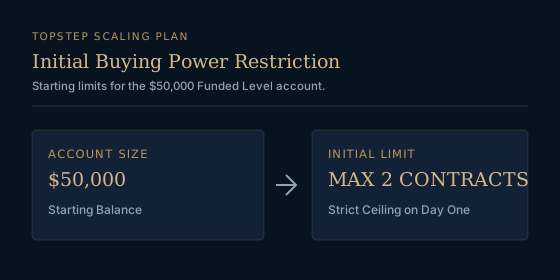
Entering a new trading environment requires adjusting to its specific boundaries. For the $50,000 Funded Level account, Topstep's scaling plan initially restricts traders to a maximum position size of 2 contracts. This means that regardless of the margin usually afforded to a $50,000 balance, the trader cannot execute an order that results in an open position larger than 2 contracts.
This initial constraint forces traders to focus on execution quality rather than relying on heavy leverage. If a trader attempts to open a position of 3 contracts while their limit remains at 2, the trading platform will typically reject the order entirely. By strictly enforcing this ceiling, the firm limits its exposure while the trader establishes a performance baseline. Traders must carefully select their setups, knowing their return per trade is mathematically capped by this restricted volume.
Are There Extra Fees To Increase Your Limit?
A common question among those entering the industry is whether contract limits can be raised by paying an additional premium. Under this specific scaling model, the answer is negative. The progression to higher contract tiers is driven entirely by the trader generating a specific amount of accumulated profit. The firm does not sell higher tiers for cash; it unlocks them based on demonstrated discipline.
This structure eliminates the risk of traders attempting to purchase their way out of a drawdown or buying larger position limits to force a recovery trade. Because the cost to scale is measured in trading performance rather than an additional fee, traders must earn the right to increase their size. This ensures that larger positions are only taken when the account has a sufficient profit buffer.
When Does The System Update Your Buying Power?
One of the most frequent sources of confusion regarding scaling plans is the exact timing of when the system recognizes a new contract limit. Traders who hit a profit target in the middle of a trading session often assume they can immediately increase their position size for the next trade. To understand how hidden mechanisms like daily limit updates and withdrawal requirements can catch traders off guard, we must examine the specific enforcement timeline.
Why Your Buying Power Doesn't Update Intraday
The mechanics of limit enforcement are just as critical as the limits themselves. Topstep calculates and updates the trader's buying power limit at the close of each trading day based on the accumulated profit, rather than intraday. This means that if a trader starts the day with a 2-contract limit and secures enough profit during the morning session to qualify for the next tier, they still cannot trade 3 contracts that same afternoon.
Updating buying power exclusively when the market closes simplifies the risk management algorithm and prevents erratic contract sizing during volatile sessions. If limits updated intraday, a trader could cross the threshold, increase their size, and immediately suffer a loss that drops them back below the threshold. By freezing the limit for the duration of the entire trading session, the firm eliminates this edge case.
How Accumulated Profit Dictates Your Limits
The scaling plan operates as a strict tier system where accumulated profit is the sole metric for progression. Accumulated profit refers to the net closed profit on the account, measured after commissions and fees, calculated from the beginning of the funded stage. It is not based on open equity or unrealized gains.
When the daily calculation occurs, the system reads the closed balance and compares it against the fixed thresholds. If the balance meets or exceeds the next target, the platform automatically adjusts the position size parameter for the following trading session. If the balance falls back below a threshold due to subsequent losses, the contract limit is reduced accordingly at the next update. This dynamic scaling ensures that the allowable leverage is constantly calibrated against actual performance.
Will The Firm Survive Regulatory Scrutiny?
Before committing time and effort to navigating a scaling plan, a trader must evaluate the structural reality of the firm offering it. Transparency regarding how trades are processed and how the firm generates revenue is the primary defense against instability and the sudden closure of a proprietary trading evaluation program. To understand the difference between live markets and the simulated environments highlighted by regulators, traders must read the actual terms of service governing their accounts.
Understanding The Simulated Trading Environment
A critical distinction must be made regarding the nature of the capital involved. The CFTC has issued advisories reminding retail customers that trading activity in proprietary trading evaluation programs typically occurs in a simulated environment, not live markets. This means that when a trader executes a 2-contract order, that order is routed to a simulation server, not to a regulated futures exchange.
Simulated execution allows the firm to manage the scaling plan without exposing itself to actual market liquidity risks. The firm acts as the counterparty to the simulation, tracking performance metrics. Acknowledging this simulated structure clarifies why rules like daily buying power updates exist: they are parameters of a software simulation designed to test discipline.
Topstep's Pioneer Status vs. Retail Advisories
The proprietary trading industry is crowded with new entrants. As noted earlier, Topstep is recognized as one of the pioneers of the futures prop trading evaluation model. This historical presence provides a baseline for evaluating their ruleset compared to newer firms.
When regulators issue advisories about the nature of these programs, they are addressing the broader market. Established firms rely on documented rulebooks. For instance, the Ordane Rulebook v1.0 is public, numbered and versioned, and no rule is ever applied retroactively to an open account. Changes produce a new version with a dated changelog entry, and the version you sign up under is the version that governs your account. Transparency in how rules are enforced is what separates a structured evaluation from a hidden trap.
How To Unlock 5 Contracts: Targets & Costs
The ultimate goal for traders operating under this specific scaling plan is to reach the maximum allowable position size. For the $50,000 account tier, this maximum ceiling represents full access to the account's intended leverage capacity. Moving from the initial restricted state to the full limit requires precise execution.
Reaching The $1,500 Accumulated Profit Goal
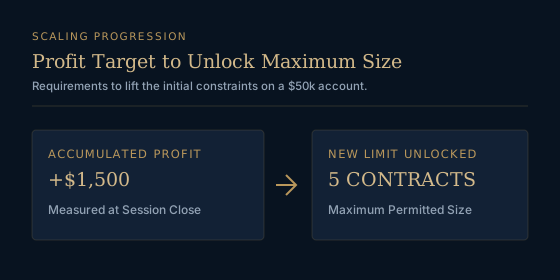
The progression from the starting limit to the maximum limit is clearly defined. Traders in the $50,000 account can unlock their maximum allowed position size of 5 contracts after their daily balance shows an accumulated profit of $1,500 or more. This exact figure serves as the single metric required to remove the early constraints.
Achieving a $1,500 accumulated profit while restricted to only 2 contracts requires capturing significant point moves in the chosen futures instrument. This calculation demonstrates that the scaling plan forces traders to rely on favorable market direction to hit their targets.
Executing With Maximum Allowed Contracts
Once the $1,500 accumulated profit threshold is confirmed at the daily update, the trader is granted access to the full 5-contract limit for the next session. This increased capacity allows for more complex trade management, such as scaling out of positions in tranches.
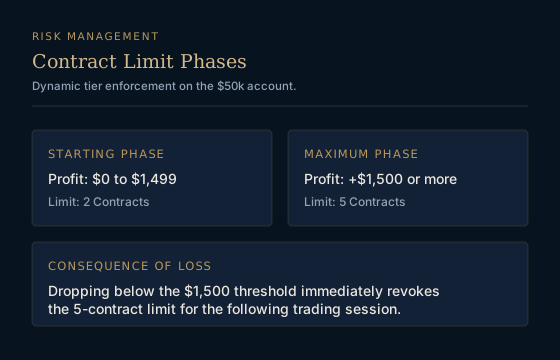
However, holding 5 contracts also amplifies the risk. If the account suffers a loss that drops the accumulated profit below the $1,500 threshold, the daily update will immediately revoke the 5-contract privilege and return the trader to a lower tier. The scaling plan acts as a permanent mechanism, continuously monitoring the account balance to ensure that the trader's position size never exceeds the risk capacity dictated by their current profit buffer.
Contract Scaling Progression Overview
| Metric | Specification |
|---|---|
| Account Size | $50,000 |
| Initial Contract Limit | 2 contracts |
| Maximum Contract Limit | 5 contracts |
| Profit Target to Unlock Maximum | +$1,500 accumulated profit |
| Enforcement Schedule | End of trading session |
Detailed Performance Requirements
| Progression Phase | Required Accumulated Profit | Permitted Maximum Position |
|---|---|---|
| Starting Phase | $0 to $1,499 | 2 Contracts |
| Maximum Phase | $1,500 or greater | 5 Contracts |
| Consequence of Loss | Drops below target | Reverts to lower tier next day |
Accountability and Guarantee Protocols
In an industry filled with subjective enforcement, verifiable clauses provide actual security. Ordane operates under a strict, versioned framework. The Ordane Guarantee ensures that every withdrawal request is approved, or denied in writing citing the exact rule breached by section number, within 24 clock hours. Past that deadline the request is treated as approved and the G-1 clock starts.
A payout approved and not paid within 48 clock hours, not business hours, triggers automatic compensation: a 100 percent refund of the account fee, plus the payout owed in full. The Ordane Guarantee has two objective exclusions: documented fraud or KYC review, and declared force majeure. Both carry a hard deadline, and beyond it the guarantee applies regardless. If you are evaluating a scaling plan and prefer to trade in an environment defined by static limits, review the Ordane Rulebook to see exactly how the risk framework operates.
Topstep Scaling FAQ
Traders evaluating the Topstep scaling plan frequently ask how the rules are applied in daily practice. This section answers the most common technical questions regarding contract limits, daily updates, and the simulated nature of the trading environment, providing clear guidance on how the risk management framework restricts leverage.
How does the Topstep scaling plan work?
The scaling plan dictates the maximum number of contracts a trader can hold at one time, tying position limits to accumulated profit. It starts with a restricted limit and increases only when the trader reaches specific accumulated profit targets.
Can I trade 5 contracts immediately on day one?
No. For the $50,000 account, the starting limit is strictly capped at 2 contracts, and you cannot bypass this limit by paying an extra fee.
Does the scaling limit update mid-day?
No. Buying power and contract limits are calculated exclusively after the market closes. Any profit accumulated during a session will not unlock a higher contract tier until the next trading day begins.
Is the scaling plan based on real money markets?
No. As noted by industry regulators, these programs operate within a simulated trading environment. The scaling plan is an internal risk parameter applied to the simulation, not a margin requirement from a live exchange.
What happens if I exceed my contract limit?
Attempting to execute an order that exceeds your current scaling limit will typically result in the platform rejecting the order. If a position somehow breaches the limit, it constitutes a hard violation and may result in immediate account closure.
Sources
- Topstep, on the scaling plan structure and daily buying power calculation. help.topstep.com Retrieved Sep 5, 2026.
- U.S. Commodity Futures Trading Commission, on proprietary trading evaluation programs and simulated environments. cftc.gov Retrieved Sep 5, 2026.
- Finance Magnates, on Topstep's role as a pioneer in the futures prop trading evaluation model. financemagnates.com Retrieved Sep 5, 2026.
- Ordane Rulebook v1.0, clause G-0 and G-1, on the Ordane Guarantee structure and withdrawal timelines. ordanemarkets.com/rulebook Retrieved Aug 4, 2026.
- Ordane Rulebook v1.0, section 1, on Ordane Instant Account operation and simulated capital. ordanemarkets.com/rulebook Retrieved Aug 4, 2026.
- Ordane Rulebook v1.0, section 6, on rulebook versioning and non-retroactive rule application. ordanemarkets.com/rulebook Retrieved Aug 4, 2026.