Home · The Ordane Journal · Rules and Mechanics · Topstep Inactivity Rule Explained
Topstep Inactivity Rule Explained
The inactivity rule is a risk management mechanism used by proprietary trading firms that automatically closes accounts if a trader fails to place a trade within a specified timeframe. Ordane accounts operate on simulated capital. No live funds are traded and no deposits are accepted.
Ordane sells one product, the Ordane Instant Account: direct access, no evaluation phase and no challenge, on simulated capital. We review rules across the market to provide structural clarity. When traders evaluate an environment, they need to know exactly how time limits operate.
What Is the Topstep Inactivity Rule?
Topstep (prop firm) enforces a 30-day inactivity rule, where accounts that do not place a trade for 30 consecutive days are automatically closed. This mechanism operates silently in the background. Traders often focus heavily on profit targets and drawdown limits while ignoring time constraints. The thirty days count consecutively. Weekends and market holidays factor into this calculation. If the limit is reached, the system triggers an automatic closure.
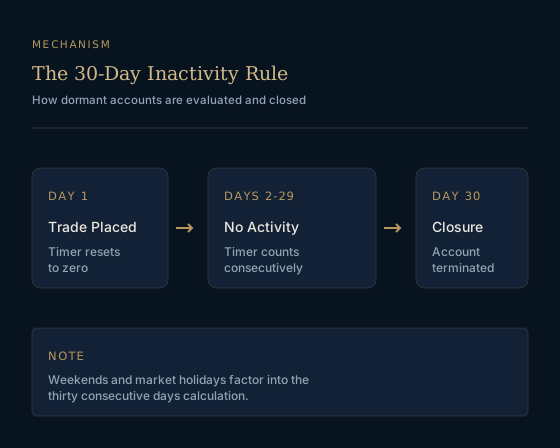
Traders frequently ask if logging into the platform resets the timer. Platform logins do not reset the inactivity timer. Only a placed trade resets the clock. This strict requirement ensures that only active participants consume server resources and data feeds. Firms pay infrastructure costs for every open account. Inactive accounts generate data fees without providing any trading volume.
The rationale behind this rule connects directly to infrastructure management. Active traders generate the data that firms analyze. Dormant accounts represent a dead weight on the technology stack. By closing inactive accounts, firms optimize their server loads. This optimization allows them to maintain stable platforms for active participants.
Server Costs and Resource Allocation
Every proprietary trading firm manages a technology stack. This stack includes price feeds, trade execution engines, and risk management software. These components cost money to operate. Firms allocate these resources based on active participation. When an account goes dormant, it still consumes a portion of this infrastructure budget.
In the proprietary trading industry, inactivity rules ranging from 14 to 30 days are standard practice to manage capital allocation and server resources. Topstep chose the maximum end of this spectrum. A thirty day window provides ample flexibility for traders who take vacations or step away during poor market conditions.
Traders must monitor their own timelines. The system will not send a warning on day twenty nine. The responsibility rests entirely on the trader to place a valid trade before the window closes. Understanding this mechanic prevents unnecessary account losses.
Will You Lose Your Account After 30 Days?
Yes, reaching the thirty day mark results in immediate account closure. This closure applies regardless of the account balance or evaluation progress. If a trader is one day away from passing an evaluation and fails to trade for thirty days, the account is lost. The system does not negotiate or grant extensions.
This brings up the first major fear traders have in this industry. Traders worry about passing an evaluation and never receiving payment. They worry that a hidden rule will invalidate their progress. At Ordane, we address this directly. Ordane's maximum drawdown is 5 percent and static: account equity may never fall below 95 percent of the initial balance. The floor is fixed on day one, never trails upward, and a breach closes the account. A breach closes the account. That is the whole consequence: no partial confiscations, no surprise fees, no renegotiation.
When a Topstep account closes due to inactivity, all progress is erased. Any accumulated profits in a simulated environment are forfeit. The trader must purchase a new evaluation to return to the platform. This absolute consequence demonstrates the mechanical nature of the rule.
The Impact on Unpaid Profits
Traders often wonder what happens to unpaid profits when an inactivity breach occurs. Because the account closes immediately, any pending profit splits are nullified. The firm reclaims the simulated capital. The trader loses access to the dashboard.
This strict enforcement is why clear rules matter. Traders fear that firms will invent reasons to deny payouts. Ordane's prohibited-practice list is closed. Clause R-6 names six practices: latency arbitrage, reverse or hedge arbitrage, high-frequency or bulk automated exploitation, copy trading between Ordane accounts, straddling news releases with paired opposing orders, platform or data-feed exploitation, and gap abuse. If a behavior is not listed in that section, it is not a violation. Discretion is not a rule.
To reset the Topstep timer, a trader only needs to execute a micro lot trade. This small action proves the account remains active. It satisfies the system requirement and resets the thirty day counter. Traders managing multiple accounts must ensure they place a trade on every single account they wish to keep active.
Regulatory Context of Inactivity Rules
Proprietary trading firms often operate without direct CFTC registration by trading their own capital rather than client funds, which allows them to set internal risk rules like inactivity breaches. This structural reality means firms have wide latitude to define their own operating parameters.
Because they are not managing customer deposits, they do not face the same strictures as retail brokers. They dictate the terms of access to their simulated environments. The inactivity rule is one of these dictated terms. It is a condition of the contract the trader accepts upon registration.
This regulatory independence brings us to the third major fear. Traders worry that the firm will vanish in twelve months. They see firms close and take fees with them. Ordane is new. Its live homepage says it will not fake a history, the rulebook says payout performance metrics begin with the first month in which a payout is requested. We provide transparency through a verifiable structure. Ordane's payout reserve is published at a public TRON address on ordanemarkets.com and in Rulebook v1.0 clause PR-1. The page carries a dated observed balance and states that the reserve is not a promise, it is an address.
Are There Any Fees for an Inactivity Breach?
An inactivity breach does not trigger a direct financial penalty. The firm will not charge a trader's credit card because the account went dormant. The financial loss is limited entirely to the initial fee paid for the account and any accumulated simulated profits that are forfeited.
This structure aligns with the general model of proprietary trading firms. Traders pay upfront for access to an evaluation or a simulated environment. Once that fee is paid, the firm assumes the infrastructure risk. If the trader breaches a rule, the account closes. The trader owes nothing more.
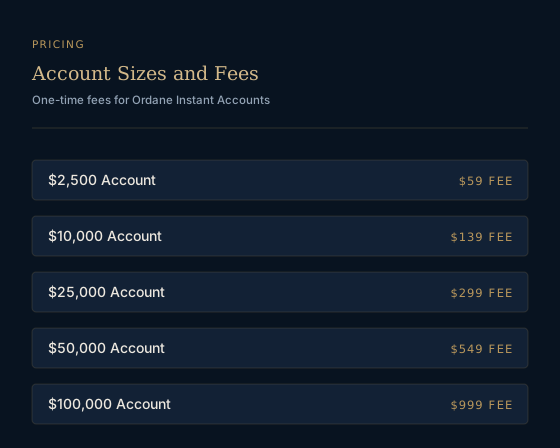
At Ordane, the pricing model is equally clear. The fee is one-time: $59 for the $2,500 account, $139 for the $10,000 account, $299 for $25,000, $549 for $50,000 and $999 for $100,000. There are no recurring fees, no hidden tiers and no coupon games. The cost is fixed and transparent from day one.
The Cost of Re-Entry
While there is no penalty fee for inactivity, returning to the platform requires purchasing a new account. This represents a replacement cost. If a trader lets a large account expire due to inactivity, the cost to replace it can be substantial.
This is why understanding the rules is a financial imperative. Every rule breach carries a replacement cost. Firms rely on these replacement costs as part of their revenue model. Traders must treat the rulebook as their primary risk management tool.
Ordane ensures that traders never face retroactive rule changes. The Ordane rulebook is public, numbered and versioned, and no rule is ever applied retroactively to an open account. Changes produce a new version with a dated changelog entry, and the version you sign up under is the version that governs your account.
Securing the Payout Structure
Traders who avoid inactivity breaches and generate simulated profit expect to receive payment. This brings us to the core of the business model. Every withdrawal request is approved, or denied in writing citing the exact rule breached by section number, within 24 clock hours. Past that deadline the request is treated as approved and the G-1 clock starts.
A payout approved and not paid within 48 clock hours, not business hours, triggers automatic compensation: a 100 percent refund of the account fee, plus the payout owed in full. This mechanism is called The Ordane Guarantee. It enforces discipline on the firm itself. The Ordane Guarantee has two objective exclusions: documented fraud or KYC review, and declared force majeure. Both carry a hard deadline, and beyond it G-1 applies regardless.
The profit split structure must also be transparent. Ordane's profit split starts at 60 percent and rises 5 percentage points with every completed withdrawal, reaching 100 percent from the ninth withdrawal onward. Withdrawals 1 and 2 are each capped at 3 percent of initial balance. From withdrawal 3 onward there is no cap.
Why Do Prop Firms Enforce Inactivity Limits?
Firms enforce these limits to clear dead weight from their systems. An account that does not trade provides no data and generates no value. It only consumes resources. By purging these accounts, firms optimize their operational efficiency.
This efficiency allows firms to offer better conditions to active traders. The resources freed by closing dormant accounts can be reallocated to improve execution speeds and platform stability. It is a necessary administrative function in a high volume digital business.
At Ordane, accounts with no trading activity for 30 consecutive days are closed. The 30 consecutive days in clause R-5 are calendar days (dias corridos), not business days. Under clause R-5, trading activity means at least one filled order. Pending orders and platform logins do not count.
The Psychology of Trading Breaks
Traders frequently take extended breaks from the markets. These breaks serve an important psychological function. After a series of losses, a trader might need weeks to recover their mental capital. Market conditions also dictate pauses. During low volatility periods, executing trades can be counterproductive.
The thirty day rule forces a conflict between necessary rest and administrative requirements. A trader seeking a mental reset might feel pressured to place a trade simply to keep the account alive. This pressure can lead to poor execution and unnecessary risk.
To resolve this conflict, traders use micro lots. Executing a micro lot trade satisfies the activity requirement while risking negligible capital. This administrative trade resets the clock without exposing the trader to the stress of a full sized position. It is a technical solution to a psychological problem.
Firms understand this dynamic. The rule exists to clear truly abandoned accounts, not to force active traders into bad positions. By allowing micro lots to reset the timer, firms balance their infrastructure needs with the realities of trading psychology.
Technical Architecture and Data Feeds
To fully grasp the necessity of inactivity rules, one must understand the technology stack. Proprietary trading firms connect to institutional data feeds. These feeds supply the real time pricing necessary for simulated execution. The data providers charge the firm for every active connection.
When a trader leaves an account dormant, the connection remains active. The firm continues to pay the data provider for a user who generates no trading volume. Across thousands of accounts, these costs compound rapidly.
Closing inactive accounts severs these expensive connections. It is a direct cost saving measure. The industry standard of fourteen to thirty days represents the balance point. It gives the trader enough time to take a normal break while protecting the firm from indefinite data costs.
Ordane runs on a trading platform it designed and built with its own engineering team, and licenses no third-party terminal: not MatchTrader, not MetaTrader, not any external vendor. The distinction is structural, not cosmetic. A firm that licenses its terminal can be closed by a decision it does not control, and in 2024 that is exactly what happened: MetaQuotes withdrew MT4 and MT5 access from prop firms, True Forex Funds announced permanent closure on 13 May after its licences were terminated, and SurgeTrader ceased all operations on 24 May, one week after losing its Match-Trader licence. Ordane owns the terminal its traders use, so no vendor can revoke it, reprice it, or decide it will no longer serve this industry.
The Role of Consistency in Simulated Environments
Inactivity rules often sit alongside consistency rules. Both mechanisms seek to define a professional trading pattern. The firm wants to identify traders who execute systematically over time.
Ordane's consistency rule is 20 percent: at the moment of a withdrawal request, no single trading day may account for more than 20 percent of the cycle's total profit. If a day exceeds 20 percent, the excess profit from that day is deferred to the next cycle. It is never confiscated, and the remainder of the cycle pays out normally.
This consistency requirement forces the trader to remain engaged. A trader cannot make one massive trade and then disappear for twenty nine days. The combination of consistency rules and inactivity limits creates an environment that rewards steady participation.
The first withdrawal is available 7 calendar days after account activation, and the cycle thereafter is every 14 days. Withdrawals reduce the account balance, and the R-1 drawdown floor stays anchored to the initial balance. This structure means the trader must actively manage their equity curve while maintaining a regular execution schedule.
Comparing Capital Structures
The regulatory framework dictates how these firms organize their capital. Firms trading their own capital operate differently than traditional brokerages. Traditional brokers hold client deposits in segregated accounts. They must adhere to strict capitalization and reporting requirements.
Proprietary firms operate outside this specific mandate. They sell an evaluation or a simulated environment. The trader purchases a service, not a financial security. This distinction is paramount.
Payouts are paid in real money from company fee revenue. No client deposits are taken and no client capital is traded. Rulebook v1.0 clause PR-1 commits Ordane to publish the payout reserve on-chain, the live rulebook and homepage publish the TRON address. This mechanism proves the firm has the capital to honor its commitments without relying on new signups paying old winners.
By managing server costs through inactivity rules and maintaining a verifiable reserve, the firm ensures long term stability. Rulebook v1.0 clause PR-3 commits Ordane to independent third-party attestation of payout records, entering effect per the public roadmap milestone. This provides external verification of the internal mechanisms.
Calculating the Inactivity Window
Traders must calculate their inactivity windows accurately to avoid accidental breaches. The calculation involves adding the firm's allowed duration to the date of the last executed trade. We can demonstrate this calculation using the industry standard metrics.
Declared inputs for this check: a 14 day industry minimum limit, a 16 day operational extension, and a 30 day maximum limit. Worked arithmetic: 14 + 16 = 30 total days.
| Metric Description | Timeframe Value | Note |
|---|---|---|
| Industry Minimum Inactivity Limit | 14 days | Standard baseline for rapid resource clearing |
| Operational Extension | 16 days | Additional time provided by flexible firms |
| Total Maximum Inactivity Limit | 30 days | The upper boundary used by Topstep and Ordane |
This calculation shows that a thirty day window is the most generous timeframe typically offered in the market. Traders who require more than thirty consecutive days away from the terminal should close all open positions and accept that they will need to purchase a new account when they return.
Comparing Industry Standards
Different firms approach this administrative task with slight variations. The table below compares the standard metrics based on the established claims.
| Firm Model | Inactivity Limit | Regulatory Context |
|---|---|---|
| Topstep | 30 Days | Internal risk rule |
| Industry Standard Baseline | 14 Days | Varies by infrastructure cost |
| Ordane Instant Account | 30 Days | Clause R-5 enforcement |
The regulatory environment permits these variations. The CFTC exemption for firms trading their own capital allows each company to define its own risk parameters. Traders must read the specific terms of service for every platform they use. Assuming that one firm operates exactly like another is a costly mistake.
Final Considerations on Time Management
Managing the inactivity timer is as critical as managing a stop loss. Both mechanisms protect the account from closure. A trader who meticulously manages market risk but ignores administrative rules will eventually lose their account.
Clear rules remove the guesswork from proprietary trading. The governing document is Ordane Rulebook v1.0, published 2026-07-23. By keeping all rules public and versioned, we ensure traders know exactly where they stand.
Traders should build a routine check into their weekly process. Reviewing the last trade date on all active accounts takes only a few minutes. This simple habit ensures that no account is lost to an administrative oversight. Maintain activity, respect the rules, and focus on consistent execution in the simulated market. Ready to review the verified ruleset? Check the public Ordane Rulebook to see exactly how these mechanisms work in practice.
Frequently Asked Questions
What happens if I violate the Topstep inactivity rule?
If you do not place a trade for 30 consecutive days, your account is automatically closed and all progress or unpaid simulated profits are lost. The trader must purchase a new account to return to the platform.
Does a platform login reset the inactivity timer?
No, logging into the trading platform does not reset the inactivity timer. Only executing a trade counts as trading activity and resets the 30-day clock.
Do weekends count toward the 30-day inactivity rule?
Yes, the 30 days are counted as consecutive calendar days, meaning weekends and market holidays are included in the inactivity timeframe.
What is the Ordane inactivity rule?
At Ordane, accounts with no trading activity for 30 consecutive calendar days are closed, and a filled order is required to reset the timer.
Sources
- Topstep Help Center, on Account Inactivity Rule. help.topstep.com Retrieved Sep 5, 2026.
- Finance Magnates, on risk management at modern retail prop firms including inactivity rules. financemagnates.com Retrieved Sep 5, 2026.
- U.S. Commodity Futures Trading Commission, on Trading Organizations and firms trading for their own account. cftc.gov Retrieved Sep 5, 2026.