Home · The Ordane Journal · Pricing and Cost · My Funded Futures Discount Code & Setup
My Funded Futures Discount Code & Setup
Traders search for a funded account every day. A promotional discount code lowers the initial evaluation fee for a simulated trading account. Ordane accounts operate on simulated capital. No live funds are traded and no deposits are accepted. (Ordane Rulebook v1.0, clause P-2, retrieved 2026-09-06)
In one sentence: A My Funded Futures discount code reduces the upfront cash exposure to start an evaluation challenge, but it does not alter the rigorous testing criteria or risk management rules required to pass.
However, before looking at any promotional offer, you must verify the structural reality of the trading environment. This fundamental fact dictates how risk is managed and how payouts are processed across the industry. When evaluating any firm, the initial cash exposure is just the first metric to consider. The rules governing the platform and the certainty of payouts matter significantly more than a temporary reduction in the upfront cost. Finding a promotional code might reduce the immediate expense, but it does not alter the rigorous testing criteria required by evaluation models.
How to Apply a My Funded Futures Promo Code?
Traders apply discount coupons directly on the My Funded Futures checkout page, inserting the code in the specific field before finalizing the evaluation account purchase. This administrative step immediately reduces the initial cash exposure.
Here are the procedural steps to complete this transaction:
- Navigate to the official billing section.
- Select the desired simulated capital size.
- Input the exact text of the promotional code into the designated field.
- Verify that the new total reflects the expected discount before confirming the payment.
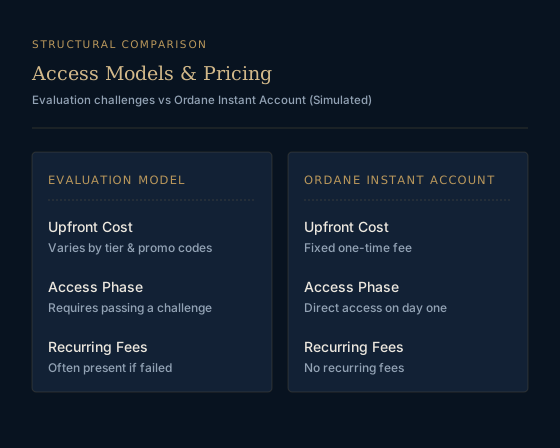
This sequence ensures the initial cash layout is minimized. However, the evaluation model inherently requires traders to pass a challenge before accessing the payout stage. The industry advertises the split and the discounts, but the structure of the product is what determines the actual cost over time. Choosing the right evaluation tier before applying the code is a necessary step to understand an instant account vs evaluation prop firm model, as different tiers carry different risk parameters and profit targets.
Ordane operates on a completely different structural premise. Ordane sells one product, the Ordane Instant Account: direct access, no evaluation phase and no challenge, on simulated capital. (Ordane Rulebook v1.0, section 1, retrieved 2026-09-06) The focus is entirely on straightforward access rather than promotional cycles. The fee is one-time: $59 for the $2,500 account, $139 for the $10,000 account, $299 for $25,000, $549 for $50,000 and $999 for $100,000. There are no recurring fees, no hidden tiers and no coupon games. This pricing model provides immediate clarity on the total cost of access.
Does the Discount Change Evaluation Rules?
A reduced upfront fee does not alter the simulated environment conditions or the definition of the traded asset. Understanding what you are trading is critical. A Commodity Futures Trading Commission (CFTC) formally defines a futures contract as an agreement to purchase or sell a commodity for delivery in the future at a price that is determined at initiation of the contract. However, in these evaluation environments, you are operating on simulated data feeds rather than executing real agreements on a live exchange.
The discount applied at checkout only changes the initial billing amount. It does not provide any leniency on the trading rules, the profit targets, or the drawdown limits required to pass the evaluation phase.
"A discount code lowers the entry barrier but does not buy a wider stop loss, an exemption from consistency rules, or a change in the evaluation architecture." — Ordane Research Desk
Are There Hidden Rules at Payout?
The threat of hidden rules that surface when it is time to request a payout is a major concern. You must understand prop firm hidden fees and recurring costs beyond the initial discounted evaluation price. Firms often rely on discretionary clauses to deny withdrawals, citing vague violations that were never clearly defined upfront. This practice creates an environment of constant uncertainty, where the trader is never entirely sure if their trading style will be deemed acceptable at the end of the month.
Ordane removes this uncertainty entirely through strict documentation. The governing document is Ordane Rulebook v1.0, published 2026-07-23. The Ordane rulebook is public, numbered and versioned, and no rule is ever applied retroactively to an open account. Changes produce a new version with a dated changelog entry, and the version you sign up under is the version that governs your account.
Ordane's prohibited-practice list is closed. Clause R-6 names six practices: latency, reverse or hedge arbitrage; high-frequency or bulk automated exploitation; copy trading between Ordane accounts; straddling news releases with paired opposing orders; platform or data-feed exploitation; and gap abuse. If a behavior is not listed in that section, it is not a violation. Discretion is not a rule.
What Are the Rules After a Breach?
If a rule is broken, the outcome is objective, and knowing what happens when you breach a prop firm account is critical: a breach closes the account. That is the whole consequence: no partial confiscations, no surprise fees, no renegotiation. Ordane's maximum drawdown is 5 percent and static: account equity may never fall below 95 percent of the initial balance. The floor is fixed on day one, never trails upward, and a breach closes the account. The daily loss limit is 3 percent, measured against the balance at the start of the server day. A breach closes the account. Maximum risk per trade is 1.5 percent of current balance and a stop-loss is mandatory at entry. Two maximum losses equal the daily limit, which is the design rather than an accident.
To ensure long-term viability, structural rules must govern trading behavior. Ordane's consistency rule is 20 percent: at the moment of a withdrawal request, no single trading day may account for more than 20 percent of the cycle's total profit. If a day exceeds 20 percent, the excess profit from that day is deferred to the next cycle. It is never confiscated, and the remainder of the cycle pays out normally. Furthermore, accounts with no trading activity for 30 consecutive days are closed. The 30 consecutive days in clause R-5 are calendar days, not business days. Under clause R-5, trading activity means at least one filled order. Pending orders and platform logins do not count.
How Are Automation and Accounts Managed?
Expert Advisors are fully permitted at Ordane: a trader may run an EA executing the trader's own strategy on an Ordane account. The R-6 prohibition on copy trading between Ordane accounts applies only between different people. Copy trading is permitted exclusively between Ordane accounts that belong to the same person, meaning the same account holder and ultimate beneficial owner. Copy trading between person A and person B is always prohibited. Ordane lists four asset classes: FX pairs (majors and minors), metals, indices and crypto. No exotics. Ordane's settled leverage is 1:50 on FX majors and minors. Leverage for metals, indices and crypto has not been set yet. Overnight and weekend holding is allowed at Ordane. It is not on the R-6 closed list, and what is not listed is not a violation.
The trading infrastructure itself is a critical rule component. Ordane runs on a trading platform it designed and built with its own engineering team, and licenses no third-party terminal: not MatchTrader, not MetaTrader, not any external vendor. The distinction is structural, not cosmetic. A firm that licenses its terminal can be closed by a decision it does not control, and in 2024 that is exactly what happened. MetaQuotes withdrew MT4 and MT5 access from prop firms. True Forex Funds announced permanent closure on May 13, 2024, after its licences were terminated, and SurgeTrader ceased all operations on May 24, 2024, one week after losing its Match-Trader licence. Ordane owns the terminal its traders use, so no vendor can revoke it, reprice it, or decide it will no longer serve this industry.
What Is the Evaluation Pricing Structure After Discount?
My Funded Futures markets evaluation accounts for futures trading in different simulated capital sizes, such as the $50,000 ones, with prices that vary according to the model, Starter or Expert. The final cash out-of-pocket cost depends directly on how to choose a prop firm account size and the specific value of the promotional code applied at checkout.
To understand the mathematical impact of these costs, we must look at concrete pricing examples using a straightforward addition model.
Declared inputs for this check: a $59 fee for the $2,500 account, a $139 fee for the $10,000 account, and a $0 recurring fee. Worked arithmetic: $59 + $139 = $198.
This calculation demonstrates the exact initial cash exposure for accessing two distinct account sizes under a fixed pricing model. When evaluating any structure, you must perform this exact calculation with the specific variables provided by the firm, factoring in the base price and any applicable reductions.
| Metric/Feature | Ordane (Simulated) | Industry Standard |
|---|---|---|
| Upfront Cost | Fixed one-time fee | Varies by evaluation tier |
| Promotional Codes | No coupon games | Frequently required for best price |
| Access Phase | Direct access on day one | Requires passing a challenge |
| Recurring Fees | No recurring fees | Often present if failed |
| Capital Type | Simulated capital | Simulated capital |
How Are Payouts Managed and Verified?
The third major fear is whether the firm will still exist in twelve months to process your withdrawals. Many operations launch with aggressive promotional campaigns, collect evaluation fees, and then disappear when the first wave of successful traders requests their earnings, which raises the question of where does prop firm payout money come from. This cycle is sustained by a lack of verifiable financial reserves.
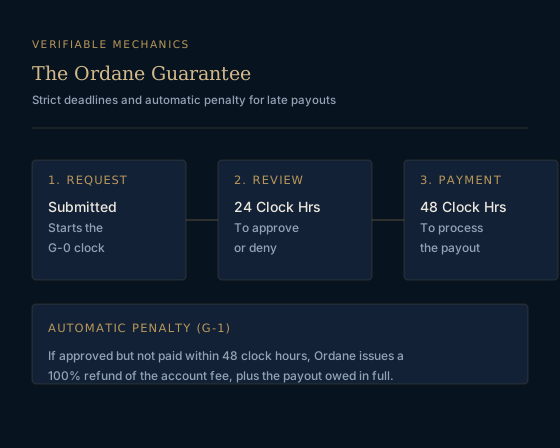
Fear of not getting paid is the primary concern for any trader entering this market. You must ask whether the firm has a binding mechanism to ensure payouts. Every withdrawal request is approved, or denied in writing citing the exact rule breached by section number, within 24 clock hours. Past that deadline the request is treated as approved and the G-1 clock starts. A payout approved and not paid within 48 clock hours, not business hours, triggers automatic compensation: a 100 percent refund of the account fee, plus the payout owed in full. Both G-2 exclusions (documented fraud or KYC review, and declared force majeure) are capped at 10 business days each. Past that deadline, G-1 applies regardless. This mechanism is known formally as The Ordane Guarantee.
Ordane addresses this directly by exposing its financial capacity to public scrutiny. Ordane's payout reserve is published at a public TRON address on ordanemarkets.com and in Rulebook v1.0 clause PR-1. The page carries a dated observed balance and states that the reserve is not a promise, it is an address. Furthermore, Rulebook v1.0 clause PR-3 commits Ordane to independent third-party attestation of payout records, entering effect per the public roadmap milestone.
How Does Capital Extraction Impact Accounts?
Once a trader is operating on an account, the mechanics of capital extraction become the sole focus, making prop firm withdrawal requirements essential to understand. The first withdrawal is available 7 calendar days after account activation, and the cycle thereafter is every 14 days. Ordane's profit split starts at 60 percent and rises 5 percentage points with every completed withdrawal, reaching 100 percent from the ninth withdrawal onward. The split ladder is in writing and never resets.
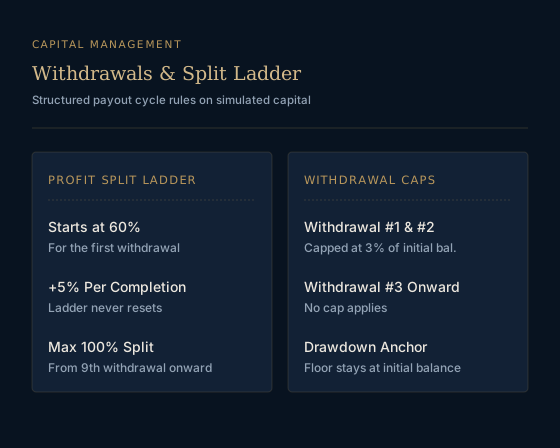
Managing the extracted capital also requires understanding how it impacts the account parameters. Withdrawals #1 and #2 are each capped at 3 percent of initial balance. From withdrawal #3 onward there is no cap. Withdrawals reduce the account balance, and the R-1 drawdown floor stays anchored to the initial balance.
This level of structural transparency is rare. Below is a structured timeline of the Ordane payout and capital management mechanics, built strictly from the published rulebook facts.
| Step | Mechanism | Consequence of Delay or Action |
|---|---|---|
| Request | Submitted by the trader | Starts the G-0 clock |
| Review | 24 clock hours to approve or deny | Treated as approved if late |
| Payment | 48 clock hours to process | Triggers The Ordane Guarantee (G-1) |
| Exclusions | 10 business days for fraud/KYC | G-1 applies after the deadline |
| Capital Extraction | Reduces the account balance | R-1 drawdown floor stays anchored |
For those looking to promote the firm, the structure is equally objective. Ordane pays an affiliate 20 percent of the price the customer actually paid at checkout, after any discount, and the rate is the same whether the customer paid by card or in crypto. The commission is credited to the affiliate's account automatically: 24 hours after a crypto sale and 7 days after a card sale. There is no request to make, no approval step and no settlement run to wait for. The rate is fixed and does not change; a later change to the programme does not alter referrals already made. Every sale counts, with no exclusion by product or account size.
Traders must prioritize verifiable rules over temporary pricing reductions. A discount code lowers the barrier to entry, but it does not change the fundamental architecture of the trading environment. Ordane is operated by Ordane Markets Ltd (in formation). Ordane charges no commission, no spread and no swap. The account fee is the only cost the trader pays. The reason is structural, not promotional: accounts run on simulated capital, so no order is routed to an exchange and nothing is financed overnight, which means neither line has an underlying bill behind it.
The industry standard relies heavily on evaluations, discretionary rules, and constant promotional cycles. You must read the rulebook of any firm you consider and demand proof of their ability to pay.
Questions traders ask about My Funded Futures discount codes
What is a My Funded Futures discount code?
A discount code is a promotional text entered at checkout that reduces the initial evaluation fee for a simulated trading account.
Does a discount code change the trading rules?
No. The discount applied at checkout only changes the initial billing amount and does not provide leniency on profit targets or drawdown limits.
Are there recurring fees with Ordane?
No. The fee is one-time, with no recurring fees, no hidden tiers and no coupon games.
Is there a challenge phase at Ordane?
No. Ordane sells one product, the Ordane Instant Account: direct access, no evaluation phase and no challenge, on simulated capital.
Sources
- CFTC Glossary, on how a Commodity Futures Trading Commission formally defines a futures contract. Retrieved 2026-09-06.
- My Funded Futures, on the pricing structure and evaluation accounts available by capital size and tier. Retrieved 2026-09-06.
- My Funded Futures Help Center: Checkout and Billing, on how discount codes are applied during the checkout process. Retrieved 2026-09-06.
- Ordane Rulebook v1.0, sections 1, P-2, R-1, R-5, R-6, G-1, G-2, PR-1 and PR-3, on Ordane's account model, capital type, rules, and payout guarantees. Retrieved 2026-09-06.