Home · The Ordane Journal · Rules and Mechanics · Alpha Capital Group Drawdown Rules
Alpha Capital Group Drawdown Rules
Drawdown rules dictate the maximum allowed loss a trader can incur before an account is closed, establishing the ultimate boundaries for strict risk management. Ordane evaluates performance using simulated capital where no live funds are traded and no deposits are accepted.
Traders evaluating a firm look for the rules that define their failure condition. The primary concerns in this market are predictable: getting paid after generating a result, navigating the rulebook without tripping over a hidden clause, and ensuring the firm remains operational long enough to process the withdrawal.
The concern regarding payments requires a mechanical answer rather than a marketing statement. Every withdrawal request is approved, or denied in writing citing the exact rule breached by section number, within 24 clock hours. Past that deadline the request is treated as approved and the G-1 clock starts. A payout approved and not paid within 48 clock hours, not business hours, triggers automatic compensation: a 100 percent refund of the account fee, plus the payout owed in full. This mechanism is known as The Ordane Guarantee. (Ordane Rulebook v1.0, clause G-1, retrieved 2026-09-05)
The concern regarding hidden rules is addressed through contract stability. The Ordane rulebook is public, numbered and versioned, and no rule is ever applied retroactively to an open account. Changes produce a new version with a dated changelog entry, and the version you sign up under is the version that governs your account. Furthermore, Ordane's prohibited-practice list is closed. Clause R-6 names six practices: latency, reverse or hedge arbitrage; high-frequency or bulk automated exploitation; copy trading between Ordane accounts; straddling news releases with paired opposing orders; platform or data-feed exploitation; and gap abuse. If a behavior is not listed in that section, it is not a violation. Discretion is not a rule. (Ordane Rulebook v1.0, clause R-6, retrieved 2026-09-05)
The concern regarding longevity requires transparent verification. Ordane's payout reserve is published at a public TRON address on ordanemarkets.com and in Rulebook v1.0 clause PR-1. (Ordane Rulebook v1.0, clause PR-1, retrieved 2026-09-05) The page carries a dated observed balance and states that the reserve is not a promise, it is an address. For context on the product structure, Ordane sells one product, the Ordane Instant Account: direct access, no evaluation phase and no challenge, on simulated capital.
What Are the Alpha Capital Group Drawdown Limits?
Alpha Capital Group limits traders to a maximum overall drawdown of 10 percent on the initial balance, and a maximum daily loss limit of 5 percent. Alpha Capital Group enforces a maximum overall drawdown limit of 10% on its evaluation accounts. (Alpha Capital Group FAQ - Trading Rules, retrieved 2026-09-05) This establishes the absolute floor for the account. If the balance or equity drops below 90 percent of the starting value at any point, the account is closed.
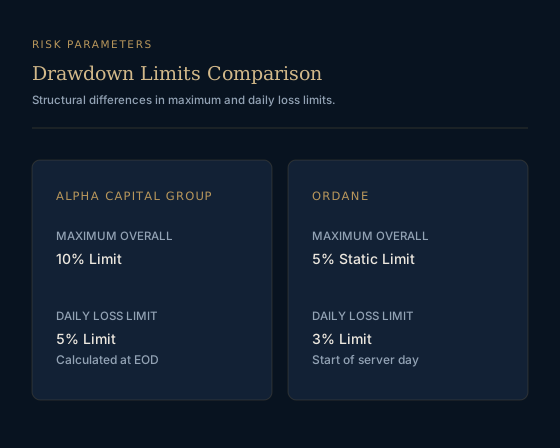
To provide a comparison point, Ordane operates with different parameters. Ordane's maximum drawdown is 5 percent and static: account equity may never fall below 95 percent of the initial balance. The floor is fixed on day one, never trails upward, and a breach closes the account. (Ordane Rulebook v1.0, clause R-1, retrieved 2026-09-05) The Ordane daily loss limit is 3 percent, measured against the balance at the start of the server day. A breach closes the account. (Ordane Rulebook v1.0, clause R-2, retrieved 2026-09-05) Maximum risk per trade is 1.5 percent of current balance and a stop-loss is mandatory at entry. Two maximum losses equal the daily limit, which is the design rather than an accident. (Ordane Rulebook v1.0, clause R-3, retrieved 2026-09-05)
Does the Overall Drawdown Limit Trail Upward?
No, the 10 percent overall limit at Alpha Capital Group is static relative to the initial balance and does not trail upward as the account gains simulated profit. The overall limit acts as the final safety net for the firm and the ultimate boundary for the trader. A 10 percent limit on a 100,000 dollar account provides a 10,000 dollar buffer. This provides a clear advantage for traders who secure early gains, as their absolute buffer to the downside increases.
Consider the operational impact of this structure through a series of observations:
- An account starting at 100,000 dollars has a hard floor at 90,000 dollars.
- If the trader generates 5,000 dollars in profit, the balance becomes 105,000 dollars.
- The overall floor remains at 90,000 dollars, meaning the trader now has a 15,000 dollar buffer before breaching the maximum limit.
- This static nature rewards consistent performance by widening the survival margin.
Why Is Position Sizing Critical for the Daily Limit?
Position sizing is critical because the 5 percent daily loss limit at Alpha Capital Group represents a hard boundary that can be consumed quickly by improperly sized trades during a single session. The daily loss limit operates independently of the maximum overall limit and is designed to prevent severe single-day drawdowns. A 5 percent daily limit on a 100,000 dollar account represents a 5,000 dollar risk allowance per trading session. This forces strict position sizing and requires a methodical approach to stop-loss placement. A trader attempting to risk 2 percent per trade can only sustain two consecutive losses before approaching the critical boundary, leaving very little room for a third trade.
Managing this limit requires precise discipline. A single market spike or an improperly sized position during a news release can consume the entire daily allowance in minutes. Therefore, understanding exactly when and how this 5 percent is calculated dictates the entire trading strategy for the session.
How Is the EOD Daily Drawdown Calculated?
The 5 percent daily drawdown limit at Alpha Capital Group is calculated based on the previous day's end-of-day equity or balance, whichever is higher, precisely at midnight server time. (Alpha Capital Group FAQ - Drawdown Rules, retrieved 2026-09-05) This establishes a firm floor exactly at midnight.
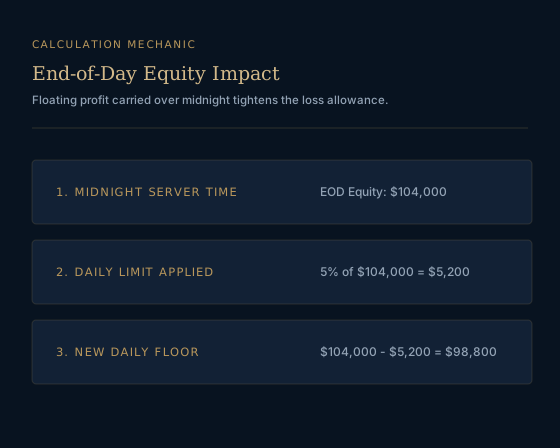
This calculation method introduces a specific dynamic for traders who hold positions overnight. Because the limit is based on the higher of the equity or balance at midnight MT4 server time, floating profits carried over into a new trading day can inadvertently tighten the loss allowance for that new session.
If a trader has a 100,000 dollar balance and holds a position with 4,000 dollars in floating profit at midnight, the end-of-day equity is 104,000 dollars. The 5 percent daily loss limit for the new day is calculated on this 104,000 dollar equity. Five percent of 104,000 is 5,200 dollars. The daily floor for the new day is therefore set at 98,800 dollars (104,000 minus 5,200). If the floating profit retraces entirely and the position is closed at breakeven, the account equity drops back to 100,000 dollars. This simple retracement consumes 4,000 dollars of the 5,200 dollar daily limit without the trader ever realizing a loss on the closed trade.
To clarify the rules and their sources, review the structural claims below.
| Metric | Specification | Source Documentation |
|---|---|---|
| Maximum Overall Drawdown | 10% limit on evaluation accounts | Alpha Capital Group FAQ |
| Daily Drawdown Limit | 5% maximum daily loss limit | Alpha Capital Group FAQ |
| Daily Calculation Method | Based on previous EOD equity or balance | Alpha Capital Group FAQ |
| Regulatory Constraint | 30:1 maximum CFD leverage for major pairs | FCA Policy Statement PS19/18 |
How Do Overnight Holding Rules Impact Drawdown?
Holding positions overnight exposes the account to end-of-day equity recalculations that can tighten the available daily drawdown buffer at Alpha Capital Group. This end-of-day mechanic requires swing traders to aggressively manage floating profits ahead of the server rollover. Partial profit taking or adjusting stop-losses to lock in gains becomes a structural necessity rather than a discretionary choice. Failure to protect floating equity across the midnight boundary exposes the account to technical breaches caused purely by market retracements.
For comparison, Ordane operates with specific holding rules. Overnight and weekend holding is allowed at Ordane. It is not on the R-6 closed list, and what is not listed is not a violation. Furthermore, Ordane's consistency rule is 20 percent: at the moment of a withdrawal request, no single trading day may account for more than 20 percent of the cycle's total profit. If a day exceeds 20 percent, the excess profit from that day is deferred to the next cycle. It is never confiscated, and the remainder of the cycle pays out normally. (Ordane Rulebook v1.0, clause R-4, retrieved 2026-09-05)
How Do Leverage Restrictions Affect Your Buffer?
Leverage restrictions directly affect your buffer by requiring more margin for positions, limiting the lot sizes you can trade without breaching the 5 percent daily loss limit. The FCA restricts leverage for retail clients trading Contracts for Difference (CFDs) to a maximum of 30:1 for major currency pairs. (PS19/18: Restricting contract for difference products sold to retail clients, retrieved 2026-09-05) This forces traders to adjust their position sizing to survive the daily drawdown.
Leverage determines the margin required to open a position. A lower leverage limit means a larger portion of the account balance is locked as margin for every lot traded. When restricted to 30:1 on major currency pairs, opening a standard lot of EURUSD requires significantly more margin than it would at 100:1 leverage. This directly impacts the trader's ability to scale into positions or hold multiple concurrent trades without triggering a margin call or breaching the daily loss limit.
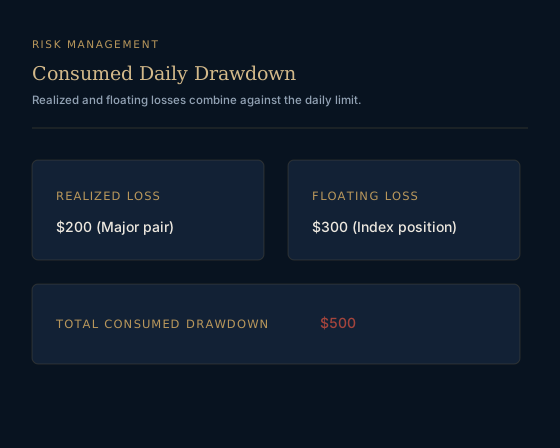
Declared inputs for this check: a 200 dollar realized loss on a major pair (Hypothetical trade), a 300 dollar floating loss on an index position (Hypothetical trade), and a 500 dollar total consumed daily drawdown. Worked arithmetic: a 200 dollar realized loss combined with a 300 dollar floating loss equals a 500 dollar total consumed daily drawdown.
This interaction between leverage and the daily loss limit creates a mechanical ceiling on risk. Even if a trader wishes to risk the full 5 percent daily allowance on a single trade, the 30:1 leverage restriction may not provide enough buying power to open the necessary lot size, depending on the stop-loss distance. This acts as a secondary layer of risk management, mathematically preventing over-leveraging while simultaneously demanding precise execution.
To compare how different firms structure these mechanics, observe the side-by-side framework below.
| Feature | Alpha Capital Group | Ordane |
|---|---|---|
| Maximum Drawdown | 10% | 5% Static |
| Daily Loss Limit | 5% | 3% |
| Daily Calculation | End of day (higher of equity or balance) | Start of server day balance |
| Capital Type | Simulated evaluation accounts | Simulated capital |
| Rulebook Transparency | FAQ availability | Versioned rulebook |
Understanding the mathematical relationship between the 30:1 leverage constraint and the end-of-day equity calculation is the foundation of surviving the evaluation. Traders must calculate their margin requirements before entry, ensuring that a sudden expansion in volatility does not trigger the 5 percent daily limit through a combination of floating losses and locked margin.
The requirement to calculate risk accurately extends to the withdrawal phase. Ordane's profit split starts at 60 percent and rises 5 percentage points with every completed withdrawal, reaching 100 percent from the ninth withdrawal onward. The split ladder is in writing and never resets. The first withdrawal is available 7 calendar days after account activation, and the cycle thereafter is every 14 days. Withdrawals reduce the account balance, and the R-1 drawdown floor stays anchored to the initial balance. (Ordane Rulebook v1.0, clause PA-1, retrieved 2026-09-05)
Every rule discussed serves a specific mechanical purpose. The 10 percent overall limit defines the maximum threshold for failure. The 5 percent daily limit restricts the velocity of losses within a single session. The end-of-day calculation dictates how floating profits are treated across the midnight server rollover. The 30:1 leverage limit restricts total market exposure. Navigating these rules requires treating them as strict mathematical boundaries rather than flexible guidelines.
The industry standardizes around parameters that require strict operational discipline. Traders who fail to calculate their end-of-day equity exposure often breach the daily limit not because their trade idea was wrong, but because they misunderstood how the firm measures risk. Mastery of the rulebook is the only verifiable method for protecting the account.
For traders comparing these evaluation constraints against a direct model, reviewing an instant account clarifies the structural differences in capital allocation. To verify the exact clauses governing direct access, consult the Ordane Rulebook.
Frequently Asked Questions
Does Alpha Capital Group have a trailing drawdown?
No, Alpha Capital Group does not have a trailing drawdown; the firm enforces a static 10 percent overall drawdown limit based on the initial account balance that does not trail upward. (Alpha Capital Group FAQ - Trading Rules, retrieved 2026-09-05)
How is the daily loss limit calculated at Alpha Capital Group?
The 5 percent daily drawdown at Alpha Capital Group is calculated based on the previous day's end-of-day equity or balance, whichever is higher at 00:00 MT4 server time. (Alpha Capital Group FAQ - Drawdown Rules, retrieved 2026-09-05)
What leverage is allowed for CFD major pairs at Alpha Capital Group?
The FCA restricts leverage for retail clients trading Contracts for Difference (CFDs) at Alpha Capital Group to a maximum of 30:1 for major currency pairs. (PS19/18: Restricting contract for difference products sold to retail clients, retrieved 2026-09-05)
What is the maximum drawdown at Ordane?
Ordane's maximum drawdown is 5 percent and static, meaning the account equity may never fall below 95 percent of the initial balance at any point. (Ordane Rulebook v1.0, clause R-1, retrieved 2026-09-05)
Are evaluation accounts at Alpha Capital Group simulated?
Yes, Alpha Capital Group evaluation accounts operate entirely on simulated capital, meaning traders navigate drawdown limits using virtual funds rather than live money.
Sources
- Alpha Capital Group FAQ - Trading Rulesretrieved 2026-09-05
- Alpha Capital Group FAQ - Drawdown Rulesretrieved 2026-09-05
- PS19/18: Restricting contract for difference products sold to retail clientsretrieved 2026-09-05
This article is for information only and is not investment, financial, or tax advice.
Ordane accounts operate on simulated capital. No live funds are traded and no deposits are accepted. Payouts depend on simulated performance under Rulebook v1.0; no level of performance is typical or assured.