Home · The Ordane Journal · Rules and Mechanics · Alpha Capital Inactivity Rule Explained
Alpha Capital Inactivity Rule Explained
Traders seek an environment where they can scale their strategies, but many lose their access not through a bad trade, but through a silent parameter. The fear of what hidden clause takes you down is real in this industry.
An inactivity rule is a firm-mandated time limit that automatically revokes trading access if no qualifying trades are executed within a specific period.
Like Alpha Capital Group, the Ordane prop firm requires traders to remain active, closing accounts if no filled order occurs for 30 consecutive calendar days.In one sentence: The Alpha Capital Group (prop firm) inactivity rule automatically revokes trading access if a trader fails to open or close a position for 30 consecutive calendar days.
Understanding the mechanics of account closure is just as critical as understanding your daily loss limit. The terms dictate how long you can step away from the terminal before the system revokes your credentials. We will explore the technical definition of a trade, the automated consequences of a breach, and why this specific rule exists across the proprietary trading industry.
What is the Alpha Capital Group inactivity rule?
Alpha Capital Group enforces a strict 30-day inactivity rule, which clearly states that an account will be breached if no trades are placed for thirty consecutive days. (Trading Rules FAQ | Alpha Capital Group, retrieved Sep 5, 2026) This specific limit requires all traders to actively participate in the market to successfully maintain their access to the simulated trading environment.
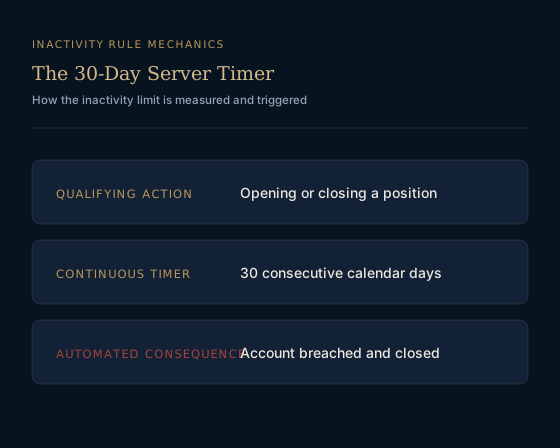
Proprietary trading firms establish parameters to govern how simulated capital is deployed. The inactivity rule is one of these parameters. It acts as a timer that constantly runs in the background of your account. Every time you execute a qualifying action, this timer resets to zero. If the timer reaches day thirty without a qualifying action, the account is terminated. Knowing how to audit a prop firm means checking these exact parameters before paying.
This mechanism ensures that the firm only monitors active participants. Traders often take breaks for psychological recovery, market conditions, or personal reasons. However, a break extending beyond the firm's specified limit results in a permanent loss of the account.
Key aspects of this timer include:
- It runs continuously in the background of the trading server.
- It requires a specific, measurable market action to reset.
- It triggers an automated closure sequence without human intervention.
- It offers no grace period upon expiration of the timeframe.
The system monitors the server time, and when the exact threshold is crossed, the trading credentials are automatically revoked.
How is the 30-day limit defined?
The Alpha Capital Group 30-day limit is defined as thirty consecutive calendar days, which includes weekends and market holidays. If a trader places a trade on a Friday, Saturday and Sunday count toward the inactivity timer, even though the forex and equity markets are closed. The timer does not pause for weekends.
Traders must also consider the specific server time zone used by the firm to calculate the day rollover. A trade placed at night in the trader's local time might register as the next day on the server, slightly shifting the inactivity window. This technical nuance is critical because the script execution is tied to the server clock, not the local computer clock.
To track this properly, traders should monitor:
- The exact server timestamp of their last closed position.
- The number of calendar days elapsed since that timestamp.
- The remaining days before the thirty-day limit is reached.
This continuous counting mechanism means traders must be acutely aware of their last trade date. A common trap occurs during low volatility periods, such as late December, when traders intentionally step away from the screens. If a trader takes a four-week vacation and does not place a trade, they will return to a breached account. The rule makes no distinction between a strategic pause and abandonment.
Why is logging into the platform not enough?
Logging into the platform is not enough to satisfy the Alpha Capital Group inactivity rule because the firm's system specifically requires a trader to open or close a position to reset the timer. (Trading Rules FAQ | Alpha Capital Group, retrieved Sep 5, 2026)
Opening the terminal, checking charts, or managing pending orders that do not trigger does not qualify as trading activity. The firm's server logs track execution, not connection. When a client terminal connects to the trading server, it sends a heartbeat signal. This signal keeps the session alive, but it does not write an execution record to the trading database.
In platforms like MetaTrader 4 or MetaTrader 5, the journal tab will show a successful connection to the access point, but this data remains on the client side. The firm's risk dashboard only updates when a trade ticket is generated by the server. Therefore, relying on terminal connection logs is a flawed strategy that leads directly to an unexpected breach.
Placing a minimal size trade, such as a micro lot on a major currency pair, is required to generate the necessary execution record and reset the timer.
The inactivity script queries the execution database, looking for the last timestamp of a filled order. If that timestamp is older than thirty days, the script executes the breach protocol. This forces the trader to take market risk, however small, to prove they are still an active participant.
What happens if you breach the inactivity limit?
Breaching the inactivity limit at Alpha Capital Group results in immediate account closure. When the thirty-day timer expires without a placed trade, the proprietary system automatically revokes trading access entirely. This breach is final, meaning the trader immediately loses the account and must purchase a brand new evaluation process.
The closure is a mechanical process. There is no manual review or intervention from a risk manager. The server executes a script that disables the account, clears any pending orders, and sends an automated email notifying the trader of the breach. The trader is immediately disconnected from the data feed.
This automated action means there is no room for negotiation. Once the script runs, the account state is permanently altered.
The immediate effects include:
- Disconnection from the simulated data feed and price stream.
- Cancellation of all pending limit and stop orders in the market.
- Revocation of terminal login credentials for the specific account.
- Reclassification of the account to a permanently breached status.
Understanding what happens when you breach a prop firm account involves recognizing that the firm prioritizes automated enforcement to maintain systemic integrity.
Account closure process
The account closure process involves looking at the server architecture. When the inactivity condition is met, the account is moved from an active group to a read-only or disabled group within the trading server. This transition happens instantly.
If the trader attempts to log in after the breach, they will face an invalid account error or find that the new order button is greyed out. The history remains visible for a short period, but the ability to interact with the market is permanently gone.
Many traders attempt to contact support after an inactivity breach, arguing that they were analyzing the market or had pending limit orders waiting for a specific price level. These appeals are universally denied because the rulebook defines activity strictly by execution. The support team cannot override the database record, making the automated closure absolute.
To avoid this process, traders must:
- Set external calendar reminders independent of the platform.
- Execute a micro-trade if a planned absence approaches thirty days.
- Verify the execution timestamp in the account history tab.
There is no appeal process for an inactivity breach because the rule is binary. The execution database either shows a trade within the last thirty days, or it does not.
Impact on evaluation fees and simulated capital
The financial impact of an inactivity breach is total. The trader forfeits the initial fee paid for the evaluation, and any simulated capital allocated to the account is withdrawn. If the account was in a profitable state, those simulated profits are also lost and cannot be claimed.
The evaluation model requires traders to pass multiple phases before accessing a performance account. If a trader spends two months passing an evaluation and then takes a thirty-day break, they lose the upfront fee, the time invested, and the potential to earn a profit split. The firm absorbs the evaluation fee as revenue, and the trader is back to square one. This cycle is profitable for the firm but detrimental to the trader.
This presents a stark contrast to how clear rules should operate. Losing access because of a calendar technicality, rather than a risk management failure like hitting a daily loss limit, is a frustrating experience. It forces the trader to spend capital to buy a new challenge.
Ordane approaches this directly. Ordane sells one product, the Ordane Instant Account: direct access, no evaluation phase and no challenge, on simulated capital. When the rules are simple, the cost of failure is predictable.
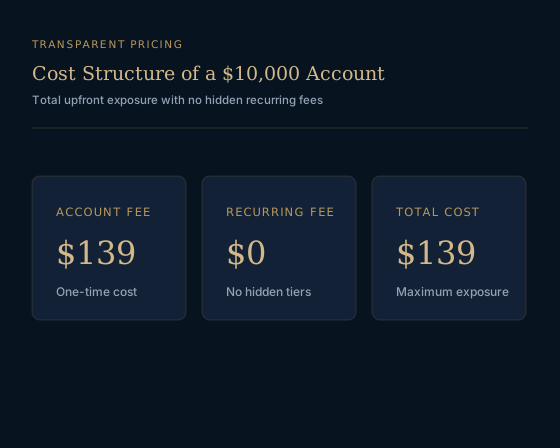
The Ordane Instant Account requires a $139 fee for the $10,000 account (Ordane Rulebook v1.0), a $0 recurring fee (Ordane Rulebook v1.0), and enforces a 5 percent maximum drawdown limit (Ordane Rulebook v1.0). The Ordane Instant Account total upfront cost is calculated as: $139 + $0 = $139.
| Metric | Account Fee | Recurring Fee | Total Upfront Cost |
|---|---|---|---|
| Value | $139 | $0 | $139 |
This transparency ensures that traders understand their exposure from the beginning, without hidden evaluation costs complicating the recovery from a breach.
Is the 30-day rule an industry standard?
In the proprietary trading industry, account inactivity limits are standard risk management tools, often set at thirty days to reallocate unused capital and limit dormant account exposure. (Prop Trading Industry Standards: Inactivity Rules Explained, retrieved Sep 5, 2026) Proprietary firms widely use these specific rules to ensure server resources and simulated risk capital are strictly dedicated to active market participants.
The proprietary trading model relies on active data and risk aggregation. Firms provide simulated capital to gather data on trading performance. If an account is dormant, it provides no data, yet it still occupies server resources and represents a contingent liability.
If thousands of dormant accounts suddenly became active simultaneously, it could strain the firm's risk management infrastructure.
Key reasons for this standard include:
- Reallocation of server bandwidth and processing power to active users.
- Maintenance of highly accurate risk exposure and aggregation models.
- Elimination of unpredictable account reactivations during volatile market events.
By closing inactive accounts, firms optimize their operational overhead and maintain tighter control over their simulated risk metrics. To avoid surprises, traders must know if a firm can enforce an unwritten rule or if they operate on a closed list.
Why prop firms use inactivity rules
From an operational perspective, maintaining active accounts requires constant database management, data feed licensing, and server capacity. Firms clean their books of inactive users to optimize these costs.
The infrastructure required to support thousands of active data feeds is substantial. Every active account consumes API limits, database storage, and processing power for real-time equity monitoring. By purging inactive accounts, the firm maintains system stability and ensures rapid execution speeds for traders who are actually participating in the market. It is an infrastructure optimization strategy disguised as a trading rule.
Furthermore, inactivity rules serve as a filter. The industry operates on the premise that active traders generate the data necessary for the firm's broader objectives. A trader who does not place a trade for a month is not generating value for the firm's internal metrics.
Consider the differences in enforcement across the industry:
- Some firms require a trade every fourteen calendar days.
- Others use a thirty-day window for maximum flexibility.
- The definition of a qualifying action can range from a login to a verified filled order.
By enforcing a strict limit, firms ensure that their active trader pool consists only of individuals actively engaging with the market. The burden of compliance always falls on the trader.
Risk management vs dormant accounts
Dormant accounts present a specific risk management challenge. A firm calculates its total exposure based on the maximum drawdown limits of all active accounts. If a large percentage of accounts are dormant, the firm might underestimate its true potential exposure if those accounts suddenly re-engage during a high-impact news event.
A dormant account is essentially a hidden liability. If a major macroeconomic event occurs, such as a central bank interest rate decision, and hundreds of dormant accounts suddenly enter the market to trade the volatility, the firm's risk aggregation algorithms could be overwhelmed. The inactivity rule prevents this scenario by ensuring the active trader base is predictable and continuously monitored, smoothing out the firm's overall risk profile.
By closing inactive accounts, the firm eliminates this unpredictable variable from its risk models. The capital allocation is effectively cleared, allowing the firm to extend simulated capital to new, active traders without overextending its theoretical exposure limits.
This standard practice can be seen across various firms, including Ordane. The rules governing inactivity must be explicit to prevent misunderstandings.
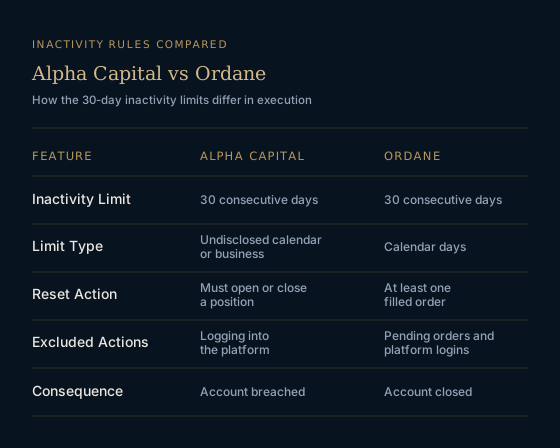
| Feature | Alpha Capital Group | Ordane Instant Account |
|---|---|---|
| Inactivity Limit | 30 consecutive days | 30 consecutive days |
| Limit Type | Undisclosed calendar or business | Calendar days |
| Reset Action | Must open or close a position | At least one filled order |
| Excluded Actions | Logging into the platform | Pending orders and platform logins |
| Consequence | Account breached | Account closed |
This comparison highlights that while the thirty-day timeframe is standard, the clarity of the underlying definitions is what protects the trader. Accounts with no trading activity for 30 consecutive days are closed. (Ordane Rulebook v1.0, clause R-5, retrieved Sep 5, 2026) The 30 consecutive days in clause R-5 are calendar days, not business days. Under clause R-5, trading activity means at least one filled order. Pending orders and platform logins do not count.
By demanding a filled order, firms ensure verifiable participation. By counting calendar days, the timeline is unambiguous. There is no confusion over whether a public holiday pauses the timer. The timer runs continuously, and the responsibility to maintain activity rests entirely with the trader.
If you are tired of monitoring evaluation timers and navigating hidden clauses that lead to an unexpected breach, comparing an instant account vs evaluation can show you how direct access protects your trading environment.
FAQ
What is the Alpha Capital Group inactivity rule?
Alpha Capital Group enforces a 30-day inactivity rule, which states that an account will be breached if no trades are placed for 30 consecutive days. (Trading Rules FAQ | Alpha Capital Group, retrieved Sep 5, 2026)
Does logging into Alpha Capital Group reset the inactivity timer?
No. Simply logging into the trading platform does not reset the 30-day inactivity timer at Alpha Capital Group; a trader must actually open or close a position. (Trading Rules FAQ | Alpha Capital Group, retrieved Sep 5, 2026)
Are inactivity rules standard in the prop firm industry?
Yes. In the proprietary trading industry, account inactivity limits are standard risk management tools, often set at 30 days to reallocate unused capital and limit dormant account exposure. (Prop Trading Industry Standards: Inactivity Rules Explained, retrieved Sep 5, 2026)
How does the Ordane inactivity rule work?
Accounts with no trading activity for 30 consecutive calendar days are closed, and trading activity means at least one filled order. (Ordane Rulebook v1.0, clause R-5, retrieved Sep 5, 2026)
What happens when an Alpha Capital Group account is closed for inactivity?
When an Alpha Capital Group account is closed for inactivity, the proprietary trading system automatically revokes trading access entirely, requiring the trader to purchase a new evaluation process.
Sources
- Alpha Capital Group, on the 30-day inactivity rule. alphacapitalgroup.uk/faq/trading-rules Retrieved Sep 5, 2026.
- Finance Magnates, on prop trading industry standards for inactivity rules. financemagnates.com Retrieved Sep 5, 2026.
- Ordane Rulebook v1.0, clause R-5, on the inactivity rule. ordanemarkets.com/rulebook Retrieved Sep 5, 2026.