Home · The Ordane Journal · Rules and Mechanics · Topstep Max Loss Limit: End of Day Rule Explained
Topstep Max Loss Limit: End of Day Rule Explained
The maximum loss limit is the hard floor a trader's equity cannot cross without violating the risk management rules and losing the simulated account. Ordane accounts operate on simulated capital. No live funds are traded and no deposits are accepted.
The trading industry offers many different rule sets for managing risk parameters. Traders must understand exactly how a platform calculates daily loss limits before they begin executing positions.
Ordane sells one product, the Ordane Instant Account: direct access, no evaluation phase and no challenge, on simulated capital. When traders evaluate any platform, they ask three primary questions. They ask if the platform actually pays withdrawals. They ask what hidden rules might cause an account failure. They ask if the firm will continue to exist over the coming months.
Clear and versioned rules answer the second question. Ordane addresses payment concerns directly through written clauses. Every withdrawal request is approved, or denied in writing citing the exact rule breached by section number, within 24 clock hours. Past that deadline the request is treated as approved and the G-1 clock starts. A payout approved and not paid within 48 clock hours, not business hours, triggers automatic compensation: a 100 percent refund of the account fee, plus the payout owed in full. These clauses form The Ordane Guarantee.
Other platforms utilize dynamic risk limits to manage exposure. Understanding the mechanics of the Topstep (prop firm) maximum loss limit requires examining how the threshold moves and when the calculation occurs.
How Is the Topstep Maximum Loss Limit Calculated?
Topstep's Maximum Loss Limit is calculated at the end of the trading day and trails the account's highest balance until it reaches the initial starting balance. (What is the Maximum Loss Limit? - Topstep Help Center, retrieved 2026-09-05) This mechanism determines the strict floor that traders must maintain to keep their trading environment active and in good standing.
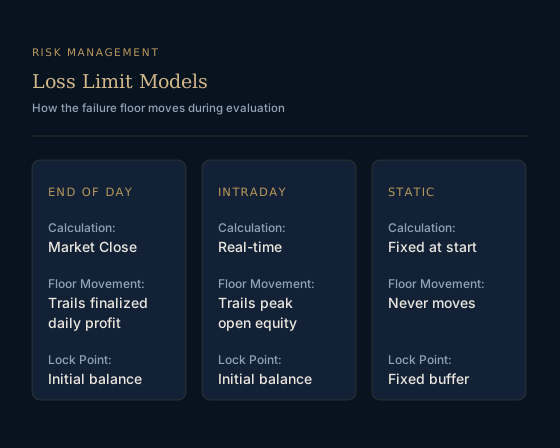
The calculation method dictates how much room a trader has to sustain losses. Because the limit is not static, the absolute dollar value of the floor changes as the account balance grows. This moving target requires continuous adjustment of position sizing and careful daily planning.
End-of-Day Calculation vs. Intraday
An end of day calculation provides a different operational environment than an intraday trailing calculation. Intraday limits monitor the highest open equity during the active session. If a position spikes in profit and then returns to breakeven, an intraday limit moves up with the spike. This penalizes the trader for the retracement.
The end of day model measures the balance only at the session close. Fluctuations that happen during the active trading hours do not pull the limit upward.
Key differences between the two models include the following points:
- Intraday limits restrict the ability to hold positions through normal market volatility.
- End of day limits allow equity to fluctuate during the session without permanently raising the failure threshold.
- Intraday models demand rapid profit-taking to avoid trailing penalties.
- End of day models support swing trading approaches and longer holding periods.
Traders often prefer the end of day calculation over the intraday model. It provides breathing room for trades to develop naturally. A position might move against the trader temporarily before reaching the projected profit target. Under an end of day rule, the temporary drawdown does not trigger a violation unless it breaches the established floor from the previous day.
Ordane provides a different approach entirely. Ordane's maximum drawdown is 5 percent and static: account equity may never fall below 95 percent of the initial balance. The floor is fixed on day one, never trails upward, and a breach closes the account. The daily loss limit is 3 percent, measured against the balance at the start of the server day. A breach closes the account.
Trailing the Highest Balance
The trailing mechanism means the failure floor follows the account growth closely. If a trader secures a profitable day, the maximum loss limit moves higher by the exact amount of the finalized profit. The distance between the current balance and the loss limit remains constant during this phase.
This trailing action continues until the loss limit reaches the initial starting balance. Once the limit hits that initial mark, it locks in place. It stops trailing completely. Further profits increase the buffer between the account balance and the loss limit.
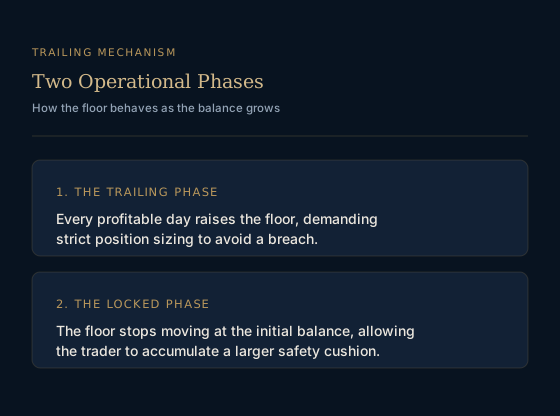
This creates two distinct operational phases for the trader:
- The Trailing Phase: Every profitable day raises the floor, demanding strict position sizing to avoid a breach.
- The Locked Phase: The floor stops moving, allowing the trader to accumulate a larger safety cushion as the balance grows.
Risk management strategies must adapt to these two phases aggressively. During the trailing phase, strict position sizing is necessary to avoid hitting the rising floor. Once the limit locks at the initial balance, the trader has more flexibility. The mathematical reality of a trailing limit demands conservative trading early in the account lifecycle. Maximum risk per trade is 1.5 percent of current balance and a stop-loss is mandatory at entry. Two maximum losses equal the daily limit, which is the design rather than an accident.
What Happens to Your Account After a Breach?
Hitting or exceeding the Maximum Loss Limit results in a broken rule and the closure of the simulated trading account. (What is the Maximum Loss Limit? - Topstep Help Center, retrieved 2026-09-05) The trader loses access to that specific environment and must begin a new evaluation process from scratch.
Platform systems monitor these limits automatically. The enforcement contains no manual review and provides no grace period.
Simulated Account Closure
The closure of the account happens at the moment the equity breaches the established limit. The trading platform disconnects the data feed and cancels all pending orders automatically. The interface updates to reflect the rule violation instantly. The trader cannot place new trades or manage existing positions.
This automated enforcement ensures uniform application of the rules across the user base. There is no negotiation after a breach occurs. The system reads the equity level, compares it to the calculated limit, and executes the closure protocol if the limit is breached.
The sequence of an automated closure follows these exact steps:
- The internal script detects an equity drop below the calculated floor.
- The system executes market orders to flatten all open positions.
- The system cancels all pending limit and stop orders.
- The account state transitions from active to disabled.
The speed of the automated closure is critical for risk management. A manual review process would introduce latency, allowing a rapidly dropping account to accrue further losses before intervention. By relying on pre-programmed scripts, the platform ensures execution within milliseconds of the breach. This efficiency protects both the trader from further negative habits and the platform from uncontrolled simulated exposure. The rules are absolute because the code executes without prejudice or hesitation.
At Ordane, the consequence for breaking a rule is identical. A breach closes the account. That is the whole consequence: no partial confiscations, no surprise fees, no renegotiation. The clarity of the outcome allows traders to plan their risk parameters without ambiguity.
The closure affects only the specific account where the breach occurred. Traders operating multiple accounts must monitor the limits on each account independently. A violation on one account does not automatically invalidate other active environments.
Broken Rule Consequences
A broken rule requires the trader to acquire a new account to resume trading. The previous progress is erased completely. Any accumulated simulated profits are nullified. The new account begins with the original starting balance and a reset maximum loss limit.
The financial consequence is the cost of the new account fee. The trader must pay the evaluation fee again to re-enter the environment. This creates a direct financial incentive to respect the loss limits and practice disciplined risk management.
Some platforms offer a reset function for a reduced fee. This function restores the account balance and resets the rules without requiring the trader to start a completely new evaluation from the beginning. However, the reset still represents a financial cost incurred due to a rule violation.
Ordane's model removes the evaluation phase entirely. The fee is one-time: $59 for the $2,500 account, $139 for the $10,000 account, $299 for $25,000, $549 for $50,000 and $999 for $100,000. There are no recurring fees, no hidden tiers and no coupon games. If an account is closed due to a breach, the trader must purchase a new Instant Account. There are no reset fees because there is no evaluation phase to reset.
Withdrawals reduce the account balance, and the R-1 drawdown floor stays anchored to the initial balance. Withdrawals #1 and #2 are each capped at 3 percent of initial balance. From withdrawal #3 onward there is no cap.
Why Do Platforms Enforce Strict Loss Rules?
Simulated trading platforms deploy strict loss limits to mandate disciplined risk management across all user accounts. These boundaries ensure that traders demonstrate consistent downside control rather than relying on oversized positions.
The business model of simulated trading requires participants to prove they can protect capital. Platforms limit their exposure to erratic trading behavior by enforcing these automatic closures.
A platform that allows unlimited losses cannot accurately assess a trader's ability to operate within professional risk parameters. The maximum loss limit acts as the primary filter, functioning differently than a traditional broker margin call. It separates traders who implement stop losses from those who hold losing positions hoping for a market reversal.
The structure of the limit reveals the platform's philosophy clearly. A trailing limit tests a trader's ability to manage a moving floor. A static limit tests the ability to manage a fixed buffer. Both mechanisms serve the same ultimate purpose. They enforce discipline.
Below is a comparative breakdown of how different loss limit models operate practically.
| Feature | End of Day Trailing Limit | Intraday Trailing Limit | Static Loss Limit (Ordane) |
|---|---|---|---|
| Calculation Timing | Market Close | Real-time | Fixed at inception |
| Impact of Unrealized Profit | None | Raises the floor | None |
| Floor Movement | Upward based on finalized daily profit | Upward based on peak open equity | Never moves |
| Best Environment For | Swing trading, holding through volatility | Scalping, high win-rate strategies | All strategies, clear risk planning |
| Lock Point | Initial starting balance | Initial starting balance | Remains at fixed percentage below initial balance |
The mathematics of risk limits can be demonstrated with a clear arithmetic check. We can verify the static drawdown model using explicit numerical inputs.
Declared inputs for this check: a 95 percent minimum equity floor from Ordane Rulebook clause R-1, a 5 percent static maximum drawdown from the same clause, and a 100 percent initial balance limit. Worked arithmetic: 95 + 5 = 100.
| Metric | Source | Value |
|---|---|---|
| Minimum Equity Floor | Ordane Rulebook R-1 | 95 percent |
| Static Maximum Drawdown | Ordane Rulebook R-1 | 5 percent |
| Initial Balance Limit | Baseline | 100 percent |
| Total Account Integrity | Worked Arithmetic | 100 percent |
Professional traders recognize that risk management is the only factor entirely under their control. The market dictates the direction of the asset, but the trader dictates the exposure. Strict loss rules force developing traders to internalize this reality. By imposing a hard boundary on daily and maximum drawdowns, platforms accelerate the learning curve. Traders quickly realize that surviving a volatile session requires modest position sizing and strict adherence to predefined exit points. This forced discipline separates long-term market participants from those who rely on temporary luck.
The enforcement of these rules maintains the integrity of the simulated environment. Without strict boundaries, the simulation loses its educational and evaluative value entirely. The rules create a framework where performance can be measured objectively and consistently across thousands of participants.
Understanding the end of day trailing mechanism allows traders to plan their session strategy effectively. They know that intraday volatility will not tighten their loss limit unexpectedly. They can calculate their exact risk parameters before the market opens and execute their trading plan with full awareness of where the critical boundary lies.
Traders who prefer a static floor rather than a moving target should review the Ordane Rulebook. Examine how the static 5 percent maximum drawdown provides a fixed risk environment, and compare an instant account against an evaluation model to trade with clear, unchanging boundaries.
Frequently Asked Questions
Does the Topstep maximum loss limit move during the trading session?
No, the Topstep Maximum Loss Limit is calculated at the end of the trading day. (What is the Maximum Loss Limit? - Topstep Help Center, retrieved 2026-09-05) Intraday unrealized profit fluctuations do not pull the floor upward.
When does the Topstep trailing limit stop moving?
It trails the account's highest end-of-day balance until it reaches the initial starting balance, where it locks in place. (What is the Maximum Loss Limit? - Topstep Help Center, retrieved 2026-09-05)
What is the maximum drawdown at Ordane?
Ordane's maximum drawdown is 5 percent and static: account equity may never fall below 95 percent of the initial balance. (Ordane Rulebook v1.0, clause R-1, retrieved 2026-09-05)
Can you hold positions overnight at Ordane?
Overnight and weekend holding is allowed at Ordane. It is not on the R-6 closed list, and what is not listed is not a violation. (Ordane Rulebook v1.0, clause R-6, retrieved 2026-09-05)
Sources
- What is the Maximum Loss Limit? - Topstep Help Center
Retrieved Sep 05, 2026 - Ordane Rulebook v1.0
Retrieved Sep 05, 2026