Home · The Ordane Journal · Rules and Mechanics · Apex Trader Funding EA Rules & HFT Restrictions
In one sentence: The Apex Trader Funding EA rule allows traders to deploy standard automated scripts and Expert Advisors on their simulated evaluation accounts, provided these bots do not utilize strictly prohibited High Frequency Trading or latency arbitrage strategies.
What Is the Apex Trader Funding EA Rule?
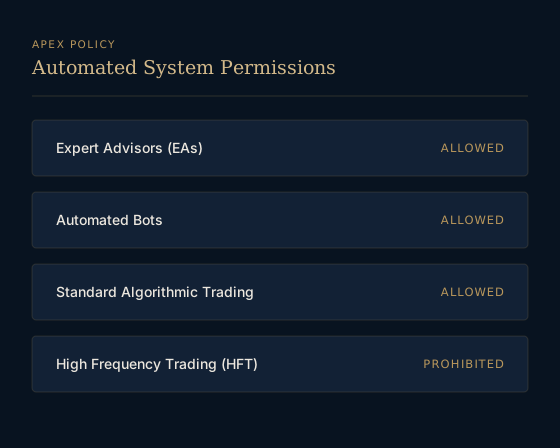
The Apex Trader Funding EA rule allows the use of standard automated trading software, Expert Advisors, and bots on their evaluation accounts, while strictly prohibiting latency arbitrage. Traders can deploy these tools without restrictions on standard algorithmic strategies.
Traders evaluating different platforms often compare the flexibility of trading rules. Ordane sells one product, the Ordane Instant Account: direct access, no evaluation phase and no challenge, on simulated capital. Ordane Rulebook v1.0, section 1, retrieved 2026-09-05. This contrasts with firms that require multi-step evaluations before a trader can request a withdrawal.
The integration of automated systems into retail trading has fundamentally changed how market participants interact with order books. At its core, algorithmic trading utilizes computer programs following defined instructions to place trades, according to the CME Group. CME Group, retrieved 2026-09-05. This broad definition encompasses everything from simple moving average crossovers to complex statistical arbitrage models.
How Do Platform Compatibility and Integration Fees Work?
Traders connect bots to Apex Trader Funding accounts by interfacing the automated trading software, Expert Advisors (EAs), or bots directly through the platform's API or native scripting framework. Apex Trader Funding, retrieved 2026-09-05. This permission allows traders to execute their strategies without manual intervention, removing emotional latency and ensuring absolute compliance with their own risk parameters.
The deployment of an Expert Advisor requires specific technical conditions. The software must interface with the trading platform through an application programming interface or native scripting language. Platforms like MetaTrader use MQL4 or MQL5, while NinjaTrader relies on C# for its NinjaScript framework. Traders writing or purchasing bots must ensure compatibility with the data feeds provided by the evaluation firm. Since retail platforms process data at different speeds compared to institutional cross-connects, the chosen Expert Advisor must account for retail tick data limitations.
Integration fees for standard automated trading platforms generally depend on the account size, but connecting an automated system inherently involves multiple layers of software that must be configured correctly. The trader must link the bot to the charting platform, which in turn connects to the data provider and the firm's simulated matching engine.
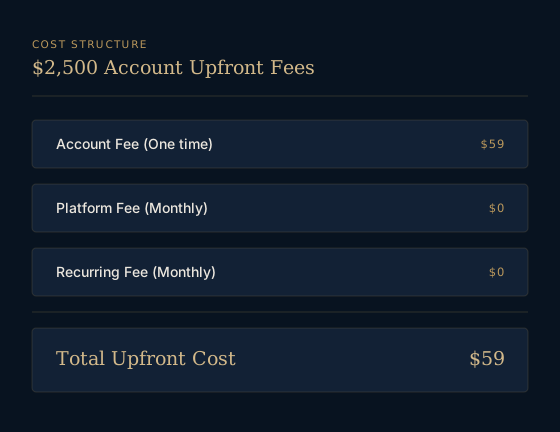
When evaluating the financial commitment of running an automated system, traders must calculate the fixed costs of the account sizes they choose. Ordane Instant Account comes in five sizes: $2,500, $10,000, $25,000, $50,000 and $100,000. Ordane Rulebook v1.0, retrieved 2026-09-05. The fee is one-time: $59 for the $2,500 account, $139 for the $10,000 account, $299 for $25,000, $549 for $50,000 and $999 for $100,000. Ordane Rulebook v1.0, retrieved 2026-09-05. There are no recurring fees, no hidden tiers and no coupon games.
Declared inputs for this check: a $59 fee for the $2,500 account, a $0 platform fee, and a $0 recurring fee. Worked arithmetic: $59 + $0 = $59 total upfront cost.
| Cost Component | Amount | Frequency |
|---|---|---|
| Account Fee ($2,500 size) | $59 | One-time |
| Platform Fee | $0 | Monthly |
| Recurring Fee | $0 | Monthly |
| Total Cost | $59 | Total upfront cost |
Which Bots Are Banned Under the HFT Restriction?
Apex Trader Funding explicitly prohibits High Frequency Trading (HFT) and latency arbitrage bots on their platform, ensuring that only standard human-scale algorithms are permitted. Apex Trader Funding, retrieved 2026-09-05. Evaluation firms operate on simulated matching engines that replicate live market conditions. These engines cannot perfectly simulate the liquidity consumption and order queue position that occurs in the real market.
A latency arbitrage bot exploits these simulation imperfections, generating profits that are mathematically impossible to replicate in a live environment. Because the firm cannot copy these trades to a real liquidity provider, the simulated profits represent a total loss for the firm if paid out. Standard algorithmic strategies remain fully compliant and allowed.
How Do Algorithmic Trading and High Frequency Trading Differ?
The primary difference is that algorithmic trading relies on technical parameters like moving averages to execute trades, whereas High Frequency Trading relies on microsecond speed advantages to front-run slightly delayed market feeds. Algorithmic trading utilizes computer programs following defined instructions to place trades. CME Group, retrieved 2026-09-05. This includes swing trading bots, scalpers holding positions for several minutes, and grid systems operating within standard retail environments.
High Frequency Trading requires co-location inside the exchange's data center, field-programmable gate arrays processing data at the hardware level, and microwave network links to transmit orders in microseconds. When a retail trader purchases a bot marketed as high-frequency software, they are typically buying a latency arbitrage script. These scripts compare the price feed of a fast provider against the slightly delayed feed of the evaluation firm. If the bot detects a price discrepancy, it executes a trade on the slow feed, essentially trading on information from the future.
Will an HFT Breach Permanently Close Your Account?
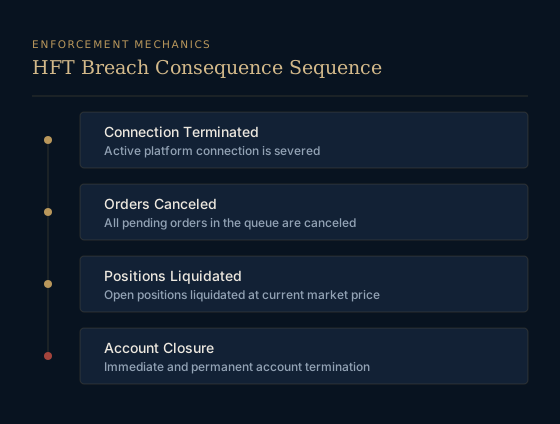
Violating the High Frequency Trading restriction results in an immediate and permanent account closure. The risk management systems operate automatically, severing the platform connection once the algorithmic threshold is breached. Traders lose access to the account, forfeit any accumulated simulated profits, and receive no refund for the evaluation fee.
When a firm's risk engine detects a prohibited high-frequency pattern, the enforcement is unilateral. The server terminates the active platform connection, cancels all pending orders in the queue, and liquidates any open positions at the current market price. The dashboard updates to reflect the breached status, and the trader is locked out of the trading terminal.
This strict enforcement is necessary because of how simulated environments function. In a live market, a trader attempting latency arbitrage against a tier-one bank will simply have their orders rejected or filled at negative slippage. The bank's infrastructure is faster and closer to the matching engine. In a simulated environment, the trader is playing against a local server mimicking the market.
What Is the Real Cost of an EA Rule Breach?
Breaching an evaluation account through unauthorized EA usage forces the trader to pay a reset fee to purchase a new evaluation account in order to continue trading. The evaluation industry is built heavily on the revenue generated from resets. When an evaluation account is breached, a trader faces two distinct financial paths to resume trading: purchase a completely new evaluation at the current retail price, or pay a reset fee to restore the current account's balance and try again.
The reset fee is typically lower than the initial purchase price, incentivizing the trader to keep paying into the system rather than walking away. For a trader running an unverified Expert Advisor, this cycle can become exceedingly expensive. A poorly coded bot can breach an account in a matter of minutes.
How Does the Ordane Rulebook Treat High Frequency Trading?
Ordane prohibits latency, reverse or hedge arbitrage, and high-frequency or bulk automated exploitation under its closed list of prohibited practices. Ordane Rulebook v1.0, clause R-6, retrieved 2026-09-05. If an account is breached, it is closed, and the trader cannot pay a fee to restore the balance. This structure aligns the firm's incentives with the trader's success.
The payout mechanics also differ substantially when the evaluation phase is removed. The first withdrawal is available 7 calendar days after account activation, and the cycle thereafter is every 14 days. Withdrawals #1 and #2 are each capped at 3 percent of initial balance. From withdrawal #3 onward there is no cap. Ordane's profit split starts at 60 percent and rises 5 percentage points with every completed withdrawal, reaching 100 percent from the ninth withdrawal onward.
Furthermore, Ordane provides an absolute timeline for processing payout requests. Every withdrawal request is approved, or denied in writing citing the exact rule breached by section number, within 24 clock hours. Past that deadline the request is treated as approved and the G-1 clock starts. A payout approved and not paid within 48 clock hours, not business hours, triggers automatic compensation: a 100 percent refund of the account fee, plus the payout owed in full.
How Does a Terminal Licence Impact Automated Trading?
A firm using licensed, third-party software risks sudden service termination, which instantly neutralizes any automated strategies running on that specific terminal. When connecting to the market, whether through a standard evaluation or an instant access account, the stability of the trading terminal is paramount.
Ordane runs on a trading platform it designed and built with its own engineering team, and licenses no third-party terminal. The distinction is structural, not cosmetic. A firm that licenses its terminal can be closed by a decision it does not control. For example, MetaQuotes withdrew MT4 and MT5 access from prop firms, and True Forex Funds announced permanent closure on 2024-05-13 after its licences were terminated. Ordane owns the terminal its traders use, so no vendor can revoke it.
What Instruments Can Expert Advisors Trade?
Expert Advisors can trade major and minor FX pairs, metals, indices, and crypto, provided the bot stays within the required margin and leverage limits. Ordane lists these four asset classes and offers no exotics. Ordane's settled leverage is 1:50 on FX majors and minors. Leverage for metals, indices and crypto has not been set yet. Accounts are simulated: no swap. Ordane charges no commission, no spread and no swap. The account fee is the only cost the trader pays.
Ordane's consistency rule is 20 percent: at the moment of a withdrawal request, no single trading day may account for more than 20 percent of the cycle's total profit. If a day exceeds 20 percent, the excess profit from that day is deferred to the next cycle. It is never confiscated, and the remainder of the cycle pays out normally. Accounts with no trading activity for 30 consecutive days are closed. The 30 consecutive days in clause R-5 are calendar days, not business days.
FAQ
What is the Apex Trader Funding EA rule?
The Apex Trader Funding EA rule allows the use of standard automated trading software, Expert Advisors (EAs), and bots on evaluation accounts, while strictly prohibiting High Frequency Trading and latency arbitrage.
What is algorithmic trading?
Algorithmic trading utilizes computer programs following predefined logic and math to execute trades automatically based on prevailing market conditions.
Is High Frequency Trading allowed on Apex Trader Funding?
No, Apex Trader Funding explicitly prohibits High Frequency Trading (HFT) on their platform, and utilizing such an exploitation bot will result in immediate account closure. Apex Trader Funding, retrieved 2026-09-05
Does Ordane allow Expert Advisors?
Yes, Ordane permits traders to run Expert Advisors and standard algorithmic bots to execute their own strategies, provided they do not use latency arbitrage or high-frequency exploitation. Ordane Rulebook v1.0, Appendix A, retrieved 2026-09-05
What happens if I use an HFT bot on an evaluation account?
Using an HFT bot on an evaluation account will result in a rule breach, causing the firm to instantly terminate the account and void any simulated profits generated.
Sources
Primary sources are linked inline above.
- Can I use an EA (Expert Advisor) or Automated Trading?, retrieved 2026-09-05
- Introduction to Algorithmic Trading, retrieved 2026-09-05
- What are the rules for Funded Accounts?, retrieved 2026-09-05
This article is for information only and is not investment, financial, or tax advice.
Ordane accounts operate on simulated capital. No live funds are traded and no deposits are accepted. Payouts depend on simulated performance under Rulebook v1.0; no level of performance is typical or assured.