Home · The Ordane Journal · Rules and Mechanics · The Funded Trader Consistency Rule Explained
The Funded Trader Consistency Rule Explained
A consistency rule is a mathematical parameter used by firms to evaluate whether a trader's performance is repeatable before approving a payout. Ordane accounts operate on simulated capital. No live funds are traded and no deposits are accepted.
In one sentence: The Funded Trader consistency rule required traders to keep every position within a 0.25x to 2.0x multiplier of their average lot size to qualify for a payout.
The Funded Trader (prop firm) applied a strict consistency rule that mandated a trader's lot sizes must fall within a 0.25x to 2.0x range of their average lot size. This mathematical multiplier dictated withdrawal eligibility, targeting what the firm defined as gambling behavior before operations were suspended in March 2024.
This structural reality means all rules serve to measure simulated performance before any payout is approved. Traders spend months navigating evaluation phases. They pay fees, dedicate time, and follow drawdown limits to reach a status where they are eligible for profit splits. Discovering that a mathematical average dictates the approval of a payout introduces a layer of operational friction that many traders fail to anticipate until the withdrawal is denied.
What was The Funded Trader consistency rule?
Firms design consistency rules to measure whether a trader demonstrates a repeatable strategy. The Funded Trader established parameters to filter out unpredictable sizing patterns.
The policy required the trader to maintain a stable profile throughout the entire trading period. A trader could not execute micro lots for three weeks and then execute a maximum capacity position on a high volatility day. The system tracked the average lot size across all executions in the active cycle. Every new position altered the running average. The trader carried the burden of monitoring their own mathematical average continuously to ensure no single execution breached the allowable boundary.
This forced the operator to divide their attention between market analysis and administrative compliance. A strategy that requires scaling into positions or adjusting exposure based on widening stop losses naturally conflicts with a strict consistency parameter. The rule demands uniformity in an environment defined by volatility.
The 0.25x to 2.0x lot size multiplier limit
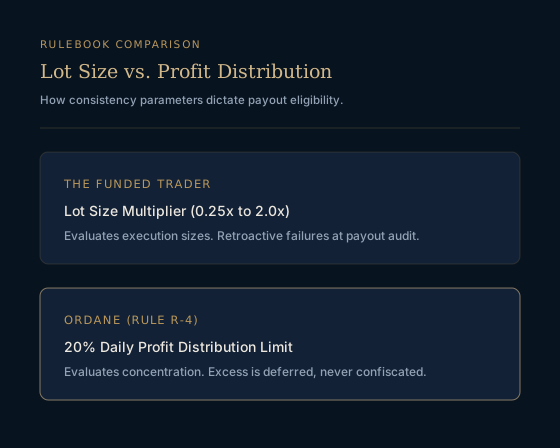
The core of the policy was a mathematical boundary applied to every executed position. The consistency rule mandated that a trader's lot sizes must fall within a 0.25x to 2.0x range of their average lot size to be considered eligible for a withdrawal.
This formula created a moving window. If a trader held an average trade size of 10 lots, the absolute minimum allowable position was 2.5 lots. The absolute maximum allowable position was 20 lots. Any position executed outside this calculated window constituted a violation of the parameter. The window shifted with every closed order. A sequence of larger trades would pull the average upward, thereby raising the minimum required size for all future orders in that cycle.
Key impacts of the moving window average:
- It penalizes scaling into positions during low volatility.
- It restricts the use of dynamic stop losses.
- It forces traders to execute redundant orders to fix averages.
A trader who decided to reduce their risk temporarily during a string of losses would naturally lower their lot size. Under this rule, reducing risk could trigger a violation if the new lot size fell below the 0.25x floor of their established average.
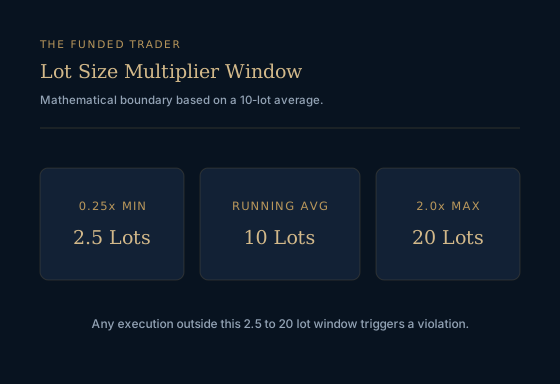
To illustrate the mathematical constraints of this rule, consider a scenario calculating the maximum allowable multiplier boundary. Declared inputs for this check: a 0.25 minimum multiplier, a 1.75 range factor, and a 2.00 maximum multiplier. Worked arithmetic: 0.25 + 1.75 = 2.00.
| Variable | Value | Description |
|---|---|---|
| Minimum Multiplier | 0.25x | The absolute lower limit for trade sizes relative to the historical average. |
| Range Span | 1.75x | The mathematical difference between the lower and upper multiplier bounds. |
| Maximum Multiplier | 2.00x | The absolute upper limit restricting position sizing for payout eligibility. |
Operators who adjusted their sizing based on varying stop loss distances found this rule particularly restrictive. A technical trader might risk the exact same percentage of their balance on a trade with a 10 pip stop loss as they do on a trade with a 50 pip stop loss. The lot size must change drastically to maintain constant risk. The multiplier limit penalized this standard risk management practice by flagging the required lot size variation as a consistency violation. The rule fundamentally treated lot size as a proxy for risk, ignoring the function of the stop loss placement entirely.
Targeting gambling behavior
The stated intent behind the multiplier limit was risk containment. The firm categorized severe sizing variations as a form of reckless execution.
Categorizing behavior requires objective definitions. Without objective definitions, the term gambling becomes a discretionary tool used to deny payouts. The industry frequently applies subjective labels to profitable trading cycles when the execution style does not match the firm's internal preference.
The subjective application of gambling labels creates structural risks:
- High conviction trades are dismissed as luck.
- Macroeconomic news trading is retroactively penalized.
- The firm retains the final discretionary authority over the capital.
A trader might hold a position through a major macroeconomic news release, capitalize on the volatility, and subsequently face a payout denial because the firm classified the execution as gambling. The multiplier limit attempted to quantify the behavior mathematically, but the application remained tied to the firm's internal review process at the moment of withdrawal. A trader could execute a highly calculated, high conviction trade that breached the 2.0x limit and see their profit dismissed as luck. The mechanism provided the firm with a mathematical justification to reject payouts that originated from outlier market events.
How did the rule affect withdrawal eligibility?
A consistency rule does not prevent a trader from opening a position. The terminal accepts the order and processes the execution normally. The rule surfaces as an eligibility barrier exclusively when the trader requests a profit split, shifting the entire compliance risk onto the operator at the payout phase.
You can compare with standard consistency rules across the industry to see that many platforms employ back end reviews rather than front end execution blocks. This structural choice shifts the entire compliance burden onto the trader. The trader operates under the assumption that their profits are valid, only to discover during the audit phase that their mechanics breached a retroactive boundary.
Evaluating average trade sizes
The evaluation process occurred at the end of the trading cycle. When the trader submitted a payout request, the firm audited the complete trade history. The audit calculated the final average trade size for the period. The reviewers then measured every individual execution against that final average.
This retrospective evaluation created a structural hazard. A trade executed on day two of the cycle might fall perfectly within the allowable multiplier at the time of execution. However, if the trader subsequently reduced their position sizing during a drawdown phase later in the month, the final average would drop. The trade from day two might suddenly exceed the 2.0x limit against the new, lower average.
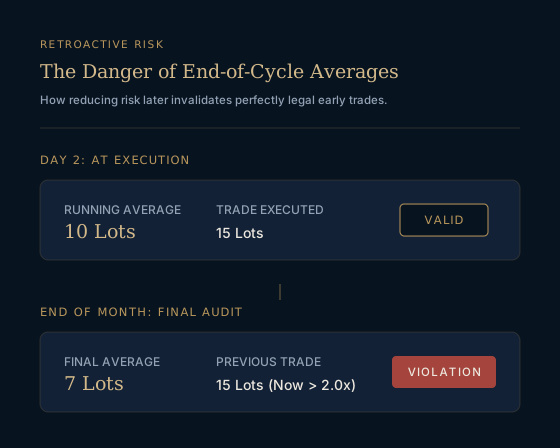
The trader would fail the consistency review based on a mathematical shift that occurred weeks after the position was closed. The retroactive application of averages forces the trader to manage the mathematical output of the rule rather than managing market risk. Traders resorted to placing redundant, break even trades simply to manipulate their average lot size back into compliance before requesting a withdrawal.
Profit distribution requirements
Lot sizing represented only one component of the eligibility criteria. Profit distribution formed the second barrier. The firm required profits to be distributed relatively evenly across the active trading days. A trader could not accumulate the majority of their simulated profits in a single volatile session.
Understand general withdrawal conditions and hidden rules to navigate payout approvals successfully. Many firms dictate that no single trading day can account for more than a specific percentage of total profits. If a trader captured a massive market movement and generated substantial returns in one afternoon, that single day would breach the distribution limit.
Common consequences of profit distribution limits:
- Deletion of profits from high yield trading days.
- Denial of the entire payout cycle due to one outsized execution.
- Artificially extended trading cycles to dilute concentrated gains.
The standard industry response to a distribution breach is the denial of the payout and the removal of the excess profits from the account balance. The trader loses the reward of a highly successful execution because the success was too concentrated. This mechanism forces traders to artificially extend their trading cycles, placing arbitrary trades on flat days merely to dilute the concentration of their winning sessions.
Why did the March 2024 suspension and payout halt happen?
The friction between complex withdrawal conditions and operator expectations reached a critical point in the first quarter of 2024. Traders reported systemic delays in processing and widespread denials based on reviews. The firm then suspended its operations and halted all payouts to conduct internal reviews regarding consistency rules.
The situation escalated rapidly across the industry.
The halt trapped simulated profits and left thousands of operators without answers. The suspension highlighted the fragility of platforms that rely on discretionary reviews and subjective rule enforcement. Learn what happens to unpaid profits when operations are suspended. When a firm pauses payouts, the trader holds zero leverage. The capital is simulated, the infrastructure belongs to the firm, and the payout relies entirely on the firm's willingness to process the transaction.
The internal reviews cited by the firm did not result in immediate capital releases. Instead, the operational pause extended, demonstrating the structural risks inherent in models where the rules act as a gatekeeping mechanism against the user.
| Mathematical Limit | |
|---|---|
| The consistency rule mandated that a trader's lot sizes must fall within a 0.25x to 2.0x range of their average lot size to be considered eligible for a withdrawal. |
This event forced the market to evaluate how firms structure their rulebooks. A transparent rulebook provides certainty. A subjective rulebook provides the firm with infinite reasons to deny a withdrawal. Traders began demanding verifiable proof of execution and explicit rule definitions that do not change retroactively.
The industry requires verifiable mechanics. Traders demand to know if a firm will actually process a payment. Ordane approaches this requirement by eliminating discretion entirely. The rules are written, numbered, and absolute.
Every withdrawal request is approved, or denied in writing citing the exact rule breached by section number, within 24 clock hours. Past that deadline the request is treated as approved and the G-1 clock starts.
A payout approved and not paid within 48 clock hours, not business hours, triggers automatic compensation: a 100 percent refund of the account fee, plus the payout owed in full.
This mechanism is called The Ordane Guarantee. It removes the uncertainty of the review phase. The firm either cites a specific, published rule violation within the deadline, or it owes the payment.
The Ordane Guarantee has two objective exclusions: documented fraud or KYC review, and declared force majeure. Both carry a hard deadline, and beyond it G-1 applies regardless.
Traders fear hidden rules that confiscate balances at the finish line. Discretionary consistency reviews function as hidden rules because the trader never knows the exact interpretation until the payout is requested. Ordane solves this by publishing a finite list of prohibitions.
Ordane's prohibited-practice list is closed. Clause R-6 names six practices: latency, reverse or hedge arbitrage; high-frequency or bulk automated exploitation; copy trading between Ordane accounts; straddling news releases with paired opposing orders; platform or data-feed exploitation; and gap abuse. If a behavior is not listed in that section, it is not a violation. Discretion is not a rule.
The consistency parameter at Ordane focuses exclusively on profit distribution, not lot size mathematics. The rule does not penalize traders by confiscating funds.
Ordane's consistency rule is 20 percent: at the moment of a withdrawal request, no single trading day may account for more than 20 percent of the cycle's total profit. If a day exceeds 20 percent, the excess profit from that day is deferred to the next cycle. It is never confiscated, and the remainder of the cycle pays out normally.
The fear of a firm vanishing overnight requires a verifiable answer. Promises of financial stability carry zero weight. Proof requires transparency.
Ordane's payout reserve is published at a public TRON address on ordanemarkets.com and in Rulebook v1.0 clause PR-1. The page carries a dated observed balance and states that the reserve is not a promise, it is an address.
The product structure remains entirely focused on simplicity and direct market access, bypassing the typical friction of an evaluation phase.
Ordane sells one product, the Ordane Instant Account: direct access, no evaluation phase and no challenge, on simulated capital.
The cost structure avoids hidden charges and promotional traps.
The fee is one-time: $59 for the $2,500 account, $139 for the $10,000 account, $299 for $25,000, $549 for $50,000 and $999 for $100,000. There are no recurring fees, no hidden tiers and no coupon games.
The payout framework rewards sustained execution without resetting the progress of the operator.
Ordane's profit split starts at 60 percent and rises 5 percentage points with every completed withdrawal, reaching 100 percent from the ninth withdrawal onward.
Every clause and parameter exists in the public rulebook. The trader knows the exact criteria for success before executing a single order. Review the full terms at ordanemarkets.com/rulebook.
Questions traders ask about consistency rules
What is a consistency rule in a prop firm?
A consistency rule is a parameter designed to measure if a trader's execution is repeatable, often using mathematical averages to dictate withdrawal eligibility.
What was The Funded Trader lot size multiplier limit?
The firm mandated that a trader's lot sizes must fall within a 0.25x to 2.0x range of their average lot size to be eligible for a withdrawal.
Does Ordane use a lot size multiplier rule?
No. Ordane's consistency rule is 20 percent: at the moment of a withdrawal request, no single trading day may account for more than 20 percent of the cycle's total profit.
What happens if I breach the 20 percent rule at Ordane?
If a day exceeds 20 percent, the excess profit from that day is deferred to the next cycle. It is never confiscated, and the remainder of the cycle pays out normally.
Sources
- The Funded Trader support documentation on the lot size consistency multiplier. thefundedtraderprogram.com Retrieved 2026-09-05.
- Ordane Rulebook v1.0, clause P-2, on all accounts operating on simulated capital with no live funds and no deposits accepted. ordanemarkets.com/rulebook Retrieved 2026-09-05.
- Ordane Rulebook v1.0, clause G-0, on withdrawal request processing and approval timelines. ordanemarkets.com/rulebook Retrieved 2026-09-05.
- Ordane Rulebook v1.0, clause G-1, on automatic compensation for delays in payout processing. ordanemarkets.com/rulebook Retrieved 2026-09-05.
- Ordane Rulebook v1.0, clause G-2, on exclusions to The Ordane Guarantee. ordanemarkets.com/rulebook Retrieved 2026-09-05.
- Ordane Rulebook v1.0, clause R-6, on prohibited practices. ordanemarkets.com/rulebook Retrieved 2026-09-05.
- Ordane Rulebook v1.0, clause R-4, on the 20 percent consistency rule for profit distribution. ordanemarkets.com/rulebook Retrieved 2026-09-05.
- Ordane Rulebook v1.0, clause PR-1, on the payout reserve address. ordanemarkets.com/rulebook Retrieved 2026-09-05.
- Ordane Rulebook v1.0, section 1, on the Ordane Instant Account product and fee structure. ordanemarkets.com/rulebook Retrieved 2026-09-05.
- Ordane Rulebook v1.0, clause PA-2, on profit split scaling with completed withdrawals. ordanemarkets.com/rulebook Retrieved 2026-09-05.