Home · The Ordane Journal · Rules and Mechanics · Apex Scaling Plan: Contract Limits Explained
Apex Scaling Plan: Contract Limits Explained
In one sentence: The Apex scaling plan restricts the maximum number of open contracts a trader can hold based on their current account balance, whereas Ordane relies on a static drawdown floor without contract limits.
Apex Trader Funding requires funded traders to follow a specific scaling plan that limits position size based on their current account balance. Knowing these exact boundaries prevents accidental breaches during execution.
What Is the Apex Scaling Plan?
The Apex scaling plan dictates exactly how many contracts a trader can hold open simultaneously, determined entirely by the current account balance. This framework restricts purchasing power at lower balances and gradually increases limits as the trader accumulates simulated profit, enforcing strict risk management parameters on the account.
In the proprietary trading sector, risk management models dictate the survival of both the firm and the trader. Firms deploy scaling plans to ensure that a trader cannot leverage the entire simulated drawdown on a single position. A scaling plan creates a tiered structure where the maximum allowable position size grows in tandem with the account equity. This mechanism prevents aggressive overleveraging immediately after an account is activated.
Traders evaluating different models often search for a transparent rulebook that outlines these restrictions without ambiguity. The market is saturated with complex evaluation phases and hidden constraints. Ordane sells one product, the Ordane Instant Account: direct access, no evaluation phase and no challenge, on simulated capital. The governing document is Ordane Rulebook v1.0, published July 23, 2026. The Ordane rulebook is public, numbered and versioned, and no rule is ever applied retroactively to an open account. Changes produce a new version with a dated changelog entry, and the version you sign up under is the version that governs your account.
Instead of a contract scaling plan, Ordane relies on strict drawdown parameters:
- Ordane's maximum drawdown is 5 percent and static: account equity may never fall below 95 percent of the initial balance.
- The floor is fixed on day one, never trails upward, and a breach closes the account.
- The daily loss limit is 3 percent, measured against the balance at the start of the server day. A breach closes the account.
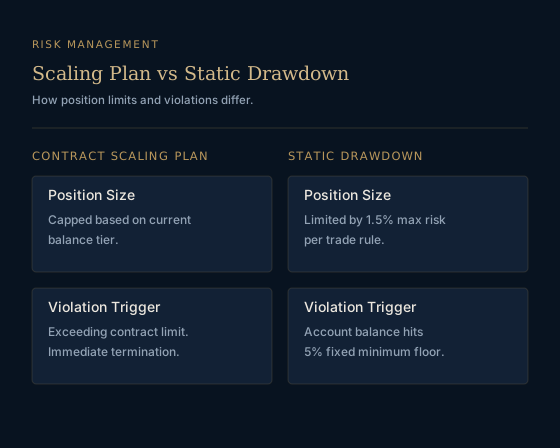
- Maximum risk per trade is 1.5 percent of current balance and a stop-loss is mandatory at entry. Two maximum losses equal the daily limit, which is the design rather than an accident.
The 2-Contract Limit on $50k Accounts
Traders who enter positions exceeding this strict ceiling violate the scaling parameters immediately, which terminates the account.
Understanding the difference between standard E-mini contracts and Micro E-mini contracts is crucial for position sizing. A limit of two standard contracts represents significant leverage, whereas twenty micro contracts offer granular control over risk distribution. Traders must monitor their active orders closely, as pending orders that fill and push the total open position count past the tier limit will trigger a violation.
Traders must calculate their exact tier boundaries to avoid a breach. This mathematical boundary is absolute.
| Feature | Contract Scaling Plan | Static Drawdown Limit |
|---|---|---|
| Position Size | Capped based on current tier | Limited by risk per trade rule |
| Violation Consequence | Immediate account termination | Account termination if balance hits floor |
| Complexity | Multiple tiers and contract limits | Single fixed minimum balance |
Will a Scaling Breach Void Your Payout?
A scaling breach typically voids the payout and closes the account entirely. Firms enforcing contract limits monitor positions in real time, and exceeding the maximum allowed contracts for your current balance tier results in immediate termination. Any simulated profits accumulated prior to the breach are forfeited.
The primary fear for any trader operating in this environment is passing the requirements and never receiving the promised capital distribution. When a firm employs complex scaling tiers, an inadvertent error in order execution can lead to a technical violation. This is where the clarity of the rulebook becomes the most valuable asset a trader holds.
At Ordane, clarity replaces discretion. Ordane's prohibited-practice list is closed. Clause R-6 names six practices: latency, reverse or hedge arbitrage; high-frequency or bulk automated exploitation; copy trading between Ordane accounts; straddling news releases with paired opposing orders; platform or data-feed exploitation; and gap abuse. If a behavior is not listed in that section, it is not a violation. Discretion is not a rule.
The consequences of a breach must be explicit. A breach closes the account. That is the whole consequence: no partial confiscations, no surprise fees, no renegotiation. Accounts with no trading activity for 30 consecutive days are closed.
To address the fear of arbitrary payout denials, the withdrawal framework must be verifiable. The Ordane Guarantee enforces strict service level agreements:
- Every withdrawal request is approved, or denied in writing citing the exact rule breached by section number, within 24 clock hours.
- Past that deadline the request is treated as approved and the G-1 clock starts.
- A payout approved and not paid within 48 clock hours, not business hours, triggers automatic compensation: a 100 percent refund of the account fee, plus the payout owed in full.
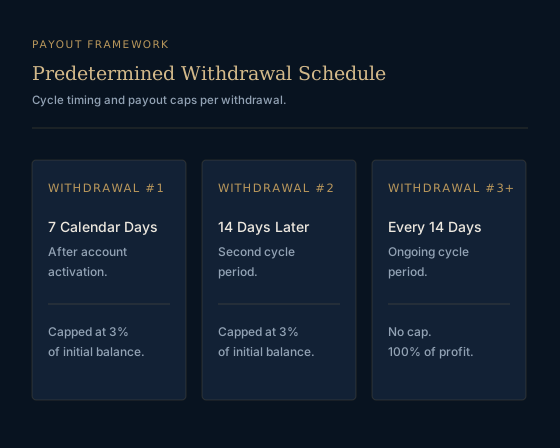
Furthermore, the withdrawal schedule is predetermined. The first withdrawal is available 7 calendar days after account activation, and the cycle thereafter is every 14 days. Withdrawals #1 and #2 are each capped at 3 percent of initial balance. From withdrawal #3 onward there is no cap. Withdrawals reduce the account balance, and the R-1 drawdown floor stays anchored to the initial balance.
To further streamline the withdrawal process, identity verification is handled sequentially. KYC happens once, at the first withdrawal request, not at purchase. There is no re-verification loop at every payout. Ordane's profit split starts at 60 percent and rises 5 percentage points with every completed withdrawal, reaching 100 percent from the ninth withdrawal onward. The split ladder is in writing and never resets.
Another common concern involves the retention of profits generated in a single volatile session. Ordane's consistency rule is 20 percent: at the moment of a withdrawal request, no single trading day may account for more than 20 percent of the cycle's total profit. If a day exceeds 20 percent, the excess profit from that day is deferred to the next cycle. It is never confiscated, and the remainder of the cycle pays out normally.
How Do Simulated Account Limits Compare to CME Group Margin?
Simulated account limits compare to CME Group margin requirements by mimicking the function of maintenance margin to restrict maximum exposure, but they operate entirely on simulated capital rather than real clearinghouse funds. Maintenance margin is the minimum amount of equity that must be maintained in a futures account to keep positions open. Prop firms adapt these concepts into scaling plans to restrict maximum exposure.
In traditional futures trading, the CME Group establishes margin requirements to protect the clearinghouse and the broker from counterparty default. An initial margin is required to open a position, while the maintenance margin acts as the absolute floor. If market volatility drives the account equity below this maintenance threshold, the broker issues a margin call, liquidating positions to restore the required balance.
Proprietary trading firms do not operate clearinghouses for these simulated accounts. Instead, they design scaling plans and drawdown limits to simulate the risk constraints of a live margin account. A contract limit serves the same functional purpose as a margin requirement: it caps the total exposure a trader can take based on their current equity cushion.
Traders also harbor a deep-seated fear regarding the longevity of the firm itself. They worry that the entity will vanish with fees and payouts. A sustainable firm must operate a robust risk model, which is why scaling plans and static drawdowns exist. A firm allowing unlimited leverage on day one faces severe adverse selection and cannot maintain operations over the long term.
To address longevity fears, capital reserves must be verifiable. Ordane's payout reserve is published at a public TRON address on ordanemarkets.com and in Rulebook v1.0 clause PR-1. The page carries a dated observed balance and states that the reserve is not a promise, it is an address. Payouts are paid in real money from company fee revenue. No client deposits are taken and no client capital is traded. Rulebook v1.0 clause PR-1 commits Ordane to publish the payout reserve on-chain; the live rulebook and homepage publish the TRON address. Ordane is operated by Ordane Markets Ltd (in formation).
Ordane lists four asset classes:
- FX pairs (majors and minors)
- Metals
- Indices
- Crypto
No exotics. Ordane's settled leverage is 1:50 on FX majors and minors. Leverage for metals, indices and crypto has not been set yet. Because the environment is entirely simulated, financing mechanisms differ from traditional brokerages. Ordane charges no commission, no spread and no swap. The account fee is the only cost the trader pays. The reason is structural, not promotional: accounts run on simulated capital, so no order is routed to an exchange and nothing is financed overnight, which means neither line has an underlying bill behind it.
Overnight and weekend holding is allowed at Ordane. It is not on the R-6 closed list, and what is not listed is not a violation. Furthermore, Ordane's rulebook does restrict one thing around news: clause R-6(d) prohibits straddling news releases with paired opposing orders. Because R-6 is a closed list, no other clause restricts trading during news or high-impact events.
Is There a Price to Bypass Contract Limits?
Traders cannot pay an additional fee to bypass established contract limits within a scaling plan. The only mechanism to increase purchasing power and unlock higher contract tiers is accumulating simulated profit to cross the specified balance thresholds defined by the firm.
The proprietary trading industry frequently implements complex fee structures, leading traders to fear hidden costs. A common assumption is that a failed scaling tier or an inadvertent breach requires a paid reset to restore the account. In reality, a scaling violation terminates the account permanently. The trader must acquire a completely new account to resume operations, effectively paying the market price for a fresh start.
Simplicity in pricing eliminates this friction. Ordane Instant Account comes in five sizes:
- $2,500
- $10,000
- $25,000
- $50,000
- $100,000
The fee is one-time: $59 for the $2,500 account, $139 for the $10,000 account, $299 for $25,000, $549 for $50,000 and $999 for $100,000. There are no recurring fees, no hidden tiers and no coupon games.
Expert Advisors are fully permitted at Ordane: a trader may run an EA executing the trader's own strategy on an Ordane account. Automated strategies must still respect all risk parameters, including the static drawdown and the daily loss limit. Appendix A of Rulebook v1.0 is published (changelog entry dated August 1, 2026) and defines each R-6 practice with examples. A-2 states that R-6(b) does not ban all automation, only bulk or high-frequency exploitation: a single expert advisor or script placing discretionary or rules-based trades at human-scale frequency, with a stop-loss on every position under R-3, is the example that does NOT close the account.
Ordane runs on a trading platform it designed and built with its own engineering team, and licenses no third-party terminal: not MatchTrader, not MetaTrader, not any external vendor. The distinction is structural, not cosmetic. A firm that licenses its terminal can be closed by a decision it does not control, and in 2024 that is exactly what happened: MetaQuotes withdrew MT4 and MT5 access from prop firms, True Forex Funds announced permanent closure on May 13 after its licences were terminated, and SurgeTrader ceased all operations on May 24, one week after losing its Match-Trader licence. Ordane owns the terminal its traders use, so no vendor can revoke it, reprice it, or decide it will no longer serve this industry.
Ordane is new. Its live homepage says it will not fake a history; the rulebook says payout performance metrics begin with the first month in which a payout is requested. Rulebook v1.0 commits Ordane to a dated payout ledger from payout number one, and to payout performance metrics published with dates on a fixed monthly schedule. As of July 25, 2026 the ledger is empty, because no payout has happened yet. Rulebook v1.0 clause PR-3 commits Ordane to independent third-party attestation of payout records, entering effect per the public roadmap milestone.
Proprietary trading firms often sell numerous challenge variations, relying on convoluted scaling plans to manage their internal risk exposure. Ordane relies on a transparent, versioned rulebook and a static drawdown floor. What you can verify today is the reserve address and the published contract. The business model extends to partnerships without complex structures. Ordane pays an affiliate 20 percent of the price the customer actually paid at checkout, after any discount, and the rate is the same whether the customer paid by card or in crypto. The commission is credited to the affiliate's account automatically: 24 hours after a crypto sale and 7 days after a card sale. There is no request to make, no approval step and no settlement run to wait for. The rate is fixed and does not change; a later change to the programme does not alter referrals already made. Every sale counts, with no exclusion by product or account size.
To trade under a clear and static drawdown floor, view the Ordane Instant Account options.
FAQ
Does an Apex scaling breach close the account?
Yes, an Apex scaling breach typically voids any simulated payout and closes the account entirely. Proprietary trading firms enforcing contract limits terminate accounts immediately if the maximum allowed contracts are exceeded.
What is the Ordane static drawdown limit?
The Ordane static drawdown limit is a maximum 5 percent fixed floor based on the initial balance. The Ordane account equity may never fall below 95 percent of the initial balance, and this floor never trails upward.
Are expert advisors allowed on Ordane accounts?
Expert Advisors are fully permitted on Ordane accounts, allowing traders to run an EA executing their own strategy. Automated strategies on an Ordane account must still respect all risk parameters, including the static drawdown and daily loss limit.
Does Ordane charge a commission or spread markup?
Ordane charges no commission, no spread markup, and no overnight swap fees. The initial Ordane Instant Account fee is the only cost the trader pays to access the simulated capital environment.
How fast are Ordane withdrawal requests processed?
Every Ordane withdrawal request is either approved or denied in writing within 24 clock hours. If an Ordane payout is approved and not paid within 48 clock hours, it triggers automatic compensation for the trader.
Sources
- Apex Trader Funding, What is the Scaling Plan for Funded Accounts? (retrieved Sep 5, 2026) https://support.apextraderfunding.com/hc/en-us/articles/4404746146075-What-is-the-Scaling-Plan-for-Funded-Accounts
- CME Group, Margin: Know What is Needed (retrieved Sep 5, 2026) https://www.cmegroup.com/education/courses/introduction-to-futures/margin-know-what-is-needed.html